
Table of Contents
Table of Contents
Searching for a WarpStream BYOC alternative usually means the team has moved past a generic Kafka platform comparison. The harder question is not whether a service can run Kafka-compatible workloads on cloud object storage. It is whether the organization can explain, to security reviewers and application owners, where Kafka records live, which control systems can influence the data plane, who can access operational metadata, and how the platform can be unwound later without turning retention data into a hostage.
That distinction matters because BYOC is a deployment label, not a security model by itself. A streaming vendor can run agents in the customer account, store raw data in customer-owned object storage, keep metadata in a vendor-managed service, receive telemetry outside the account, or require support pathways that change during incident response. None of those choices is automatically wrong. They are architecture decisions that need to be visible before a regulated workload, high-volume event pipeline, or multi-year platform standard lands on the shortlist.
WarpStream helped popularize a diskless, object-storage-centered approach to Kafka-compatible streaming, and Confluent announced its acquisition of WarpStream on September 9, 2024. That acquisition made the BYOC conversation more important, not less. Buyers now have to evaluate the architecture they liked in WarpStream, the Confluent roadmap they may inherit, and alternatives that offer a different control-plane boundary while preserving Kafka client compatibility.
1What BYOC Should Mean for Kafka Workloads
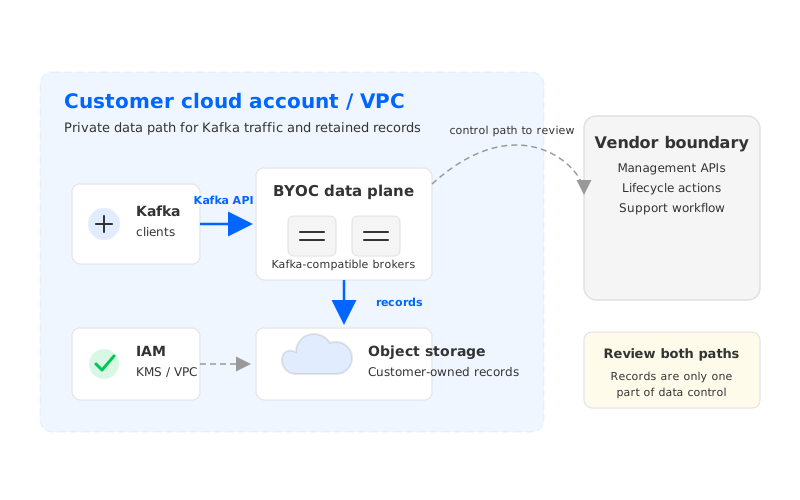
For Kafka workloads, BYOC should start with a plain data-flow inventory. Producers and consumers talk Kafka protocol. Brokers or agents accept writes, serve reads, coordinate topic and consumer-group behavior, and persist records somewhere. Object storage may replace broker-local disks as the durable storage layer. A control plane may create clusters, manage upgrades, configure networking, collect metrics, or coordinate support access.
The security review is about separating these paths. The data path carries Kafka records, offsets, topic data, and retained history. The control path carries desired state, orchestration instructions, health signals, usage records, and sometimes metadata about topics or clusters. A serious BYOC review asks whether each path stays in the customer cloud account, crosses a vendor boundary, or depends on a vendor-hosted component to continue operating.
The practical checklist is short but unforgiving:
- Record location: Are Kafka records written to customer-owned object storage, customer-owned block storage, vendor storage, or a mix?
- Metadata location: Where are topic metadata, partition ownership, consumer-group state, billing signals, and operational metadata stored?
- Control-plane dependency: Can the data plane continue serving traffic if the vendor control plane is unavailable?
- Network path: Do Kafka clients, brokers, object storage, and management services communicate over private networking, public endpoints, or both?
- Operator access: What permissions does the vendor, operator, or support workflow need in the customer account?
- Exit path: Can retained data, topic configuration, ACLs, schemas, and client endpoints be migrated without opaque dependencies?
Those questions sound procedural until a production incident arrives. During a write outage, the team needs to know whether restarting a data-plane component will require a vendor API. During an audit, the team needs to know whether metadata that identifies customer topics or workloads left the account. During a migration, the team needs to know whether object storage contains portable data or implementation-specific state that only one service can interpret.
2Data Path vs. Control Path
The most useful way to compare WarpStream and its alternatives is to draw two diagrams before reading any marketing copy. The first diagram shows the Kafka data path: clients, brokers or agents, cache, write-ahead layer if present, and object storage. The second shows the control path: cluster lifecycle, upgrades, metrics, billing, metadata services, support access, and automation. If a vendor cannot help you draw both, the BYOC claim is still incomplete.
WarpStream's public documentation describes a separation between the agent deployed in the customer environment and a cloud control plane. It also describes raw data being stored in object storage such as S3, while metadata and coordination are handled separately. For many teams, that model is an attractive compromise: customer-owned object storage for the large record payloads, plus a managed service experience around operations. For other teams, especially those with strict data-sovereignty or control-plane-residency requirements, the question becomes whether metadata, orchestration, telemetry, and support boundaries also need to remain inside the customer account.
Object storage ownership is the easiest part to verify because it maps to familiar cloud controls. On AWS, a security team can review S3 bucket ownership, bucket policies, IAM roles, KMS keys, VPC endpoints, server-side encryption, access logs, and retention policies. Similar reviews exist for Google Cloud Storage and Azure Blob Storage. The harder part is deciding whether object ownership alone is enough. Kafka includes retained bytes, live coordination state, client identity, topic configuration, and operational context.
For example, a topic name may reveal a business process. A consumer group may reveal application topology. A retention policy may reveal compliance posture. A burst pattern may reveal trading hours, fraud activity, or customer behavior. These details are not the raw Kafka record payload, but they can still be sensitive in regulated environments. BYOC evaluation should therefore include metadata classification beyond record storage location.
3BYOC Checklist for WarpStream Alternatives
The right alternative depends on how far the organization wants the customer-account boundary to extend. Some teams mainly want to avoid moving high-volume records into a vendor cloud. Others want the entire operating plane, including management services, to run in their VPC. A few want an open-source path for self-managed evaluation before adopting a commercial deployment. The shortlist should reflect those requirements explicitly.
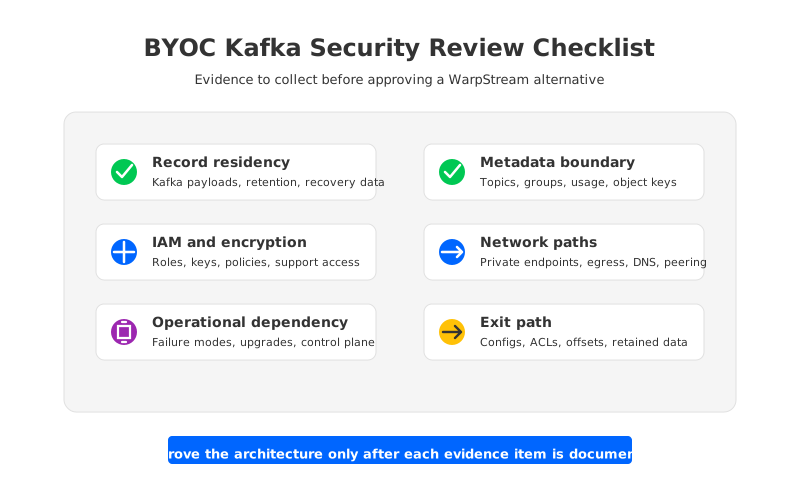
Use this review model before running a proof of concept:
| Review area | Questions to ask | Evidence to request |
|---|---|---|
| Data residency | Where do Kafka records, retained segments, and recovery data live? | Architecture docs, object storage layout, encryption model |
| Metadata residency | Where are topic metadata, cluster state, usage data, and coordination state stored? | Control-plane docs, data classification, retention policy |
| IAM boundary | Which roles, policies, service accounts, and cross-account permissions are required? | Terraform, IAM policy templates, permission rationale |
| Network boundary | Which paths use private endpoints, peering, public egress, or vendor APIs? | VPC diagrams, firewall rules, DNS model |
| Operational dependency | What happens if the vendor SaaS, control plane, or support channel is unavailable? | Failure-mode docs, runbooks, upgrade design |
| Observability | Which metrics and logs leave the account, and are payloads or identifiers included? | Telemetry schema, redaction rules, opt-out options |
| Exit path | How are data, configuration, ACLs, and client endpoints migrated out? | Migration docs, compatibility matrix, rollback plan |
This table deliberately avoids asking whether a product is "fully BYOC." That phrase compresses too many design choices into one adjective. A better question is: "Which assets and decisions remain under our cloud account, and which ones depend on the vendor boundary?" Once that answer is written down, the architecture tradeoff becomes reviewable.
The same checklist also prevents overcorrecting. Keeping every component inside the customer account may satisfy a strict residency requirement, but it also moves more responsibility to the platform team. The team must operate upgrades, cloud quotas, node pools, object storage policies, observability, backups, and emergency access. A good BYOC alternative should make those responsibilities explicit rather than hiding them behind a comforting deployment label.
4Where AutoMQ Fits
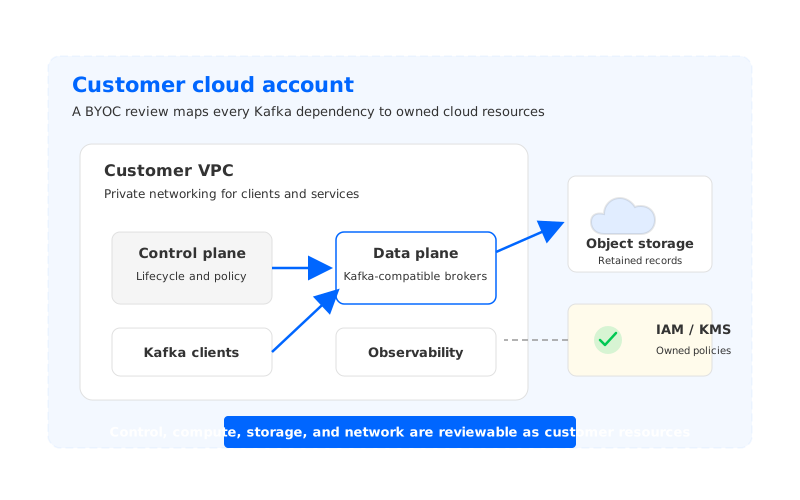
After the data path and control path are separated, AutoMQ fits into the category of Kafka-compatible, object-storage-backed streaming systems that keep the customer cloud boundary central to the architecture. In AutoMQ BYOC, the control plane and data plane are deployed in the customer's cloud account and VPC, while Kafka records are stored in customer-owned object storage. AutoMQ Cloud acts as the environment management entry point rather than the place where customer Kafka records are stored.
That design is different from treating BYOC as "large data stays in your bucket, but the operational brain is elsewhere." AutoMQ's data plane uses Kafka-compatible brokers with a Shared Storage architecture: durable data is moved away from broker-local disks and into object storage through the AutoMQ storage layer. Brokers are less tied to local disk ownership, which changes the operational profile of scaling, replacement, and partition movement. In a BYOC review, the relevant point is not a slogan about storage; it is that compute, storage, networking, and management components can be mapped to resources in the customer's account.
AutoMQ is not the answer for every WarpStream evaluation. If a team wants a highly managed Confluent-centered experience and accepts the associated control-plane boundary, staying with WarpStream or Confluent's roadmap may be reasonable. If a team wants a self-managed Apache Kafka cluster with mature operational muscle and no architectural change, traditional Kafka may still fit. AutoMQ becomes more relevant when the requirement is a Kafka-compatible platform that uses object storage as the durable layer, keeps customer data and infrastructure in the customer cloud account, and offers a clearer path to reason about control-plane and data-plane ownership.
The proof of concept should therefore test boundaries rather than throughput alone. Create a representative topic set, enable the same authentication and authorization model you expect in production, use private networking where required, verify object storage policies, inspect emitted telemetry, and simulate loss of external connectivity to understand which operations continue. Then test the mundane migration work: topic configs, ACLs, client bootstrap changes, consumer lag, schema dependencies, and rollback windows.
5Security Review Questions to Bring to the Vendor Call
A vendor call is more useful when the architecture questions are specific. Ask where Kafka records are persisted, where metadata is persisted, and whether both answers are true during normal operation, upgrade, failure recovery, and support escalation. Ask which cloud permissions are required permanently and which are only needed during installation. Ask whether the data plane continues producing and consuming if the vendor control plane becomes unavailable.
Then move from location to interpretation. Can the vendor read topic names, consumer group names, throughput patterns, or object keys? Are logs redacted before leaving the account? Are support bundles generated locally? Can telemetry be disabled or routed to the customer's own observability stack? If identifiers must leave the account, can they be hashed, scoped, or retained under a documented policy?
Finally, ask about reversibility. BYOC should not end at deployment. A production platform needs a path to rotate keys, change VPC design, move regions, migrate topics, export configuration, and retire the vendor without losing access to retained records. The stronger the data-control requirement, the more the exit plan should be tested as part of the first PoC rather than postponed to procurement.
6Decision Framework
Choose the BYOC model that matches the sensitivity of the workload and the maturity of the platform team. A log aggregation pipeline may mainly care about object storage cost and private ingestion. A payments event stream may require private networking, strict IAM, customer-managed keys, and detailed support-access controls. A healthcare data platform may treat topic names, metrics, and logs as sensitive even when message payloads are encrypted.
The practical decision tree looks like this:
- If your main concern is managed Kafka operations and you accept a vendor-managed control plane, evaluate WarpStream and Confluent's current roadmap directly.
- If your main concern is keeping large Kafka record payloads in your object storage while reducing broker-disk operations, compare diskless and object-storage-backed systems by metadata, telemetry, and failure-mode boundaries.
- If your main concern is keeping both the operating plane and data plane in your account, prioritize BYOC architectures where control services, brokers, object storage, networking, and observability can be reviewed as customer-account resources.
- If your main concern is long-term exit optionality, include data format, topic configuration export, ACL portability, client compatibility, and migration tooling in the PoC.
This is also where procurement and engineering can finally use the same language. Procurement asks who owns the data. Engineering asks which process writes it, which role can read it, which API coordinates it, and which dependency is required to recover it. A credible BYOC alternative should answer both versions without changing the architecture story.
If your team is evaluating a WarpStream BYOC alternative because the cloud-account boundary is the hard requirement, use the first PoC to prove the boundary. Validate data path, control path, IAM, telemetry, and exit mechanics before running a benchmark. For teams that want Kafka compatibility with customer-owned infrastructure and object-storage-backed shared storage, try AutoMQ as one candidate in that architecture category.
7FAQ
7.1Is BYOC the same as self-managed Kafka?
No. BYOC means the service runs some or all infrastructure in the customer's cloud account. Self-managed Kafka usually means the customer operates Apache Kafka directly. A BYOC product may still include vendor automation, managed upgrades, support workflows, and a control plane.
7.2What is the most important BYOC question for Kafka?
Start with record storage, but do not stop there. Kafka metadata, operational logs, metrics, topic names, consumer groups, control-plane dependencies, and support access can all matter in security reviews.
7.3Does storing Kafka data in S3 automatically solve data control?
No. Customer-owned object storage is a strong control point, but Kafka platforms also need metadata, coordination, authentication, observability, and operations. Data control depends on the complete path, not the bucket alone.
7.4How should teams compare WarpStream and AutoMQ?
Compare them by architecture boundary rather than brand category: Kafka compatibility, record storage, metadata location, control-plane residency, IAM requirements, networking, telemetry, failure behavior, migration path, and exit plan. Then test the requirements in a PoC.
7.5Why mention Confluent's acquisition of WarpStream?
The acquisition is relevant because it may affect buyer assumptions about roadmap, support, procurement, and platform consolidation. The technical review should still focus on the current documented architecture and the buyer's own control-plane requirements.


