
Table of Contents
Table of Contents
Searching for WarpStream competitors usually means the team has moved past the basic question of whether Kafka matters. The harder question is which Kafka-shaped system should own a production data plane for the next several years. WarpStream made that question more interesting by putting Kafka-compatible agents in the customer's cloud account and storing data directly in object storage. Confluent then acquired WarpStream on September 9, 2024, which made the buying question both architectural and commercial.
The useful comparison is not "which vendor has the longest feature list?" It is "which storage and ownership model fits the workload?" Traditional Kafka, managed Kafka, diskless BYOC, and shared-storage Kafka all preserve some part of the Kafka operating model and change another part. Once that becomes clear, the shortlist gets easier to defend.
1The Main Categories of WarpStream Competitors
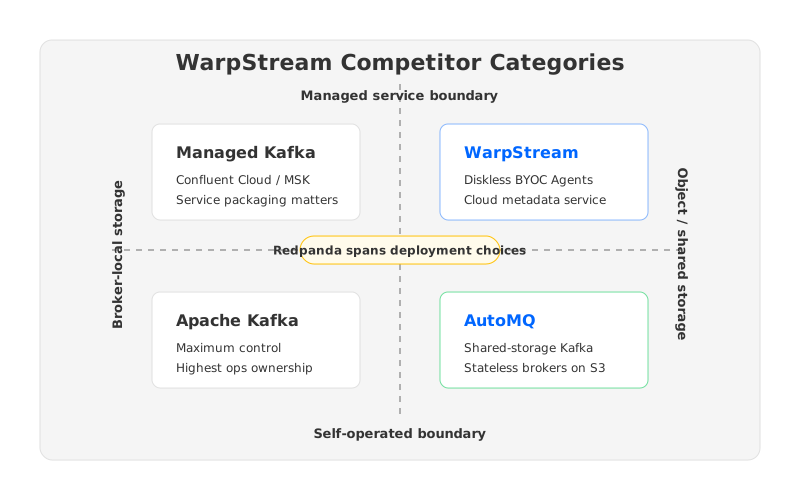
WarpStream's official documentation describes a diskless Kafka-compatible platform where stateless Agents speak the Apache Kafka protocol, write data to object storage, and rely on WarpStream's cloud metadata store and control plane for coordination. That architecture puts it in a different category from ordinary hosted Kafka, so the relevant competitors are not all trying to solve the same problem.
There are four practical categories:
- Apache Kafka and self-managed distributions. Kafka gives the strongest ecosystem continuity, direct operational control, and familiar broker semantics, while leaving the team responsible for broker storage, replication factor, partition placement, upgrades, and capacity planning.
- Managed Kafka services such as Confluent Cloud and Amazon MSK. These reduce operational burden while preserving the Kafka mental model. The tradeoff is that the service boundary, pricing model, and scaling behavior become part of the architecture.
- Diskless or BYOC Kafka-compatible systems such as WarpStream. These move the data plane closer to the customer's cloud account and object storage while externalizing some control-plane responsibilities. The evaluation point is metadata dependency, latency profile, and compatibility depth.
- Shared-storage Kafka-compatible systems such as AutoMQ. This category keeps Kafka protocol compatibility but reworks the storage layer around object storage and stateless brokers. AutoMQ fits here: it is a Kafka-compatible streaming platform built on S3Stream, with object storage as the persistent data foundation.
That last distinction matters because "object storage" is not a complete architecture. It can be a cold tier, primary log store, batch file target, or shared storage substrate. Those designs create different answers for tail latency, replay throughput, broker recovery, data control, and migration.
2Side-by-Side Comparison Table
The following table is a buyer's map, not a benchmark. Performance depends on workload shape, cloud region, instance type, partition count, message size, batching, retention, and client behavior. The more reliable first pass is to compare the assumptions each architecture makes about storage, control, and operations.
| Option | Best fit | Storage model | Main validation point |
|---|---|---|---|
| Apache Kafka | Teams with deep Kafka operations | Broker-local replicated logs | Capacity planning, reassignments, recovery |
| Confluent Cloud | Teams wanting managed Kafka plus platform services | Managed Kafka service with Confluent packaging | Pricing dimensions, networking, service boundary |
| Amazon MSK | AWS-first Kafka teams | Managed Apache Kafka with EBS-backed brokers; tiered storage for eligible Standard workloads | AWS data transfer, storage, broker sizing |
| WarpStream | BYOC teams seeking diskless Kafka-compatible infrastructure | Stateless Agents write to object storage; metadata in WarpStream cloud | Kafka feature depth, latency, metadata dependency |
| Redpanda | Teams open to a Kafka API-compatible engine | Redpanda engine with cloud and BYOC options | Engine behavior, ecosystem edge cases |
| AutoMQ | Teams wanting Kafka compatibility with shared object storage | S3Stream-backed storage with stateless brokers | WAL/cache path, object storage behavior, operations |
The table shows why "WarpStream competitor" is imprecise. Confluent Cloud competes for managed streaming platform ownership. MSK competes for AWS-native Kafka operations. Redpanda competes as a Kafka API-compatible engine. AutoMQ competes closer to the storage architecture question because it also moves persistent Kafka data away from broker-local disks and toward shared object storage.
3Kafka Compatibility Is Necessary, Not Sufficient
Every serious alternative in this space speaks some form of Kafka. That does not make them interchangeable. Kafka compatibility has layers: wire protocol, producer and consumer behavior, consumer groups, transactions, ACLs, topic configuration, compaction, Connect, Schema Registry patterns, tooling, and failure semantics. A proof of concept that only runs kafka-console-producer and kafka-console-consumer validates very little.
Apache Kafka remains the reference point. Its documentation describes the partition as the unit of replication; under normal operation, each partition has one leader and followers, and reads and writes go through the leader. That design is why Kafka operators spend so much time thinking about replication factor, leader balance, disk usage, partition reassignment, and broker recovery.
WarpStream changes that model aggressively. Its Agents are stateless and any Agent can serve requests for a virtual cluster, while data lands in object storage and metadata operations go through its metadata store. AutoMQ changes the model at a different layer: it keeps Kafka protocol and semantics as the user-facing contract, then replaces Kafka's local log storage with S3Stream and stateless brokers. Redpanda changes the engine implementation while preserving Kafka API compatibility. Confluent Cloud and MSK keep a more recognizable managed Kafka service model.
For buyers, compatibility should be phrased in workload terms:
- Do clients, serializers, ACLs, schemas, and offsets behave the same way under failure and rebalance?
- Are compacted topics, transactions, idempotent producers, long retention, fan-out reads, and backfills supported as expected?
- Can existing Kafka metrics and runbooks still explain the system?
- What is the documented behavior when a feature is missing, partial, or intentionally different?
This is where a vendor shortlist often gets smaller. Marketing pages can say "Kafka-compatible"; production teams need to know which part of Kafka carries their risk.
4Storage Architecture Drives the Real Tradeoff
Most WarpStream competitor pages underplay storage. That is a mistake because storage architecture determines the shape of the bill and the shape of recovery. In traditional Kafka, brokers own local log segments and replication copies those logs across brokers. MSK manages Kafka but remains broker-centered, with tiered storage available for eligible Standard broker workloads. Confluent Cloud gives users a higher-level managed Kafka experience and a service-oriented cost model.
WarpStream's wager is that Kafka data should go directly to object storage through stateless Agents. Its write path documentation says produce requests are acknowledged after data is persisted in the object store and metadata is committed. That removes broker-local disk ownership, but it makes batching, object operation cost, metadata coordination, and caching central.
AutoMQ's design starts from a similar cloud-native observation but reaches a different architecture. Its documentation describes S3Stream as the layer that offloads Kafka log storage to object storage while WAL and cache components support the write and read paths. Because brokers are stateless, replacement and scaling are less tied to moving partition data between local disks. This changes which components must be sized and tested.
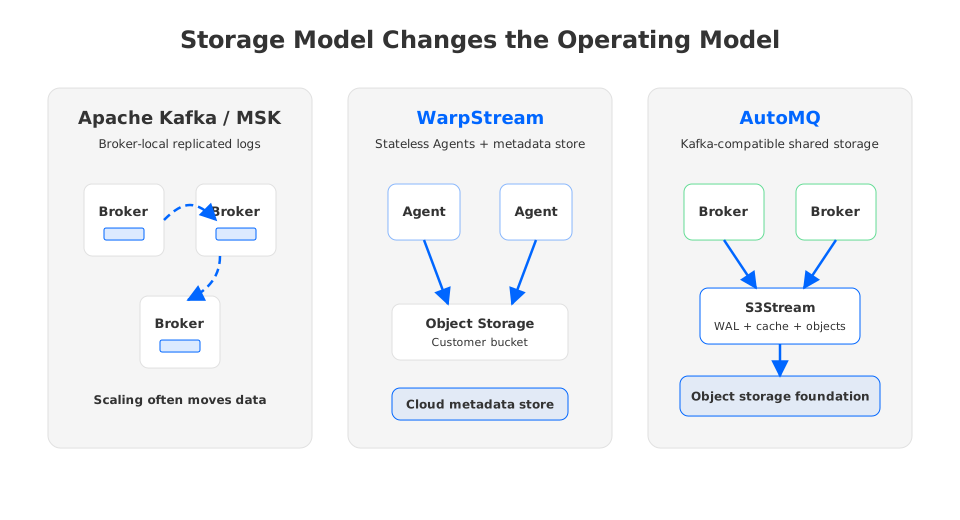
That architecture split also explains why tiered storage is not the same as diskless or shared-storage Kafka. Tiered storage helps with retention economics; it does not automatically make brokers stateless.
5Cost and Data Control Are Joined at the Hip
FinOps teams often start with unit prices, then discover that streaming bills are shaped by topology. A Kafka workload can pay for broker instances, attached storage, provisioned throughput, inter-zone replication, cross-zone client traffic, private networking, object storage requests, connectors, monitoring, and support. Each platform moves those line items around.
WarpStream's pitch is strongest when cross-AZ Kafka replication and broker disk overprovisioning dominate the bill. Its object storage docs recommend VPC endpoints or equivalent private paths so Agent-to-object-storage traffic avoids avoidable data transfer costs. Confluent Cloud pricing exposes dimensions such as eCKU-hour, data in/out, and data stored. Amazon MSK pricing calls out broker storage and AWS data transfer charges. These are architecture in invoice form.
Data control has the same pattern. BYOC can mean several things:
- The data plane runs in the customer's cloud account, but metadata or control may be vendor-operated.
- The bucket belongs to the customer, but lifecycle rules and access policies must match the engine.
- Private networking may coexist with vendor support, telemetry, upgrades, or control operations.
- Open-source, proprietary, and managed components may sit on different sides of the boundary.
None of these models is automatically wrong. The mistake is to treat BYOC as a checkbox instead of a design contract.
6When Kafka Itself Is Enough
Apache Kafka remains a strong answer when the organization has operational muscle and the workload fits the broker-local model. If the team has mature automation for upgrades, reassignment, broker replacement, quotas, and capacity forecasting, self-managed Kafka can be rational. It also gives a clean escape path from vendor packaging because the core project and ecosystem are broadly available.
Kafka becomes less attractive when the pain is specifically cloud storage economics and elasticity. Broker-local storage encourages overprovisioning because disks, partitions, and leaders are attached to machines. Scaling up may require data movement, while scaling down requires the cluster to shed data safely. These are solvable problems, but solving them is work.
If your workload is steady, latency-sensitive, and run by a team that wants direct Kafka control, Kafka may still be right. If it is bursty, retention-heavy, or dominated by cloud infrastructure cost, the conversation should move into the storage model itself.
7When AutoMQ Is the Closer Fit
AutoMQ belongs on a WarpStream competitor shortlist when the requirement is not "someone else should run Kafka for us," but "Kafka should behave like cloud infrastructure." Brokers should be easier to replace, storage should not be trapped on broker-local disks, and scaling should not trigger large data movement projects. AutoMQ's documented approach is to retain Kafka compatibility while using S3Stream and object storage as the persistent storage foundation.
This makes AutoMQ closer to WarpStream than MSK or Confluent Cloud in one specific respect: both challenge the broker-local disk assumption. The implementation choices differ. WarpStream uses stateless Agents, direct object storage writes, and a cloud metadata store. AutoMQ reimplements the storage layer with S3Stream while preserving Kafka-facing behavior.
A serious AutoMQ evaluation should include:
- Compatibility tests with existing clients, Connect jobs, schema workflows, ACLs, and topic settings.
- Storage-path tests for write latency, read latency, historical replay, and fan-out behavior.
- Operations tests that replace brokers, scale compute, change retention, and observe application behavior.
- Cost modeling for broker compute, object storage, object operations, network path, and support.
The strongest reason to evaluate AutoMQ is architectural: if Kafka's local-disk ownership is the root of your cloud elasticity and cost problem, a Kafka-compatible shared-storage design attacks that root directly.
8Decision Guide by Workload
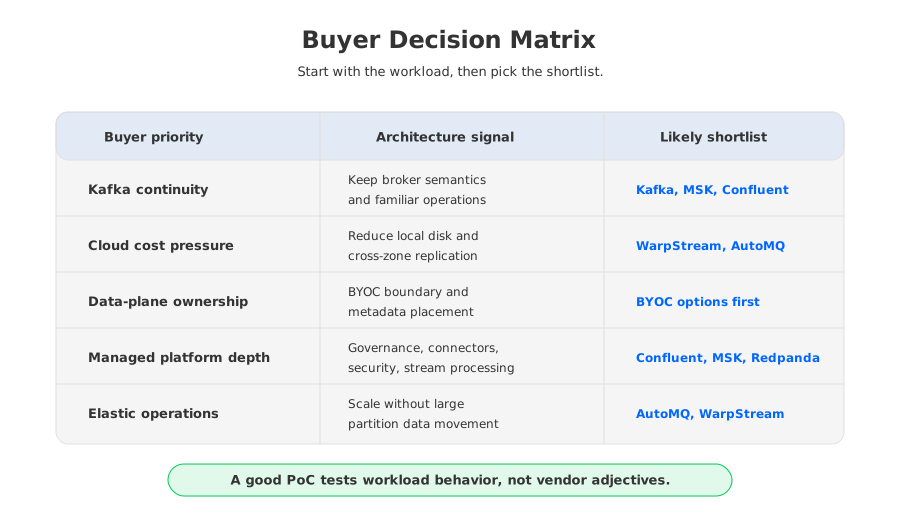
Different workloads should produce different shortlists. A committee that tries to pick one universal winner usually ends up debating abstractions while ignoring the workload that pays the bill.
| Workload pattern | Shortlist first | Why |
|---|---|---|
| Existing Kafka estate with mature ops | Apache Kafka, MSK, Confluent Cloud | Migration risk may matter more than storage redesign. |
| AWS-first managed Kafka | Amazon MSK, AutoMQ BYOC | AWS networking and billing may dominate. |
| Cost-sensitive high-ingest streams | WarpStream, AutoMQ, Redpanda | Object-storage economics may matter more than broker layout. |
| Strong cloud-account ownership | WarpStream BYOC, AutoMQ BYOC, Redpanda BYOC, MSK | Validate data, metadata, telemetry, and control boundaries. |
| Platform services and governance | Confluent Cloud, MSK, Redpanda Cloud | Platform completeness can outweigh raw infrastructure efficiency. |
| Frequent scaling or broker replacement | AutoMQ, WarpStream | Stateless or lower-state operations reduce capacity-change pain. |
The table is not a substitute for testing. It keeps the test honest. If the workload is dominated by long retention and backfill, do not over-index on low-latency microbenchmarks. If procurement risk is the driver, ask how packaging, support, and exit terms change over time.
9Procurement Checklist
Before a final decision, ask each vendor the same questions and force the answers into one document. The discipline matters because vendor demos optimize for what their system does well.
- Which Kafka APIs and behaviors are compatible, partial, or intentionally different?
- Where do raw data, metadata, control-plane state, telemetry, and backups live?
- What happens when object storage, cache, or metadata services slow down?
- Which costs sit outside the vendor invoice, such as object operations, private connectivity, cross-zone traffic, monitoring, or support?
- Do broker or agent failures require data movement?
- How are compacted topics, transactions, ACLs, retention, and backfills validated?
- What is the migration path in and out, including offsets, topic configuration, security, and rollback?
Run a small but realistic PoC with production-like message sizes, partition counts, retention, fan-out, schema usage, and failure drills. The result should be a decision memo, not a dashboard screenshot from a quiet five-minute test.
10References
- WarpStream Architecture
- WarpStream Write Path
- WarpStream Object Storage Configuration
- WarpStream Billing Reference
- Confluent Acquires WarpStream
- Confluent Cloud Pricing
- Confluent Cloud Overview
- Amazon MSK Pricing
- Amazon MSK Tiered Storage
- Apache Kafka Design: Replication
- Apache Kafka KRaft Operations
- Redpanda Cloud BYOC Tiers
- Redpanda BYOC
- AutoMQ S3Stream Overview
- AutoMQ S3 Storage
- AutoMQ Stateless Broker
- AutoMQ Cloud BYOC Overview
11FAQ
11.1Is WarpStream a direct replacement for Apache Kafka?
WarpStream is Kafka-compatible, but it is not a conventional Kafka broker deployment. Treat it as a Kafka-compatible architecture change, not a drop-in infrastructure clone.
11.2Which WarpStream competitor is closest architecturally?
AutoMQ is close because it also challenges broker-local disk ownership and uses object storage as a core storage foundation. The implementation differs: WarpStream uses stateless Agents and a cloud metadata store, while AutoMQ uses S3Stream with stateless brokers.
11.3Is MSK a WarpStream competitor?
Yes, for AWS teams evaluating production Kafka operations. MSK is not diskless Kafka, but it competes for the same budget and platform ownership.
11.4Is Redpanda a Kafka competitor or a WarpStream competitor?
Both. Redpanda is Kafka API-compatible and can belong in the same shortlist when teams are open to a different engine implementation.
11.5Where should AutoMQ enter the evaluation?
AutoMQ should enter after the team identifies broker-local storage as a root problem. If the requirement is Kafka compatibility plus object-storage-backed shared storage and stateless broker operations, it belongs on the shortlist.


