
Table of Contents
Table of Contents
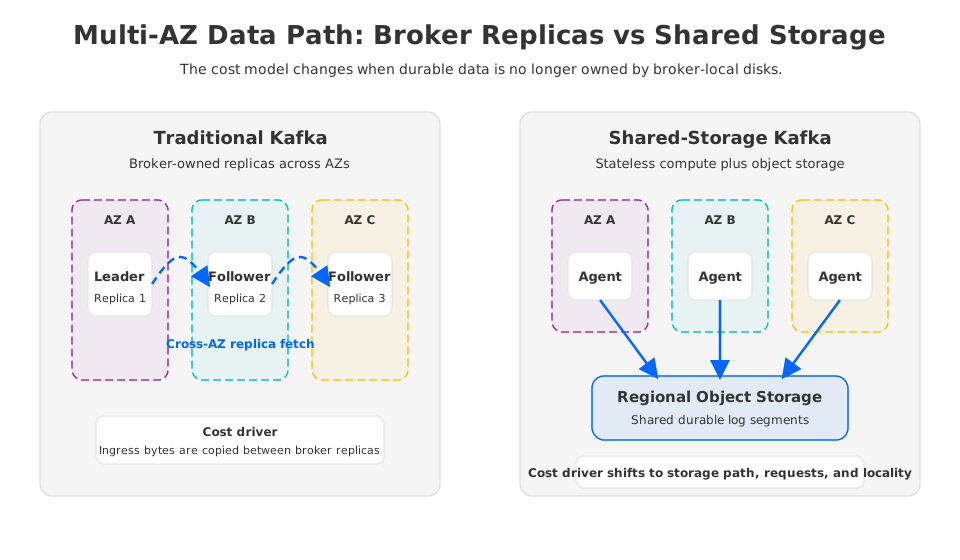
Multi-AZ Kafka looks reassuring on an architecture diagram until the bill and the recovery model are inspected together. Traditional Kafka spreads replicas across availability zones so a broker or zone failure does not take the topic down, but that safety is paid for through broker-to-broker replication, leader placement work, reassignment planning, and cross-zone data transfer. The uncomfortable part is that the most reliable-looking topology can also be the one that moves the most data through the most expensive path.
WarpStream changes that conversation by replacing broker-local durable disks with stateless agents and object storage. Instead of treating every broker as the long-term owner of a partition replica, WarpStream agents expose Kafka-compatible endpoints while data is stored in cloud object storage. That architecture can reduce the cross-AZ replication pattern that makes classic Kafka expensive, but it does not remove the need to reason about zones. It moves the hard questions from "how many replicas are moving between brokers?" to "which data path crosses zones, which control-plane dependency is regional, and what happens when object storage, metadata, or a zone is impaired?"
Confluent announced its acquisition of WarpStream on September 9, 2024, which also made WarpStream part of a broader Confluent portfolio discussion. For platform teams, the evaluation should remain architectural rather than emotional. A good multi-AZ decision separates four concerns that are easy to blend together:
- Durability: where committed records survive and which component acknowledges writes.
- Availability: which clients can continue producing and consuming during broker, zone, metadata, or object-storage incidents.
- Network cost: which data paths incur cross-zone or cross-region transfer charges.
- Latency: how often the hot path waits on local compute, remote compute, metadata, or object-storage operations.
Those dimensions interact, but they are not the same thing. A platform can reduce inter-AZ broker replication and still depend on a regional object-storage service. A design can keep data in the customer's cloud account and still require careful placement of agents, clients, and gateways. Multi-AZ Kafka is not a yes-or-no feature; it is a set of failure-domain choices.
1Why Multi-AZ Kafka Gets Expensive
Kafka's original durability model is intentionally simple: write a record to the leader replica, replicate it to follower replicas, and consider it committed based on the configured acknowledgement and in-sync replica policy. In a three-AZ deployment with replication factor 3, followers usually live in other zones so the topic can survive a zone loss. That means the same logical record is copied across zone boundaries as part of the write path.
The cost is not a Kafka bug. It is a mismatch between a data-center-era replication model and cloud network pricing. AWS documents data transfer charges between availability zones in the same region for EC2 traffic; Google Cloud documents inter-zone data transfer pricing within a region; Azure's bandwidth pricing also distinguishes availability-zone and regional paths. The exact price depends on provider, region, SKU, and direction, so a production estimate should use the current pricing page for the target region rather than a copied benchmark number.
The mechanism is stable even when prices change:
| Traffic source | Traditional multi-AZ Kafka behavior | Why it matters |
|---|---|---|
| Producer writes | Leader receives the write, followers in other AZs fetch replicas | Cross-AZ bytes scale with ingress and replication factor |
| Consumer reads | Consumers may read from leaders outside their local AZ unless rack-aware fetching is configured and effective | Fan-out can multiply network transfer beyond write volume |
| Reassignment and recovery | Moving partitions after broker changes copies retained data between brokers | Operational events become large data-movement projects |
| Replays | Long retention plus catch-up reads can pull historical data through non-local paths | Backfills can surprise FinOps teams more than steady-state traffic |
Kafka has mitigations. Rack awareness helps place replicas across racks or zones, and follower fetching can keep consumers closer to replicas when configured correctly. These are valuable controls, especially for clusters that must stay on broker-local storage. They also have an important limit: they improve placement and read routing inside the broker-replica model; they do not remove the model's need to maintain multiple broker-owned copies of data.
2How WarpStream Changes the Network Path
WarpStream's public architecture documentation describes a data plane of stateless agents that run in the customer's environment and use object storage as the storage layer. The agents speak the Kafka protocol to clients, while WarpStream's control plane coordinates cluster metadata and management. That design attacks one of classic Kafka's most expensive assumptions: durable records do not have to live as broker-local replicas.
In a multi-AZ deployment, this changes the main data path. Producer traffic goes to an agent, and durable data is written to object storage rather than replicated from broker to broker as retained local logs. If clients and agents are placed carefully, the application-facing network path can be more local, while object storage becomes the shared durability substrate. WarpStream documentation also discusses reducing networking costs through zone-aware routing, which makes placement and client routing part of the cost model rather than an afterthought.
That is a real architectural shift, but the word "shared" can hide several different dependencies:
- Agent locality: producers and consumers still connect to compute endpoints. Poor client-to-agent placement can reintroduce cross-zone traffic.
- Object-storage path: the object store is regional or zonal depending on provider and service design. Its request, retrieval, and availability characteristics become part of the Kafka SLO.
- Metadata path: a stateless data plane still needs metadata coordination. If metadata access is impaired, the data plane's failure behavior must be understood, not assumed.
- Read amplification: object-storage-backed systems can behave differently under tail reads, large fan-out, and historical replay. The cost model should include request volume as well as bytes.
The practical question is not whether WarpStream is "multi-AZ." It is what kind of multi-AZ architecture the workload gets after durable storage moves out of brokers. For write-heavy workloads where traditional Kafka's cross-AZ replication dominates the bill, the shift can be attractive. For workloads with strict p99 latency, heavy replay, or complex consumer locality, the evaluation needs direct workload testing.
3Failure Domains Move, They Do Not Disappear
The easiest mistake in a diskless or shared-storage Kafka evaluation is to declare the broker failure domain solved and stop there. Stateless agents reduce the blast radius of losing a compute node because another agent can serve the workload without owning a unique local log. That is valuable. It also means the durability and availability discussion now includes the shared services that make stateless compute possible.
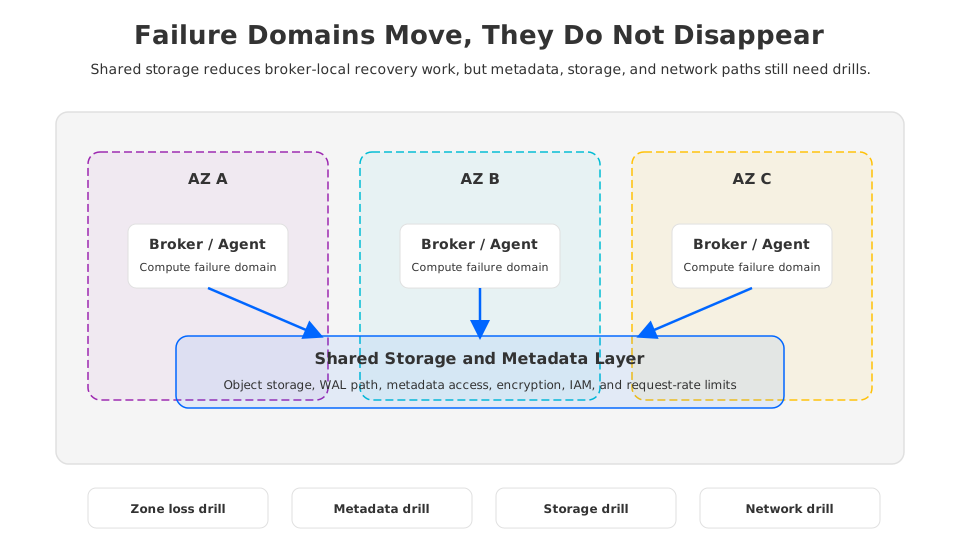
A useful review names each failure domain explicitly:
| Failure domain | Traditional Kafka question | Shared-storage Kafka question |
|---|---|---|
| Broker or agent | How quickly can partition leadership and replicas recover? | Can another stateless node serve the workload without local data movement? |
| Zone | Are enough replicas and controllers still available? | Are clients routed to healthy agents, and can storage and metadata paths still serve the workload? |
| Metadata | Are controllers or KRaft quorum healthy? | Is the control or metadata dependency reachable enough for the data plane to continue? |
| Storage | Are broker disks and replicas intact? | Is object storage available, durable, and performing within SLO? |
| Network | Are inter-broker and client paths healthy? | Are client-to-agent, agent-to-storage, and metadata paths healthy? |
This framing is useful because it avoids false certainty. Traditional Kafka has mature, well-understood failure behavior, but recovery can involve large partition movement and operational load. Shared-storage systems reduce the coupling between compute and durable data, but the shared layer becomes more important. A strong design is not the one with fewer boxes on the diagram; it is the one where each box has an owner, an SLO, and a tested failure response.
4Where AutoMQ Fits in the Alternative Set
Once the problem is framed this way, the category becomes clearer. The alternative to broker-local multi-AZ Kafka is not merely "managed Kafka" or "object storage." It is Kafka-compatible streaming with stateless compute and a shared storage layer, plus an explicit design for the write-ahead log, metadata, and cloud-account boundary. AutoMQ belongs in that category: it keeps Kafka protocol compatibility while using S3Stream and object storage for durable shared storage, with stateless brokers designed to reduce data movement during scaling and recovery.
AutoMQ's architecture is relevant to multi-AZ planning because it separates several choices that traditional Kafka bundles together. Durable stream data is no longer tied to broker-local disks. Broker scaling is a compute operation rather than a retained-log migration project. In BYOC deployments, teams can keep data-plane resources in their cloud account and evaluate network, IAM, encryption, and object-storage policies through their own cloud controls. AutoMQ also documents WAL deployment options, including Regional EBS WAL and NFS WAL patterns, so the write path can be reviewed as its own failure-domain decision instead of being treated as an implementation detail.
That does not make every workload automatically fit. The right evaluation still tests latency, replay behavior, consumer fan-out, operational tooling, and the exact cloud-region cost model. The difference is that AutoMQ gives teams another shared-storage architecture to compare against WarpStream and traditional Kafka, especially when they want Kafka compatibility, customer-controlled infrastructure, and less broker-to-broker data movement.
5Multi-AZ Cost and Design Checklist
The checklist below is intentionally mechanical. It keeps teams from debating product labels before they have mapped the paths that produce cost and risk.
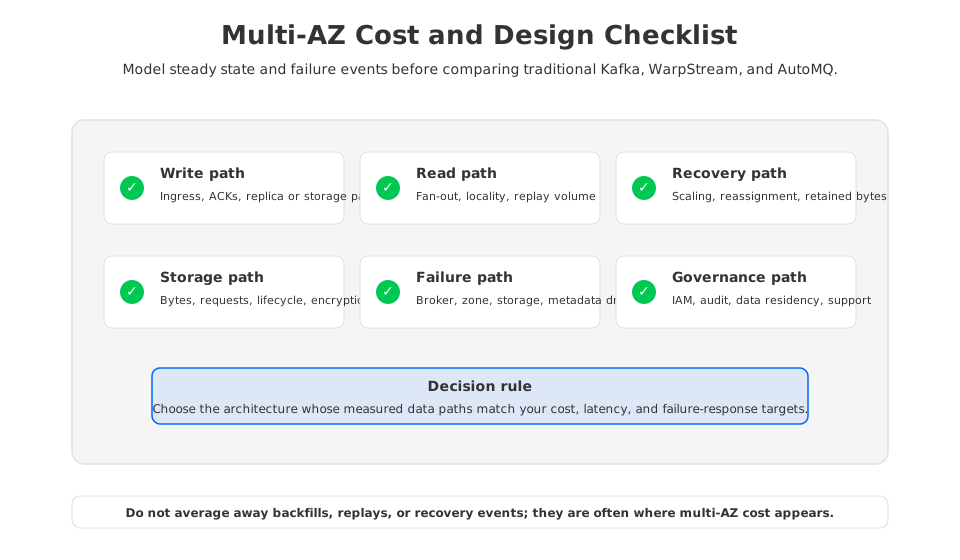
| Check | What to measure | Decision signal |
|---|---|---|
| Write path | Ingress MiB/s, replication behavior, acknowledgement policy, local versus cross-zone bytes | Traditional Kafka costs rise with cross-AZ replica traffic; shared storage changes the path |
| Read path | Consumer fan-out, follower fetching, locality, replay frequency | High fan-out can dominate cost even when writes look modest |
| Recovery path | Broker replacement, scaling, partition reassignment, retained data copied | If operations move terabytes, compute elasticity is not really elastic |
| Storage path | Object-storage bytes, requests, retrieval, lifecycle, encryption | Shared storage shifts cost from disks and replication to object-storage economics |
| Failure path | Broker, zone, metadata, storage, and network incident tests | A diagram is credible only after failure drills prove it |
| Governance path | Cloud account boundary, IAM, audit logs, data residency, support model | BYOC and managed control planes have different ownership tradeoffs |
For a first-pass estimate, model steady-state writes, steady-state reads, and at least one replay or recovery event. Then run the same model for traditional Kafka, WarpStream, and AutoMQ using current provider pricing. Avoid averaging away spikes. Many Kafka bills look acceptable at daily averages and painful during consumer catch-up, repartitioning, or backfill windows.
If your current multi-AZ design looks clean on the diagram but noisy on the network bill, the next useful step is not another vendor comparison table. Build the path model above, run one failure drill, and test a shared-storage Kafka candidate against the workload that hurts. For teams evaluating AutoMQ in that process, the practical starting point is the AutoMQ project and deployment material.
6References
- WarpStream Architecture Documentation
- WarpStream documentation on reducing infrastructure costs
- WarpStream documentation on zone-local Kafka clients
- Confluent announcement: Confluent acquires WarpStream
- Apache Kafka documentation: replication
- Apache Kafka documentation: rack awareness
- AWS EC2 On-Demand Pricing: data transfer
- Google Cloud VPC network pricing
- Azure bandwidth pricing
- AutoMQ documentation: S3Stream shared streaming storage
- AutoMQ Cloud BYOC overview
7FAQ
7.1Does WarpStream eliminate multi-AZ network cost?
No architecture can eliminate every network path. WarpStream changes the cost shape by using stateless agents and object storage instead of broker-local replicated logs, and its documentation discusses zone-aware routing to reduce networking costs. Teams still need to model client-to-agent traffic, agent-to-storage traffic, metadata access, object-storage requests, and replay behavior.
7.2Is traditional Kafka still a reasonable multi-AZ choice?
Yes, especially when the team values mature operational behavior, has strong rack-awareness practices, and can accept the cost of broker-owned replicas. The tradeoff is that durability and recovery are tied to data movement between brokers. That can make scaling, reassignment, and recovery expensive in cloud environments.
7.3How should I compare WarpStream and AutoMQ for multi-AZ workloads?
Start with the workload rather than the vendor. Measure write throughput, read fan-out, replay frequency, latency targets, retention, failure drills, and cloud-account requirements. Then compare how each architecture handles the write path, shared storage, metadata, operational recovery, and governance boundaries.
7.4When does AutoMQ become relevant in this evaluation?
AutoMQ is relevant when the desired architecture is Kafka-compatible shared storage with stateless brokers, reduced broker-to-broker data movement, and deployment options that keep data-plane resources in the customer's cloud account. It should be evaluated with the same workload tests as WarpStream: latency, replay, cost, failure behavior, and operational fit.
7.5What is the most common multi-AZ planning mistake?
The most common mistake is treating "multi-AZ" as a checkbox. Multi-AZ design is a map of data paths and failure domains. A team should know which bytes cross zones, which component acknowledges writes, which metadata path is required, and what happens during broker, zone, storage, and network incidents.


