
Table of Contents
Table of Contents
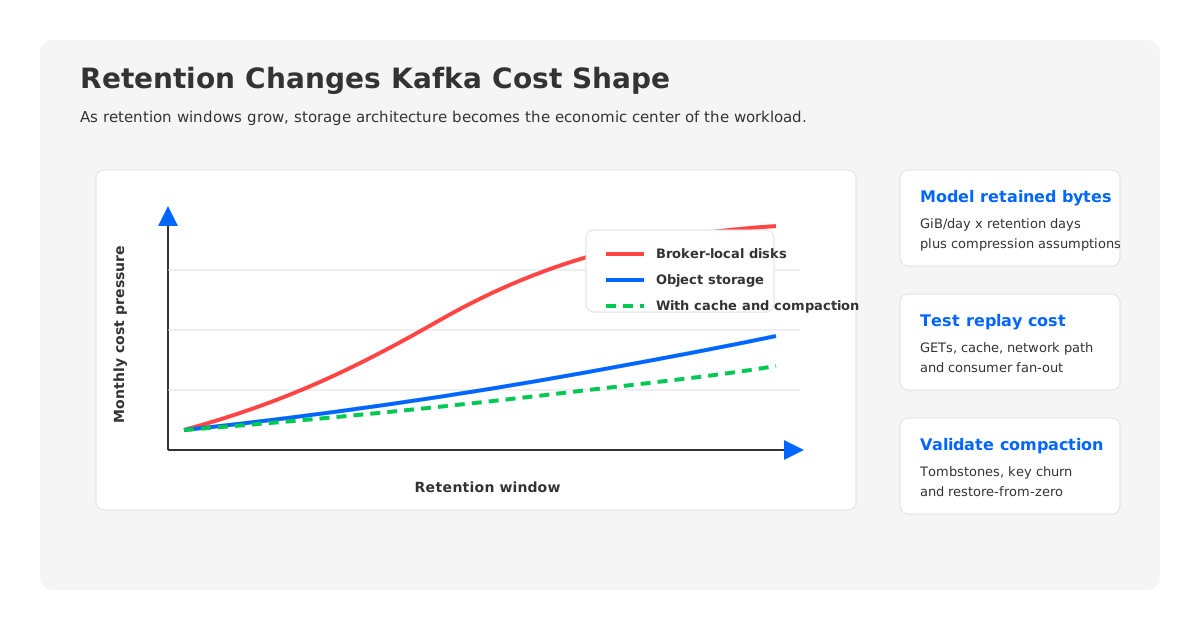
High-retention Kafka workloads expose a simple tension: the data is valuable enough to keep, but not always valuable enough to keep on broker-local disks. Logs, metrics, audit events, clickstream history, security telemetry, and compliance event trails often need weeks or months of retention. They also need occasional replay, backfill, incident investigation, or reprocessing after downstream code changes. The cost problem is the long tail of retained bytes multiplied by replication, broker capacity, operational headroom, and recovery time.
This is why object-storage-backed Kafka-compatible systems attract attention for high-retention workloads. WarpStream's official documentation describes a diskless, Apache Kafka-compatible streaming platform built directly on object stores such as Amazon S3, Google Cloud Storage, and Azure Blob. Its architecture replaces stateful Kafka brokers with stateless Agents, stores data in object storage, and uses a cloud metadata store for file and offset coordination. That can change the economics of retention, but it does not remove the need to model replay cost, request behavior, compaction, metadata dependency, and read latency.
1Why retention changes Kafka economics
Traditional Kafka binds durable log storage to brokers. A topic with a long retention.ms or a large retained byte target consumes broker disk, affects partition placement, and lengthens failure recovery or reassignment work. Apache Kafka's topic configuration reference defines retention through settings such as retention.ms, retention.bytes, segment.ms, segment.bytes, and cleanup.policy; those settings control when old log segments are eligible for deletion and whether log compaction is active. The operational bill includes disk capacity, replicated copies, broker memory, page cache pressure, network replication, and data movement work.
High retention changes the shape of the workload in four ways:
- Storage becomes the largest steady-state component when data is produced continuously and replayed irregularly.
- Cold reads become a production event, because consumers may need to scan older data after incidents, schema changes, analytics backfills, or disaster recovery drills.
- Compaction policy matters more, especially for changelog, state, inventory, identity, and metadata topics where old keys can be collapsed but tombstones still need retention.
- Object request patterns become visible, because object storage bills for storage, requests, and sometimes retrieval or lifecycle operations depending on class and provider.
A platform team should model high-retention Kafka as a storage and replay system, not only as streaming ingress. Produce latency still matters, but the deciding question is whether the architecture can keep retained data cost-effective without making historical reads painful.
2The cost drivers that survive object storage
Object storage can lower the pressure to provision broker-local disks for the worst retained byte count. It can also simplify durability assumptions by relying on cloud storage services that replicate data under the hood. Yet the bill does not disappear. It moves into a different set of variables.
AWS S3 pricing is a useful public anchor because it exposes the components that matter here: monthly storage by class, PUT/COPY/POST/LIST requests, GET and other requests, lifecycle transitions, retrieval charges for some classes, and minimum duration or object-size rules for infrequent-access and archive classes. The exact numbers vary by region and time, so a serious model should use the current pricing page or cloud pricing API.
For high-retention Kafka, the working formula is:
| Cost driver | What to measure | Why it matters |
|---|---|---|
| Retained bytes | GiB or TiB retained per topic class over the retention window | Storage GB-month dominates long-lived topics |
| Write volume | Uncompressed and compressed GiB/day, plus object flush pattern | Affects platform metering and object PUT volume |
| Object layout | File size, partition mixing, compaction cadence, metadata entries | Determines request count and replay efficiency |
| Replay frequency | Backfills per month, average replay size, consumer fan-out | Converts "cold storage" into GET, scan, cache, and network load |
| Compaction | Key churn, tombstone lifetime, compacted topic size after cleanup | Changes retained bytes and replay semantics |
| Network path | Same-AZ, cross-AZ, cross-region, internet egress | Can outrank storage cost in multi-AZ or analytics paths |
WarpStream's billing documentation adds platform-specific dimensions on top of the cloud bill. It says BYOC clusters are metered by cluster-minutes, uncompressed GiB written, and uncompressed GiB stored; serverless clusters add compressed GiB written and read. For retention-heavy workloads, "uncompressed GiB stored" matters because retained logical data becomes a direct platform billing dimension as well as a cloud storage dimension.
3WarpStream's high-retention design center
WarpStream is not tiered storage in the classic Kafka sense. Its architecture documentation says Agents do not require local disks, stream data to object storage, and can serve any topic-partition. The data plane runs in the customer's VPC, while WarpStream's cloud services operate metadata, control, coordination, and observability functions. For high-retention workloads, the key idea is that retention no longer forces every broker to carry a local copy of old segments.
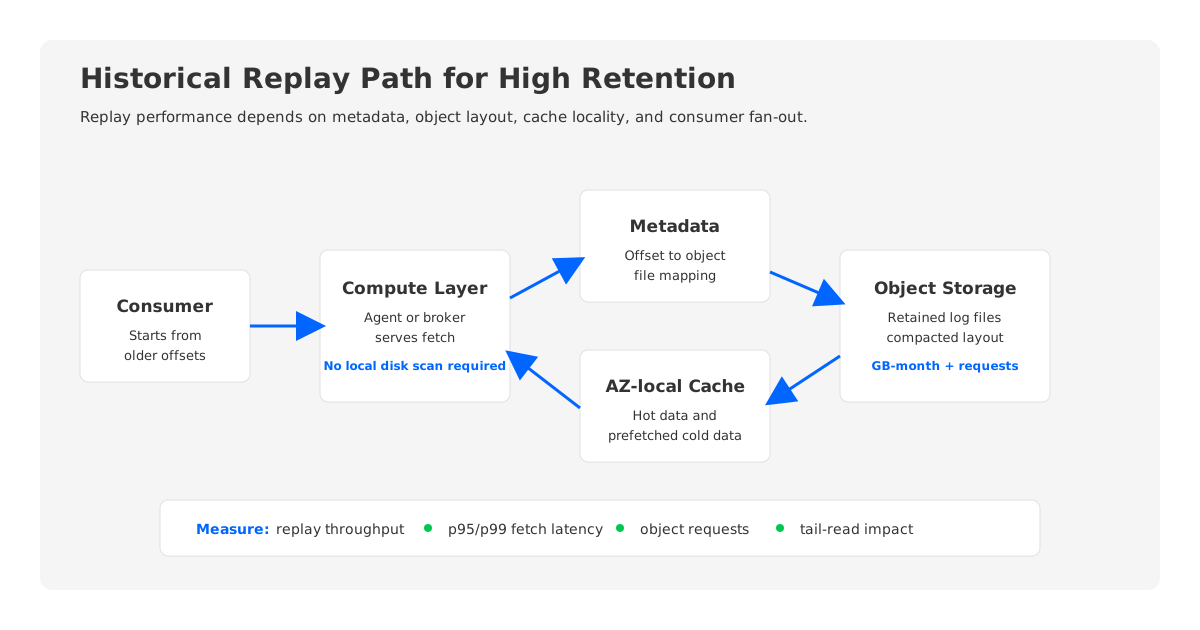
The write path is built around batching and metadata commit. WarpStream documents that Agents buffer produce requests across producers and partitions, write records in batches to object storage, commit file metadata to the metadata store, and then acknowledge the produce requests. The same documentation notes that Agents create files containing records from multiple topic-partitions rather than a file per partition. Background file compaction then rewrites small files into larger files and improves locality for historical replays.
This is the architecture pattern high-retention teams want to test. Append-only audit events replayed a few times per month may fit object storage well. Frequent random historical reads, heavy fan-out over older offsets, or aggressive compaction on high-churn keys make object layout and cache behavior critical.
4Retention, replay, and compaction are separate questions
It is tempting to summarize the decision as "object storage is lower cost." That is directionally useful but operationally incomplete. High retention has at least three separate mechanisms.
Retention deletion answers when old data can be removed. In Kafka-compatible systems, operators still need topic policies such as time-based retention, byte-based retention, and topic-level overrides. WarpStream's documentation query interface identifies retention.ms as the retention control for old data removal and notes that compacted topics also involve delete.retention.ms for tombstones.
Historical replay answers how efficiently old data can be fetched. WarpStream's write-path documentation says background compaction improves IO access patterns for historical replays, while the architecture page describes zone-aware object storage cache participation as a control-plane responsibility. For a high-retention PoC, this is not a footnote. A replay that looks cost-effective on storage alone can still be too slow or too request-heavy if object layout, cache locality, or consumer fan-out is mismatched.
Log compaction answers how key histories collapse over time. Compacted topics have different economics from append-only telemetry topics. A compacted topic with high key churn, frequent tombstones, and replay-from-zero consumers needs validation of final-state correctness, tombstone retention, and compaction freshness. WarpStream's documentation states that compaction uses background file rewrites in object storage and heuristics rather than Kafka's log-cleaner settings, with topic settings such as min.compaction.lag.ms and max.compaction.lag.ms influencing freshness.
The practical takeaway: do not ask whether a platform "supports retention." Ask which mechanism does the work, which bill it touches, and what happens during replay.
5Where AutoMQ fits in the same architecture category
Once the problem is framed as Kafka-compatible streaming over shared object storage, AutoMQ belongs in the same evaluation category, with a different storage design. AutoMQ is a Kafka-compatible cloud-native streaming system that uses S3Stream to offload Kafka log storage to object storage and make brokers stateless. Its documentation describes S3Stream as a shared streaming storage component with WAL storage and data caching for low-latency writes and efficient tail and catch-up reads.
The architectural distinction matters for high retention. WarpStream's public docs emphasize a diskless Agent model where data is persisted to object storage before acknowledgement and coordinated through the WarpStream metadata store. AutoMQ's docs emphasize a WAL plus S3 storage design: data is written to WAL for low-latency persistence and uploaded to S3 as primary storage, with cache used for hot data and prefetched cold data. AutoMQ's WAL options differ by edition and deployment environment, including S3-compatible WAL for open source and block or file storage options for commercial deployments.
For buyers, this creates a useful comparison:
| Dimension | WarpStream angle | AutoMQ angle | What to test |
|---|---|---|---|
| Primary storage | Object storage first, no local disks | S3Stream with object storage as persistent storage | Retained byte growth and object layout |
| Write path | Agent batching to object storage, metadata commit before ack | WAL persistence before client success, upload to S3 | p95/p99 produce latency under retention load |
| Historical reads | Compacted files and object storage cache | Cache plus hot/cold read isolation and catch-up read path | Backfill speed, request volume, tail-read impact |
| Operations | Stateless Agent pool, vendor metadata/control plane | Stateless brokers, Kafka-compatible operations | Scaling, failure recovery, metadata dependencies |
| Commercial boundary | BYOC and serverless billing dimensions | BYOC/self-managed paths depending on product | Data plane, control plane, support access, exit plan |
This is not a claim that one architecture is universally better. A security telemetry platform with 90-day retention, rare replay, and cost-sensitive storage may choose differently from a stream-processing platform that replays large compacted topics every day.
6A workload model before the PoC
The most useful high-retention PoC starts with a workload model, not with a cluster deployment. The model should separate topics into classes because logs, metrics, audit events, compacted changelogs, and reprocessing topics behave differently.
Use a table like this before testing:
| Topic class | Write rate | Retention | Read pattern | Compaction | Evaluation focus |
|---|---|---|---|---|---|
| Application logs | High | 30-180 days | Rare replay, wide scans | Delete | Storage GB-month, scan throughput |
| Audit events | Medium | 180-365 days | Investigation replay | Delete | Durability, compliance boundary |
| Metrics | High | Short to medium | Aggregation and backfill | Delete | Object request count, fan-out |
| Changelog topics | Variable | Long | Restore from offset 0 | Compact | Tombstones, compaction lag |
| ML/event history | High | Long | Batch reprocessing | Delete or compact | Replay speed, egress path |
Then calculate daily data growth from observed producer metrics. Convert write throughput into GiB/day, multiply by retention days, and apply compression assumptions explicitly. Keep logical platform billing units separate from physical object storage units because vendors may meter uncompressed data while the cloud provider bills physical stored objects.
7What to test before production
The minimum production test should simulate steady-state writes and the disruptive events that make high retention valuable. A platform that looks fine during tail reads can behave differently during a large backfill.
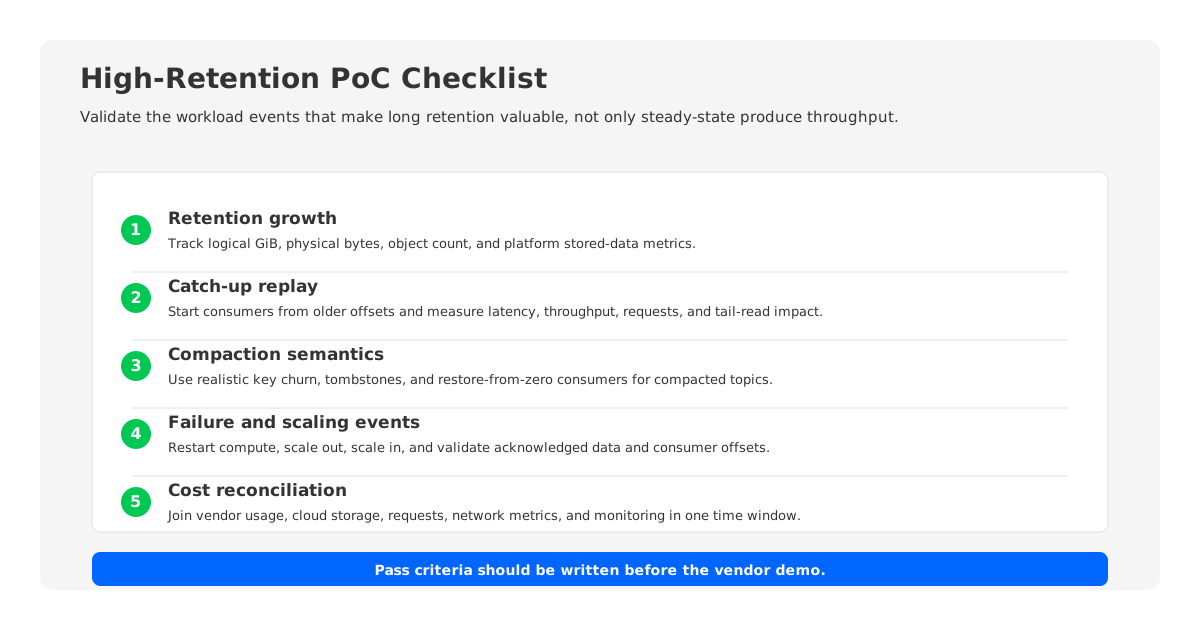
Run the following checks with the same producer, consumer, topic, and retention profile across candidates:
- Retention growth: measure object count, total stored bytes, topic-level logical bytes, and platform-reported retained GiB over a multi-day run.
- Catch-up replay: start consumers from older offsets and record throughput, p95/p99 fetch latency, GET/request volume, and any impact on tail consumers.
- Compaction behavior: test compacted topics with realistic key churn, tombstones, and restore-from-zero consumers.
- Failure recovery: restart compute nodes or Agents during writes and during replay, then validate acknowledged data, consumer offsets, and recovery time.
- Scaling events: scale compute up and down while sustained writes continue, watching whether data movement, metadata operations, or cache warmup dominate.
- Cost observability: reconcile vendor usage, cloud storage metrics, request metrics, network metrics, and monitoring data into the same time window.
The pass/fail threshold should be business-specific. Replaying 30 days of audit data in several hours may be acceptable; for incident response, it may not. Write the threshold before the vendor demo.
8Decision guidance for high-retention Kafka
WarpStream is most compelling when the workload aligns with its object-storage-first design: high retained bytes, Kafka-compatible client expectations, cloud object storage as the durable data layer, and a preference for stateless compute over broker-local disk operations. The architecture is especially relevant when traditional Kafka retention forces the team to buy disks for old data that is rarely read.
The tradeoffs are also clear enough to test. Teams should validate metadata dependency, cache behavior, historical read performance, compaction semantics, object request cost, and platform billing for stored logical data. Confluent's September 9, 2024 announcement that it acquired WarpStream is also a procurement fact to include in vendor and roadmap review, especially for buyers comparing independent, BYOC, managed, and open-source deployment paths.
AutoMQ should be evaluated when the team wants Kafka compatibility, object-storage-backed retention, stateless brokers, and a storage design that combines WAL, S3, and cache paths. It is not a reason to skip the PoC. It is a reason to make the PoC architecture-aware instead of brand-aware: compare the write path, replay path, compaction model, metadata boundary, and cost telemetry under the same high-retention workload.
If retention is the reason your Kafka estate is expensive, the next step is to test retention directly. Build the workload model, run the replay and compaction checks, and compare object-storage-backed systems against the operational pain that long-lived broker disks create. AutoMQ's Kafka-compatible architecture and deployment documentation can help you decide whether a shared-storage model belongs in that shortlist: AutoMQ docs.
9FAQ
9.1Is WarpStream a good fit for high-retention Kafka workloads?
It can be, especially when the workload stores many retained bytes and reads old data less frequently than it writes current data. The deciding factors are replay performance, object request cost, compaction behavior, and the operational boundary between the customer data plane and the vendor control plane.
9.2Does object storage remove Kafka retention cost?
No. It changes the cost model. Broker-local disk pressure may fall, but storage GB-month, object requests, retrieval, lifecycle operations, platform metering, cache, and network paths still need to be modeled.
9.3What should I test for historical replay?
Test consumers starting from old offsets, full-topic scans, multiple consumer groups replaying at once, tail consumers running during replay, and downstream egress paths. Measure throughput, latency percentiles, object request count, cache hit behavior, and impact on current writes.
9.4How are compacted topics different from append-only topics?
Compacted topics require validation of key-level final state, tombstone retention, compaction freshness, and restore-from-zero behavior. Append-only topics are usually dominated by retained byte volume and scan throughput.
9.5Where does AutoMQ differ from WarpStream for retention-heavy workloads?
Both belong to the Kafka-compatible, object-storage-backed architecture category. WarpStream emphasizes diskless Agents writing directly to object storage with a cloud metadata store. AutoMQ emphasizes S3Stream with WAL, object storage, cache, and stateless brokers. The right comparison is a workload PoC, not a generic feature list.


