
Table of Contents
Table of Contents
Kafka teams rarely worry about lock-in while the first cluster is working. The concern usually appears at renewal, during a cloud-account review, after a security architecture change, or when an acquisition changes the procurement conversation. Confluent announced that it had acquired WarpStream on September 9, 2024, and that made a governance question more visible: if a team standardizes on WarpStream for Kafka-compatible streaming, how hard would it be to move later?
The answer is not "Kafka-compatible, therefore portable." Kafka API compatibility protects an important part of the workload, especially producers, consumers, topic semantics, consumer groups, and common ecosystem tools. But a production streaming platform is larger than the API surface your application calls. It includes metadata, schemas, ACLs, object storage layout, operational automation, billing commitments, private networking, dashboards, support procedures, and the cutover mechanics that keep applications alive during a move.
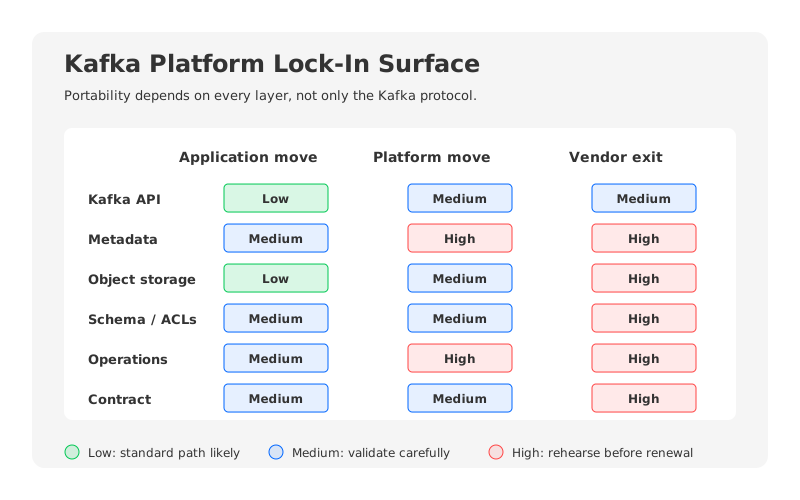
Lock-in is not a moral failure. It is the accumulation of switching costs that become hard to predict. A platform can be technically strong and still create exit risk if the team never tests the exit path. WarpStream's architecture changes the shape of the risk because the Agents run in the customer's environment and data is written to customer-controlled object storage, while metadata and coordination depend on WarpStream's cloud services. That split can be attractive. It also means portability has to be evaluated layer by layer.
1Compatibility Is Not the Same as Portability
Apache Kafka gives teams a unusually durable contract: clients speak a documented protocol, topics expose an ordered log abstraction, and consumer groups track progress through offsets. WarpStream's documentation says its Agents speak the Apache Kafka protocol and support the basic ability to create topics, delete topics, produce data, consume data, and use consumer groups. That matters because application rewrites are often the most expensive part of leaving a platform.
Still, compatibility has edges. WarpStream's protocol and feature support page lists supported Kafka request types, notes that some broker-oriented requests have no meaning in its stateless architecture, and documents known incompatibilities such as ignored tagged fields, ignored throttling-related fields or settings, and a maximum timeout for most Kafka protocol requests. It also documents feature-specific differences, including retention behavior based on real creation time rather than custom record timestamps.
For a portability review, those differences are not automatically blockers. They are test cases. A workload that mostly uses produce, fetch, consumer groups, simple topic administration, and standard client behavior may be easy to move between Kafka-compatible systems. A workload that relies on unusual admin APIs, broker placement assumptions, timestamp-based retention behavior, throttling controls, or exact Schema Registry semantics needs a more careful plan.
| Layer | What Kafka compatibility preserves | What still needs exit testing |
|---|---|---|
| Clients | Producer and consumer libraries can often keep the same Kafka API model. | Client tuning, timeout behavior, idempotence, transactions, batching, and retry settings may need adjustment. |
| Topics and offsets | Topic names, partitions, records, and consumer group concepts remain familiar. | Topic configs, offset migration, retention semantics, and replay windows must be validated. |
| Administration | Common create, delete, describe, and group operations may work. | Broker-specific admin operations, reassignments, quorum views, and throttling may not translate. |
| Ecosystem tools | Kafka Connect, stream processors, and UIs may connect through Kafka interfaces. | Tool-specific assumptions about metadata, ACLs, Schema Registry, and metrics can break quietly. |
The practical lesson is blunt: do not treat a successful client smoke test as an exit strategy. A smoke test proves that a small path works. Portability means the full workload can move with bounded data loss risk, bounded downtime, known operational work, and a rollback plan.
2The Lock-In Surface Area
WarpStream's biggest architectural difference from traditional Kafka is that its Agents are stateless and store data directly in object storage, while a Cloud Metadata Store tracks the mapping between files, offsets, topics, and partitions. Its architecture documentation says any Agent can serve any produce or consume request, and that virtual cluster metadata operations are journaled before being acknowledged. That design removes broker-local disk ownership from the operating model, but it introduces a platform-specific metadata layer that a migration plan must respect.
The lock-in surface is therefore broader than "can I read my bucket?" Customer-owned object storage is useful because it improves data-plane control and cloud-account ownership. It does not automatically mean another Kafka engine can attach to the same bucket and understand the object layout, offset mapping, compaction state, retention state, or virtual cluster metadata. The bucket is part of the exit story, not the whole story.
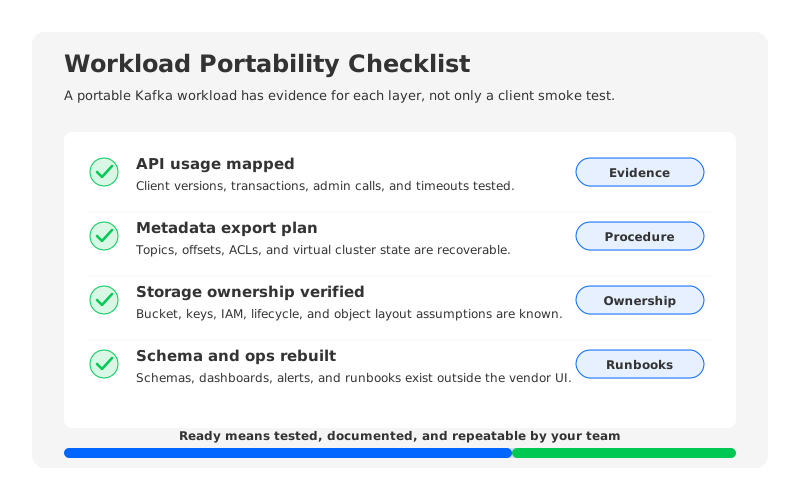
The cleanest way to evaluate risk is to assign an owner and a test to each surface:
- API and protocol. Verify the exact Kafka APIs, client versions, producer settings, transaction behavior, consumer group behavior, and admin operations your workload uses. The result should be a compatibility matrix based on your traffic, not a generic yes-or-no claim.
- Metadata and control plane. Identify where topic metadata, file-to-offset mappings, consumer group state, ACLs, virtual cluster state, billing identity, metrics, and support access live. Then ask which of those can be exported, recreated, or verified independently.
- Data plane and object storage. Confirm who owns the bucket, encryption keys, IAM roles, lifecycle policy, network path, and deletion policy. Also confirm whether the stored objects are useful only through WarpStream's metadata services or can support a documented migration workflow.
- Schema and data contracts. WarpStream documents a BYOC Schema Registry in the Agent binary and says it supports most Confluent Schema Registry APIs, with listed gaps such as unsupported data contracts, mode endpoints, exporters, subject aliases, and compatibility groups. If your organization relies on those features, schema portability is a first-class migration workstream.
- Operations and observability. Dashboards, alert rules, SLOs, runbooks, autoscaling policies, incident procedures, and support escalation paths become part of the platform. They may be more expensive to recreate than the application client changes.
- Commercial commitments. Renewal timing, minimum commits, support terms, acquisition-driven packaging changes, and termination assistance can create lock-in even when the technical path is manageable.
This is where BYOC needs careful language. BYOC can keep the data path inside your cloud account and give your security team a stronger boundary for network, IAM, and storage. It does not remove every dependency on a vendor-operated control plane or metadata service. The right question is not "is BYOC portable?" The right question is "which parts of this BYOC deployment can be moved, rebuilt, or operated without the vendor, and how long would that take?"
3Questions to Ask WarpStream or Confluent
A good vendor lock-in review should be boring in the best possible way: specific questions, concrete evidence, and a rehearsal that proves the answers. If the answer depends on a future feature, a custom support script, or a professional-services engagement, write that down as a dependency. Procurement teams care about dependencies because dependencies become leverage during renewal.
Use these questions before standardizing on a platform, not after the platform is already sitting on petabytes of retained history:
| Area | Question | Evidence to request |
|---|---|---|
| Kafka API | Which Kafka protocol requests, client versions, transactions, ACLs, and admin operations are supported for my workload? | A workload-specific compatibility matrix and a reproducible test suite. |
| Metadata | Can virtual cluster metadata, topic state, ACLs, consumer groups, and offset mappings be exported or reconstructed? | Export documentation, API references, and a dry-run migration report. |
| Object storage | Can another system interpret the stored objects directly, or is migration required through Kafka reads and writes? | Documented object layout guarantees or a migration procedure with throughput limits. |
| Schema Registry | Which Confluent Schema Registry APIs are unsupported, and how are schemas exported? | Schema export/import procedure and compatibility test results. |
| Networking | Which private endpoints, VPC routes, DNS names, and IAM roles must change during exit? | Network diagram, Terraform modules, and rollback instructions. |
| Operations | Which metrics, logs, alerts, dashboards, and support tools are portable? | Observability mapping and incident runbook diff. |
| Contract | What happens to support, data access, migration assistance, and usage commits at termination? | Contract language reviewed by procurement and security. |
The strongest answer is not a slide that says "open API." It is a rehearsal: mirror a representative topic, preserve offsets for a consumer group, run a read-after-cutover test, validate schema compatibility, fail back, and measure how much manual coordination was required. That exercise turns lock-in from a vague fear into an engineering variable.
4How to Keep a Kafka Workload Portable
Portability improves when the workload is designed as if an exit test will happen every year. That does not mean avoiding managed services. It means keeping the critical state understandable and reducing the number of hidden assumptions that can only be discovered during an incident.
For Kafka workloads, the minimum discipline is straightforward. Keep topic configuration as code. Track client configuration templates. Maintain an inventory of producer idempotence settings, transaction IDs, consumer group IDs, schema subjects, ACLs, connector offsets, stream processing checkpoints, and alert dependencies. For each item, mark whether it can be exported through a standard Kafka API, through a vendor API, through infrastructure-as-code state, or only through a support request.
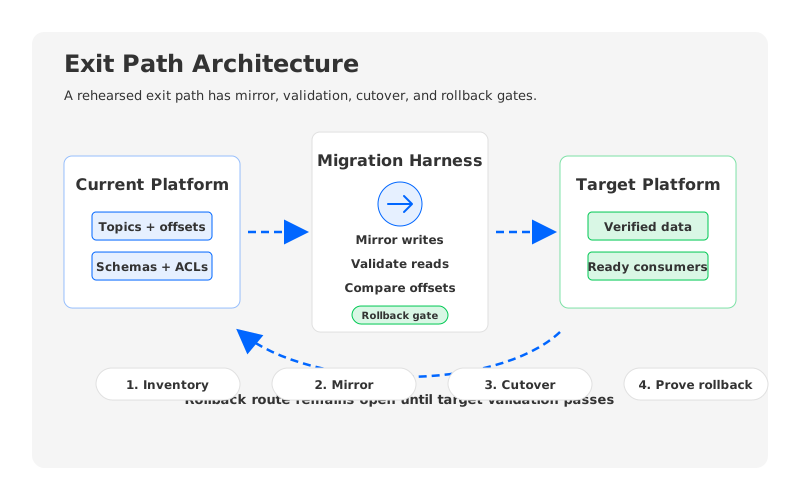
Then test the exit path with real traffic patterns. A portable workload should survive at least four exercises: live dual-write or mirrored write validation, historical replay from retained data, consumer group cutover with explicit offset handling, and rollback after a failed target validation. Teams that skip rollback usually discover the hardest part too late. Moving forward is only half of portability; getting back to the previous known-good state is the other half.
The target architecture also matters. Traditional Kafka, Confluent Cloud, WarpStream, Redpanda, Amazon MSK, and cloud-native shared-storage systems all expose different operating boundaries. AutoMQ belongs in the Kafka-compatible, object-storage-backed shared-storage category: it keeps the Apache Kafka protocol and ecosystem contract, moves durable storage into S3-compatible object storage, and uses stateless brokers so scaling and recovery do not depend on moving large broker-local data sets. That does not make every migration automatic. It does make the evaluation comparable: test protocol compatibility, data ownership, metadata handling, storage layout, and rollback with the same workload plan.
For teams considering AutoMQ as part of a lock-in review, the useful next step is not a product demo in isolation. Start with the same portability checklist you apply to WarpStream: clients, topics, offsets, schemas, ACLs, observability, storage ownership, and exit rehearsal. AutoMQ's public documentation on Kafka compatibility, architecture, and stateless brokers gives you a concrete baseline to validate against your own workload instead of relying on platform labels.
5A Practical Exit Readiness Scorecard
The fastest way to make the discussion actionable is to score each workload before committing more data or more contracts to a platform. Use a 1-to-5 scale where 1 means "unknown or vendor-dependent" and 5 means "tested, documented, and repeatable by the platform team." The score is less important than the gaps it exposes.
| Dimension | Low score signal | High score signal |
|---|---|---|
| API coverage | The team assumes Kafka compatibility without mapping actual API usage. | All client, admin, transaction, ACL, and schema paths are covered by tests. |
| Metadata control | Topic, offset, ACL, and virtual cluster metadata export is unclear. | Metadata export or reconstruction is documented and rehearsed. |
| Data movement | The only exit plan is "read everything later." | Migration throughput, replay windows, and cutover order are measured. |
| Operations | Dashboards, alerts, and runbooks are vendor-console specific. | Observability and incident workflows can be recreated from versioned config. |
| Contract reversibility | Renewal and termination terms are reviewed after deployment. | Exit assistance, data retention, support windows, and commits are negotiated upfront. |
Any dimension below 3 deserves a mitigation plan before the workload becomes business-critical. That may be a technical change, a contract change, a runbook, or a smaller initial scope. The point is not to eliminate all switching cost. The point is to stop pretending switching cost is unknowable.
6References
- Confluent: Confluent acquires WarpStream
- WarpStream: Architecture
- WarpStream: Protocol and Feature Support
- WarpStream: BYOC Schema Registry
- Apache Kafka: Protocol Guide
- AutoMQ: Architecture Overview
- AutoMQ: Compatibility with Apache Kafka
- AutoMQ: Stateless Broker
7FAQ
7.1Does Kafka compatibility eliminate WarpStream lock-in?
No. Kafka compatibility can reduce application migration work, but platform portability also depends on metadata, object storage layout, schema registry behavior, ACLs, observability, networking, support processes, and contract terms. Treat compatibility as the first layer of the exit plan, not the whole plan.
7.2Is BYOC enough to keep my Kafka data portable?
BYOC can improve data-plane control because the Agents and object storage run in the customer's cloud environment. Portability still depends on whether the metadata, object layout, schemas, offsets, and operational state can be exported, rebuilt, or migrated with known downtime and rollback behavior.
7.3What is the biggest WarpStream exit-path question?
The biggest question is how to move from a WarpStream virtual cluster to another Kafka-compatible target while preserving topic data, offsets, schemas, ACLs, and operational confidence. If the answer is "read and rewrite everything through Kafka clients," the team should measure the required throughput, replay time, and cutover risk before the workload grows.
7.4How should procurement evaluate vendor lock-in?
Procurement should ask for technical exit evidence and contract language together. The technical side should include export procedures, migration limits, support responsibilities, and a dry-run plan. The contract side should cover termination assistance, data retention, support access, renewal commitments, and any acquisition-related packaging changes.
7.5Where does AutoMQ fit in this evaluation?
AutoMQ is a Kafka-compatible shared-storage system that uses object storage and stateless brokers to change the storage and scaling model while preserving Kafka ecosystem compatibility. It should be evaluated with the same portability scorecard: protocol behavior, data ownership, metadata handling, schema and connector paths, observability, and rollback testing.


