
Table of Contents
Table of Contents
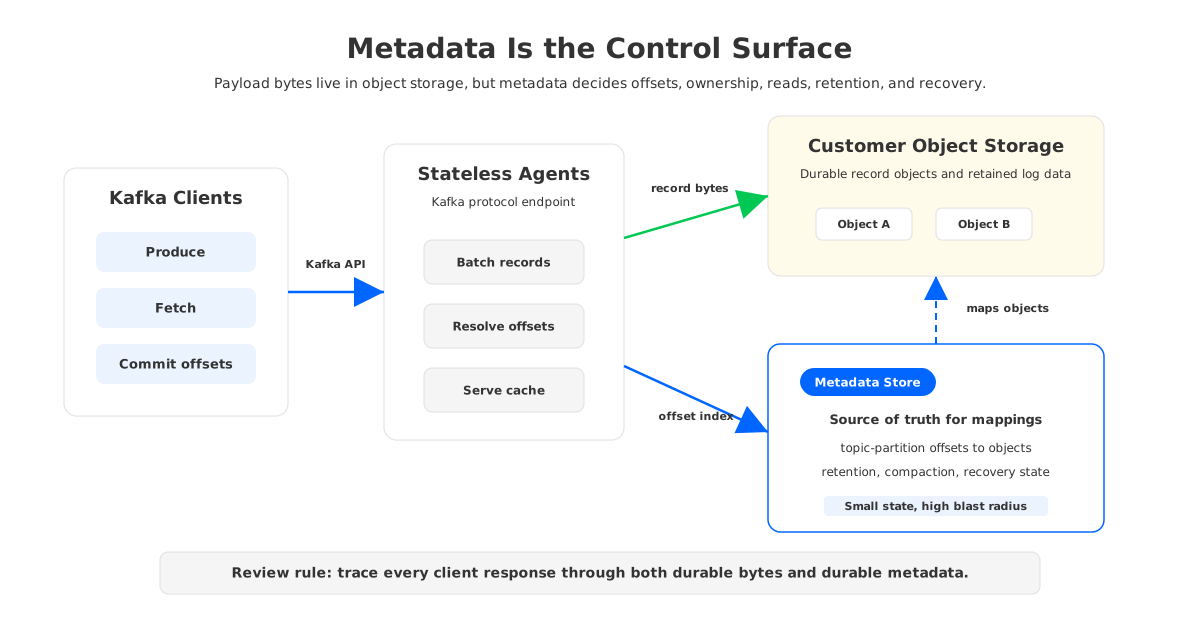
When Kafka teams evaluate object-storage-backed streaming platforms, they often spend most of the review on data placement. That instinct is reasonable: message payloads are the regulated, expensive, high-volume part of the system. But the harder architecture question is usually metadata. Once log segments move to object storage and compute nodes become stateless, the system still needs a source of truth for topic-partition state, offsets, file mappings, consumer coordination, retention, compaction, and operations.
WarpStream's public architecture makes that tradeoff explicit. Its Agents speak the Apache Kafka protocol and run in the customer's environment, while metadata management is separated into WarpStream's cloud metadata store and control plane. The design is not a minor implementation detail. It determines what happens during produce acknowledgments, read path resolution, agent failover, control plane interruption, regional isolation, audit review, and eventual migration away from the platform.
The useful question is not "does WarpStream use a metadata store?" It does. The useful question is what that store means for production ownership. Kafka operators should know which metadata is externalized, what availability promise surrounds it, how metadata latency appears in the request path, who can inspect or export it, and how an exit plan would reconstruct equivalent state elsewhere.
1Why Metadata Matters in Object-Storage Streaming
Apache Kafka began with a simple operational model from the user's point of view: brokers own partitions, partitions are logs, and replicas make those logs durable. The implementation evolved from ZooKeeper-based metadata management to KRaft, where Kafka stores cluster metadata in an internal Raft quorum. Either way, Kafka needs a strongly consistent source of truth for topics, partitions, leaders, configurations, ACLs, consumer group coordination, and transactional state.
Object-storage-backed streaming changes the shape of the problem. If brokers or agents no longer own local disks, a produce request cannot be understood as "append to this broker's log." The system must also record where the new data landed in object storage and which offset ranges now point to which objects. A read request must translate a Kafka offset into object references, cached fragments, and sometimes compacted file layouts. A retention or deletion job must know which objects are still reachable from topic-partition history.
That metadata is small compared with payload bytes, but it is on the critical path of correctness. If object mappings are stale, reads can miss data. If commit metadata is not durable, acknowledged writes become ambiguous. If metadata export is incomplete, migration becomes a reconstruction project instead of a controlled cutover. In a shared-storage design, metadata is the index, the coordination layer, and the operating contract between the Kafka API and the object store.
This is why metadata deserves the same review discipline as storage, networking, and security. A Kafka team should separate five classes of state:
- Kafka control metadata: topics, partitions, configurations, ACLs, leaders, and cluster identity.
- Offset and group metadata: committed offsets, group membership, assignments, and coordination state.
- Object mapping metadata: object names, offset ranges, epochs, snapshots, and compaction lineage.
- Operational metadata: agent health, cache placement, compaction work, retention scanning, metrics, and audit events.
- Commercial or support metadata: account identity, billing dimensions, console actions, support traces, and access logs.
The exact field list varies by platform, and public documentation may not expose every internal detail. That is why the review should ask for a field-level inventory rather than relying on a diagram that says "metadata."
2What WarpStream Docs Say About Metadata
WarpStream's architecture documentation describes three separations: storage from compute, data from metadata, and data plane from control plane. Agents run as a stateless binary that communicates with object storage and WarpStream's Cloud Metadata Store. The docs also describe a Virtual Cluster as the metadata store for WarpStream: a replicated state machine that stores mappings between files in object storage and ranges of offsets in each Kafka topic-partition.
Those statements are important because they explain how WarpStream can make any Agent serve any topic, commit offsets, or coordinate cluster work. The Agent pool can be elastic because the durable source of truth is not broker-local storage. The metadata store and control plane carry the coordination burden that traditional Kafka places in its metadata quorum plus broker-owned logs.
WarpStream also states that Kafka API operations within a Virtual Cluster are atomic, including producing records to multiple topics and partitions. The docs say every Virtual Cluster metadata operation is journaled to strongly consistent log storage before execution and acknowledgment. For an architecture review, that sentence should trigger a direct produce-path question: what parts of the write acknowledgment depend on object storage durability, metadata journal durability, and the Agent-to-cloud path?
The public docs additionally state that the Agent pool runs inside the customer's VPC and that customer data is not sent outside that VPC; metadata about which files belong to a Virtual Cluster is transferred to WarpStream Cloud. That is a useful boundary claim, but it should be treated as the beginning of diligence rather than the end. Teams should ask which metadata fields cross the boundary, whether names such as topics and consumer groups are included, which region stores them, and what retention and deletion controls apply.
2.1Coordination
Coordination is the first production concern because it affects every operational story that sounds simple in a stateless architecture. If any Agent can serve any topic, the platform needs authoritative metadata for routing, offset mapping, compaction assignment, retention scanning, and failure recovery. That metadata layer is not passive catalog storage; it participates in the system's control loop.
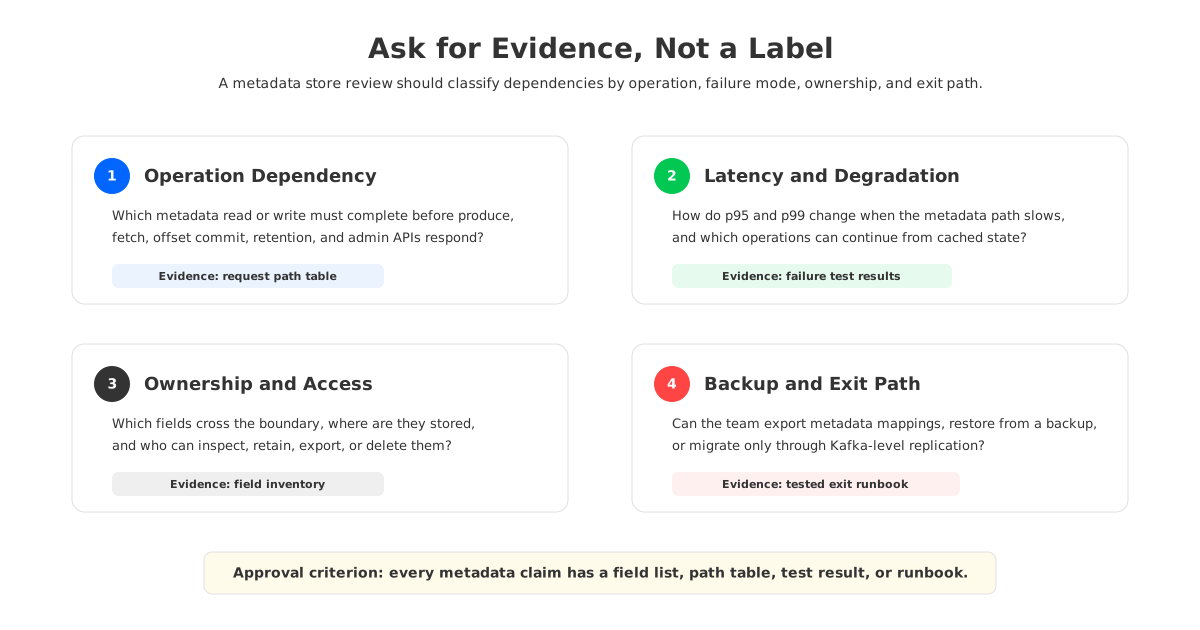
The review should ask how coordination behaves under partial failure. Can existing producers and consumers continue if Agents can reach object storage but cannot reach the metadata service? Are there cached metadata modes, and if so, which operations remain valid? How does the system prevent split-brain behavior when Agents observe different metadata snapshots? How are metadata replicas placed across zones or regions, and what is the recovery time when a replica fails?
Kafka teams should phrase these questions as workload scenarios, not abstract availability requests. For example, "during a control-plane network interruption, can an existing consumer group continue reading already committed data from cache or object storage?" is more useful than "is the metadata service highly available?" The first question exposes the dependency boundary; the second often returns a generic SLA answer.
2.2Availability and Latency
The second concern is latency, especially for write-heavy or request-latency-sensitive workloads. WarpStream's public docs describe a metadata journal step before the Agent acknowledges a client produce request. That does not automatically make the design unsuitable; many distributed systems rely on remote consensus or log storage. It does mean the metadata path is part of the latency model and should be measured alongside object storage API latency, cache hit rate, and batching behavior.
Ask vendors to break down request latency by operation class:
| Operation | Metadata question | Why it matters |
|---|---|---|
| Produce | What metadata commit must complete before acknowledgment? | Determines the tail-latency effect of metadata quorum and network distance. |
| Fetch | When does a read need object mapping lookup versus local cache metadata? | Determines cold-read behavior and catch-up performance. |
| Offset commit | Where is consumer group state persisted and replicated? | Determines failure recovery and migration completeness. |
| Retention | Which metadata decides that an object can be deleted? | Determines data loss risk during compaction and lifecycle work. |
| Admin API | Which topic/configuration changes require cloud metadata writes? | Determines operational dependency during control plane incidents. |
The goal is not to demand zero remote dependency. That would be unrealistic in most managed or BYOC systems. The goal is to know which operations are blocked, degraded, or cached when the metadata path is slow or unavailable. Production readiness depends on knowing the failure mode before the failure happens.
2.3Ownership and Exit Path
The third concern is ownership. Payload records may reside in customer-owned object storage, but object files are not enough to reconstitute a Kafka cluster. A target platform needs topic metadata, partition layout, offset ranges, ordering information, producer state where relevant, consumer offsets, ACLs, configurations, schemas if the platform manages them, and a clean view of which objects are live.
This makes exit planning a metadata problem. If a platform stores object mappings in a vendor-operated metadata service, the buyer should ask whether those mappings can be exported in a documented format, how often backups are taken, whether the customer can trigger a point-in-time export, and what support process is required during termination. If the answer is "use Kafka clients to mirror the data out," that may be acceptable for many teams, but it should be recognized as a data-plane migration, not a metadata-portable exit.
Regulated teams should also ask about classification. Metadata can disclose sensitive context even without message payloads. Topic names, group names, client IDs, partition counts, error samples, and traffic patterns can reveal products, customers, regions, or internal workflow names. A vendor can truthfully say that it does not receive message payloads while still operating metadata that deserves access control, retention, audit, and deletion review.
3A Kafka-Native Comparison Point: KRaft and Object Metadata
The comparison point for WarpStream is not old ZooKeeper-era Kafka. Kafka has moved to KRaft, where cluster metadata is managed by a Kafka-native metadata quorum rather than an external ZooKeeper ensemble. In classic Kafka, this metadata still coordinates broker-owned logs; in a shared-storage architecture, the system must additionally manage object mappings and stream indexes.
AutoMQ belongs to the Kafka-compatible shared-storage category rather than the external-metadata-service category described above. Its documentation says S3Stream replaces Kafka's native log storage with a shared streaming storage layer backed by object storage, making brokers stateless. AutoMQ's S3 storage documentation also states that metadata information of objects on S3 is stored in KRaft. In practical terms, AutoMQ keeps the Kafka control-plane mental model closer to KRaft while adding object metadata needed by S3Stream.
That does not remove the need for review. It changes the review questions. Instead of asking how a vendor-operated Cloud Metadata Store participates in the write path, teams should ask how KRaft quorum sizing, controller placement, object metadata scale, compaction, backup, and recovery are handled. Instead of asking whether object mappings can be exported from an external control plane, they should ask how Kafka metadata and S3Stream metadata are backed up, inspected, and reconstructed in the customer's operating model.
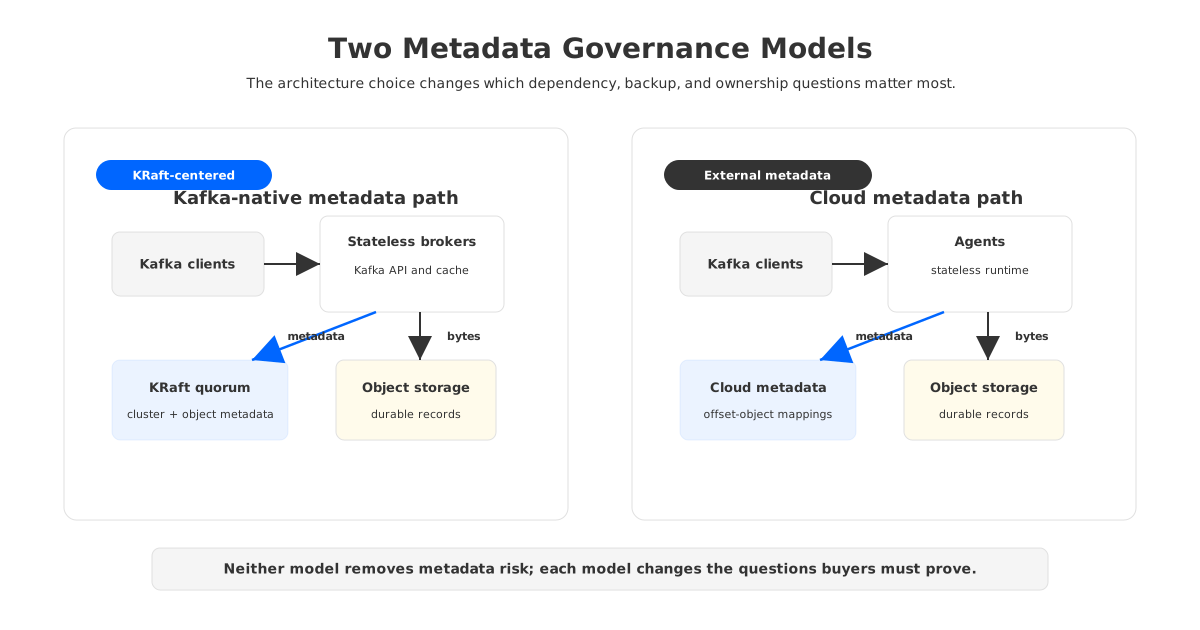
This is the natural place to mention AutoMQ: as a Kafka-compatible, object-storage-backed streaming platform that stores Kafka and object metadata through a KRaft-centered architecture. For teams that want shared storage and stateless brokers while keeping metadata governance aligned with Kafka's native quorum model, that difference is worth evaluating. It is not a universal answer; it is an architectural category that deserves a side-by-side test.
4Architecture Review Checklist
Metadata reviews go better when the team asks for evidence. A vendor architecture diagram is useful, but the approval packet should include runbooks, failure-mode tables, endpoint lists, and export procedures.
Use this checklist before approving production workloads:
- Define metadata scope. List topic names, partition mappings, offset ranges, consumer group state, ACLs, schemas, object names, compaction state, metrics, audit logs, and support traces separately.
- Map residency. Identify which metadata stays in the customer account, which moves to vendor systems, which region stores it, and which subprocessors or support paths can access it.
- Trace acknowledgments. For produce, fetch, offset commit, and admin APIs, document which metadata writes or reads must succeed before the client receives a response.
- Test failure modes. Simulate Agent restart, metadata-service unavailability, object storage slowdown, control-plane network loss, zone failure, and regional impairment where possible.
- Measure latency impact. Capture p50, p95, and p99 latency during normal operation and during metadata-path stress, using representative partition counts and consumer group patterns.
- Validate backup and restore. Ask how metadata replicas are backed up, how restore is tested, what recovery point is possible, and whether the customer receives evidence.
- Review access control. Treat metadata as potentially sensitive. Require role-based access, audit trails, retention limits, and deletion evidence.
- Design the exit path. Decide whether the exit will be metadata export, Kafka-level replication, dual-write, or application replay, and test it before renewal pressure appears.
The key is to avoid turning metadata into a black box. If a team understands the metadata contract, it can make a grounded decision: accept the dependency, mitigate it with architecture and process, or choose a platform whose metadata model better matches its governance requirements.
5References
- WarpStream Architecture
- WarpStream Security and Privacy Considerations
- Apache Kafka Documentation: KRaft
- Apache Kafka Documentation: Replication
- AutoMQ Architecture Overview
- AutoMQ S3Stream Overview
- AutoMQ S3 Storage
6FAQ
6.1Is WarpStream's metadata store the same thing as Kafka KRaft?
No. Kafka KRaft is Kafka's native metadata quorum for cluster metadata. WarpStream's public docs describe a Virtual Cluster and Cloud Metadata Store that manage mappings between object-storage files and Kafka topic-partition offset ranges, alongside other coordination functions. Both solve metadata consistency problems, but they sit in different architecture models.
6.2Does metadata matter if customer payload data stays in object storage?
Yes. Payload residency is only one part of the review. Metadata can affect availability, write acknowledgment, read correctness, retention, support access, audit scope, and migration. It may also reveal business-sensitive context through topic names, group names, client IDs, and traffic patterns.
6.3What should Kafka teams ask first about WarpStream metadata?
Start with the produce path. Ask which object-storage and metadata-store operations must complete before a client receives an acknowledgment. Then ask the same question for fetch, offset commit, retention, and admin APIs. That sequence quickly shows where the metadata dependency is operationally important.
6.4How does AutoMQ differ in metadata architecture?
AutoMQ is also Kafka-compatible and object-storage-backed, but its documentation states that S3 object metadata is stored in KRaft. That keeps the metadata discussion closer to Kafka's native quorum model while adding the object metadata needed by S3Stream. Teams should still review KRaft sizing, object metadata scale, backup, and recovery.
6.5Can a team migrate away from an object-storage-backed Kafka platform by copying objects?
Usually no. Object files alone do not contain the full Kafka operating state in a directly portable form. A migration plan must account for topic configuration, offset mappings, consumer offsets, ACLs, schemas, producer or transaction state when relevant, and the platform-specific metadata that maps Kafka offsets to stored objects.


