
Table of Contents
Table of Contents
A useful WarpStream review should not read like a star rating. Kafka teams are usually asking a harder question: whether a diskless, Kafka-compatible platform can carry their workload, cost model, support process, and migration risk better than the systems already in production. A PoC that starts with benchmark scripts before it defines those questions can generate numbers that look precise and still fail to answer the buying decision.
WarpStream is interesting because it changes the old Kafka operating model in a very specific way. Its documentation describes a diskless Apache Kafka-compatible platform where Agents run in the customer's environment, use object storage such as Amazon S3, Google Cloud Storage, or Azure Blob Storage for data, and rely on a cloud control plane for metadata and coordination. That design can reduce broker-local storage pressure and make BYOC deployment attractive, but it also moves the review from "does Kafka work?" to "which responsibilities moved, who owns them now, and how do they behave under stress?"
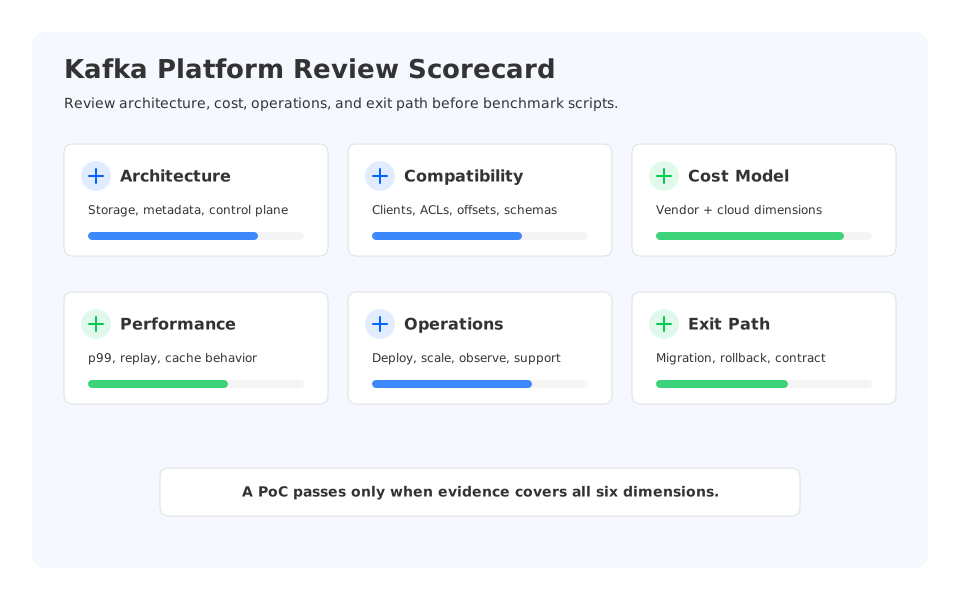
1What to review before adopting any Kafka platform
The first review mistake is treating Kafka compatibility as the end of the conversation. Compatibility matters, but production Kafka is not only a wire protocol. It includes client configuration, topic-level semantics, offset behavior, ACLs, schemas, connector workflows, observability, incident response, Terraform modules, and the patience of every team that gets paged when consumer lag climbs.
A platform review should separate four questions that often get blended together:
| Review layer | Core question | Evidence to collect before the PoC |
|---|---|---|
| Protocol and semantics | Will existing clients and operational assumptions keep working? | Client matrix, topic configs, ACLs, consumer group behavior, transaction and idempotence tests |
| Architecture | What moved from brokers into object storage or a control plane? | Data path diagram, metadata boundary, failure-mode notes, cache behavior |
| Economics | Which dimensions create cost as traffic grows? | Vendor metering, cloud compute, object storage, request operations, network paths |
| Operations | Who can diagnose, repair, upgrade, and migrate the system? | Support scope, telemetry controls, runbooks, upgrade policy, exit plan |
The point is not to slow down evaluation. It is to keep the PoC honest. If the team only measures producer throughput on an empty cluster, it may miss the thing that matters six months later: replay cost, tail latency during cache misses, support visibility during incidents, or the operational steps required to leave.
2WarpStream evaluation framework
WarpStream's architecture deserves a review framework built around its own trade-offs, not a traditional broker checklist copied from self-managed Kafka. In traditional Kafka, each broker owns local log segments and replication moves data among brokers. In WarpStream's model, the Agent is stateless relative to durable log storage, data lives in object storage, and the control plane coordinates metadata. That is the design readers are evaluating, so the PoC questions should follow the design.
Ask architecture questions that force concrete answers:
- Where is the durable copy of record data at every point in the write path?
- Which metadata leaves the customer's environment, and which data never leaves it?
- What happens to producers and consumers when an Agent is restarted, replaced, or isolated from the control plane?
- How does the system behave when object storage has higher latency, throttling, or request errors?
- Which workloads depend on cache warmth, and how long does performance take to recover after a cold start?
Those questions are especially important because object storage is both the economic engine and the new failure surface. It is durable and operationally powerful, but it is not a local NVMe disk. A strong review does not pretend that this trade-off disappears; it checks whether the workload benefits more from diskless elasticity and storage separation than it loses from extra dependency on object storage behavior.
2.1Architecture and compatibility
WarpStream documents Kafka protocol compatibility, but teams should still test compatibility at the feature level. A platform can accept common producer and consumer APIs while still having workload-specific differences around transactions, compaction, offset tooling, admin APIs, connector assumptions, or operational metrics. The uncomfortable part is that the riskiest incompatibilities usually appear in old applications nobody wants to touch.
Build a compatibility matrix from real clients rather than from a generic feature list. Include Java clients, non-JVM clients, Kafka Connect workers, schema registry integration, stream processors, security settings, and admin automation. Then run tests that preserve how those clients actually behave in production: batching, compression, retry settings, long polls, consumer rebalance patterns, and replay volume.
Apache Kafka's own documentation is useful here because it names the semantics that applications may depend on: consumer groups, offsets, idempotent producers, transactions, topic configuration, security, and admin operations. The PoC should turn those semantics into tests. A green result means the application behavior is preserved, not merely that a sample producer can write a message.
2.2Cost and performance
Cost review should start with billing dimensions, then expand into the cloud bill. WarpStream's billing documentation describes BYOC metering across cluster-minutes, uncompressed GiB written, and uncompressed GiB stored, while serverless clusters add compressed GiB written and compressed GiB read. It also documents hourly metering and monthly invoicing in arrears, with custom contracts possible. These are not footnotes; they are the columns of the financial model.
A clean cost model should split vendor charges from cloud infrastructure charges:
| Cost dimension | Why it can surprise teams | PoC measurement |
|---|---|---|
| Cluster-minutes | Idle non-production clusters can become visible over a long contract period | Track active cluster hours by environment |
| GiB written | Ingestion growth can dominate even when retention is stable | Measure uncompressed write volume, not only compressed payload size |
| GiB stored | Retention and compaction policy can change stored logical data | Model retained bytes by topic class |
| Object storage operations | Request volume may rise with replay, small files, or cache churn | Capture storage requests and request-class cost |
| Read fan-out | Catch-up consumers and replays can change cache and egress behavior | Run normal reads plus replay scenarios |
| Network path | BYOC does not automatically mean every byte is free to move | Map AZ, region, VPC, and private connectivity paths |
Performance should be measured as a distribution, not a headline. Averages hide the exact cases Kafka teams care about: p95 and p99 produce latency, consumer catch-up after downtime, behavior during Agent replacement, and latency when reads miss warm cache. If a workload is latency-sensitive, the PoC should state the target before testing. If the workload is throughput- or retention-heavy, the PoC should say that too. The fairest review is the one that admits which dimension matters most.
2.3Operations, support, and exit path
BYOC changes the support boundary. WarpStream's security documentation says raw data for BYOC clusters does not leave the customer's VPC or object storage buckets, while workload metadata required for cluster operation leaves the VPC. It also describes optional controls for logs and profiling data. That boundary is good for data control, but it means support review must ask what the vendor can see, what the customer must provide, and what happens during a production incident when evidence is incomplete.
The support packet should answer practical questions. Who owns Agent upgrades? Which logs and metrics are required for escalation? How are emergency fixes delivered? What is the deprecation policy for APIs, Terraform resources, control plane regions, or deployment modes? After Confluent announced its acquisition of WarpStream in September 2024, and IBM completed its acquisition of Confluent on March 17, 2026, roadmap and escalation ownership became questions buyers should make explicit rather than infer from branding.
Exit path belongs in the same review. Kafka compatibility lowers migration friction, but it does not make migration automatic. A real exit plan covers topic creation, historical data, consumer offsets, producer cutover, consumer cutover, schemas, ACLs, dashboards, alerts, Terraform state, rollback, and contract timing. The team does not need to execute a full migration before a PoC, but it should know what would have to be true for migration to be possible.
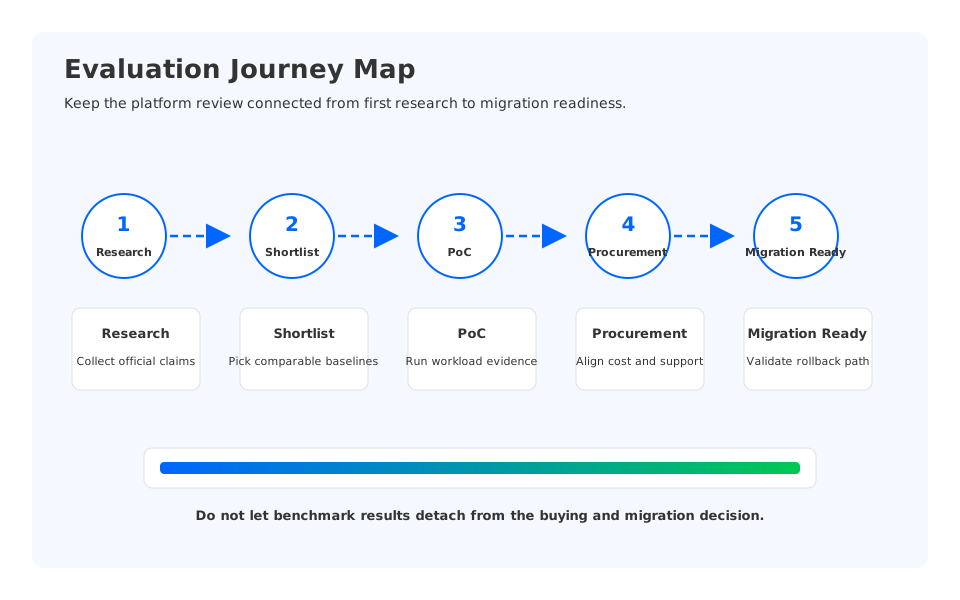
3How to benchmark AutoMQ as an alternative
Once the review reaches architecture categories, AutoMQ fits as a Kafka-compatible, object-storage-backed streaming system to benchmark beside WarpStream and traditional Kafka options. AutoMQ's S3Stream documentation describes a shared stream storage layer that offloads Kafka log storage to object storage, combines WAL storage with object storage, and decouples storage from compute. In plain terms, it belongs in the same broad architectural conversation: Kafka protocol compatibility, cloud storage as the durable layer, and less dependence on broker-local disks.
That does not make AutoMQ an automatic answer. It makes it a useful baseline. If a team is evaluating a diskless or storage-compute-separated Kafka architecture, it should compare alternatives with the same workload, the same success criteria, and the same skepticism. Otherwise, the review becomes a product comparison in name only.
A fair AutoMQ benchmark should use the same tests planned for WarpStream:
- Produce and consume with the real client versions, security settings, and batching configuration.
- Run the normal workload, a replay workload, and a catch-up-after-outage workload.
- Measure p50, p95, and p99 latency instead of relying on average throughput.
- Track vendor charges separately from cloud compute, storage, request, and network costs.
- Test operational actions such as scaling, rolling upgrade, node replacement, alerting, and backup assumptions.
- Validate migration mechanics, including producer switching, consumer switching, offset handling, and rollback.
The useful comparison is not "which platform has the better architecture diagram?" It is whether the architecture changes the team's actual constraints. AutoMQ may be relevant when the team wants Kafka protocol compatibility, BYOC-style data control, object-storage economics, and stateless scaling behavior. WarpStream may still be the right choice for workloads that match its latency, operating, and commercial profile. The PoC should make that distinction visible.
4PoC success criteria
A good PoC has pass/fail criteria before the first cluster is deployed. Without that discipline, every result becomes negotiable: high latency is explained as tuning, unexpected cost is explained as test shape, and operational friction is postponed until production. The review team should write the decision record before running the test, then fill in the evidence.
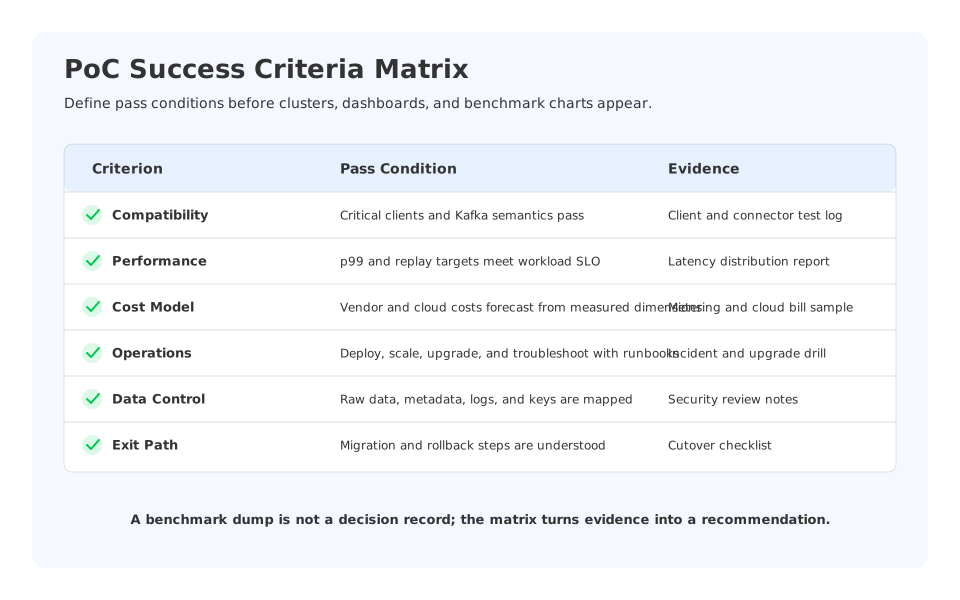
Use a compact scorecard with weighted criteria:
| Criterion | Example pass condition | Why it belongs in the scorecard |
|---|---|---|
| Compatibility | All critical clients, connectors, ACLs, schemas, and topic settings pass | Prevents protocol compatibility from hiding application-level gaps |
| Performance | p99 latency and replay throughput meet the workload target | Aligns the benchmark with user-facing behavior |
| Cost model | Vendor and cloud costs can be forecast from measured dimensions | Makes renewal and growth scenarios explainable |
| Operations | Team can deploy, scale, upgrade, observe, and troubleshoot with defined runbooks | Tests the work humans will do after launch |
| Data control | Raw data, metadata, keys, logs, and support visibility are documented | Converts BYOC claims into security review evidence |
| Exit path | Migration and rollback steps are understood, even if not fully executed | Preserves leverage and reduces future lock-in risk |
Keep the PoC small enough to finish and real enough to matter. One representative workload is better than five artificial microbenchmarks. One replay scenario is better than a dozen dashboard screenshots. One documented failure test is better than a vague confidence score.
The decision should end with a written recommendation, not a benchmark dump. Renew or adopt WarpStream if the evidence shows that the platform fits the workload and the organization can operate it with clear cost and support boundaries. Choose another Kafka-compatible architecture if the evidence points there. Keep traditional Kafka if the new architecture solves a problem the team does not actually have.
For teams that want a second baseline before committing, review the AutoMQ architecture documentation and the AutoMQ migration guide. The best time to test an alternative is before the PoC calendar turns into a procurement deadline.
5References
- WarpStream documentation: Introduction
- WarpStream documentation: Architecture
- WarpStream documentation: Billing
- WarpStream documentation: Security and Privacy Considerations
- Confluent announcement: Confluent Acquires WarpStream
- IBM announcement: IBM Completes Acquisition of Confluent
- Apache Kafka documentation
- AutoMQ documentation: S3Stream Shared Streaming Storage
- AutoMQ documentation: Executing Migration
6FAQ
6.1Is WarpStream a Kafka replacement or a managed Kafka service?
WarpStream is a Kafka-compatible data streaming platform with a diskless architecture built around Agents, object storage, and a control plane. Teams should review it as a Kafka platform alternative, not as a drop-in label swap for every self-managed Kafka deployment.
6.2What should a WarpStream PoC test first?
Start with compatibility and workload shape. Test the real client versions, topic settings, security settings, connector workflows, latency targets, replay behavior, and operational actions that production depends on. Synthetic throughput tests are useful only after those assumptions are clear.
6.3How should teams review WarpStream pricing?
Separate vendor metering from cloud infrastructure costs. For BYOC, review cluster-minutes, uncompressed GiB written, uncompressed GiB stored, object storage operations, compute, network paths, support terms, and growth scenarios by environment.
6.4Does BYOC mean customer data never leaves the environment?
For WarpStream BYOC, the security documentation states that raw data does not leave the customer's VPC or object storage buckets, while workload metadata required for cluster operation leaves the VPC. Teams should confirm the exact metadata, logging, profiling, and support access boundaries during security review.
6.5When should AutoMQ be included in the same evaluation?
Include AutoMQ when the team wants a Kafka-compatible baseline that uses object storage as the durable storage layer and can be tested against the same compatibility, latency, cost, operations, data-control, and migration criteria. It should be evaluated with the same workload evidence as WarpStream.


