
Table of Contents
Table of Contents
Object-storage streaming changes the Kafka cost conversation, but it does not remove the need to model the bill. Traditional Kafka makes teams pay for brokers, disks, replication traffic, and operational headroom. WarpStream changes that shape by moving the data plane toward stateless agents and object storage, then charging for consumption dimensions such as uncompressed data written, uncompressed data stored, and cluster minutes. That can be a very attractive model, especially for teams trying to escape broker-local disk economics.
The catch is not that WarpStream pricing is opaque. Its public pricing page and billing documentation explain the units clearly. The catch is that the units are different from the ones many Kafka teams use in capacity planning. If your internal model starts with compressed network throughput, physical object-store bytes, EC2 instance size, or retained Kafka segment size, you have to translate those numbers before comparing WarpStream with Amazon MSK, Confluent Cloud, self-managed Kafka, or another diskless Kafka option such as AutoMQ.
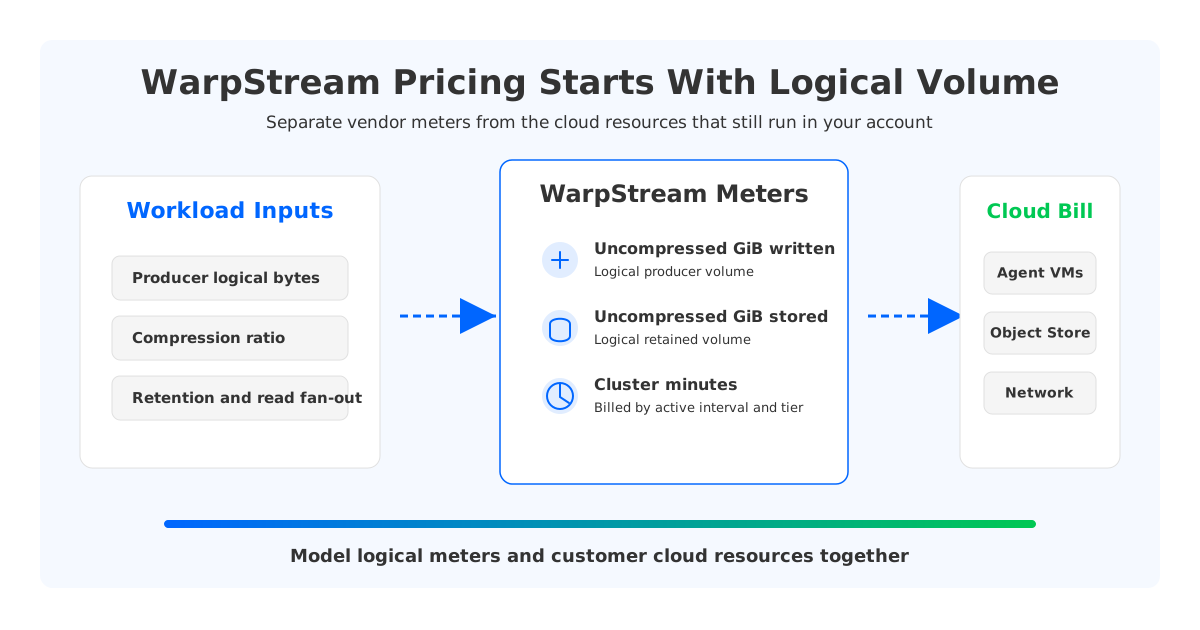
The useful pricing question is not "is WarpStream lower cost than Kafka?" It is "which workload meters line up with my workload, and which costs still sit in my cloud account?"
1What WarpStream Charges For
WarpStream offers a Bring Your Own Cloud model where agents run in the customer's cloud environment and data is stored in object storage such as S3, GCS, or Azure Blob. As of May 20, 2026, WarpStream's public pricing page describes BYOC clusters as being charged for uncompressed writes, cluster minutes, and storage, with the customer-managed data plane also carrying infrastructure costs such as agent VMs, object-store API calls, and object-store capacity. The exact unit prices and tiers should be checked on the live pricing page before procurement, because pricing pages change.
The core metered dimensions are:
- Uncompressed GiB written. WarpStream meters write throughput based on logical data volume before compression. Its billing documentation says the
Uncompressed GiB writtenmetric uses tiered pricing, with tier thresholds based on cumulative monthly volume written to a single cluster. - Uncompressed GiB stored. Storage is also modeled as logical data volume, not the compressed physical bytes that may land in object storage. This matters when retention is high or compression ratios vary by topic.
- Cluster minutes. WarpStream's pricing page describes cluster minutes as billed in 15-minute increments for intervals where the cluster receives requests, with prices varying by cluster tier.
- Customer cloud infrastructure. In BYOC, the agents, object storage, object-store API requests, and network paths are still cloud resources in the customer's account. They are not free just because the vendor bill moved to consumption units.
- Add-ons and operating boundary. Dedicated control-plane cells, private networking, self-managed control plane options, audit logs, and adjacent products such as Tableflow have their own pricing or sales-led terms.
This shape is different from broker-based Kafka pricing. A broker-based model often starts with provisioned broker count, broker class, attached storage, partition count, throughput ceilings, inter-zone traffic, and support. WarpStream's model starts with logical write and storage volume, then adds the customer-side resources needed to run the data plane. The first model asks "how many brokers and disks do I need?" The second asks "how much logical data do I write and retain, and what infrastructure does that generate?"
2Why Uncompressed GiB Matters
Kafka teams usually care deeply about compression. A topic compressed with LZ4, ZSTD, Snappy, or GZIP can reduce network transfer, disk footprint, object-store footprint, and consumer egress. In traditional Kafka, compressed batches are written to disk in compressed form, so many internal cost models are built around physical bytes. WarpStream intentionally meters key dimensions on uncompressed logical bytes, which makes the bill less sensitive to the compression algorithm but more sensitive to raw event volume.
That tradeoff is not automatically good or bad. It depends on the workload. A clickstream topic with repetitive fields may compress far better than an image metadata stream or encrypted payload. Under an uncompressed billing unit, both workloads are modeled by their logical volume first, even if their physical object-store footprints differ significantly after compression.
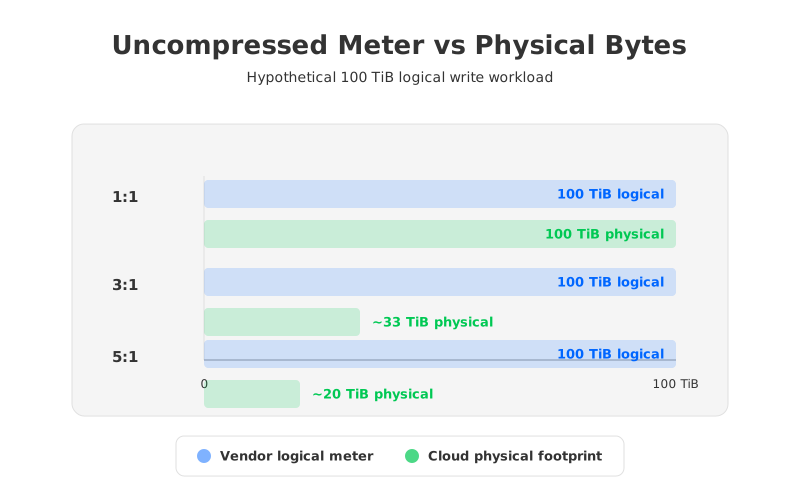
Consider a hypothetical producer workload that writes 100 TiB of logical data in a month. If the workload compresses 1:1, 3:1, or 5:1, the physical bytes sent or stored after compression can be very different. The uncompressed metering basis stays anchored to 100 TiB for the vendor write metric, while the customer cloud bill for object storage and network may still reflect compressed physical bytes, API request shape, and cloud-region pricing.
| Workload assumption | Logical data written | Physical data at rest after compression | What the WarpStream write meter sees | Why it matters |
|---|---|---|---|---|
| 1:1 compression | 100 TiB | About 100 TiB | 100 TiB uncompressed | Logical and physical models are close |
| 3:1 compression | 100 TiB | About 33 TiB | 100 TiB uncompressed | Object storage may shrink faster than the vendor write unit |
| 5:1 compression | 100 TiB | About 20 TiB | 100 TiB uncompressed | Compression helps cloud resources, but not the logical write meter |
These numbers are not a WarpStream quote. They are a worksheet example for understanding how logical and physical volume diverge. The real bill depends on the live WarpStream tier, cluster tier, object-store region, object-store request pattern, agent sizing, read volume, retention, private networking, support terms, and any negotiated agreement.
The practical implication is simple: use the same source workload twice. First calculate logical GiB written and retained because that maps to WarpStream's billing language. Then calculate compressed GiB, request count, and network path because that maps to your cloud bill. A single "Kafka throughput" number is too ambiguous for a clean comparison.
3BYOC Does Not Mean Cost-Free Infrastructure
BYOC is often described as a middle ground between SaaS and self-managed infrastructure. The vendor operates or manages important parts of the platform experience, while the data plane runs closer to the customer's cloud boundary. That can improve data locality, procurement fit, and security posture. It also means the buyer has two bills to reason about: the vendor service bill and the cloud provider bill.
For WarpStream, the cloud-provider side usually deserves the same attention as the vendor-side meter:
- Agent compute. Stateless agents still need CPU, memory, and network capacity. Workloads with high ingress, high fan-out, or low-latency requirements may need different instance shapes than a retention-heavy logging workload.
- Object storage capacity and API calls. Object storage is usually far lower cost per GiB than block storage, but request rates, compaction behavior, retention, and storage class choices still affect cost.
- Networking. BYOC can keep data in the customer's cloud account, but traffic still follows real network paths. Inter-zone traffic, private connectivity, cross-region replication, and consumer placement should be modeled explicitly.
- Control-plane and metadata boundary. Some BYOC offerings keep raw data in the customer's environment while a vendor-managed control plane or metadata service remains outside. That may be fine, but it should be a security and reliability decision rather than an assumption.
The Confluent context also matters. Confluent announced the WarpStream acquisition on September 9, 2024, positioning WarpStream as a BYOC option between Confluent Cloud and Confluent Platform. IBM completed its acquisition of Confluent on March 17, 2026. For buyers, that does not change the arithmetic of uncompressed GiB, but it does change vendor due diligence: support path, roadmap ownership, contract entity, and integration direction are worth checking during evaluation.
4How to Compare WarpStream with AutoMQ and Kafka
WarpStream, AutoMQ, and traditional Kafka can all be part of a Kafka replacement conversation, but they optimize different parts of the architecture. A fair comparison starts by separating three layers: protocol compatibility, storage architecture, and billing unit.
Traditional Apache Kafka keeps the log on broker-attached storage and replicates data across brokers for durability and availability. Tiered storage can move older segments to object storage, but the primary storage and replica mechanics still shape scaling, rebalancing, and hot data cost. WarpStream takes a diskless approach with stateless agents and object storage as the storage foundation. AutoMQ also follows a diskless Kafka direction, but it keeps Kafka-native compatibility while replacing Kafka's log storage with S3Stream, a shared storage layer that uses object storage as the primary repository and WAL options for write acceleration and recovery.
AutoMQ's pricing model is also worth separating from its architecture. As of May 20, 2026, AutoMQ's usage-based BYOC documentation describes metering for data ingress, data egress, data retention, and cluster uptime in AWS environments, with data volume metrics measured after compression. Its public pricing page lists unit ranges and an example calculation based on compressed data volumes. That difference is important for compression-heavy workloads: WarpStream's main write and storage units are described as uncompressed logical volume, while AutoMQ's usage-based BYOC docs describe ingress, egress, and retention as compressed data size.
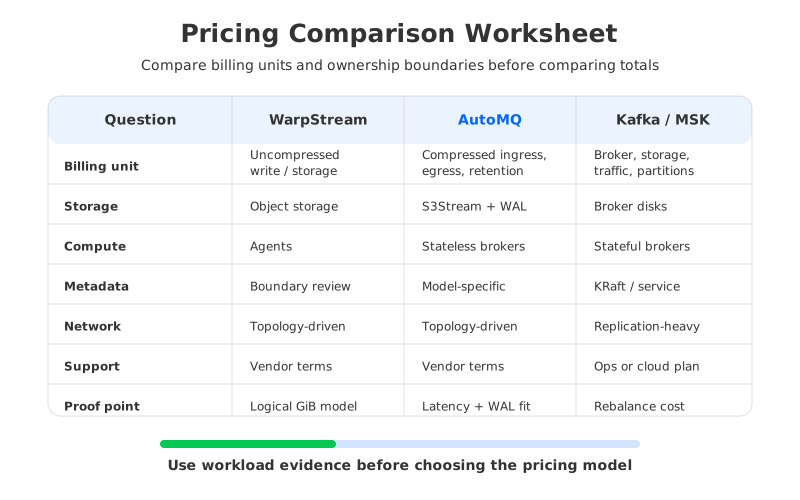
The deeper architectural question is latency and workload fit. Object storage is durable and elastic, but it is not a low-latency local disk. WarpStream addresses this with agents, object-storage design, and optional low-latency deployment choices. AutoMQ addresses the object-storage latency problem with WAL storage in front of object storage. Its WAL documentation describes WAL as the component that provides low-latency persistence writes and failure recovery for data not yet uploaded to S3, with multiple storage media options such as Regional EBS, S3 WAL, and NFS WAL depending on deployment and workload requirements.
That makes the comparison less about slogans and more about workload evidence:
| Question | WarpStream evaluation angle | AutoMQ evaluation angle | Broker-based Kafka angle |
|---|---|---|---|
| Billing unit | Uncompressed written and stored GiB, cluster minutes, add-ons, customer cloud resources | Compressed ingress, egress, retention, cluster uptime, customer cloud resources in usage-based BYOC | Broker hours, storage, partition limits, replication traffic, operational labor |
| Storage design | Stateless agents with object storage | S3Stream shared storage with WAL acceleration and object storage as primary storage | Broker-local storage, often with optional tiered storage for older data |
| Kafka compatibility | Kafka-compatible service with BYOC positioning | Kafka-compatible platform designed to reuse Kafka clients and ecosystem tooling | Native Kafka, highest ecosystem familiarity |
| Latency fit | Validate agent sizing, object-store path, and low-latency options under workload | Validate WAL option, object-store path, and consumer behavior under workload | Validate broker, disk, ISR, and rebalancing behavior under workload |
| Operating boundary | Data plane in customer cloud; control-plane and add-on boundaries need review | BYOC and software options; control plane, data, and metadata boundary depends on selected model | Fully self-managed or managed by a cloud provider |
No pricing article can decide this for every team. A write-heavy observability workload with strong compression, many partitions, long retention, and relaxed latency has a different answer from a payment event stream with tight p99 latency, modest compression, and strict isolation requirements. The right comparison uses your own workload distribution, not an average Kafka benchmark.
5Workload Worksheet
A good WarpStream pricing worksheet starts with the Kafka facts you already have, then converts them into billing and infrastructure dimensions. Pull the last 30 to 90 days of metrics if you can; one peak-day snapshot often overstates or understates the steady-state bill.
Use these fields as the minimum model:
- Logical write volume. Measure uncompressed producer bytes by topic or workload class. If you do not already capture this, estimate from event count and average uncompressed payload size, then mark it as an estimate.
- Compression ratio. Track the ratio between logical bytes and compressed bytes for each major topic family. Do not use one global compression ratio for CDC, logs, metrics, and business events.
- Retention profile. Separate short-retention hot topics from long-retention audit, observability, or replay topics. Storage pricing behaves very differently across these groups.
- Read fan-out. Consumer count and replay behavior affect network, cache, object-store access, and latency. A topic read once is not the same as a topic read by 20 independent services.
- Latency envelope. Model p50, p95, and p99 expectations by workload. Object-storage-native systems should be tested against the real latency SLO, not only average throughput.
- Cloud placement. Identify regions, availability zones, private connectivity, cross-region replication, and where consumers run. Network cost often hides in topology, not in the Kafka service line item.
- Operational boundary. Decide who owns upgrades, incident response, agent sizing, object-store configuration, metadata/control-plane availability, and support escalation.
Once those fields are filled, the pricing comparison becomes much calmer. WarpStream can be evaluated on its public uncompressed GiB and cluster-minute model. AutoMQ can be evaluated on compressed data volumes, cluster uptime, WAL/storage options, and Kafka compatibility. Traditional Kafka or MSK can be evaluated on broker capacity, storage, replication, and operational overhead. The output is not a universal winner; it is a workload-specific cost and risk map.
6Sources
- WarpStream pricing
- WarpStream billing documentation
- WarpStream compression documentation
- WarpStream reducing infrastructure costs
- Confluent blog: Confluent + WarpStream, September 9, 2024
- IBM announcement: IBM and Confluent announce real-time data capabilities after acquisition completion, March 17, 2026
- AutoMQ usage-based billing
- AutoMQ pricing
- AutoMQ WAL storage
- AutoMQ stateless broker
7FAQ
7.1Does WarpStream charge for compressed or uncompressed data?
WarpStream's pricing and billing documentation describe key write and storage metrics as uncompressed logical data volume. That means teams should model uncompressed GiB written and retained, then separately model compressed physical bytes for customer-side cloud resources such as object storage and network.
7.2Is uncompressed GiB pricing bad for compressed workloads?
Not automatically. Uncompressed metering can make the vendor bill less sensitive to compression algorithm changes, but it also means high compression does not reduce the logical write meter in the same way it may reduce physical storage or network bytes. Compression-heavy workloads need an explicit logical-versus-physical model before comparison.
7.3What cloud costs remain in WarpStream BYOC?
The customer cloud account still pays for resources such as agent compute, object storage capacity, object-store API requests, and network paths. Private networking, cross-region traffic, low-latency storage choices, audit logs, and add-ons can also affect the full TCO.
7.4How is AutoMQ pricing different from WarpStream pricing?
As of May 20, 2026, AutoMQ's usage-based BYOC documentation describes data ingress, data egress, and data retention as measured after compression, while WarpStream describes write and storage metrics as uncompressed logical volume. The platforms also differ architecturally, so buyers should compare billing units, storage design, latency path, operating boundary, and Kafka compatibility together.
7.5Can I compare WarpStream and MSK using only monthly write throughput?
No. Write throughput is necessary, but it is not enough. Add retention, read fan-out, compression ratio, partition count, latency SLO, inter-zone traffic, object-store requests, cluster tier, support terms, and migration overlap. Kafka pricing mistakes usually come from compressing all of those variables into one throughput number.


