
Table of Contents
Table of Contents
When a team searches for WarpStream pricing, the real question is rarely "what is the sticker price?" The more useful question is whether an object-storage-first Kafka architecture will make the monthly bill easier to model than the Kafka estate it might replace. That requires separating the vendor bill from the cloud bill, and then separating both from the operational costs that show up as rebalancing time, over-provisioned capacity, incident handling, and procurement risk.
WarpStream's public pricing page makes one point very clear: the commercial model is not the same as buying raw object storage. As of May 27, 2026, the public page shows plan tiers with monthly minimums and feature boundaries, and it also describes usage dimensions such as uncompressed data written, uncompressed data stored, cluster minutes, and query-related usage. For BYOC, the customer also pays the cloud provider for compute, object storage, object API requests, and any relevant network transfer. For Serverless, some of those infrastructure concerns are abstracted by the service, but the workload dimensions still matter.
That is the central budgeting trap. Object storage can remove major cost centers from traditional Kafka, especially broker-local disk pressure and replication-heavy capacity planning. It does not make the platform cost collapse into one S3 line item. A credible estimate needs a workload model.
1What Pricing Pages Usually Include and Exclude
Public pricing pages are optimized for comparison, not final procurement. They expose commercial units such as base tier, included limits, metered dimensions, support level, SLA, and quote-only enterprise features. They usually do not include every cloud-provider charge in a BYOC account, every security or observability dependency, or the labor cost of operating production streaming.
For WarpStream, the public materials create two buckets that should stay separate in a spreadsheet:
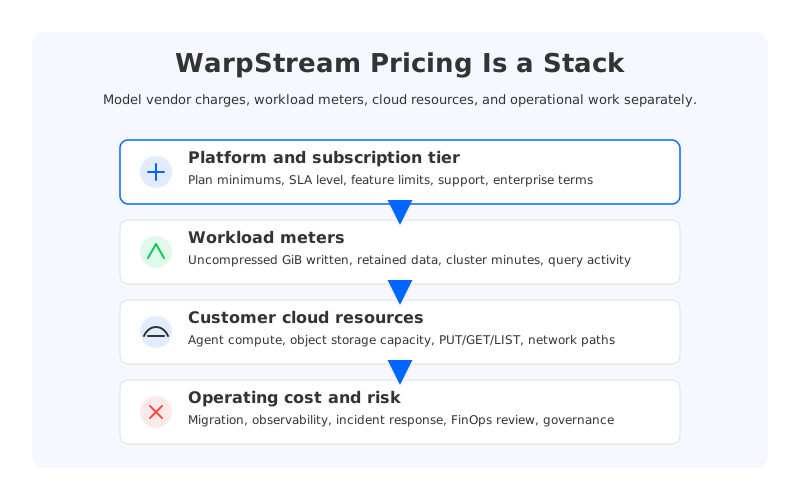
- WarpStream-controlled charges: plan or cluster tier, usage-based units, support, SLA tier, and any commercial features tied to the subscription.
- Customer cloud charges: virtual machines or containers for agents, object storage capacity, object storage requests, network transfer, private connectivity, logging, metrics, and any auxiliary infrastructure.
- Internal operating cost: platform engineering time, incident response, FinOps review, security review, migration testing, and ongoing workload governance.
The boundary matters because BYOC can be excellent for data control while still requiring cloud-cost literacy. A log analytics workload with high write volume and long retention stresses storage and writes. A serving workload with short retention but high fanout stresses reads, cache behavior, and network placement. Cost modeling has to start with workload physics, not a vendor name.
2The Main WarpStream Cost Drivers
The useful mental model is a stack, not a single formula. At the top is the commercial plan. Under it sit workload meters. Under those sit cloud resources sensitive to object count, request pattern, placement, and retention. At the bottom are operational choices that decide whether the architecture is used efficiently.
| Cost driver | What to measure | Why it changes the bill |
|---|---|---|
| Write volume | Average and peak MiB/s, compression ratio, monthly GiB written | Usage meters and object storage writes scale with ingest. |
| Retention | Hours or days retained per topic class | Stored GiB-month grows with write rate and retention window. |
| Read fanout | Consumer groups, catch-up reads, replay frequency | Reads can affect request volume, egress, and compute. |
| Object storage requests | PUT, GET, LIST, lifecycle, metadata-sensitive operations | Cloud object stores charge per request class, not only per GiB stored. |
| Compute | Agent size, count, autoscaling floor, headroom | BYOC data-plane resources run in the customer's cloud account. |
| Network | AZ placement, region placement, PrivateLink, replication | Data transfer can reappear if placement is not designed carefully. |
| Operations | SLO, support tier, monitoring, migration, governance | A low invoice can still be costly if it creates incident load. |
2.1Platform and Billing Units
WarpStream's public pricing currently distinguishes plan tiers and metered usage. The page lists Dev, Fundamentals, Pro, and Enterprise-style tiers, with higher tiers adding stronger SLA targets and larger limits. It also describes units such as cluster minutes and uncompressed data written or stored. Those units decouple the vendor bill from the exact VM shape but keep it tied to workload volume and uptime.
Uncompressed units deserve special attention. Many Kafka teams think in compressed broker bytes because clients often compress batches before they reach the broker. If a pricing unit is based on uncompressed data, the budgeting input must match that definition. Before comparing vendors, normalize every candidate to the same basis: compressed client bytes, uncompressed logical bytes, retained physical bytes, or billable metered bytes.
Cluster minutes are also easy to underweight. For always-on production systems, uptime is close to a fixed monthly floor. For dev, test, or bursty analytics, the ability to scale down or stop environments can matter as much as the per-GiB rate. A cluster that is lightly used but always running can have a very different cost profile from a high-throughput job that runs during defined windows.
2.2Object Storage, Storage Requests, and Retention
Object storage can reduce retained-data cost and decouple retention from broker sizing, but the bill has more than one line item. AWS S3 pricing, for example, charges for storage by class and region, and also charges for request classes such as PUT, COPY, POST, LIST, GET, SELECT, lifecycle transitions, and retrievals where applicable.
That request dimension is why object layout matters. A system that writes many small objects, performs frequent metadata scans, or repeatedly replays cold data can create a different request profile from one that batches data into larger objects. Buyers should ask which workload metrics drive object creation, GET volume, and LIST or metadata operations.
Retention should be modeled as a rolling average rather than a static storage number. A simple estimate is:
retained GiB = average write MiB/s x 3600 x retention hours / 1024
Then adjust it for the pricing definition. If the vendor meters uncompressed retained data, use logical input. If the cloud provider bills compressed physical objects, estimate physical bytes. If multi-region storage is enabled, model each region explicitly.
2.3Compute and Networking
WarpStream's BYOC architecture uses agents running in the customer's cloud account. Compute is therefore part of the infrastructure bill. A production estimate should include a minimum running floor, peak scaling behavior, instance family assumptions, and any Kubernetes or orchestration overhead.
Networking is where teams often expect object-storage-first architectures to save money. Traditional Kafka replicates partition data across brokers, and multi-AZ deployments can generate cross-AZ transfer when leaders, followers, producers, and consumers are not co-located. Apache Kafka's documentation describes replication as the mechanism for fault tolerance: each partition has replicas, one leader, and followers that copy the leader's log.
WarpStream positions its architecture as avoiding some traditional Kafka inter-AZ replication cost by using object storage as the durable layer. That does not mean all networking is free. Client placement, object storage endpoint placement, PrivateLink or equivalent connectivity, cross-region replication, and disaster recovery design can still create network charges.
3How to Estimate TCO From Workload Metrics
A useful TCO worksheet starts with metrics the platform team can observe: write rate, read rate, retention, topic count, partition count, consumer fanout, availability requirements, and deployment geography. Once those are stable, pricing becomes a translation exercise instead of a guessing exercise.
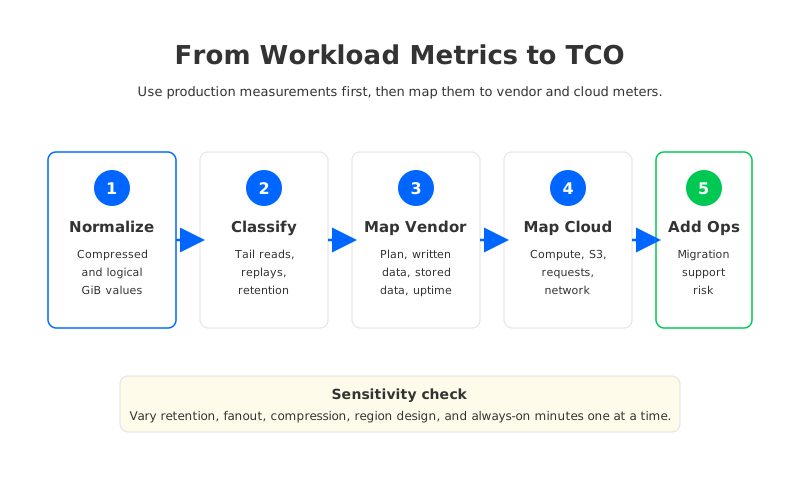
Use this five-step sequence:
- Normalize data volume. Record average write MiB/s, peak write MiB/s, compression ratio, monthly written GiB, average retained GiB, and replay volume. Keep compressed and uncompressed values in separate columns.
- Classify workload behavior. Separate tailing consumers from replay-heavy consumers, short-retention topics from long-retention topics, and production traffic from dev/test traffic.
- Map vendor meters. Apply the current WarpStream pricing units: plan tier, cluster minutes, written data, stored data, query or analytics usage, and feature tier.
- Map cloud meters. Add compute, object storage capacity, object requests, network transfer, private connectivity, monitoring, and log retention in the customer account.
- Add operating assumptions. Include migration effort, support tier, incident response expectations, on-call ownership, and cost governance work.
For example, assume a workload writes 60 MiB/s on average, retains 168 hours, and reads at 2x fanout. The retained-data estimate before compression adjustments is about 35,438 GiB:
60 MiB/s x 3600 sec/hour x 168 hours / 1024 = 35,437.5 GiB
That number is not a quote. It is a sizing anchor. A real estimate must then decide whether the billable retained unit is compressed or uncompressed, whether additional copies exist for multi-region durability, how many requests the object layout creates, and how much compute is required at the target latency.
The worksheet should also expose sensitivity. Change one variable at a time: retention from 7 days to 30 days, fanout from 2x to 6x, compression from 4:1 to 2:1, single-region to multi-region, dev tier to production tier. Large swings reveal the variables that deserve negotiation, benchmarking, or redesign.
4How AutoMQ Approaches Cost Modeling
The broader category here is Kafka-compatible streaming on shared object storage. WarpStream is one implementation. AutoMQ is another: it keeps Kafka protocol compatibility while moving durable stream storage to S3-compatible object storage and using stateless brokers so compute can scale without tying each partition's durable data to broker-local disks. In AutoMQ BYOC, cloud infrastructure and managed service fees can be modeled separately, which helps FinOps review.
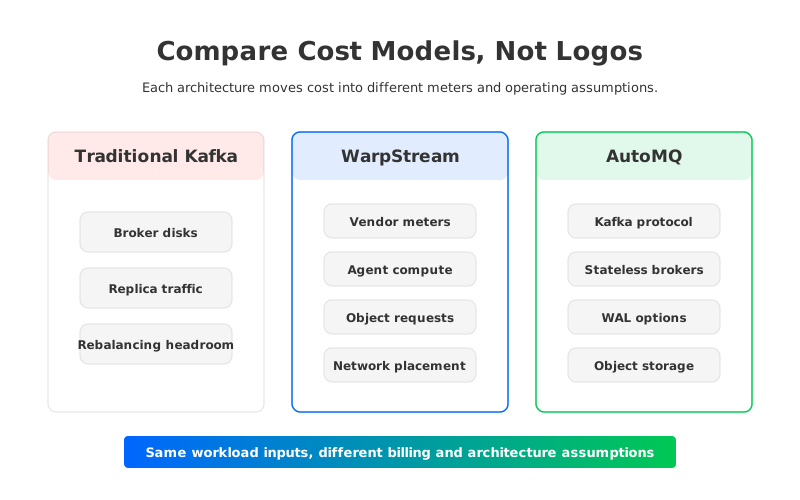
AutoMQ's public pricing page uses workload inputs such as write throughput, read throughput, retention, availability-zone mode, and cluster tier. It also exposes unit-price concepts for data ingress, data egress, data retention, and cluster uptime. That does not replace workload analysis; it means the estimate can be built from primitives Kafka teams already track.
The architectural distinction is not "object storage versus no object storage." It is how each system turns object storage into a streaming data plane. Ask concrete questions:
- Does the system meter compressed or uncompressed bytes?
- What local or cloud-disk write-ahead log is used, if any, and who pays for it?
- How are small writes aggregated into objects?
- Which reads hit memory, local cache, WAL, or object storage?
- What happens to cost during broker, agent, or node replacement?
- Which control-plane and data-plane components run in the customer account?
- How does multi-AZ or multi-region design affect data written, data stored, and network transfer?
This is where AutoMQ should enter the evaluation: as a shared-storage Kafka-compatible architecture with a different broker, WAL, and scaling model to benchmark against the same workload. If your current cost pain is mostly broker-local disk, cross-AZ replication, slow partition reassignment, and idle headroom, AutoMQ belongs in the same evaluation set as WarpStream. If your pain is connector licensing, stream processing, or governance, include those platform requirements too.
5A Practical TCO Worksheet
The worksheet below is vendor-neutral. Fill it once, then apply it to WarpStream, AutoMQ, self-managed Kafka, Confluent Cloud, Amazon MSK, or any other candidate. The goal is to make differences visible.
| Worksheet field | Input to collect | Notes for pricing review |
|---|---|---|
| Average write throughput | MiB/s | Capture compressed and uncompressed values. |
| Peak write throughput | MiB/s | Drives compute headroom and scaling limits. |
| Average read throughput | MiB/s | Include fanout and replay jobs. |
| Retention by topic class | Hours or days | Separate hot operational topics from archive-like topics. |
| Partitions and topics | Count | May affect limits, metadata, and operational overhead. |
| Availability target | SLA/SLO | Determines tier, region, AZ, and support requirements. |
| Deployment geography | Region, AZ, multi-region | Drives network and replication assumptions. |
| Object storage profile | GiB-month, PUT/GET/LIST | Ask for expected request behavior, not only storage capacity. |
| Compute floor | Instance count and size | Include always-on minimums and autoscaling policy. |
| Migration and ops | Engineer weeks, runbooks | Include cutover, validation, observability, and rollback planning. |
Two practices keep this worksheet honest. First, make every formula visible; hidden replication, compression, or network assumptions create trouble later. Second, keep a source column next to every price because public pricing, private quotes, discounts, and marketplace offers age at different speeds.
6Decision Checklist
Before using WarpStream pricing in a budget request, ask these questions in order:
- Which plan tier or enterprise contract is required for the SLA, partition count, private connectivity, and support response the production workload needs?
- Are written and stored data measured as compressed bytes, uncompressed bytes, or another billable representation?
- What cloud resources run in the customer account, and which team owns their scaling policy?
- How many object storage requests should the workload generate under steady state, catch-up reads, and replay-heavy incidents?
- What network paths remain billable after removing traditional broker-to-broker replication?
- How does the estimate change for multi-region HA, disaster recovery, or data residency?
- What happens to cost during migration, dual-write, backfill, and rollback windows?
- Which dimensions are negotiable through committed use, marketplace private offers, or enterprise terms?
If the answers are vague, treat the model as incomplete. The next step is a representative proof of concept with object storage request metrics, compute utilization, p95/p99 latency, catch-up read behavior, and failure recovery in the measurement plan.
7References
- WarpStream Pricing
- WarpStream Billing Reference
- AWS S3 Pricing
- AWS EC2 On-Demand Pricing and Data Transfer
- Apache Kafka Documentation: Replication
- Confluent Completes Acquisition of WarpStream
- AutoMQ Pricing
- AutoMQ Documentation Overview
8FAQ
8.1Is WarpStream priced only by object storage usage?
No. Object storage is an important infrastructure component, especially for BYOC deployments, but public WarpStream pricing also includes commercial plan and usage dimensions. A realistic estimate should include vendor charges, customer cloud infrastructure, object storage requests, network placement, and operational cost.
8.2Why does uncompressed data matter in a pricing model?
Kafka teams often observe compressed bytes on the wire or on disk. If a vendor meters uncompressed written or stored data, the billable volume can differ from the compressed physical volume. Always keep compressed, uncompressed, and retained physical bytes in separate worksheet columns.
8.3Can object storage remove cross-AZ Kafka replication cost?
It can reduce or remove specific broker-to-broker replication patterns associated with traditional Kafka, depending on the architecture. It does not automatically remove every data transfer charge. Client placement, private connectivity, cross-region replication, and replay paths still need to be modeled.
8.4How should I compare WarpStream and AutoMQ pricing?
Start with the same workload inputs: write throughput, read fanout, retention, partition count, latency target, availability target, and deployment geography. Then map each product's public pricing units and cloud infrastructure requirements to those inputs. The comparison is only meaningful if both models use the same compression and retention assumptions.
8.5What is the fastest way to make a reliable estimate?
Build a worksheet from production metrics, then run a proof of concept with the same workload shape. Track vendor meters, cloud compute, object storage capacity, object storage request counts, network transfer, latency, recovery behavior, and operator time. Pricing pages start the estimate; measured workload behavior finishes it.


