
Table of Contents
Table of Contents
A regulated Kafka review rarely fails because a vendor says the wrong thing in a high-level architecture deck. It fails because the deck does not answer a more concrete question: which data artifacts leave the customer's environment, who can access them, how long they persist, and what evidence proves the answer? That question matters for financial services, insurance, healthcare, public sector, and any platform team that has to explain event streaming infrastructure to security, audit, procurement, and legal teams.
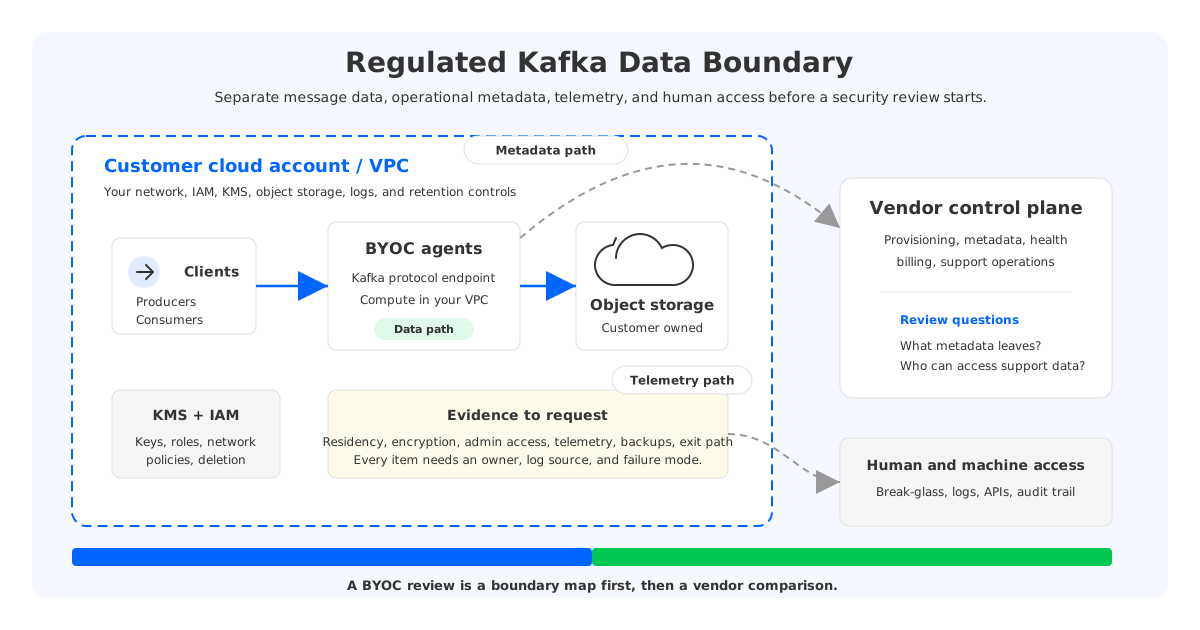
WarpStream is attractive in that conversation because it was built around a BYOC model and an object-storage-based architecture. Its documentation describes agents running in the customer's VPC, with original Kafka records written to customer-owned object storage and not transferred to the WarpStream control plane. It also states that workload metadata is stored in a control plane region, and that no PII should be included in that metadata. Since Confluent announced its acquisition of WarpStream in 2024, and IBM completed its acquisition of Confluent on March 17, 2026, security reviewers should also treat the vendor and support boundary as part of the diligence packet, not as an implementation footnote.
The practical takeaway is not that BYOC is unsafe. It is that BYOC changes the review. Instead of asking only whether a provider runs Kafka for you, the review has to classify message data, metadata, telemetry, support access, backups, deletion, and exit artifacts separately.
1Why BYOC Is Attractive for Regulated Kafka Workloads
Traditional managed Kafka services usually optimize for operational convenience: the provider owns the service plane, automates broker operations, and exposes a managed endpoint. That model can be acceptable for many workloads, but regulated environments often care about the placement and control of the infrastructure itself. A platform team may need private networking, customer-owned object storage, customer-managed encryption keys, strict IAM boundaries, region-specific retention, and audit trails for human support access.
BYOC, short for bring your own cloud, tries to close that gap. The vendor operates or orchestrates software while the workload runs in infrastructure controlled by the customer. For Kafka-like systems, that can mean the compute plane lives in the customer's VPC and durable records land in the customer's object storage account. This is especially relevant for architectures such as WarpStream and AutoMQ, which use object storage as the durable storage layer rather than treating broker-local disks as the primary persistence boundary.
The difference is architectural, but it is not magic. A BYOC product can reduce the amount of regulated payload data that leaves a customer account while still requiring some control plane communication, telemetry, metadata, billing data, upgrade coordination, or support workflow. A security review should therefore avoid the lazy version of the question: "Is it BYOC?" The useful version is: "Which exact artifacts are customer-controlled, which exact artifacts cross the boundary, and what controls govern each one?"
That framing also keeps the comparison fair. Apache Kafka itself provides security capabilities such as TLS encryption, SASL authentication, ACL-based authorization, and pluggable authorizers, but the operating model determines where keys, logs, brokers, disks, metadata, and operational access actually live. A Kafka-compatible platform can preserve client behavior while changing the storage and operations boundary; auditors still need to inspect the new boundary.
2The Security Questions to Ask
Security teams usually ask for policies. Platform teams should answer with a map. For regulated Kafka workloads, the map should divide the environment into at least four zones: customer runtime, customer durable storage, vendor control plane, and vendor support or operations access.
2.1Data and Metadata Residency
Start with message payloads because they carry the highest business risk, but do not stop there. WarpStream's security documentation says agents run in the customer's VPC and that original customer data stored in customer object storage is not transferred to the WarpStream control plane. That is a strong boundary claim, and it is the kind of claim security reviewers should document with diagrams, endpoint lists, IAM policies, bucket policies, and retention configuration.
The next question is metadata. Kafka infrastructure creates many artifacts that are not message payloads: topic names, partition counts, offsets, consumer group identifiers, cluster identifiers, health signals, configuration state, support traces, and billing-related metrics. Some of these fields can reveal regulated business context even when they are not formally classified as personal data. A topic name like claims-adjudication-prod or a consumer group tied to a sanctions screening workflow can be sensitive.
Ask for a field-level inventory:
- Which metadata fields are stored in the vendor control plane?
- Which region stores that metadata, and can the region be selected?
- Are topic names, consumer group names, client IDs, headers, schemas, or error samples included?
- What is the retention period for metadata, telemetry, and support logs?
- What is the deletion process after termination, and what proof is available?
This is also where Confluent's ownership of WarpStream becomes relevant. The product's current operational and support model should be reviewed as it exists now, not as it existed before the acquisition. The same rule applies to every vendor: the legal entity, subprocessors, support path, and data processing terms are part of the control boundary.
2.2Encryption and IAM
Encryption claims are only useful when they identify the key owner, scope, and revocation behavior. For object-storage-backed Kafka, durable records usually sit in cloud object storage, which means the review should inspect server-side encryption, customer-managed keys where required, bucket policy, object lifecycle policy, and access paths from the streaming compute layer. On AWS, for example, S3 supports server-side encryption options including SSE-S3 and SSE-KMS; regulated environments often prefer customer-managed KMS keys because they provide tighter control over key policy, rotation, audit, and revocation.
The IAM review should be equally concrete. Which role can write objects? Which role can list buckets? Can vendor automation assume a role? Can support personnel obtain access through a break-glass path? Are temporary credentials scoped to one cluster, one bucket, and one region? Does the deployment require broad permissions during installation that should be removed afterward?
For WarpStream-style BYOC, the agent boundary is a key audit object. Review the permissions granted to agents, the network egress destinations they require, and the controls that prevent agents from sending payload data outside the customer account. For any Kafka-compatible BYOC alternative, including AutoMQ, the same IAM discipline applies: do not approve an architecture because the diagram says "customer VPC"; approve it because the roles, endpoints, keys, and logs support that claim.
2.3Operations, Telemetry, and Support
Operations data can be more revealing than teams expect. Metrics and logs may include topic names, partition IDs, broker or agent identifiers, client addresses, error traces, configuration values, and timing patterns that disclose business activity. A vendor may need telemetry to operate the service, but regulated workloads need to know the shape and destination of that telemetry.
The support path deserves its own review. Ask whether support engineers can inspect cluster metadata, query logs, trigger configuration changes, access dashboards, or request temporary access to customer infrastructure. Ask how emergency access is approved, logged, reviewed, and revoked. If the system supports customer-managed observability exports, determine whether the customer can keep the primary operational record in its own monitoring stack.
This is not paperwork theater. During an incident, the fastest support path often becomes the real control path. If break-glass access is unclear before production, the team may discover during an outage that its compliance model depends on a manual exception nobody has rehearsed.
3Data Versus Metadata: A Practical Residency Map
Regulated reviews become easier when teams stop treating "data" as one category. A Kafka platform has multiple artifact classes, and each class needs a residency, access, retention, and deletion answer.
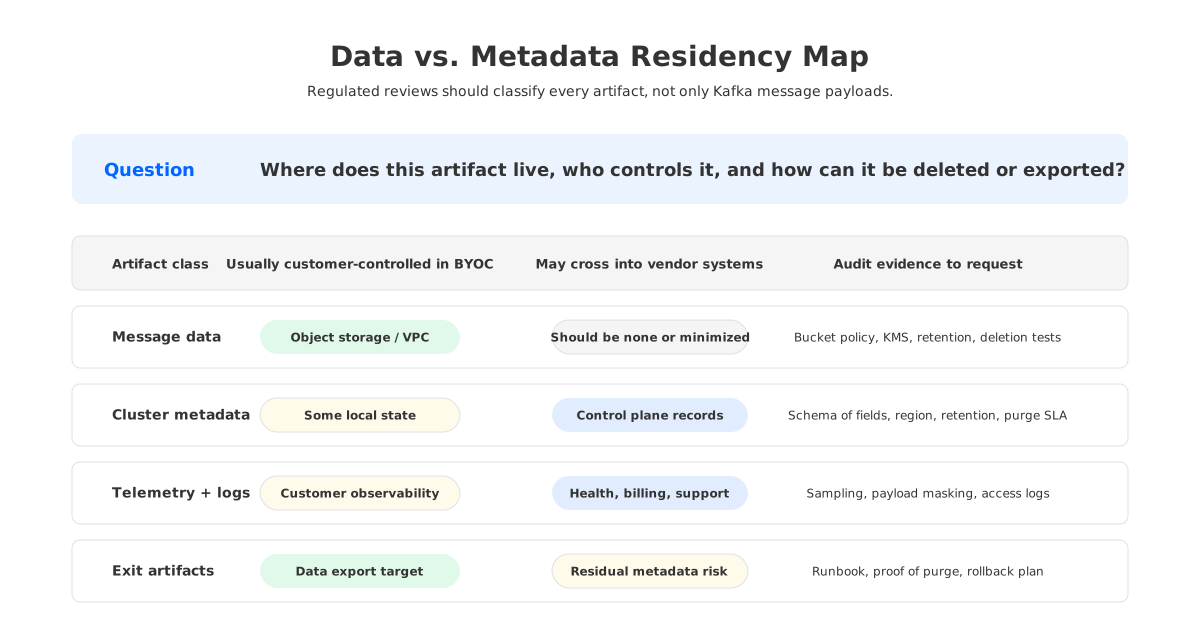
| Artifact class | Main risk | Questions to ask |
|---|---|---|
| Message payloads | Regulated customer, transaction, health, or operational data | Where are records stored? Are they ever copied to vendor systems? Who controls encryption keys and deletion? |
| Kafka metadata | Business-sensitive names and topology | Are topic names, consumer groups, client IDs, schemas, or offsets stored outside the customer account? |
| Telemetry and logs | Operational signals that reveal workload behavior | What is exported, sampled, masked, retained, and accessible by vendor personnel? |
| Support artifacts | Screenshots, traces, debug bundles, tickets | Can support files contain customer identifiers? Where are they stored and purged? |
| Backup and recovery artifacts | Secondary copies that can escape normal controls | Are object versions, snapshots, or disaster recovery copies governed by the same policy? |
| Exit artifacts | Data and metadata needed to leave the platform | Can the customer export data, verify deletion, and operate independently during transition? |
This table is intentionally product-neutral. It works for WarpStream, Confluent Cloud, self-managed Kafka, AutoMQ, and other Kafka-compatible systems. The value is that it forces a vendor to answer in operational terms rather than brand terms.
4Where AutoMQ Fits in the Architecture Category
Once the review is framed around boundaries, AutoMQ belongs in the same broad category of Kafka-compatible systems that decouple streaming compute from durable storage. AutoMQ uses object storage as the primary durable storage layer and keeps Kafka protocol compatibility for existing clients and ecosystem tools. In BYOC-style deployments, AutoMQ emphasizes that the data plane runs in the customer's cloud environment and that message data does not pass through AutoMQ Cloud.
That positioning is relevant for regulated workloads, but it should be evaluated with the same rigor applied to WarpStream. Ask AutoMQ for the control plane boundary, data plane components, object storage permissions, telemetry fields, support access process, and deletion or exit runbook. The point is not to replace one trust statement with another. The point is to compare architectures using the same evidence model.
There are also tradeoffs to inspect. Object-storage-backed Kafka-compatible systems can reduce the operational burden of broker-local disks and large replica movement, but they introduce dependency on object storage latency, bucket policy, cloud IAM, and metadata-plane design. For regulated workloads, those tradeoffs are often acceptable when they produce clearer ownership of durable data, but they still need to be tested against workload latency, recovery, audit, and incident response requirements.
5Procurement and Audit Checklist
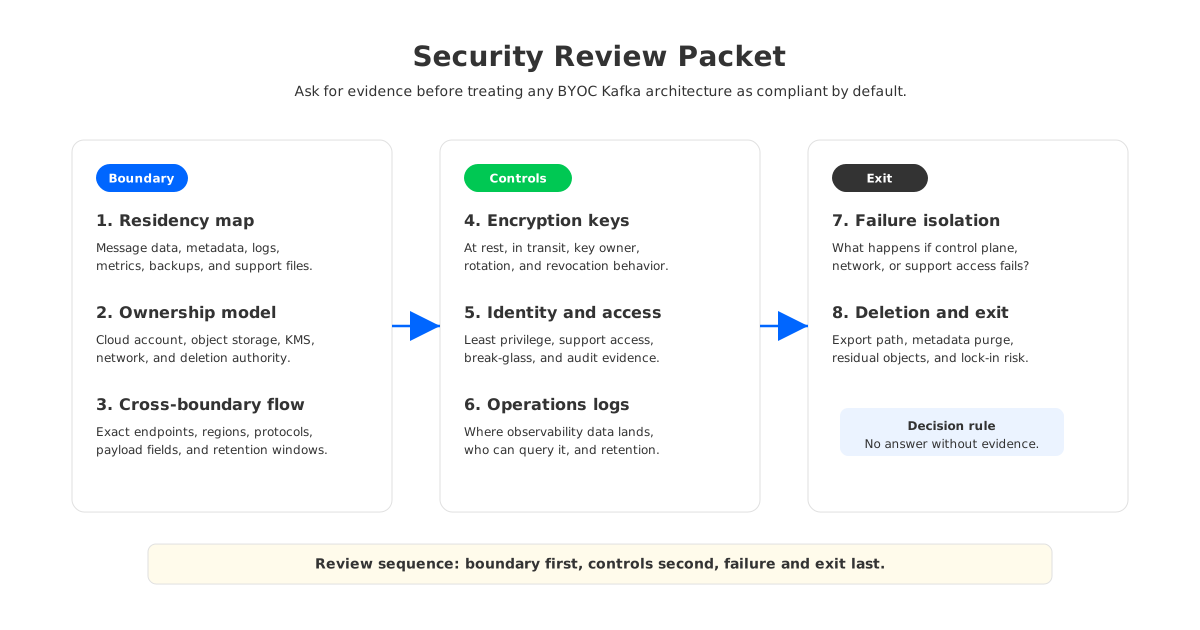
Before approving WarpStream or any BYOC Kafka platform for regulated workloads, ask vendors to provide a security review packet that answers these questions in writing:
- Data boundary: Which artifacts remain in the customer account, and which leave it?
- Metadata boundary: Which topic, consumer group, schema, offset, health, and configuration fields are stored in the control plane?
- Region control: Can control plane, telemetry, and support data residency be configured by region?
- Encryption: Which data is encrypted in transit and at rest, and who controls the keys?
- IAM: Which roles, policies, service accounts, and temporary credentials are required?
- Network: Which inbound and outbound endpoints are required during steady state and support events?
- Observability: Which metrics and logs are exported to vendor systems, and can payload-adjacent fields be masked?
- Support access: Who can access what, under which approval workflow, and where is the audit trail stored?
- Backup and deletion: How are object versions, metadata records, tickets, traces, and logs deleted?
- Exit: How can the customer export data, validate offsets, remove vendor access, and prove residual data deletion?
The checklist should become part of the procurement record, not a side conversation in Slack. For critical workloads, run a tabletop incident using the proposed support model before production. Simulate a broken agent, a blocked control plane endpoint, a KMS permission failure, and a termination request. The answers are often clearer after one rehearsal than after five architecture meetings.
6FAQ
6.1Is WarpStream automatically compliant because it is BYOC?
No. BYOC can improve data control by keeping runtime components and durable records in the customer's cloud environment, but compliance depends on the full operating model. Metadata, telemetry, support access, encryption keys, deletion, subprocessors, and audit evidence still need review.
6.2What is the most important question for regulated Kafka workloads?
Ask what leaves the customer environment. Split the answer into message payloads, Kafka metadata, telemetry, support artifacts, backups, and exit records. Each category needs a residency, access, retention, and deletion answer.
6.3Does object storage make Kafka easier to audit?
It can. Object storage provides familiar controls such as bucket policies, encryption settings, lifecycle rules, object versioning, and access logs. But those controls only help if the streaming platform's compute layer, metadata layer, and support workflows are designed around them.
6.4How should teams compare WarpStream and AutoMQ for regulated workloads?
Use the same evidence model for both. Compare where the data plane runs, who owns object storage, what the control plane stores, which telemetry leaves the account, how support access works, and how exit is proven. Avoid comparing marketing labels without the boundary map.
6.5Should regulated teams avoid managed Kafka entirely?
Not necessarily. Some teams can approve a fully managed service with the right contractual, technical, and regional controls. Others need BYOC or self-managed infrastructure. The decision should follow the workload's classification, data residency requirements, latency targets, staffing model, and incident response obligations.
7References
- WarpStream documentation: Security and privacy considerations
- WarpStream documentation: Secrets overview
- Confluent blog: Confluent + WarpStream = Large-Scale Streaming in your Cloud
- IBM announcement: IBM completes acquisition of Confluent
- Apache Kafka documentation: Security
- AWS documentation: Protecting data with server-side encryption
- AutoMQ documentation: What Is AutoMQ Cloud
- AutoMQ documentation: BYOC environment overview


