
Table of Contents
Table of Contents
A WarpStream renewal is not only a commercial event. It is the point where a platform team compares the system it bought against the workload it now runs, the budget it now owns, and the risk profile it will carry into the next contract period. Once producers, consumers, schemas, observability, and incident runbooks depend on a streaming platform, the next renewal can either preserve optionality or quietly remove it.
The goal is not to treat acquisition or consolidation as a red flag by itself. Confluent announced its acquisition of WarpStream on September 9, 2024, positioning WarpStream as a BYOC option for Kafka-compatible workloads with relaxed latency requirements. IBM then completed its acquisition of Confluent on March 17, 2026. Those two events make public roadmap and support questions more important, but they do not answer them. A buyer still has to ask what is changing in packaging, who owns support escalation, how pricing will be measured, and what migration choices remain open if the platform direction no longer matches the workload.
1Why renewal is the right time to reassess
Streaming platforms are sticky for structural reasons. Kafka clients may be portable, but production deployments include topic settings, ACLs, consumer group offsets, connector behavior, schema registry integration, dashboards, alerts, Terraform modules, and operational muscle memory. A renewal that checks only this month's invoice misses the larger question: whether the platform still gives the team enough control over cost, performance, and exit.
WarpStream's own documentation describes a diskless, Apache Kafka-compatible data streaming platform built on cloud object stores such as S3, GCS, and Azure Blob. Its architecture separates storage and compute, separates data from metadata, and separates data plane from control plane. Agents run in the customer's environment, speak the Kafka protocol, and use object storage for durable data, while WarpStream's cloud control plane manages metadata and coordination.
That architecture can change the economics and operations of Kafka-like workloads, but it also changes what should be reviewed at renewal. A diskless BYOC renewal needs a broader checklist:
- What billing dimensions grew faster than expected?
- Which usage patterns are driving retained data, writes, reads, cluster minutes, or cloud infrastructure spend?
- Which support tasks require vendor access, control plane coordination, or product-specific troubleshooting?
- What roadmap items are now tied to Confluent or IBM portfolio priorities?
- How quickly could the team migrate if commercial terms or technical direction changed?
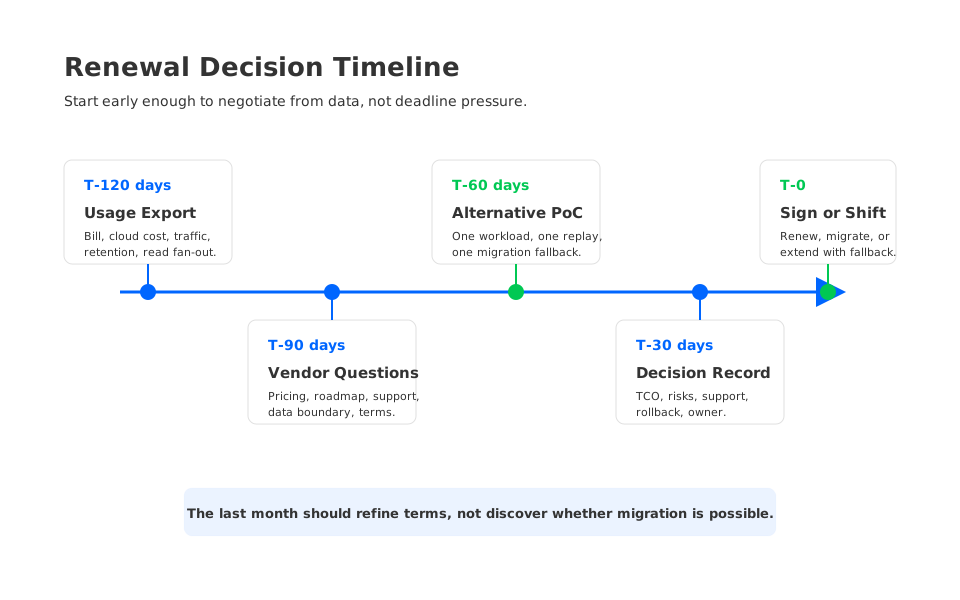
Do not wait until a renewal is a procurement fire drill. Treat it as an architecture review with a commercial deadline.
2Build the renewal model before negotiating
The first mistake is to compare a renewal quote against the prior quote. A logging pipeline may have added tenants, an observability system may retain more history, or a data lake feed may have shifted from batch export to continuous streaming. If the workload changed, the old contract is a weak baseline.
Start with a usage model that separates vendor charges from cloud resource charges. WarpStream's billing documentation says BYOC clusters are metered by cluster-minutes, uncompressed GiB written, and uncompressed GiB stored. Serverless clusters add compressed GiB written and compressed GiB read. Usage is metered hourly and invoiced monthly in arrears unless custom terms apply. For multi-region clusters, WarpStream documents that uncompressed GiB written and stored are multiplied by the number of control plane regions, while cluster minutes are not multiplied.
That means a renewal model should cover more than list price:
| Renewal input | What to collect | Why it matters |
|---|---|---|
| Write volume | Uncompressed GiB written by cluster and month | Drives platform billing tiers and object storage behavior |
| Retention | Retained logical GiB, retention hours, compaction profile | Determines stored data charges and cloud storage footprint |
| Read pattern | Consumer fan-out, replay frequency, catch-up reads | Exposes cache pressure, query cost, and egress risk |
| Cluster uptime | Active clusters, environments, idle test clusters | Prevents non-production usage from hiding in the bill |
| Cloud resources | Agent compute, object storage, request operations, networking | Shows the full BYOC cost, not vendor invoice alone |
| Contract terms | Commit, overage, support tier, marketplace terms | Determines whether growth lowers unit cost or creates surprise spend |
This table is also useful during negotiation. Instead of asking for a generic discount, the buyer can ask for terms that match the actual workload shape: tier thresholds, commitment flexibility, support response, marketplace routing, multi-region assumptions, and non-production treatment.
3Pricing questions to ask before signing
Pricing questions should be precise because object-storage-backed Kafka systems move cost across boundaries. A lower broker footprint may coincide with higher object storage requests, retained bytes, network paths, or platform metering dimensions that are invisible in a traditional Kafka cluster.
Ask for a renewal quote that breaks down usage and assumptions by environment. Production, staging, development, backfill, and replay workloads should not be blended into one line item. If the quote depends on tiered pricing, ask how tiers reset, which dimensions are tiered, and how committed spend interacts with burst usage.
For BYOC, also ask where the cloud bill lands. The customer may pay the cloud provider directly for compute, storage, request operations, and network traffic, while paying the vendor for platform usage. That split is normal for BYOC, but it must be visible in the renewal model. Otherwise, the team may optimize the vendor invoice while the cloud bill expands elsewhere.
The renewal packet should answer:
- Which metering dimensions are expected to grow in the next term?
- What happens if write volume doubles but retained data remains stable?
- What happens if retention doubles but write volume stays flat?
- Are support, private connectivity, control plane options, migration tooling, or enterprise security features separate SKUs?
- Are there minimum commitments, ramp periods, annual true-ups, or marketplace fees?
- Which dimensions are excluded from the vendor quote because they appear on the cloud provider bill?
The vendor does not need to predict your future workload perfectly. The renewal packet needs enough detail for your team to rerun the model when traffic changes.
4Roadmap and support after portfolio consolidation
The acquisition chain matters because product roadmaps are resource allocation decisions. Confluent's 2024 blog described WarpStream as a Kafka-compatible BYOC offering for customers who want data streaming in their own cloud environment. IBM's 2026 announcement framed Confluent as part of IBM's real-time data and AI platform strategy. Neither announcement gives a buyer a workload-specific roadmap guarantee.
That is why renewal teams should convert roadmap uncertainty into concrete questions:
- Which WarpStream features are committed during the renewal term?
- Which features are being integrated with Confluent or IBM systems for billing, support, identity, governance, or observability?
- Will existing APIs, Terraform resources, agent deployment patterns, and console workflows remain compatible?
- What deprecation policy applies to agents, cluster tiers, connectors, migration tools, and control plane regions?
- Who owns support escalation: the WarpStream team, Confluent support, IBM support, or a blended process?
- What operational events require vendor intervention rather than customer-side action?
Support deserves its own review because BYOC support is not the same as SaaS support. WarpStream's security documentation states that raw data for BYOC clusters never leaves the customer's VPC or object storage buckets, while metadata required for cluster operation leaves the VPC. It also describes optional log and profiling data collection controls. For renewal, verify what support can see, what must be enabled for escalation, and how quickly the vendor can help without raw data access.
5Data control and exit-path checklist
Exit path is often discussed too late. The right time to design one is before renewal, when the buyer still has leverage and time. The goal is not to plan an immediate migration away from WarpStream; it is to prevent renewal from becoming a single-vendor dependency with no tested fallback.
A credible exit plan has five layers.
First, confirm the data boundary. For WarpStream BYOC, raw data is documented as remaining in the customer's VPC or object storage buckets, while workload metadata is sent to the control plane. Renewal review should verify bucket ownership, encryption ownership, deletion behavior, backup behavior, and what metadata is needed to reconstruct or migrate workloads.
Second, map Kafka compatibility at the feature level. Apache Kafka compatibility is not a single checkbox. Validate producer settings, consumer groups, ACLs, transactions, idempotent producers, compaction, schema workflows, Kafka Connect, MirrorMaker-style replication, and client library versions. If an application depends on a WarpStream-specific feature, label it as a portability risk.
Third, test offset and topic migration. A migration is not complete when new producers can write to a target cluster. Consumers must resume at correct offsets, historical data must be available where needed, and rollback behavior must be understood. AutoMQ's migration documentation, for example, describes a Kafka Linking process that considers message synchronization, producer switching, consumer switching, mirror topic promotion, and rollback conditions. The same level of detail should exist for any alternative under consideration.
Fourth, document operational replacement. List the dashboards, alerts, runbooks, Terraform modules, access policies, and incident workflows that would need to move. Migration often fails in these surrounding systems, not in the basic produce-consume path.
Fifth, tie the plan to contract terms. Ask for data export assistance, transition support, reasonable termination windows, and clarity on access after contract end.
6When to benchmark an alternative
Benchmarking an alternative during renewal is not a hostile act. It is the engineering version of a disaster recovery test. A lightweight benchmark gives procurement and platform engineering a clearer view of whether renewal is the right technical choice.
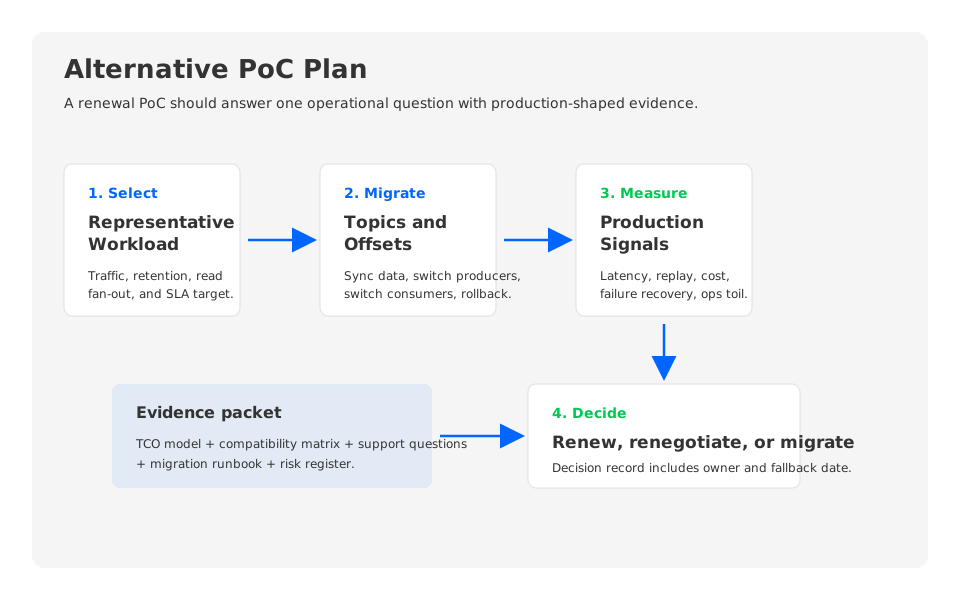
Run an alternative PoC when any of these signals appear:
- The renewal quote assumes workload growth that the team cannot validate.
- A roadmap dependency is material to the next twelve months of architecture work.
- Support escalation paths changed after portfolio consolidation.
- Compliance review asks for stronger evidence around metadata, access, residency, or deletion.
- The workload is moving toward lower latency, higher replay, more regions, or larger retention.
- A migration fallback has never been tested.
Keep the PoC narrow. Pick one representative workload, one replay scenario, one operational failure scenario, and one migration path. Measure latency distribution, throughput, consumer catch-up, cloud resource cost, operational steps, and compatibility gaps. The output should be a renewal decision record, not a vendor bake-off spreadsheet.
7How AutoMQ fits into a renewal evaluation
Once the renewal review reaches architecture categories, AutoMQ belongs in the shortlist of Kafka-compatible, object-storage-backed streaming systems. AutoMQ's S3Stream documentation describes a shared stream storage layer that offloads Kafka log storage to object storage, combines WAL storage with S3, and decouples storage from compute. AutoMQ BYOC documentation also separates subscription fees from the customer's cloud resource fees, which is the same kind of full-cost split buyers should model for any BYOC platform.
The evaluation should stay technical. AutoMQ is not a universal replacement for every WarpStream workload, and no renewal decision should skip validation. It is relevant when the team wants Kafka protocol compatibility, object-storage economics, BYOC deployment options, and a migration plan that can be tested before contract signature.
Use AutoMQ as one architecture baseline alongside renewal of the current platform and any other Kafka-compatible option under review. Compare the same inputs: write volume, retention, read fan-out, latency target, failure recovery, support model, data boundary, migration tooling, and contract flexibility. If the renewal still wins after that comparison, the team has evidence. If another architecture wins, the renewal process gave the organization time to move deliberately.
For teams building a second baseline, review the AutoMQ architecture documentation and the AutoMQ migration guide before the renewal window closes.
8Renewal checklist
Use the following checklist as the working document for the renewal meeting:
| Area | Pass condition | Evidence to request |
|---|---|---|
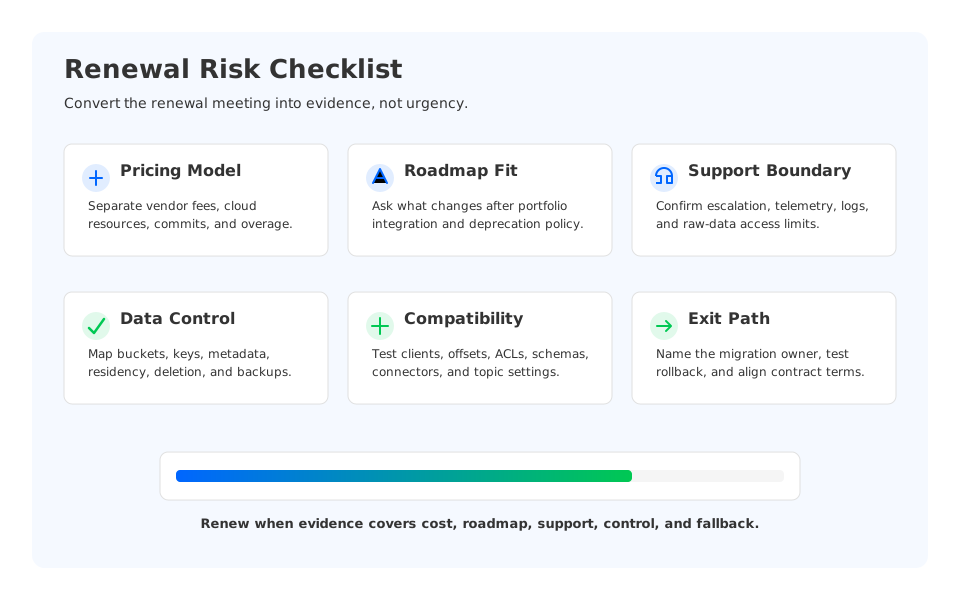
| Pricing | Renewal model separates vendor fees and cloud resource fees | Usage export, quote assumptions, tier rules, cloud bill sample |
| Roadmap | Required features are committed or risk-accepted | Written roadmap notes, deprecation policy, release window |
| Support | Escalation paths and data-access boundaries are understood | Support plan, incident process, telemetry controls |
| Data control | Raw data, metadata, keys, buckets, and deletion are mapped | Security docs, IAM model, encryption ownership |
| Compatibility | Kafka feature dependencies are tested, not assumed | Client test matrix, connector list, topic config review |
| Exit path | Migration fallback has a named owner and test plan | PoC result, replication plan, rollback steps |
| Alternatives | At least one credible architecture baseline is compared | PoC metrics, TCO model, risk register |
The strongest renewal posture is calm and specific. Renew because the platform still fits, the cost model is understood, support is acceptable, and the exit path is not theoretical. Do not renew because migration feels hard and the deadline arrived.
9References
- WarpStream documentation: Introduction
- WarpStream documentation: Architecture
- WarpStream documentation: Billing
- WarpStream documentation: Security and Privacy Considerations
- Confluent blog: Confluent acquires WarpStream
- IBM announcement: IBM Completes Acquisition of Confluent
- Apache Kafka documentation
- AutoMQ documentation: S3Stream Shared Streaming Storage
- AutoMQ documentation: Executing Migration
10FAQ
10.1Is a WarpStream renewal mainly a pricing exercise?
No. Pricing is important, but the renewal should also review roadmap fit, support escalation, BYOC data boundaries, Kafka compatibility, and exit-path readiness. A low renewal quote can still be risky if the team cannot explain how it would migrate, recover, or renegotiate when workload assumptions change.
10.2Does Confluent's acquisition of WarpStream mean teams should migrate away?
Not by itself. Confluent's 2024 acquisition and IBM's 2026 acquisition of Confluent make roadmap and support questions more relevant, but they do not determine the answer for a specific workload. The right response is to ask concrete questions, benchmark where needed, and document risk before signing.
10.3What should be included in a WarpStream pricing renewal review?
Include cluster-minutes, uncompressed GiB written, uncompressed GiB stored, read and ingress dimensions where applicable, support terms, cloud compute, object storage, request operations, network traffic, and any minimum commitments. Separate production and non-production environments so idle or test usage does not distort the model.
10.4What is the most common exit-path mistake?
The most common mistake is assuming that Kafka-compatible clients make migration automatic. A real exit path must cover topics, offsets, ACLs, schemas, connectors, dashboards, alerts, Terraform, support access, rollback, and contract timing.
10.5When should AutoMQ be evaluated as an alternative?
Evaluate AutoMQ when the team wants a Kafka-compatible system that uses object storage as the persistent storage layer, supports BYOC-style deployment evaluation, and can be tested through a focused migration PoC. The decision should be based on workload evidence, not on vendor category labels.


