
Table of Contents
Table of Contents
A WarpStream replacement project usually looks safe during the first demo. A producer connects, a consumer reads, and the bootstrap address changes without much drama. That is a useful first signal, but it is not the migration. The real risk sits in the parts of Kafka that production workloads depend on after the happy path is over: topic configurations, consumer offsets, security rules, schema dependencies, connector behavior, networking paths, observability, and rollback.
That distinction matters because WarpStream is not a generic Kafka broker fleet. Its documentation describes it as a diskless, Apache Kafka-compatible streaming platform built on cloud object stores, with Agents in the customer environment and WarpStream Cloud participating in control-plane and metadata flows. Confluent also announced on September 9, 2024 that it had acquired WarpStream to add a BYOC streaming option to its portfolio. Those facts do not make replacement necessary by themselves, but they do make architecture due diligence more concrete: you are not only changing a vendor, you are changing the operational boundary around a Kafka-compatible system.
The replacement checklist below treats migration as a sequence of engineering gates. Each gate should produce evidence that a platform team, SRE team, security team, and application owner can review before the next gate opens.
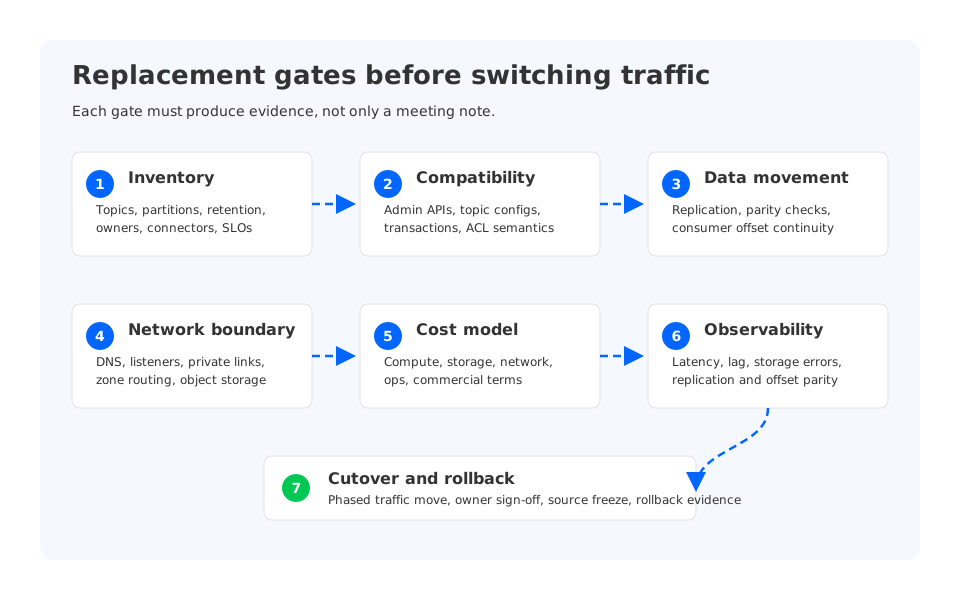
1Gate 1: Build a Workload Inventory Before Picking a Target
The first gate is not product selection. It is inventory. Without it, teams tend to evaluate a replacement against the easiest workload in the estate, then discover later that the hard workload used compacted topics, transactional producers, strict ACL patterns, or a connector with assumptions about cluster metadata.
Create a workload register with one row per application-facing stream group, not only one row per cluster. At minimum, capture:
- Topic count, partition count, replication assumptions, retention settings, cleanup policy, compression, and maximum message size.
- Produce throughput, consume fan-out, peak-to-average ratio, consumer lag patterns, and catch-up read behavior.
- Consumer group IDs, offset reset policies, commit frequency, and any manual offset management.
- Security model: SASL, TLS, mTLS, ACLs, service accounts, network ingress, and private connectivity.
- Schema Registry, Kafka Connect, Flink, Spark, ksqlDB, CDC, observability, and internal platform dependencies.
- Current RPO, RTO, maintenance windows, rollback expectations, and owner sign-off requirements.
This inventory also prevents a common migration mistake: treating "Kafka-compatible" as a single checkbox. Apache Kafka exposes many operational surfaces beyond Produce and Fetch. The official Kafka documentation covers topic-level configurations, consumer groups and offset management, ACL-based authorization, and transactions as distinct areas. A replacement must be tested against the surfaces your workloads actually use, not against Kafka as an abstract category.
2Gate 2: Validate Kafka Compatibility Beyond Produce and Consume
The compatibility gate should start with a negative assumption: the target is not compatible for your workload until tests prove otherwise. That does not mean every Kafka API must matter equally. It means you need a compatibility matrix tied to your inventory.
| Compatibility surface | What to validate | Evidence to collect |
|---|---|---|
| Topic configuration | Retention, cleanup policy, compaction, partition count changes, message size, compression, and defaults | Exported source config, target config, and diff |
| Client behavior | Producer retries, idempotent producer settings, batching, fetch size, metadata refresh, and error handling | Client test logs under normal and failure conditions |
| Consumer groups | Group rebalances, committed offsets, lag reporting, offset reset behavior, and tooling | Offset comparison before and after test cutover |
| Transactions | Transactional IDs, producer fencing, read isolation, and exactly-once usage where applicable | End-to-end transaction tests with duplicate detection |
| Security | ACL semantics, authentication mechanisms, TLS termination, service identity mapping | Security policy diff and access test results |
| Ecosystem tools | Connectors, Schema Registry, stream processors, dashboards, and CLI/admin tools | Tool-by-tool certification notes |
For WarpStream specifically, include its documented protocol and feature support, topic configuration reference, ACL documentation, and Orbit migration documentation in the source-side review. The point is not to reproduce WarpStream inside the replacement. The point is to know which assumptions your applications currently make because of WarpStream's behavior, and which assumptions come from Kafka itself.
This is where many replacement plans either become credible or collapse. If your estate uses only straightforward append-and-read topics, the gate may be short. If it uses compacted topics, transactional producers, long catch-up reads, strict service-level network isolation, or platform-owned connectors, this gate deserves a test suite rather than a meeting note.
3Gate 3: Decide How Data Moves, Then Prove Offsets
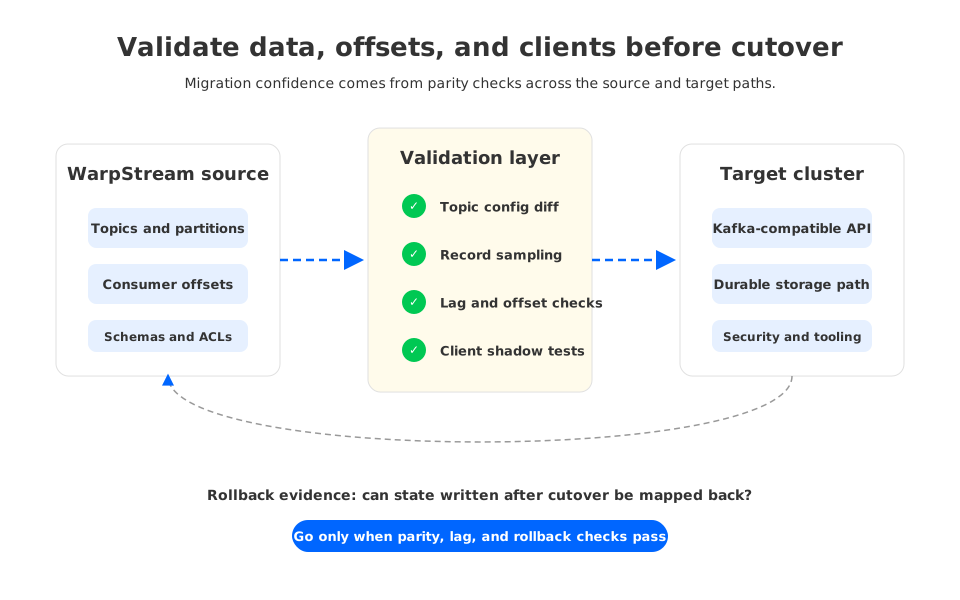
Data movement is the visible part of a replacement, but offsets are the part that decides whether the cutover feels controlled. Moving records without preserving consumer progress can turn a clean infrastructure migration into an application incident.
A practical plan has three tracks running at the same time:
- Replicate records from the source into the target with clear topic mapping and timestamp handling.
- Track consumer progress so application teams know where each group should resume.
- Compare record counts, offsets, lag, and sampled payloads before any producer cutover.
Do not make a global promise such as "zero downtime" until a workload-specific PoC proves it. RPO and RTO depend on throughput, lag, connector behavior, the migration tool, client restart patterns, and how much dual-running your applications can tolerate. A logging pipeline can often accept a different cutover profile than an order-processing stream with transactional producers.
When the target is AutoMQ, the relevant category is Kafka-compatible shared storage with stateless brokers. AutoMQ documentation describes 100% Kafka protocol compatibility, S3Stream as a storage layer that offloads Kafka log storage to object storage, and Kafka Linking as a migration mechanism for data synchronization and offset consistency. Those capabilities are useful only if they are tested against your own workload inventory, so place them in the same migration gate as any other target capability.
4Gate 4: Rebuild the Network Boundary, Not Only the Cluster
WarpStream replacement planning should include a network diagram before it includes a cutover date. WarpStream BYOC deployments involve Agents in the customer environment, object storage, client connectivity, and documented options for advanced network setups. A target architecture may keep data in the same cloud account, move it to another VPC, change private connectivity, or introduce a different control-plane boundary.
Validate these items as design artifacts and as live network tests:
- Bootstrap addresses, advertised listeners, DNS, certificate names, and client metadata refresh behavior.
- VPC, subnet, security group, firewall, NAT, PrivateLink, peering, or transit gateway paths.
- Zone-local routing assumptions for producers, consumers, and connectors.
- Object storage access policies, KMS keys, encryption requirements, and private endpoints.
- Egress paths for metrics, logs, support access, audit logs, and billing telemetry.
The network gate should include failure drills. Block one zone. Rotate certificates. Remove object storage permission from a test role. Restart client pods during a metadata change. These exercises often reveal whether a design is resilient or whether it only works while every dependency is healthy.
5Gate 5: Model Cost by Driver, Not by Vendor Invoice
A replacement cost model should be built from workload drivers, not from a vendor invoice total. That keeps the model portable across Kafka-compatible targets and prevents teams from missing charges that move from one line item to another.
Use a driver table like this:
| Cost driver | What to measure | Why it matters during replacement |
|---|---|---|
| Compute | Broker or Agent CPU, memory, scaling floor, peak capacity, and headroom | A target may trade storage cost for compute or metadata overhead |
| Storage | Retention volume, object storage class, request rate, WAL or local disk layer, and compaction behavior | Diskless and shared-storage systems still have storage access patterns |
| Network | Cross-AZ traffic, private connectivity, egress, replication traffic, and dual-run window | Migration can temporarily double write paths and validation reads |
| Operations | On-call effort, upgrade model, rebalancing work, observability, and incident response | Lower infrastructure cost does not help if operational burden rises |
| Commercial terms | Subscription unit, marketplace fee, support tier, minimum commit, and exit terms | Procurement risk can dominate technical preference |
Avoid precision theater. A model that says "$X/month" without assumptions is less useful than a model that says "under this write rate, read fan-out, retention period, dual-run duration, and cloud region, these are the dominant drivers." Use current official pricing pages for vendor and cloud numbers, then keep the spreadsheet tied to assumptions so FinOps can change them.
6Gate 6: Make Observability Equivalent Before Cutover
Do not cut over before the target can answer the same operational questions as the source. Replacement projects sometimes treat dashboards as post-migration cleanup. In a streaming platform, dashboards are part of the control system.
At minimum, platform operators need:
- Cluster health, produce latency, fetch latency, error rate, request rate, and throttling signals.
- Consumer lag by group, topic, and partition.
- Storage write/read error signals and object storage latency where object storage is part of the data path.
- Connector status, task failures, dead-letter queues, and schema compatibility failures.
- Security audit events and denied authorization attempts.
- Migration-specific dashboards for replication lag, topic parity, offset parity, and validation job results.
Application teams also need a smaller view: "Can I produce, consume, and recover within my expected SLO?" If that answer requires platform engineers to run ad hoc queries during cutover, the observability gate is not closed.
7Gate 7: Cut Over in Phases, With a Written Rollback Path
A good cutover plan is boring. It names the decision points, assigns owners, and defines the moment when rollback is still possible. The plan should be rehearsed on non-critical workloads before any high-value stream moves.
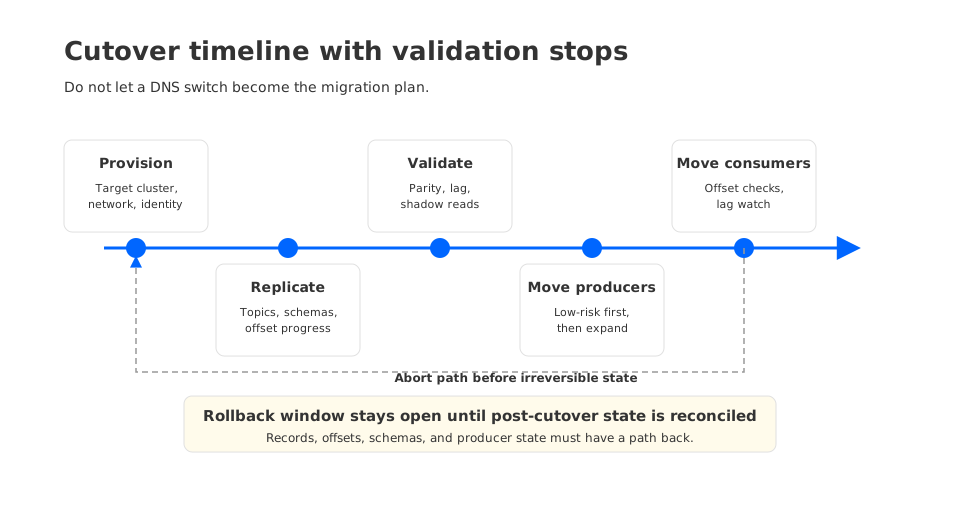
A typical phased plan looks like this:
- Provision the target and lock down network, identity, and object storage permissions.
- Mirror topics and schemas, then validate configuration parity.
- Start replication and track lag until it stays within the agreed window.
- Run shadow consumers or validation jobs that compare payloads and offsets.
- Move a low-risk producer, then a low-risk consumer group.
- Expand by workload tier, keeping rollback windows explicit.
- Freeze the source only after retention, audit, and application-owner sign-off are complete.
Rollback needs its own design. If producers have written to the target for an hour, can you replay those records into WarpStream? If consumers have committed offsets on the target, how will you map progress back? If schema changes occurred during dual-run, which registry is authoritative? A rollback plan that only says "switch DNS back" is not a rollback plan; it is a hope that no state changed.
8Where AutoMQ Fits in the Target Architecture Discussion
AutoMQ belongs in the evaluation when the desired target is Kafka-Compatible, cloud-native streaming with object storage as the primary durable layer and stateless brokers as the operational model. Its architecture is closer to the "replace broker-local data movement with shared storage" category than to a lift-and-shift Kafka broker fleet. That can matter when the replacement driver is elasticity, partition reassignment speed, storage growth, or cloud infrastructure cost.
It should not be evaluated as a magic endpoint swap. The same gates still apply: compatibility, data movement, offsets, security, networking, observability, cost, cutover, and rollback. The stronger your test evidence, the less the final decision depends on vendor claims.
For teams that want to evaluate this architecture directly, start with the AutoMQ documentation on Kafka compatibility, S3Stream, stateless brokers, and migration, then build a PoC around your two hardest workloads rather than your easiest one. You can also review the project on GitHub or discuss a BYOC evaluation path with the AutoMQ team at go.automq.com/home.
9Go/No-Go Checklist
Use this checklist before approving a production switch:
- Inventory covers every production topic family, consumer group, connector, schema dependency, and security dependency.
- Compatibility tests cover the Kafka features your workloads use, not only basic Produce and Fetch.
- Data replication has proven topic parity, payload sampling, lag behavior, and offset continuity.
- Networking has been tested across DNS, advertised listeners, private connectivity, object storage access, certificate rotation, and zone failure.
- Cost model separates compute, storage, network, operations, and commercial terms with explicit assumptions.
- Observability is equivalent or better for platform teams and application owners.
- Cutover has phased owners, measurable gates, and a rollback plan that handles state written after the switch.
- Source retirement has retention, compliance, audit, and application-owner sign-off.
If any line is still marked "unknown," keep the migration in PoC. Unknowns are much easier to handle while traffic is mirrored than after the first critical producer has moved.
10FAQ
10.1Is replacing WarpStream the same as migrating from Apache Kafka?
No. WarpStream is Kafka-compatible, but its architecture and operating model are not identical to a traditional Apache Kafka broker fleet. Treat the source as a Kafka-compatible system with its own feature support, Agent deployment model, object storage behavior, and control-plane boundaries.
10.2What is the highest-risk part of a WarpStream replacement?
For many teams, the highest risk is not producing records to the target. It is preserving consumer progress, security semantics, schema dependencies, connector behavior, and rollback options. Offsets and stateful ecosystem dependencies deserve early tests.
10.3Can a WarpStream replacement be zero downtime?
It depends on the workload and migration design. A low-latency transactional workload, a high-volume observability pipeline, and a batch-oriented lake ingestion stream may need different cutover patterns. Validate RPO, RTO, and rollback in a workload-specific PoC before using any downtime claim.
10.4When should AutoMQ be on the shortlist?
AutoMQ is relevant when you want a Kafka-Compatible target that uses Shared Storage architecture, object storage, stateless brokers, and BYOC deployment options. It is especially worth testing when your replacement goals include cloud elasticity, storage growth management, partition movement, and clearer data-plane ownership.
11References
- WarpStream documentation: Introduction
- WarpStream documentation: Architecture
- WarpStream documentation: Protocol and Feature Support
- WarpStream documentation: Orbit Cluster Linking
- WarpStream documentation: Billing
- Confluent announcement: Confluent Acquires WarpStream
- Apache Kafka documentation
- AutoMQ documentation: Native Compatible with Apache Kafka
- AutoMQ documentation: S3Stream Shared Streaming Storage
- AutoMQ documentation: Stateless Broker
- AutoMQ documentation: Executing Migration


