
Table of Contents
Table of Contents
Searching for a WarpStream substitute usually means the team has accepted one premise: stateful Kafka brokers plus broker-local disks are no longer the default answer for cloud Kafka. The open question is practical. Can you move a workload that was headed toward, or already running on, WarpStream to another Kafka-compatible architecture without giving up the operational and cost advantages that made object storage attractive?
The answer depends less on brand comparison and more on workload shape. WarpStream describes itself as a diskless, Apache Kafka-compatible streaming platform that integrates with object stores such as S3, GCP, and Azure object storage. Its architecture documentation explains a model built around stateless Agents, object storage, a cloud metadata store, and separation of storage, compute, metadata, data plane, and control plane.
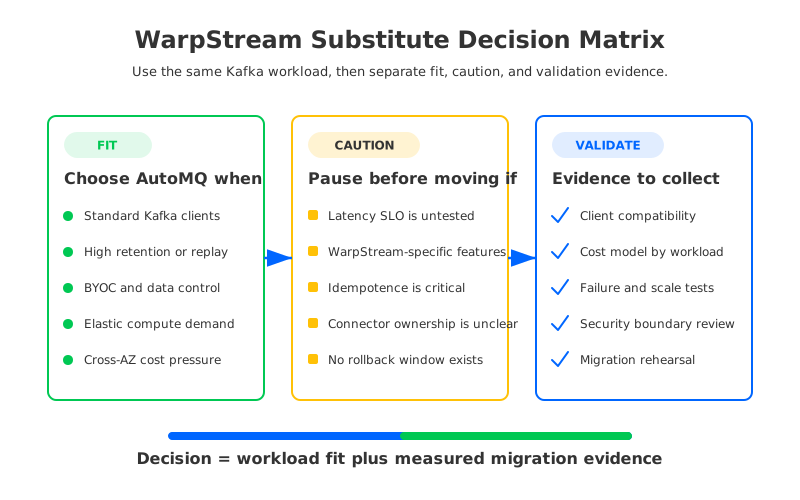
That means the right substitute cannot be evaluated with a generic managed Kafka checklist. A replacement candidate has to preserve Kafka client compatibility, durable object-storage-backed data, elastic compute, operational control, and a credible migration path. AutoMQ belongs in that category because it is a Kafka-compatible streaming platform built on object storage, with stateless brokers and BYOC-oriented deployment options.
1What "substitute" should mean for Kafka workloads
A substitute is not merely a service that exposes port 9092. Kafka compatibility has layers: consumer group behavior, offset continuity, ACLs, ecosystem tools, telemetry, connector deployment, failure semantics, and upgrade processes. A credible substitute has to be tested at those layers, especially if the workload relies on idempotent producers, transactions, high partition counts, long retention, or strict latency envelopes.
For Kafka teams, the substitution question is better framed as four smaller questions:
- Can existing applications connect with minimal client changes? Client libraries, authentication, bootstrap behavior, and metadata refresh behavior must be tested with production versions.
- Can the target architecture preserve the economics that motivated the move? If the original goal was to avoid broker-local disk replication and large cross-AZ data movement, the substitute should not quietly reintroduce those costs.
- Can operators keep the desired control boundary? BYOC, VPC placement, cloud account ownership, and data residency often matter as much as the streaming API.
- Can migration be rehearsed and reversed? A substitute that only looks compatible on a clean benchmark can still fail the first time consumer offsets, schema dependencies, or connector cutover meet production reality.
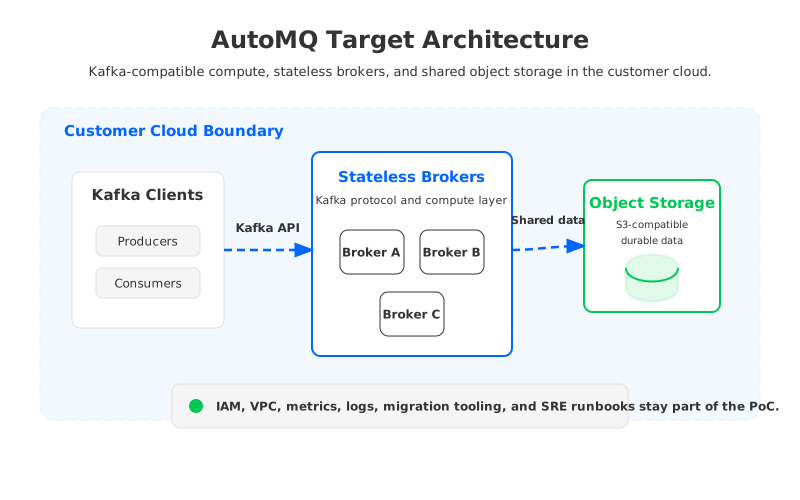
Implementation details differ. WarpStream documentation says Agents communicate with object storage and a cloud metadata store, while AutoMQ documentation preserves Kafka's compute layer and replaces the storage layer with S3-based shared storage. Those distinctions affect operations, failure handling, and PoC scope.
2When AutoMQ is a strong fit
AutoMQ is most compelling as a WarpStream substitute when the workload is Kafka-centered rather than product-feature-centered. If the estate is built around standard Kafka clients, Kafka Connect, Kafka Streams, Flink, Debezium, or Kafka-compatible observability tooling, the evaluation can focus on compatibility, migration mechanics, and cloud operations.
The strongest fit usually appears in one of these patterns:
| Workload signal | Why it matters | What to validate in AutoMQ |
|---|---|---|
| Standard Kafka client estate | The substitute decision is mostly about server architecture, not application redesign. | Client versions, auth mode, consumer group behavior, producer settings, and error handling. |
| High retention or large stored volume | Object storage can change the storage cost profile and reduce dependence on broker-local capacity planning. | Retention policy, replay throughput, catch-up reads, and object storage cost assumptions. |
| Elastic or bursty traffic | Stateless compute is valuable when capacity needs change faster than partition reassignment can comfortably follow. | Scale-out time, scale-in behavior, rebalance impact, and steady-state headroom. |
| BYOC or strict data control | The team wants managed operations without giving up cloud account, VPC, or storage ownership. | Deployment boundary, IAM model, network paths, telemetry export, and support access. |
| Cross-AZ cost pressure | Multi-AZ Kafka can spend heavily on replication and client traffic across zones. | Zone-local produce/fetch configuration, inter-zone traffic metrics, and failover behavior. |
The practical test is whether the application is asking for Kafka as an interface and cloud object storage as the durability layer. If yes, AutoMQ deserves a serious PoC. If the application depends on WarpStream-specific operational features, client ID features, metadata behavior, or managed pipeline features, include those dependencies explicitly.
3Kafka API compatibility
Kafka compatibility should be proven from the outside in. Start with the application clients you already run, not a toy producer and consumer. Include metadata, leader changes, idempotence, compression, fetch sizing, offset commits, and consumer group coordination under load.
AutoMQ documentation states that AutoMQ uses Kafka's compute layer and makes minimal storage-layer modifications to preserve compatibility. It also documents compatibility with Kafka clients, connectors, proxy components, and ecosystem tools for relevant Kafka versions. That makes AutoMQ plausible when the workload relies on mainstream Kafka behavior rather than a proprietary API surface.
Compatibility claims are not a substitute for a compatibility test. WarpStream's documentation lists known client issues and mitigations for Sarama, librdkafka, and the Java client, including fetch response size, leader epoch handling, and idempotent producer behavior. Your AutoMQ PoC should include the same classes of tests: exact client versions, producer flags, batch sizes, key distribution, and failure events.
4BYOC and data control
A WarpStream substitute decision often includes an organizational constraint: the data plane must stay under the customer's cloud boundary. WarpStream's architecture documentation says its Agent pool runs inside the customer's VPC and that customer data is not sent outside that VPC, while metadata is handled by WarpStream cloud services.
Evaluate AutoMQ through the same control-boundary lens. In AutoMQ's BYOC-oriented model, the goal is to run Kafka-compatible streaming infrastructure while keeping cloud resources, networking, and storage aligned with the customer's environment. That matters for regulated workloads, strict IAM practices, and teams standardizing observability and infrastructure-as-code.
The checklist is concrete:
- Identify which cloud account owns the object storage bucket, compute resources, networking, and logs.
- Confirm which service identity can read or write data, metadata, metrics, and operational diagnostics.
- Verify whether support access is always-on, delegated, temporary, or disabled by default.
- Decide how audit logs, metric streams, and alerting are exported into the team's existing tools.
- Test disaster recovery and deletion workflows before production data arrives.
This is where "substitute" becomes an architecture governance question. Two platforms can both be Kafka-compatible and object-storage-backed while placing control responsibilities in different places. The better choice is the one security, platform, and SRE teams can operate without inventing exceptions.
5Object-storage-backed cost structure
WarpStream's public billing documentation describes a consumption model with dimensions such as cluster-minutes, uncompressed GiB written, and uncompressed GiB stored, with separate dimensions for serverless clusters. That differs from self-managed Kafka, where cost is often hidden inside EC2, EBS, cross-AZ transfer, operational labor, over-provisioned brokers, and incident risk.
AutoMQ's cost case should be tested in the same language. Its documentation emphasizes S3-based shared storage, reduced broker-local disk dependence, and reduced inter-zone data transfer through architecture and configuration. The right comparison is not "which service has the lower headline price." It is the total cost to operate the workload at its required durability, latency, retention, and compliance levels.
A useful cost model has five rows:
| Cost row | What to measure | Why teams miss it |
|---|---|---|
| Compute | Broker or agent capacity, peak headroom, and autoscaling limits. | Peak traffic often determines provisioned capacity even when average traffic is modest. |
| Storage | Retained logical data, object storage class, request volume, and metadata overhead. | Long retention can dominate the bill after the first growth cycle. |
| Network | Cross-AZ produce, replication, fetch, and control traffic. | Network charges are often discovered after production scale. |
| Operations | Upgrades, balancing, incident response, observability, and support workflows. | Human time is usually outside the first spreadsheet. |
| Migration | Dual-run period, backfill, validation, rollback, and application restart windows. | Cutover work can exceed platform setup work. |
Use your own workload's write rate, compressed and uncompressed sizes, retention, consumer fan-out, object storage request profile, and region. If a vendor gives unit pricing in different dimensions, normalize the model before comparing. A substitute that looks cost-effective at low retention may look different when replay and long retention are included.
6When to be cautious
The most useful substitute page should say when not to move. AutoMQ is not the right answer if the team cannot yet describe the workload's latency budget, ordering requirements, client versions, connector dependencies, and rollback plan. The next step is discovery rather than migration.
Be especially cautious in these situations:
- Ultra-low-latency workloads without tolerance data. Benchmark produce latency, fetch latency, and tail latency against the actual SLO.
- Heavy reliance on WarpStream-specific behavior. If the workload depends on WarpStream client ID features, managed data pipelines, schema-linking behavior, or a particular control plane workflow, map each dependency to an AutoMQ equivalent or an external component.
- Unusual producer semantics. Idempotence, transactions, large batches, strict key ordering, and high fan-in patterns should be part of the first PoC, not the final acceptance test.
- Connector ownership ambiguity. If "Kafka" in your environment really means a bundle of Connect, Schema Registry, stream processing, custom ACL automation, and dashboards, decide which parts move and which remain.
- No operational owner. BYOC gives control back to the customer environment. That is powerful only when platform, security, and SRE teams agree on ownership.
These cautions are not reasons to avoid AutoMQ. They are reasons to avoid an under-specified substitution project. A disciplined PoC can answer most of them quickly.
7PoC checklist
Treat the PoC as a migration rehearsal, not a benchmark beauty contest. The goal is to test AutoMQ under the same constraints production will impose.
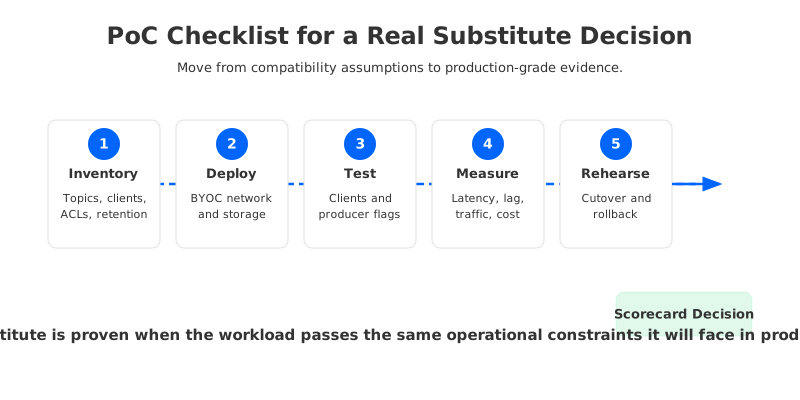
Start with a narrow slice that represents a real business path. Pick one producer family, one consumer family, a meaningful retention window, and the operational controls expected in production. Then run tests in an order that reveals blockers early:
- Inventory the source environment. Record topics, partitions, retention, ACLs, client versions, producer configs, consumer groups, schema dependencies, connector tasks, and traffic peaks.
- Deploy the target architecture. Create the AutoMQ environment in the intended cloud boundary, with the same network, identity, monitoring, and object storage assumptions you expect in production.
- Run compatibility tests. Use the real client libraries and representative producer settings, including idempotence or transactions if the workload uses them.
- Measure steady-state behavior. Capture throughput, produce latency, fetch latency, consumer lag, object storage request patterns, and inter-zone traffic.
- Test failure and elasticity. Restart brokers, scale compute, simulate zone-local routing changes, and observe whether clients recover within SLO.
- Rehearse migration. Use MirrorMaker2 or AutoMQ's migration tooling where appropriate, validate consumer progress handling, and document application restart requirements.
- Decide with a scorecard. Separate hard blockers from tunable settings, then compare the result with the current or planned WarpStream deployment.
AutoMQ's migration documentation describes batch-based migration planning, source and target cluster setup, data synchronization, consumer progress handling, producer and consumer switchover, and MirrorMaker2. It also notes that commercial editions offer a Kafka Linking Tool for byte-for-byte message synchronization and zero-downtime migrations.
8Decision framework
Choose AutoMQ instead of WarpStream when the decision is driven by Kafka-compatible server substitution, S3-based shared storage, stateless scaling, BYOC control, and a migration plan your team can rehearse. Keep WarpStream in the evaluation if you are specifically buying its Agent and cloud metadata model, managed pipeline surface, client-side tuning model, or current operational relationship with Confluent.
The decision should fit this pattern:
| Decision | Choose AutoMQ when... | Pause when... |
|---|---|---|
| Architecture | You want Kafka-compatible compute with storage moved to object storage and stateless broker operations. | You cannot explain which parts of Kafka semantics your workload depends on. |
| Control boundary | You need cloud-account, VPC, IAM, and observability alignment with your platform standards. | Security ownership is unclear or support access expectations are unresolved. |
| Cost | The pain is storage growth, cross-AZ traffic, over-provisioning, or long retention. | You have not modeled compressed size, retention, replay, and network paths. |
| Migration | You can isolate workload batches and rehearse cutover with real client versions. | Cutover requires a big-bang migration with no rollback window. |
| Product fit | You want a Kafka-compatible object-storage-backed platform rather than a broader Confluent-managed streaming bundle. | You rely on vendor-specific features that have not been mapped. |
This is where AutoMQ should enter the buying conversation honestly. It is not a generic "better Kafka" claim. It is a specific architecture choice: keep the Kafka protocol and ecosystem, move persistent data to shared object storage, make brokers stateless, and operate the system in a cloud-native control boundary.
If your team is evaluating this path, the most useful next step is not a sales comparison table. It is a scoped architecture review: one workload, one target cloud, one migration route, one measurable scorecard. The AutoMQ team can help review that plan through the AutoMQ contact page, or you can start from the AutoMQ documentation.
9References
- WarpStream Introduction
- WarpStream Architecture
- WarpStream Billing
- WarpStream Kafka Client Known Issues
- AutoMQ Overview
- AutoMQ Compatibility with Apache Kafka
- AutoMQ Migration from Apache Kafka
- AutoMQ Inter-Zone Traffic Overview
- Apache Kafka Protocol Guide
10FAQ
10.1Is AutoMQ a drop-in substitute for WarpStream?
Not automatically. AutoMQ belongs in the same architectural evaluation zone for many Kafka workloads, but production substitution still requires testing client behavior, migration mechanics, security boundaries, and operational workflows.
10.2When should I choose AutoMQ instead of WarpStream?
Choose AutoMQ when your priority is Kafka compatibility, S3-based shared storage, stateless broker operations, BYOC-style control, and a migration process your team can validate topic by topic. It is strongest when your applications rely on standard Kafka behavior rather than WarpStream-specific features.
10.3What workloads need extra validation?
Validate workloads with tight tail-latency SLOs, idempotent or transactional producers, heavy connector dependencies, strict ordering requirements, very small messages at high volume, or vendor-specific client configuration.
10.4Can existing Kafka clients work with AutoMQ?
AutoMQ documentation describes compatibility with Apache Kafka clients and ecosystem components for relevant Kafka versions. In practice, you should test the exact client libraries, versions, authentication settings, producer configs, and failure scenarios used by your applications.
10.5How should a team migrate from a WarpStream-oriented plan to AutoMQ?
Start with a workload inventory and a small migration batch. Validate the AutoMQ target environment, mirror data where appropriate, map consumer progress, switch consumers and producers in a controlled order, and keep a rollback window until latency, lag, and correctness are stable.


