
Table of Contents
Table of Contents
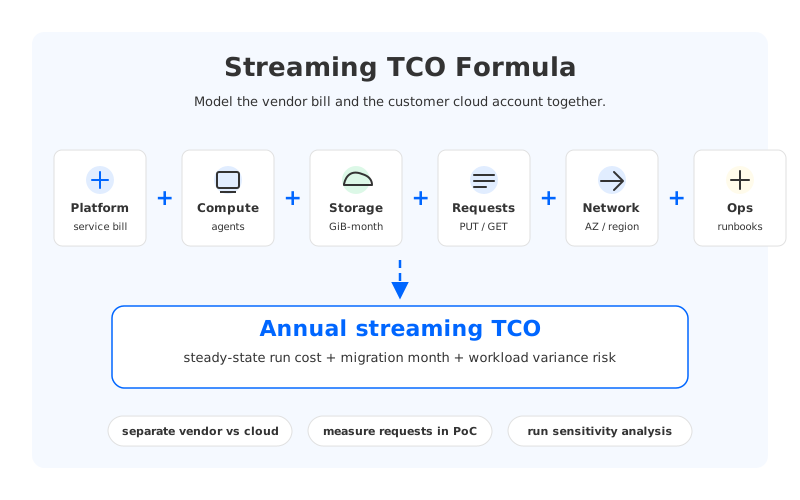
A WarpStream TCO estimate can look deceptively clean if the model starts and ends with the vendor invoice. That is the wrong boundary for a Kafka platform decision. The real budget includes the managed service bill, customer cloud spend, object storage API operations, data transfer, migration overlap, observability, support, and operating work.
WarpStream's architecture changes the cost conversation because it moves durable stream storage into object storage and runs agents in the customer's cloud for BYOC deployments. That can remove some expensive patterns from traditional Kafka, especially the tight coupling between broker-local disks, partition replication, and capacity headroom. It also introduces a different modeling problem: object storage is not a flat bucket of lower-cost bytes. Requests, reads, cache behavior, and workload burstiness still decide whether the final bill behaves the way the spreadsheet promised.
The useful question is whether your workload's write rate, fanout, retention, locality, and operating model map well to an object-storage-first streaming design. A defensible TCO model makes that question visible before procurement turns into commitment.
1Why Vendor Pricing Is Not Full TCO
Public pricing pages are necessary, but they are not a TCO model. They describe the commercial units a buyer should understand before talking to sales or running a proof of concept. For WarpStream, public materials describe plan tiers and usage dimensions such as cluster minutes, uncompressed data written, uncompressed data stored, and query-related usage. In BYOC, the customer also pays the cloud provider for data-plane infrastructure.
That split is easy to miss because BYOC feels like one architectural decision. In finance terms, it creates at least three cost owners:
- Vendor-controlled spend covers the WarpStream subscription, usage meters, support tier, SLA tier, and commercial features tied to the contract.
- Customer-cloud spend covers agents or compute, object storage capacity, object storage requests, network transfer, private connectivity, logging, metrics, and surrounding platform services.
- Internal operating spend covers migration engineering, incident response, cost governance, security review, quota management, and the ongoing work of keeping workloads inside the envelope the model assumed.
This boundary is not a criticism of BYOC. It is one of BYOC's reasons to exist: data and infrastructure can remain under the customer's cloud control. But it also means the platform team and FinOps team need a shared worksheet. A procurement view that sees only the vendor line item will undercount the cloud account, while a cloud-cost view that sees only S3, compute, and networking will undercount the managed service and support commitments.
Traditional Kafka makes the opposite mistake. Many teams already own the cloud resources, so they treat the Kafka bill as familiar infrastructure: instances, EBS volumes, load balancers, and network transfer. The hidden part is often operational: replication factor, partition reassignment, disk replacement, over-provisioned brokers, and cross-AZ traffic. A WarpStream TCO model should compare against that full baseline, not against a stripped-down Kafka cluster that nobody would run in production.
2Inputs Every Kafka TCO Model Needs
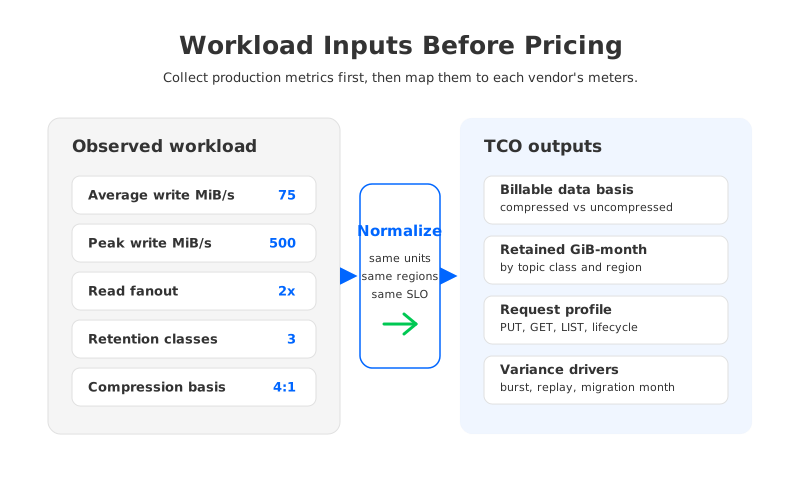
A credible TCO model starts with workload shape. Vendor rate cards translate workload into money; they do not tell you what the workload is. If the first tab of the spreadsheet begins with a monthly target, the model will quietly adapt to the target. If it begins with throughput, fanout, retention, and availability assumptions, the model has a chance to survive contact with production.
| Input | Unit to collect | Why it matters |
|---|---|---|
| Average write throughput | MiB/s | Drives written data, storage growth, compute, and object write behavior. |
| Peak write throughput | MiB/s | Determines headroom, autoscaling assumptions, and burst cost risk. |
| Compression ratio | Ratio and basis | Separates compressed client bytes from uncompressed billable bytes. |
| Read fanout | Multiples of write volume | Captures tailing consumers, replay jobs, and catch-up behavior. |
| Retention by topic class | Hours or days | Converts write rate into retained GiB-month. |
| Topic and partition count | Count | Affects metadata, limits, and migration scope. |
| Deployment geography | Region, AZ, VPC, multi-region | Drives network transfer, durability design, and data residency. |
| Availability target | SLO/SLA | Determines plan tier, support, redundancy, and recovery testing. |
2.1Throughput and Fanout
Write throughput is the anchor because most streaming costs start as bytes entering the system. Keep average and peak rates separate. A platform that writes 80 MiB/s steadily is not the same as one that averages 80 MiB/s but bursts to 500 MiB/s during market open, events, or backfills. The first workload stresses steady-state economics; the second stresses headroom.
Compression needs its own column. Kafka operators often observe compressed bytes because producers compress batches before they hit the broker. Pricing and billing references may use uncompressed data for written or stored units. Comparing 100 MiB/s compressed in one model with 100 MiB/s uncompressed in another breaks the conclusion.
Read fanout is the other half of throughput. Many TCO models count writes carefully and then treat reads as a vague multiplier. That is risky for object-storage-backed systems because read behavior decides cache hit rate and cold object access. A workload with 1x tailing consumption and rare replay is different from one with many consumer groups, frequent backfills, and long analytical scans.
2.2Retention and Storage Growth
Retention converts throughput into storage. A simple first-pass formula is:
retained GiB = average write MiB/s x 3600 x retention hours / 1024
For example, a workload writing 75 MiB/s with 168 hours of retention has a logical retention anchor of about 44,297 GiB before compression and implementation-specific overhead:
75 x 3600 x 168 / 1024 = 44,296.875 GiB
That number is not a quote. It is a way to keep the model honest. From there, the worksheet needs to state whether the vendor meter uses compressed or uncompressed data, whether object storage stores compressed physical objects, whether data is replicated across regions, and whether compaction creates temporary storage. Without those assumptions, a neat retained-data number is more decoration than evidence.
Retention also needs topic classes. Operational topics with 24 hours of retention, compliance topics with 30 days, and replay topics with 90 days should not be averaged into one convenient value. Averages hide the topics that dominate the bill and the topics that dominate migration risk.
2.3Object Storage API Operations
Object storage pricing includes capacity and API operations. AWS S3 pricing, for example, lists request categories such as PUT, COPY, POST, LIST, GET, SELECT, lifecycle transitions, and retrieval-related charges. That matters because streaming systems generate objects continuously.
A first TCO model does not need the vendor's internal object format. It does need measurable proxies: object count growth, PUT rate, GET rate under steady reads, replay behavior, LIST or metadata-sensitive operations, and cache hit behavior. The team should ask for these during the PoC, not after the contract is signed.
Network should be modeled with the same discipline. Apache Kafka's replication model uses leaders and followers for partition fault tolerance; followers copy the leader's log. In cloud deployments, that can translate into cross-AZ data transfer when replicas, producers, and consumers span zones. Object-storage-first systems can reduce broker-to-broker replication traffic, but they do not make every network path free.
3Hidden Cost Categories To Validate In PoC
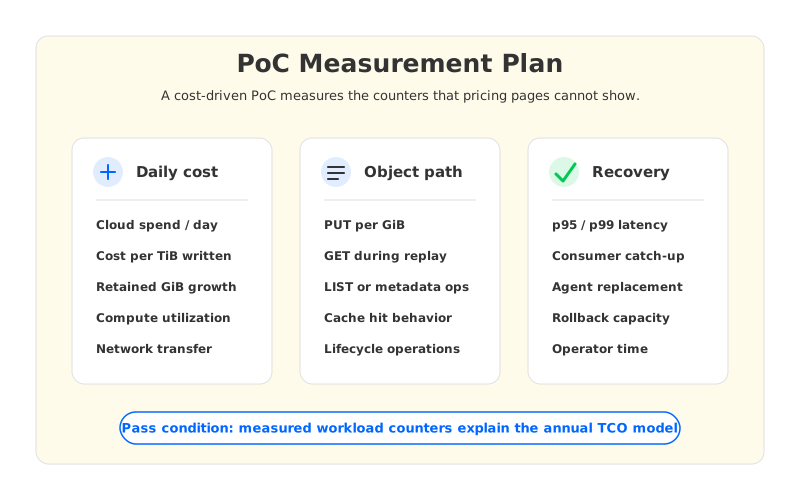
The PoC should not be a latency demo with a cost spreadsheet attached later. If TCO is the reason for evaluating WarpStream, the PoC has to produce the counters that make or break TCO: cloud spend per day, object requests per GiB written, compute utilization, cache behavior, network paths, recovery cost, and operator effort.
Validate the production edges that small tests avoid:
- Migration overlap: dual-write, backfill, validation, rollback capacity, and temporary observability can make the migration month more expensive than steady state.
- Failure and recovery behavior: node replacement, agent restart, throttling, and consumer catch-up can change compute, request, and latency patterns.
- Operational ownership: BYOC still needs on-call boundaries for cloud quotas, object store throttling, Kubernetes capacity, and vendor incidents.
- Governance and security: private connectivity, IAM review, audit logging, encryption, data residency, and procurement controls belong in TCO.
- Committed-use risk: private offers can lower unit prices, but they also convert workload uncertainty into contract risk.
The proof-of-concept workload should include at least one replay scenario and one failure scenario. Streaming platforms are bought for the steady state, but they are judged during catch-up and recovery. Daily cost per TiB written, requests per GiB, retained GiB growth, p95 and p99 latency, compute saturation, and recovery time make those trends visible.
4Comparing WarpStream TCO With AutoMQ
The broader category is Kafka-compatible streaming on shared object storage. WarpStream is one implementation in that category. AutoMQ is another: it keeps Kafka protocol compatibility while using object storage as the durable storage layer and stateless brokers to reduce the coupling between broker compute and retained data. In BYOC-style deployments, that architecture can expose cloud resource consumption in the customer's own account, which gives FinOps teams a cleaner path from workload metrics to cloud bills.
The important comparison is not a slogan like "object storage is lower cost." It is the set of mechanisms each system uses to turn object storage into a streaming data plane. A fair worksheet asks the same questions of both systems:
| Question | Why it affects TCO |
|---|---|
| What bytes are metered: compressed, uncompressed, logical, or physical? | The same workload can look different if billing units use different byte definitions. |
| What write-ahead or local persistence path exists before data reaches object storage? | WAL design affects latency, cloud resources, and recovery cost. |
| How does the system aggregate writes into objects? | Object size and count influence PUT, GET, LIST, metadata, and compaction behavior. |
| Which reads are served from memory, local cache, WAL, or object storage? | Read path determines replay cost, latency, and object request volume. |
| How does scaling change data movement? | Stateless scaling can reduce the cost of adding or replacing compute capacity. |
| Which resources run in the customer cloud account? | FinOps teams need a clear split between vendor invoice and cloud-provider invoice. |
AutoMQ should enter the TCO discussion when the buyer's pain is architectural: broker-local disk headroom, partition reassignment, replication traffic, recovery time, or over-provisioned Kafka capacity. AutoMQ's public pricing calculator uses workload-style inputs such as write throughput, read throughput, retention, availability-zone mode, and cluster tier, which makes it useful as a comparison exercise alongside a WarpStream worksheet.
There are cases where the TCO comparison should widen beyond WarpStream and AutoMQ. If the dominant cost is connectors, stream processing governance, Schema Registry workflows, or an enterprise platform bundle, Confluent Cloud may need to stay in the model. If the priority is AWS-native procurement and familiar Kafka operations, Amazon MSK may remain part of the baseline.
5A TCO Worksheet You Can Reuse
The worksheet below is intentionally vendor-neutral. Fill it once, then map it to WarpStream, AutoMQ, self-managed Kafka, Confluent Cloud, Amazon MSK, or any other candidate.
| Worksheet section | Fields to include |
|---|---|
| Workload | Average/peak writes, reads, compression, fanout, retention classes |
| Architecture | Region, AZs, private connectivity, DR, multi-region replication |
| Vendor bill | Plan, usage meters, support, SLA, enterprise features |
| Cloud bill | Compute, object storage, requests, transfer, logs, metrics |
| Operations and risk | Migration, on-call, security, forecast variance, lock-in surface |
Two rules keep the worksheet from turning into theatre. First, every number needs a source column: public pricing pages, vendor billing docs, cloud pricing pages, private quotes, or measured PoC output. Second, every assumption needs a sensitivity column. Change retention from 7 days to 30 days, fanout from 2x to 6x, compression from 4:1 to 2:1, and steady traffic to bursty traffic.
The model should also include a migration month. During cutover, old and new systems may run together, producers may dual-write, consumers may validate offsets, and observability may be duplicated.
6Procurement Questions Before You Commit
A final TCO review should be specific enough that sales, engineering, FinOps, and security can all disagree productively.
Use these questions before turning a PoC into a commitment: Which plan tier and support level are required for the production SLO? Are written and retained bytes metered as compressed, uncompressed, logical, or physical bytes? What customer-cloud resources are required at the minimum footprint and at peak traffic? How many object storage PUT, GET, LIST, and lifecycle operations should you expect per TiB written, read, and replayed? Which network paths remain billable? What happens to cost during agent replacement, zone impairment, object store throttling, consumer rewind, and rollback? Which discounts require committed usage? Which operating responsibilities remain owned by the customer?
The answer does not have to make WarpStream, AutoMQ, or any other platform look perfect. It has to make the risk legible. A platform that is slightly more expensive but easier to forecast may be the right choice for a regulated organization. A platform that is lower in steady state but sensitive to replay may still be right for append-heavy telemetry. The wrong outcome is not choosing one architecture over another. The wrong outcome is discovering the real cost model after the system is already part of your data plane.
7References
- WarpStream Pricing
- WarpStream Billing Reference
- WarpStream BYOC documentation
- AWS S3 Pricing
- AWS EC2 On-Demand Pricing and Data Transfer
- Apache Kafka Documentation: Replication
- Confluent Announces Intent to Acquire WarpStream
- AutoMQ Pricing
- AutoMQ Documentation
8FAQ
8.1What should be included in WarpStream TCO?
Include the WarpStream service bill, customer-cloud compute, object storage capacity, object storage API requests, network transfer, private connectivity, observability, support, migration overlap, and internal operating work. A vendor quote is one input to TCO, not the full model.
8.2Why does uncompressed data matter for Kafka cost modeling?
Kafka teams often observe compressed producer bytes, while some billing meters use uncompressed written or stored data. Keep compressed bytes, uncompressed logical bytes, retained physical bytes, and billable bytes in separate worksheet columns so vendor comparisons use the same basis.
8.3How do object storage requests affect streaming cost?
Object storage providers charge for API operations as well as storage capacity. Streaming workloads can generate PUT, GET, LIST, lifecycle, and retrieval-related operations depending on object layout, read fanout, replay behavior, and retention policy.
8.4Is AutoMQ a direct TCO alternative to WarpStream?
AutoMQ belongs in the comparison when the evaluation is about Kafka-compatible streaming on shared object storage, BYOC resource visibility, stateless scaling, and reducing the cost tied to broker-local storage. The comparison should still use the same workload inputs and PoC measurements for both systems.
8.5What is the quickest way to validate a TCO model?
Run a representative PoC that records daily vendor meters, cloud compute, object storage capacity, API calls, network transfer, p95 and p99 latency, replay behavior, recovery behavior, and operator time. The fastest reliable model is built from production-like counters, not from a pricing page alone.


