
Table of Contents
Table of Contents
Most teams comparing WarpStream vs Amazon MSK are not asking whether Kafka is useful. They already have producers, consumers, topics, offsets, monitoring, and a long list of workloads that expect the Kafka protocol to be there. The harder question is where the operational boundary should sit: inside an AWS-managed Kafka service, inside a Bring Your Own Cloud data plane that writes to object storage, or inside a Kafka-compatible shared-storage architecture that keeps more of the broker behavior familiar.
That is why "WarpStream vs MSK" can be a misleadingly short search query. Amazon MSK is AWS's managed Apache Kafka service, with provisioned clusters and serverless clusters designed to reduce the amount of Kafka infrastructure a team operates directly. WarpStream takes a different path: agents run in the customer's cloud environment and use object storage as the system of record, with a vendor-operated control plane coordinating the service. Both can be reasonable. They optimize for different failure modes, cost drivers, and operational habits.
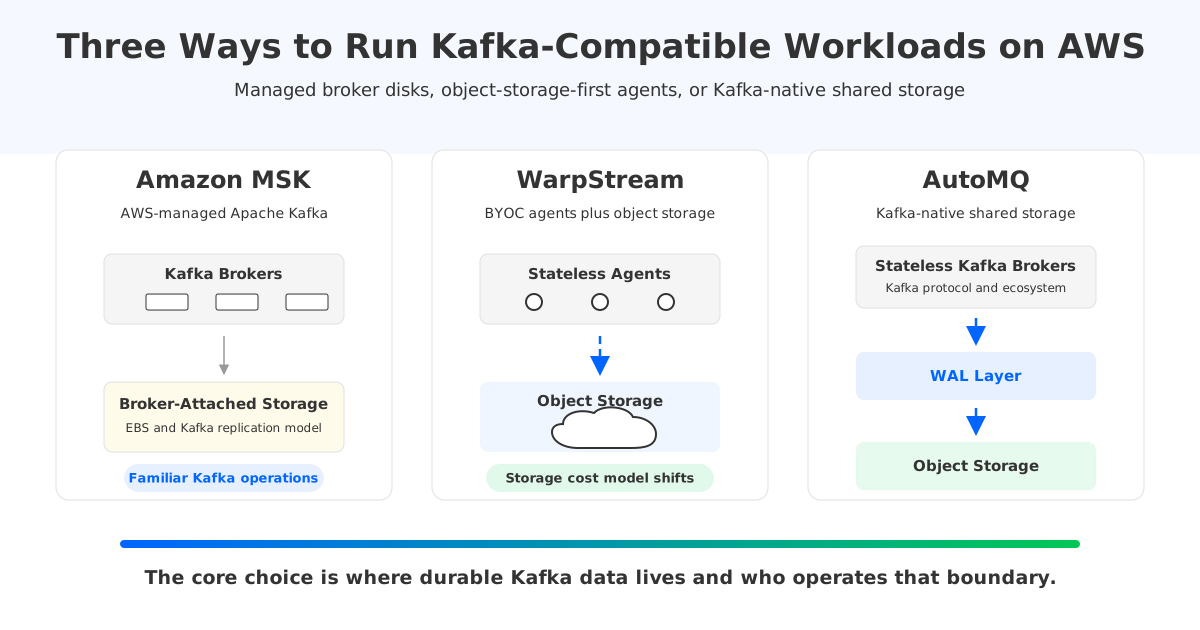
The practical decision is not "managed Kafka or not managed Kafka." It is whether your workload is better served by broker-owned disks, object-storage-first agents, or Kafka-native brokers that separate compute from shared storage.
1Quick Answer by Workload
Amazon MSK is usually the default candidate when the team wants AWS-native managed Kafka and accepts Kafka's traditional broker-and-disk model. You still choose cluster type, instance family, storage, networking, authentication, upgrades, and monitoring strategy, but the service removes a large amount of undifferentiated cluster management. For teams standardizing on AWS and already comfortable with Kafka operations, that is a strong baseline.
WarpStream is more interesting when the primary pain is the cost and operational shape of broker-local storage. Its architecture uses stateless agents in the customer's cloud account and stores data in object storage rather than on broker-attached disks. That changes the scaling conversation: retained bytes and traffic patterns become tightly connected to object storage, request volume, network paths, and vendor service fees, rather than to a fleet of long-lived Kafka brokers with attached storage.
AutoMQ belongs in the same evaluation when the team wants Kafka-native compatibility and cloud storage economics together. AutoMQ keeps the Kafka protocol and ecosystem surface, uses stateless brokers, and persists data through a shared-storage design with WAL options and object storage. It is not the same architecture as MSK or WarpStream, which is exactly why it is useful as a third reference point.
| Workload pattern | Amazon MSK tends to fit when... | WarpStream tends to fit when... | AutoMQ is worth evaluating when... |
|---|---|---|---|
| Existing AWS Kafka estate | The team wants AWS-managed Kafka with familiar broker behavior | The team wants to move the log away from broker disks | The team wants Kafka-native behavior with shared-storage elasticity |
| Long retention | EBS or tiered storage tradeoffs are acceptable | Object storage economics are the central design goal | Object storage economics matter, but Kafka compatibility depth still matters |
| Latency-sensitive services | The team can provision and tune brokers for predictable latency | The team accepts or validates the latency tradeoffs of an object-storage-first path | The team wants low-latency writes through WAL plus object-storage durability |
| Operational ownership | AWS service ownership is preferred | BYOC data-plane ownership is preferred | BYOC or self-managed control with Kafka-native operations is preferred |
The right answer often changes by workload. A compacted operational topic, a high-throughput analytics firehose, and a payments event stream do not need to land on the same platform merely because they all speak Kafka.
2Architecture Comparison
MSK starts from Apache Kafka's familiar shape. Provisioned MSK clusters run brokers, store data on broker-attached storage, and expose Kafka endpoints inside AWS networking patterns. MSK Serverless changes the capacity-management experience by automatically provisioning compute and storage resources, but it is still an AWS-managed Kafka service with AWS-defined service boundaries and limits.
WarpStream starts from a different premise: Kafka-compatible access should not require the durable log to live on broker-local disks. WarpStream agents run in the customer's environment and communicate with a control plane while persisting data to object storage. Its public documentation describes this as a separation between the data plane in the customer's cloud and the control plane operated by WarpStream.
AutoMQ is also shared-storage oriented, but the evaluation surface is different. AutoMQ presents Kafka-compatible brokers and redesigns the storage layer around shared storage and WAL. That means the application-facing contract can look closer to Kafka, while the storage and scaling model avoids tying durable data to individual broker disks.
Those distinctions matter during incidents. In a broker-disk model, replacing or resizing a broker can trigger partition movement, replica catch-up, storage balancing, and operational waiting time. In an object-storage-first model, the agent fleet is lighter, but latency and cost depend on object storage behavior, metadata flow, and the service's protocol implementation. In a Kafka-native shared-storage model, the broker can become stateless without asking every application owner to reason about a completely different streaming abstraction.
3Cost and Billing Model
MSK cost analysis starts with AWS resources and service dimensions. For provisioned clusters, teams typically evaluate broker instance hours, storage, data transfer, optional features, and operational overhead. For serverless clusters, AWS pricing uses serverless dimensions instead of fixed broker fleets. Region, cluster type, storage throughput, traffic direction, and retention policy can all change the final bill, so exact comparisons should be calculated from the current AWS pricing page for the target region.
WarpStream cost analysis starts with a BYOC split. The customer pays for the cloud resources consumed in their own account, such as object storage, compute, requests, and network paths, and also pays WarpStream according to its commercial model. The attractive part is that durable storage can move to object storage. The part that needs careful modeling is that object storage is not free infrastructure: request volume, egress paths, compaction behavior, metadata operations, and low-latency options can all affect the bill.
AutoMQ cost analysis should be modeled in the same plain way. AutoMQ's pricing and deployment model need to be combined with the underlying cloud bill for compute, object storage, WAL storage, traffic, and operations. The useful comparison is not a single headline number. It is a workload worksheet that shows which architecture charges for retained bytes, which one charges for broker capacity, and which one moves cost into object storage and network behavior.
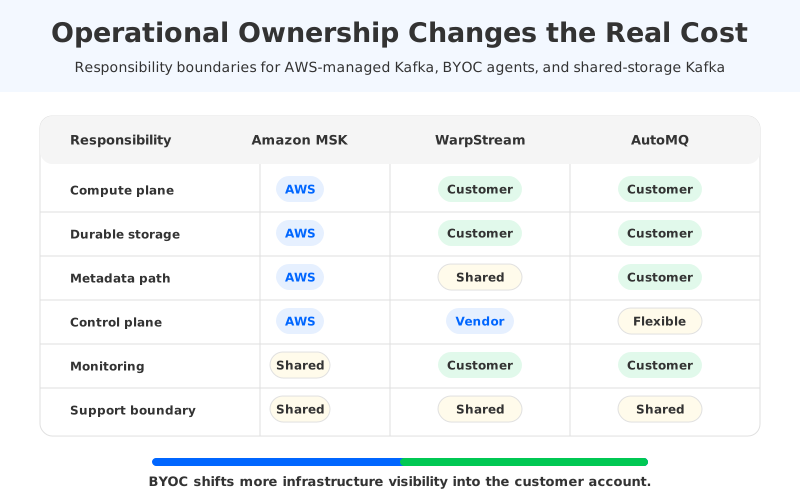
A clean cost model should separate six lines before any vendor comparison begins:
- Compute capacity: broker instances, agents, controllers, or serverless capacity units. This is where bursty workloads and always-on fleets diverge.
- Durable storage: EBS, object storage, tiered storage, and WAL storage. Retention-heavy workloads usually expose the architectural difference fastest.
- Read and write traffic: producer ingress, consumer fan-out, replication, cross-AZ paths, and public or private egress. Network cost can erase storage savings if the topology is sloppy.
- Metadata and request volume: object-store requests, controller work, catalog operations, and background maintenance. These are easy to miss in high-message-count workloads.
- Managed service or license fees: AWS service charges, vendor service fees, support, and committed spend. They must be modeled alongside infrastructure, not after it.
- Migration overlap: the period when MSK and the target platform run in parallel. A migration plan that ignores overlap cost will look better on paper than in the monthly bill.
The safest comparison is region-specific and date-stamped. As of May 20, 2026, the public pricing and documentation for AWS MSK, WarpStream, and AutoMQ should be rechecked before publication because cloud service dimensions and packaging can change without the architecture itself changing.
4Latency and Compatibility Considerations
Latency is where architecture stops being abstract. Kafka applications often assume that produce acknowledgments, consumer lag, rebalance behavior, and offset commits behave within a familiar envelope. If a platform changes the storage path, the team should test the actual producer and consumer behavior rather than accepting a generic latency claim.
MSK's advantage is familiarity. It runs Apache Kafka as a managed AWS service, so teams can reason with known Kafka concepts: brokers, partitions, replicas, client versions, storage throughput, and standard Kafka observability. That does not make every MSK workload low-latency by default. It does mean most tuning work uses the Kafka mental model the team already knows.
WarpStream's advantage is that it removes broker-local disks from the durable log path, but that same shift makes latency validation mandatory. WarpStream documents protocol and feature support separately from Apache Kafka itself, which is the right signal to read carefully. Low-latency clusters and object-storage choices may improve specific paths, but they also introduce deployment, region, and cloud-storage assumptions that should be tested under the real workload.
AutoMQ should be tested with the same discipline. Its compatibility documentation describes Kafka client and ecosystem compatibility, while its stateless broker and WAL documentation explain how it handles durable writes and shared storage. For teams coming from MSK, the question is not whether shared storage sounds elegant. The question is whether their own clients, connectors, quotas, ACLs, observability, and recovery runbooks behave correctly against the target platform.
5Where AutoMQ Fits in the Same Decision
The gap between MSK and WarpStream is bigger than "AWS service vs vendor service." MSK preserves the traditional Kafka storage model behind a managed AWS boundary. WarpStream changes the log-storage model more aggressively by using stateless agents and object storage. AutoMQ sits between those poles in a useful way: it keeps a Kafka-native broker surface while moving persistence to shared storage.
That makes AutoMQ relevant for three kinds of teams:
- Teams that like MSK's Kafka compatibility but dislike the operational consequences of broker-local durable storage.
- Teams that like WarpStream's object-storage economics but want a Kafka-native broker model and a different compatibility profile.
- Teams that need BYOC control, cloud account ownership, and lower data movement during scaling or recovery.
The product point should not be overstated. AutoMQ is not a universal replacement for every MSK or WarpStream deployment, and a serious evaluation still needs a proof of concept. Its strongest role in this comparison is architectural: it shows that the choice is not limited to "traditional managed Kafka" or "object-storage-first agents." There is a third pattern where Kafka compatibility and shared storage are designed together.
6Workload Fit Matrix
Before choosing a platform, put each workload on a matrix instead of forcing one cluster strategy across the whole estate.
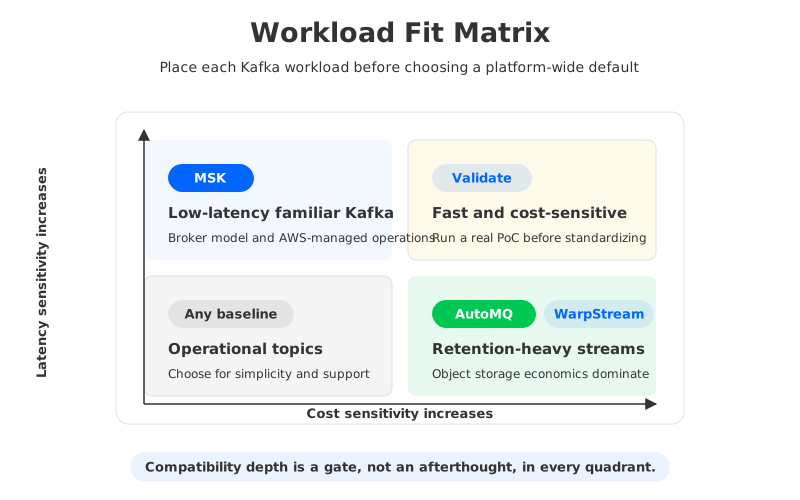
High-compatibility, low-latency workloads are often easiest to start on MSK because the managed service keeps familiar Kafka mechanics close to the surface. Cost-sensitive, retention-heavy workloads deserve a serious object-storage evaluation because the traditional broker-disk model can make retained data expensive to scale and rebalance. Workloads that need Kafka-native compatibility and cloud-storage economics at the same time are where AutoMQ deserves a side-by-side test.
The decision becomes cleaner when the team stops asking for the "ideal Kafka alternative" and starts writing down workload facts:
- What client versions, Kafka APIs, and ecosystem tools are actually used?
- How sensitive is the workload to p99 produce latency, consumer lag, and rebalance duration?
- How much retained data exists, and how fast does it grow?
- How much consumer fan-out exists, and where does the traffic cross AZ, VPC, or region boundaries?
- Who must own the data plane, metadata, cloud resources, monitoring, upgrades, and incident response?
- What rollback path exists if the migration target behaves differently under peak traffic?
That worksheet usually reveals the answer. MSK is compelling when AWS-managed Kafka familiarity is worth the broker-storage tradeoff. WarpStream is compelling when object-storage-first BYOC economics dominate and the workload validates its protocol and latency needs. AutoMQ is compelling when the team wants Kafka-native compatibility, shared-storage elasticity, and a clearer ownership boundary in its own cloud environment.
7Sources
- Amazon MSK developer guide: What is Amazon MSK?
- Amazon MSK Provisioned
- Amazon MSK Serverless
- Amazon MSK pricing
- WarpStream architecture
- WarpStream Kafka protocol and feature support
- WarpStream low latency clusters
- WarpStream security and privacy considerations
- AutoMQ compatibility with Apache Kafka
- AutoMQ stateless broker
- AutoMQ WAL storage
- AutoMQ pricing
8FAQ
8.1Is WarpStream the same kind of service as Amazon MSK?
No. Amazon MSK is an AWS-managed Apache Kafka service. WarpStream is a BYOC-oriented streaming platform where agents run in the customer's cloud environment and use object storage as the durable storage layer. Both can expose Kafka-compatible interfaces, but their architecture and operating boundaries are different.
8.2Is Amazon MSK always lower-latency than WarpStream?
Not automatically. MSK keeps the traditional Kafka broker model, which is familiar for latency tuning, while WarpStream's object-storage-first architecture has different latency tradeoffs and deployment options. The only safe answer is to test the actual producer, consumer, retention, and fan-out pattern in the target AWS region.
8.3When should a team consider AutoMQ instead of only comparing WarpStream and MSK?
Consider AutoMQ when the team wants Kafka-native compatibility, shared-storage economics, and a BYOC or self-controlled deployment model. It is especially relevant when MSK feels operationally familiar but too tied to broker-local storage, while WarpStream feels cost-attractive but too different from the Kafka broker model the team wants to keep.
8.4What is the biggest cost mistake in a WarpStream vs MSK comparison?
The biggest mistake is comparing only one billing line. MSK analysis should include broker or serverless charges, storage, network, and operations. WarpStream analysis should include vendor charges plus the customer's own cloud bill for agents, object storage, requests, network paths, and low-latency configuration. Migration overlap cost should be included for both.
8.5Can I migrate from MSK to a BYOC Kafka platform without rewriting applications?
Often, yes, if the target platform supports the Kafka APIs, client behavior, security model, and ecosystem tools your applications use. You still need to test offsets, ACLs, TLS, schema dependencies, connector jobs, lag behavior, monitoring, and rollback before treating the migration as a bootstrap-server change.


