
Table of Contents
Table of Contents
AWS teams often start their Kafka decision with Amazon MSK because procurement, IAM, VPC networking, CloudWatch, and support already live in the same operating model. That is a rational default, especially when the immediate goal is to stop self-managing brokers without changing the application surface area. The harder question appears after the first production bill or the first painful capacity event: are you buying a managed Kafka control plane, or are you also changing the storage and scaling economics underneath Kafka?
WarpStream and Amazon MSK answer different versions of that question. MSK keeps the Apache Kafka broker model recognizable and offers several AWS-managed deployment modes. WarpStream changes persistence by using diskless Agents and cloud object storage, with a cloud control plane around a BYOC data plane. The choice is less about the longer feature list and more about which failure mode you would rather own.
1Quick Answer for AWS Teams
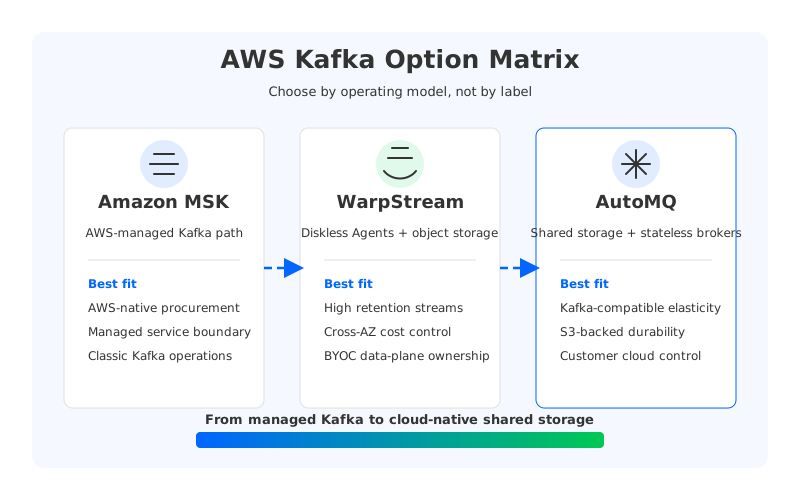
Choose Amazon MSK when you want the most AWS-native Kafka path, need compatibility with standard Kafka operational expectations, and prefer AWS to own the managed service boundary. MSK Provisioned gives teams direct control over broker type, storage, partitions, and networking. MSK Serverless removes more capacity planning. MSK Express, according to AWS, is designed to provide faster scaling and recovery than standard brokers while reducing the operational work of sizing storage.
Choose WarpStream when the dominant problem is Kafka's cloud cost shape: replicated broker disks, inter-AZ traffic, and slow data movement during scaling or recovery. WarpStream's documentation describes it as a diskless, Apache Kafka-compatible streaming platform built on cloud object stores such as S3. Its Agents run in your environment, but durable data lands in object storage rather than on broker-local disks.
AutoMQ belongs in the same architectural discussion as a Kafka-compatible, shared-storage system for teams that want BYOC-style data control and stateless broker operations while keeping Kafka clients and ecosystem tools. The important distinction is not the logo. It is whether the data plane still treats brokers as the long-term home of data, or whether brokers become compute around a cloud storage layer.
| Decision axis | Amazon MSK | WarpStream | AutoMQ |
|---|---|---|---|
| Primary fit | AWS-native managed Kafka | Object-storage-first Kafka-compatible BYOC | Kafka-compatible shared-storage BYOC |
| Data persistence model | Kafka brokers with managed storage options | Diskless Agents plus object storage | Stateless brokers plus shared stream storage |
| Operational owner | AWS manages service mechanics; user still designs topics, quotas, clients, and capacity choices | User runs Agents; WarpStream Cloud handles control plane services | Customer cloud data plane with AutoMQ control and operations model |
| Cost question to model | Broker hours, storage, data transfer, tiering, and operational labor | Object storage, Agent compute, platform fee, and client locality | Object storage, compute, control plane/license, and cross-AZ reduction |
| Best first test | Existing Kafka workload already standardized on AWS | High-retention or bursty workload where disk replication dominates cost | Kafka workload needing cloud-native elasticity and data-plane control |
This table is deliberately high level. A real selection should be workload-specific because Kafka cost follows write rate, replication, retention, read fan-out, and availability-zone topology. A small cluster with strict AWS procurement rules may be a perfect MSK workload. A high-retention stream with frequent rebalances may be a poor fit for broker-local storage even when the service is managed.
2Architecture Comparison
Amazon MSK is managed Kafka on AWS, so the mental model stays close to standard Kafka operations. Topics are partitioned, partitions have leaders and followers, and broker capacity matters because brokers still serve reads, writes, replication, and storage-related work. AWS abstracts away many undifferentiated chores, but it does not erase the architectural coupling between compute and the data that brokers own.
That coupling matters during growth. In a traditional Kafka layout, adding brokers is only the beginning; partitions must be reassigned, data may move, and leaders and followers must settle into a healthier balance. Apache Kafka's tooling includes partition reassignment because the platform has to redistribute data and leadership when cluster shape changes. MSK makes this easier than self-managed Kafka, but the underlying design remains recognizable.
WarpStream changes the center of gravity. Its public documentation describes Agents as the data-plane process and object storage as the durable storage layer. In that model, an Agent is not a broker that must retain a specific partition's full log on local disk. It is a compute and protocol-serving layer around object storage, coordinated by WarpStream services.
AutoMQ takes a related shared-storage direction: it keeps Kafka protocol compatibility while moving stream storage onto a cloud-native shared storage layer. For AWS teams, that puts AutoMQ in the category of "Kafka-compatible, object-storage-backed systems" rather than "managed traditional Kafka." That category is attractive when the operational goal is to make expansion, recovery, and catch-up reads less dependent on copying large volumes of broker-owned data.
3AWS Cost Drivers
The cost comparison is not "MSK expensive, object storage inexpensive." That framing is too blunt for a real review. MSK pricing includes broker or capacity charges depending on the mode, storage-related charges, data transfer, and optional features. WarpStream and AutoMQ shift durable storage to object storage, but they introduce their own compute, control plane, and platform pricing models. The right question is which bill components grow with retained bytes, replicated bytes, and operational change.
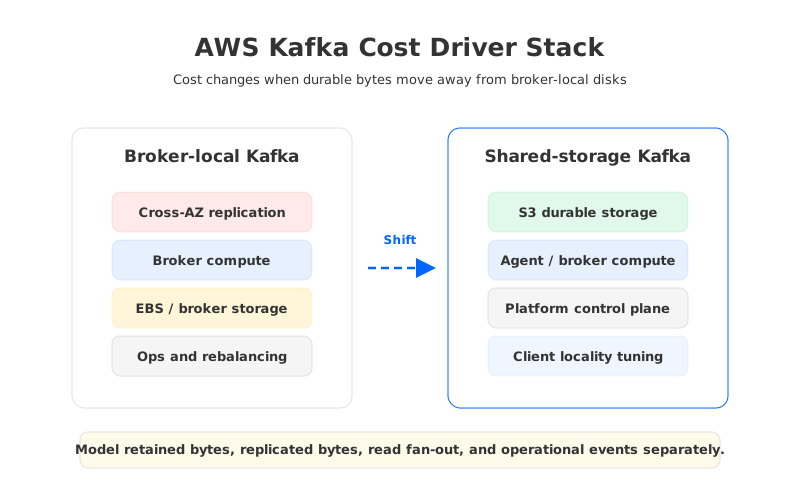
The largest AWS Kafka bills usually come from a few places:
- Broker or Agent compute. MSK charges for broker instances or serverless capacity dimensions depending on the deployment mode. WarpStream and AutoMQ still need compute to accept produce requests, serve fetches, cache hot data, and run protocol-facing services.
- Durable storage. Standard Kafka designs keep log segments attached to brokers, commonly through EBS-backed storage in AWS-managed setups. Object-storage-first systems push the long-lived log into S3 or compatible object storage.
- Cross-AZ traffic. Multi-AZ Kafka replication and client placement can create inter-zone transfer. AWS documents data transfer pricing separately from many service pages, so FinOps teams should model it explicitly rather than treating it as background noise.
- Retention and catch-up reads. Longer retention changes the storage curve. Heavy consumer replay changes the read path and cache pressure. These are different workloads even when the write throughput looks identical.
- Operations. A managed service reduces some labor, but capacity planning, client tuning, topic governance, incident response, and migration work still exist.
Object storage is compelling because retained bytes and durable replication are where cloud storage platforms are strong. But object storage also changes latency and read-path design. WarpStream addresses this with Agent-side behavior, client tuning guidance, and low-latency options such as lightning topics. AutoMQ uses a shared-stream storage architecture with a write-ahead layer and object storage beneath it. In both cases, ask how the system handles hot reads, cold reads, metadata, and write acknowledgments, not only where old segments live.
4Scaling and Operations
Scaling Kafka on AWS has two very different meanings. One meaning is "increase capacity so clients have more headroom." The other is "redistribute existing data and leadership so the cluster actually uses that capacity." Traditional Kafka often makes the second part the expensive part because partitions are not abstract counters; they are logs with physical placement and leader ownership.
MSK gives teams AWS-managed machinery around that process. Express brokers are AWS's attempt to make this experience more elastic by improving scaling and recovery behavior compared with standard brokers. That matters for teams that want to stay close to AWS-native Kafka while reducing operational drag. It does not make every Kafka scaling problem disappear, especially if the workload's root issue is long retention, high fan-out, or a partition layout that has drifted over years.
WarpStream attacks the problem from the storage side. If Agents are stateless relative to the durable log, adding more Agents should not require the same broker-local data migration. You still operate compute, networking, IAM, monitoring, and client configuration, but scaling no longer revolves around moving retained logs between broker disks.
AutoMQ's shared-storage design has a similar operational thesis. Stateless brokers make expansion and recovery closer to compute scheduling than storage relocation. That is especially relevant on Kubernetes or EKS, where teams already expect workloads to be rescheduled and replaced without treating each node as a unique data-bearing asset.
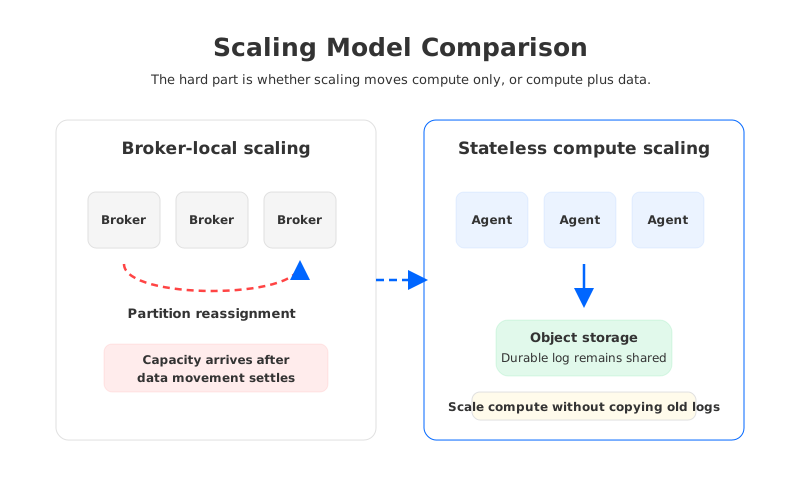
The practical test is a failure drill, not a slide. Before choosing, run a workload that includes leader changes, consumer catch-up, broker or Agent replacement, and a scale-out event. Measure p99 produce latency, fetch latency during replay, time to restore headroom, and cross-AZ data transfer. A benchmark that only writes fresh messages for 30 minutes will miss the part of Kafka that hurts in production.
5Security, Networking, and Data Control
MSK wins a lot of enterprise reviews because its boundary is familiar. The service lives inside AWS, integrates with VPC patterns, supports AWS-native access patterns, and fits procurement teams that already trust AWS as a managed service provider. For regulated teams, that can be more important than theoretical architecture elegance. The downside is that the service boundary and feature roadmap are AWS-defined.
WarpStream's BYOC model changes the trust boundary. The Agents run in your cloud environment and use your object storage, while WarpStream Cloud provides control-plane services. That is appealing when data locality and cloud account ownership matter, but the platform team must understand Agent deployment, object storage permissions, network paths, and telemetry. BYOC reduces one vendor data-plane concern while increasing the need for disciplined cloud operations.
AutoMQ also uses BYOC positioning for teams that want customer-account data planes and Kafka compatibility. In an AWS review, its natural comparison is not "another hosted Kafka endpoint" but "another way to run Kafka-compatible infrastructure where durable data is backed by cloud storage and brokers are not long-lived storage owners." That framing helps security teams ask the right questions:
- Which component can read customer payload data?
- Which IAM role can read or write the object storage bucket?
- What crosses the control channel, and what stays in the data plane?
- How are upgrades, support access, audit logs, and emergency operations authorized?
- Can the system run inside the required VPC, subnet, and private connectivity model?
The answers are product-specific and should be verified in the vendor's current documentation during procurement. The pattern is the same: draw the data boundary first, then evaluate control-plane convenience.
6Workload-by-Workload Guidance
An AWS team choosing between WarpStream and MSK should start with workload shape rather than vendor identity. Kafka workloads that look similar at the API layer can behave very differently under cost and failure pressure.
| Workload pattern | Better default | Why |
|---|---|---|
| Small to medium production Kafka with AWS-first procurement | Amazon MSK | The managed service path is straightforward, and architectural cost pressure may not justify a new storage model. |
| High retention with steady write throughput | WarpStream or AutoMQ category | Object storage can change the retained-byte cost curve and reduce broker disk pressure. |
| Frequent burst scaling or node replacement | WarpStream or AutoMQ category | Stateless compute makes capacity changes less dependent on data relocation. |
| Ultra-low-latency workloads with tight p99 budgets | Test carefully | Object-storage-backed systems need a write-path design that matches the latency target; MSK may be easier to reason about for classic Kafka latency expectations. |
| Strict AWS service standardization | Amazon MSK | Organizational fit may outweigh architectural optimization. |
| BYOC with strong data-plane ownership requirements | WarpStream or AutoMQ category | Customer-account deployment and object storage ownership become central decision factors. |
The most common mistake is treating this as a binary migration question. Many organizations will keep MSK for workloads that benefit from AWS-native simplicity and evaluate object-storage-backed Kafka-compatible systems for workloads where the old Kafka cost model is misaligned with cloud economics. That mixed posture is not indecision. It is architecture matching.
7Evaluation Checklist
Run the comparison with the same inputs for all options:
- Model write throughput and retention together. A 50 MiB/s stream retained for 24 hours is a different storage problem from the same stream retained for 30 days.
- Separate producer replication from consumer fan-out. Cross-AZ cost can come from writes, reads, and client placement. Do not collapse it into a single "network" line.
- Benchmark recovery, not only steady state. Replace a broker or Agent, trigger catch-up reads, and measure the noisy interval.
- Inspect client changes. Kafka compatibility does not always mean no tuning. Fetch sizes, batching, metadata refresh, and zone-aware clients can matter.
- Draw the trust boundary. Identify the control plane, data plane, object storage account, IAM roles, support access path, and audit trail.
- Price the operating model. Include engineering time for topic governance, upgrades, alerting, incident response, and migration.
This checklist usually clarifies the decision faster than a feature matrix. MSK is a strong answer when managed AWS integration is the main problem. WarpStream is a strong answer when Kafka's broker-disk model is the main problem. AutoMQ becomes relevant when the team wants the same shared-storage direction with Kafka compatibility, BYOC deployment, and stateless broker operations.
8References
- Amazon MSK pricing
- Amazon MSK Developer Guide
- WarpStream documentation: Introduction
- WarpStream documentation: Architecture
- WarpStream documentation: Configure clients to eliminate AZ networking costs
- Apache Kafka documentation
- AutoMQ documentation: Architecture overview
- AutoMQ documentation: Deploy to AWS EKS
9FAQ
9.1Is WarpStream a drop-in replacement for Amazon MSK?
Not in the procurement and operations sense. WarpStream is Kafka-compatible, but it uses a different architecture with Agents and object storage, so teams should validate client behavior, latency, security boundaries, monitoring, and migration mechanics before treating it as a replacement.
9.2Is Amazon MSK always more operationally efficient than running Kafka yourself?
For many AWS teams, yes, because AWS manages a large part of the service mechanics. The remaining work still includes capacity design, topic governance, client tuning, incident response, and cost control, so the operational gain depends on the workload and the team's current maturity.
9.3Does object storage make Kafka latency worse?
It can, if the write path is a naive object-storage write on every acknowledgment. Systems such as WarpStream and AutoMQ add architecture around object storage to handle persistence, caching, metadata, and hot reads. The right answer is workload-specific testing, especially for p99 latency and catch-up reads.
9.4When should AutoMQ be evaluated alongside WarpStream and MSK?
Evaluate AutoMQ when the requirement is Kafka compatibility with a cloud-native shared-storage architecture, stateless broker operations, and BYOC-style data control. It is most relevant when the team wants to reduce the operational and cost penalties of broker-local storage without leaving the Kafka ecosystem.
9.5Can one company use both MSK and an object-storage-backed Kafka-compatible system?
Yes. MSK can remain the default for AWS-native workloads where simplicity and organizational fit matter most, while object-storage-backed systems can handle high-retention, bursty, or cost-sensitive workloads. A portfolio approach is often more realistic than forcing every stream into one platform.


