
Table of Contents
Table of Contents
Teams comparing WarpStream and AutoMQ are usually past the first Kafka question. They are asking whether the traditional Kafka storage model still fits cloud workloads where retained data is large, availability zones are billed boundaries, and capacity changes should not require moving large amounts of broker-owned data.
That is why this comparison is more interesting than a normal vendor matrix. WarpStream and AutoMQ both keep the Kafka API surface familiar while moving durable stream storage toward cloud object storage. Both respond to the same pressure in conventional Kafka: brokers are compute nodes, replication participants, and long-lived storage owners at the same time.
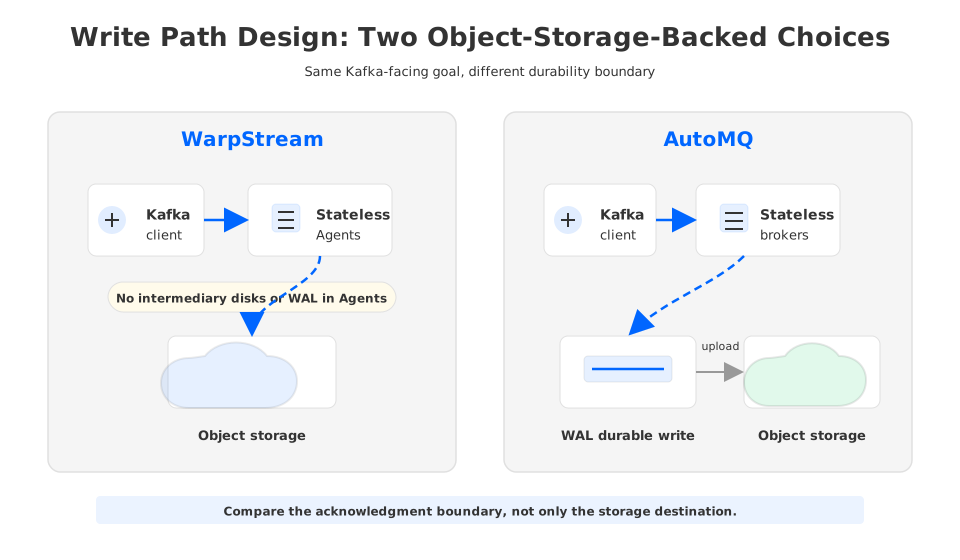
The important difference is how each system makes object storage usable for Kafka-compatible workloads. WarpStream presents a diskless Agent model that writes data directly to object storage, with no intermediary disks or write-ahead log in the Agents. AutoMQ uses Kafka-compatible stateless brokers backed by S3Stream, where writes are first made durable through WAL storage and then uploaded to object storage.
1Quick Answer
Choose WarpStream when the main objective is to remove broker disks from Kafka economics and adopt a diskless Agent model where object storage is the primary durable layer. WarpStream's documentation describes Agents as stateless data-plane components that speak the Kafka protocol, handle reads and writes, and store data in object storage. It also emphasizes that Agents use no intermediary disks and no WAL, which is central to its cost and operations story.
Evaluate AutoMQ when the goal is Kafka compatibility with a shared-storage architecture that keeps brokers stateless while using WAL storage for low-latency durability before data is uploaded to object storage. In AutoMQ, S3Stream replaces Kafka's local log storage layer, and the WAL is a durable write buffer rather than the long-term home of data.
Neither design should be reduced to "Kafka on S3." Kafka clients expect offsets, ordering, leader behavior, consumer catch-up, and predictable acknowledgments. Object storage is excellent at durable, low-cost, large-scale storage, but the platform's write path, metadata model, cache behavior, and recovery design determine whether the system feels operationally credible.
| Decision axis | WarpStream | AutoMQ |
|---|---|---|
| Primary storage thesis | Diskless Agents write directly to object storage | Stateless brokers use S3Stream, WAL storage, and object storage |
| Kafka surface | Apache Kafka-compatible protocol endpoint | Apache Kafka-compatible protocol and semantics |
| Write durability posture | No intermediary disks or WAL in Agents | WAL durable write before near-real-time object upload |
| Durable data location | Customer cloud object storage | Customer-owned WAL storage plus S3-compatible object storage |
| Scaling intuition | Add or replace Agents without broker-local log movement | Add or replace brokers without moving partition data between local disks |
| Best-fit question | "Can we make Kafka economics diskless?" | "Can we separate Kafka compute from storage while preserving a familiar durability path?" |
This is a starting point, not a verdict. A high-retention observability stream, a latency-sensitive payments stream, and a bursty AI event pipeline can all use Kafka APIs while putting very different pressure on storage, cache, and recovery.
2What Both Platforms Are Trying to Fix
Traditional Kafka was designed around brokers that own local log segments. Replication across brokers gives durability and availability, while partition leaders handle client traffic. This model remains a strong default for many environments, but its cloud pain appears when durability, locality, and capacity are all tied to broker placement.
Three issues usually drive the review:
- Retained bytes stay close to compute. Long retention forces teams to provision broker storage even when the data is rarely read.
- Replication creates network cost and recovery work. Multi-AZ Kafka protects availability, but inter-zone replication and client traffic can become material.
- Compute and storage scale together. A team may need more network, CPU, or cache without needing proportionally more retained storage.
WarpStream and AutoMQ both attack that coupling. They preserve Kafka compatibility at the client layer, then move durable storage away from broker-local disks. Nodes become more replaceable because long-lived data is no longer a unique local asset attached to each broker.
3Architecture Comparison
WarpStream's data plane is built around Agents. Agents run in the customer's environment, expose Kafka-compatible endpoints, and interact with object storage for durable data. WarpStream Cloud provides control-plane and metadata services, while the customer's cloud account hosts the Agents and object storage. The system is designed so Agents do not need local disks as a persistence layer.
That "no intermediary disk" choice is not a footnote. It is the architectural move that makes WarpStream distinct. Without a local WAL in the Agent, the write path depends on object-storage-oriented commit behavior, metadata coordination, batching, and cache design. This can simplify the data plane, but teams should test tail latency and failure behavior rather than assuming it behaves like a broker with local append logs.
AutoMQ keeps a different boundary. Its brokers remain Kafka-compatible request-processing nodes, but Kafka's local log storage is replaced by S3Stream. A produce request reaches the broker and partition leader, S3Stream appends the record, the write is made durable through WAL storage, and data is then uploaded or compacted into S3-compatible object storage. The WAL can be implemented with different storage media depending on deployment model, while object storage remains the long-term shared storage layer.
This makes AutoMQ feel closer to a shared-storage evolution of Kafka's log model. The broker does not own long-lived partition data on local disk, but the write path still has a durable low-latency stage before object storage becomes the main backing store.
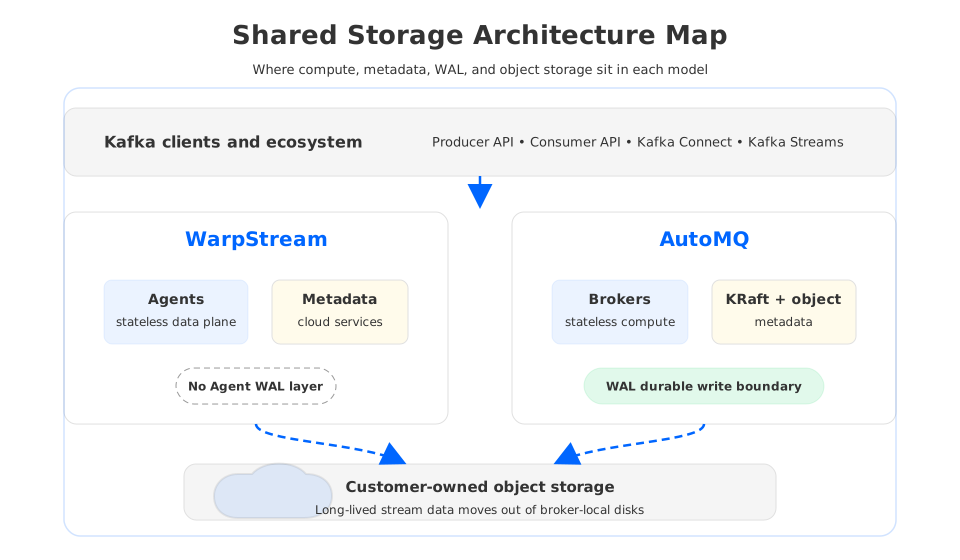
Metadata is another boundary to inspect. Kafka-compatible systems must coordinate topics, partitions, offsets, leaders, stream objects, and placement decisions. In WarpStream, control-plane and metadata services are part of the WarpStream Cloud and BYOC architecture. In AutoMQ, Kafka metadata uses KRaft while AutoMQ adds object metadata and scheduling logic around S3Stream.
4Write Path, Latency, and Recovery
The write path is the cleanest comparison because it exposes the real tradeoff. A Kafka-compatible producer needs trusted acknowledgments and predictable behavior when a node disappears, an availability zone degrades, or a consumer falls far behind.
WarpStream's no-WAL design pushes the system toward fewer moving parts in the Agent. There are no broker disks to fill, rebalance, mirror, or recover. The tradeoff is that object storage, metadata coordination, batching, and caching become the center of latency engineering. Platform teams should benchmark p95 and p99 behavior with their producer batch sizes, consumer fan-out, and zone topology.
AutoMQ's WAL stage adds an explicit durability buffer. The system can acknowledge after durable WAL write, then move data into object storage as the long-term layer. The tradeoff is that WAL storage is another resource to design, provision, monitor, and secure. In AutoMQ Open Source, S3 WAL keeps the deployment simpler; commercial deployment models can use other WAL storage types for lower write latency or different failure domains.
Recovery tests should include more than node replacement. A serious PoC should run producer load, force broker or Agent loss, trigger consumer catch-up from cold data, and then scale compute while measuring latency, availability, object-storage requests, and time to restore headroom.
5Cost and Operations
Object storage changes the cost curve, but it does not make streaming cost disappear. Both WarpStream and AutoMQ still need compute, network, metadata services, observability, support, and operational time. The architecture changes which components scale with retained bytes and which scale with active traffic.
For WarpStream, the cost model is shaped by Agent compute, object storage capacity, object requests, network placement, and the commercial WarpStream service. Its public materials emphasize reducing cost drivers associated with broker disks and inter-zone replication.
For AutoMQ, cost is shaped by broker compute, WAL storage, object storage, object requests, network placement, and deployment model. The design keeps retained data in object storage while using the WAL as a write accelerator and recovery buffer.
The hidden cost in both systems is operational unfamiliarity. Kafka operators know broker disks, partition reassignment, ISR health, and consumer lag. In object-storage-backed systems, they also need visibility into object-store request rates, cache hit ratios, compaction, metadata growth, WAL health or Agent state, and cloud IAM boundaries.
6BYOC, Data Control, and Exit Path
WarpStream and AutoMQ both speak to buyers who care about data-plane control. WarpStream's BYOC model runs Agents in the customer's cloud environment and stores data in the customer's object storage. WarpStream Cloud provides control-plane services around that deployment.
AutoMQ BYOC places the control plane and data plane in the customer's cloud account or VPC, with customer-owned storage for workload data. AutoMQ Cloud Console is used as the environment management entry point, but customer business data stays in the customer's environment.
Exit path should be treated as a first-class requirement. Kafka compatibility helps because clients, Kafka Connect, Kafka Streams, schemas, and operational habits remain relevant. It does not automatically make data-plane migration free. Teams should ask how to mirror topics, preserve offsets where needed, validate ordering, move consumer groups, and retire the old cluster.
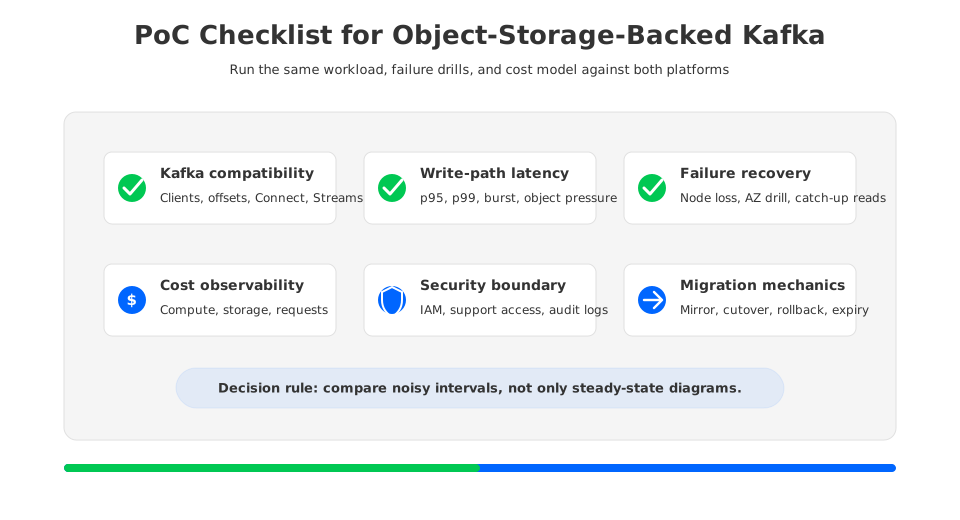
The strongest migration plan avoids vendor-specific optimism. It defines a source cluster, a target cluster, a validation window, rollback triggers, and a point at which old retention can expire. For both platforms, the PoC should prove client compatibility, authentication, connector behavior, schema registry integration, monitoring, alerting, and emergency support.
7When to Evaluate AutoMQ as a WarpStream Alternative
AutoMQ deserves a closer look when the team likes WarpStream's object-storage-backed direction but wants to compare the write path and control boundary. If the workload is latency-sensitive, the WAL-based design may be easier to reason about during failure testing.
It is also worth evaluating AutoMQ when open-source inspection and Kafka-adjacent operational familiarity matter. Public code and documentation can help engineering teams understand the storage abstraction, S3Stream behavior, and deployment mechanics before procurement becomes the main conversation.
WarpStream remains a strong option for teams that explicitly want the diskless Agent model and are comfortable validating its latency and control-plane assumptions. Its acquisition by Confluent also changes the strategic context: some buyers may see category validation, while others may want an alternative path independent of Confluent's broader platform direction.
Use this workload fit table as a practical starting point:
| Workload or constraint | Better first evaluation path | Why |
|---|---|---|
| High-retention streams where broker disk cost dominates | WarpStream and AutoMQ | Both move long-lived data into object storage and reduce broker-local storage pressure. |
| Latency-sensitive writes with strict p99 review | AutoMQ, then benchmark WarpStream low-latency options | WAL durability can be easier to reason about, but actual results must be measured. |
| Strong preference for no local persistence layer in data-plane nodes | WarpStream | The Agent design explicitly avoids intermediary disks and WAL. |
| Kafka-compatible shared storage with familiar broker semantics | AutoMQ | Stateless brokers plus S3Stream map naturally to Kafka operational concepts. |
| Existing Confluent-centered strategy | WarpStream | Confluent ownership may fit platform consolidation goals. |
| Desire for independent alternative evaluation | AutoMQ | It gives teams another object-storage-backed path outside the WarpStream and Confluent track. |
The decisive test is whether the platform keeps its promises under the workload that matters to you: produce bursts, consumer replay, zone-aware clients, connector behavior, node loss, object-store throttling, and operational handoff.
8PoC Checklist
Run the same test plan against both platforms and keep the inputs fixed:
- Kafka API compatibility. Validate producer idempotence, transactions if used, consumer groups, offset commits, Kafka Connect, Kafka Streams, schema registry, ACLs, and monitoring integrations.
- Write-path latency. Measure p50, p95, p99, and p99.9 produce latency under normal load, burst load, and object-store pressure.
- Read-path behavior. Separate tailing reads from catch-up reads. Measure cold replay latency, cache hit ratio, and object-store request volume.
- Failure recovery. Terminate Agents or brokers, simulate availability-zone loss where feasible, and record time to restore client headroom.
- Cost observability. Break out compute, object storage capacity, object requests, network transfer, WAL storage if applicable, and vendor charges.
- Security boundary. Draw the control plane, data plane, object storage bucket, IAM roles, support access path, and audit log flow.
- Migration mechanics. Test topic mirroring, offset strategy, cutover, rollback, and retention expiry before touching a critical workload.
This checklist often reveals the real decision. WarpStream and AutoMQ are both credible answers to Kafka's cloud storage problem, but they are not interchangeable implementations. One removes the local persistence layer from Agents; the other uses WAL-backed shared storage to separate brokers from long-lived data.
9References
- WarpStream documentation: Architecture
- WarpStream documentation: Deploy the Agents
- WarpStream documentation: Configure clients to eliminate AZ networking costs
- WarpStream documentation: BYOC
- Confluent announcement: Confluent acquires WarpStream
- Apache Kafka documentation
- AutoMQ documentation: Architecture overview
- AutoMQ documentation: S3Stream shared streaming storage
- AutoMQ documentation: WAL Storage
- AutoMQ documentation: AutoMQ BYOC overview
10FAQ
10.1Is WarpStream the same architectural category as AutoMQ?
They are in the same broad category because both are Kafka-compatible systems that move durable streaming data toward object storage and reduce dependence on broker-local disks. They differ in the write path: WarpStream emphasizes diskless Agents with no intermediary disks or WAL, while AutoMQ uses S3Stream with WAL storage plus object storage.
10.2Is AutoMQ a drop-in replacement for WarpStream?
Not automatically. Kafka compatibility reduces client-side migration risk, but teams still need to validate authentication, offsets, connector behavior, schema registry integration, observability, latency, failure recovery, and operational processes. Treat it as an architecture-compatible alternative that needs a real PoC.
10.3Does the absence of a WAL make WarpStream better or worse?
It makes WarpStream different. Removing the WAL simplifies local persistence and supports a diskless data-plane model, but it shifts more importance to object-storage write design, metadata coordination, batching, caching, and low-latency features. Whether that is better depends on the workload's latency and recovery requirements.
10.4Why does AutoMQ use WAL storage if the goal is object storage?
In AutoMQ, the WAL is not the long-term storage layer. It is a durable write buffer used for low-latency acknowledgment and recovery, while object storage remains the shared long-term storage layer. This design separates hot write durability from retained data storage.
10.5How should teams compare cost between WarpStream and AutoMQ?
Use the same workload model for both: write throughput, retention, consumer fan-out, replay frequency, availability-zone topology, object request volume, compute, network transfer, WAL storage if applicable, vendor charges, and operational labor. Avoid comparing only object storage capacity because that misses the write and read paths.
10.6When should AutoMQ be evaluated first?
Evaluate AutoMQ first when the team wants Kafka-compatible shared storage, stateless brokers, BYOC-style data control, and a WAL-backed write path that can be tested against strict latency and recovery requirements. It is especially relevant when WarpStream's object-storage direction is appealing but the team wants an independent alternative with a different durability design.


