
Table of Contents
Table of Contents
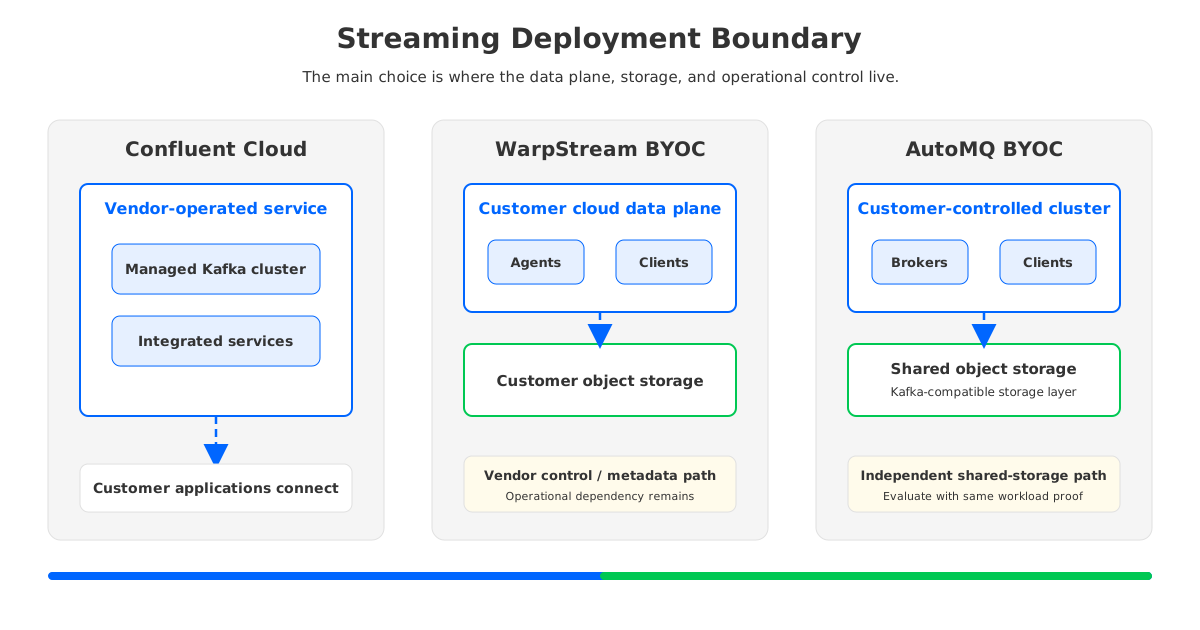
The awkward part of comparing WarpStream vs Confluent Cloud is that the comparison is no longer only vendor A versus vendor B. Confluent announced its acquisition of WarpStream on September 9, 2024, so buyers are comparing Confluent-aligned paths for Kafka-compatible streaming: a fully managed Confluent Cloud cluster, a Freight-style path for high-throughput relaxed-latency workloads, or WarpStream's BYOC architecture where Agents run in the customer's environment and use object storage.
That distinction matters more than the brand label. A platform team choosing Confluent Cloud is often buying operational abstraction, integrated services, governance, and a managed Kafka experience. A team choosing WarpStream is usually trying to keep the data plane closer to its own cloud boundary, reduce broker-local disk and replication cost, and operate a stateless Agent fleet. Both choices can be rational. They optimize different failure domains, cost lines, and exit paths.
1The Relationship Has to Be Clarified First
WarpStream began as a Kafka-compatible streaming system built around stateless Agents and object storage. Its documentation describes Agents as completely stateless and deployable like stateless containers, with required configuration for an object storage bucket, Agent key, virtual cluster ID, and WarpStream region. WarpStream's BYOC model also keeps produce and fetch traffic out of hosted metadata endpoints; its docs state that the hosted administrative endpoint does not handle Produce and Fetch because WarpStream does not have access to customer data in the BYOC product.
Confluent Cloud is broader. It offers Apache Kafka as a fully managed cloud service, plus services such as Schema Registry, connectors, governance, Flink, and private networking. Confluent's current cluster documentation lists Basic, Standard, Enterprise, Dedicated, and Freight clusters. Dedicated clusters are provisioned with CKUs, while Basic, Standard, Enterprise, and Freight use elastic CKUs. Freight is relevant because Confluent positions it for high-throughput workloads with relaxed latency requirements, and its client guidance requires changes such as disabling idempotent producers.
The right framing is therefore not "which product is more Kafka?" It is "which operating boundary should own my streaming workload?"
| Question | Confluent Cloud path | WarpStream BYOC path |
|---|---|---|
| Who operates the Kafka service? | Confluent operates the managed service | Customer operates Agents; WarpStream operates control and metadata services |
| Where does the data plane run? | In Confluent Cloud, with public or private connectivity options | In the customer's cloud environment through Agents and object storage |
| What is the core abstraction? | Managed Kafka cluster plus Confluent services | Kafka-compatible virtual cluster backed by object storage |
| What is the primary buyer motivation? | Operational simplicity, ecosystem services, governance, support | Data-plane control, object-storage economics, stateless deployment |
| What must be tested carefully? | Networking, service limits, cluster type, integration dependencies | Client tuning, metadata path, object storage behavior, API compatibility |
The acquisition does not make the technologies identical. It makes procurement subtler because both paths may now appear in the same enterprise account conversation.
2Deployment Boundary: SaaS Convenience vs BYOC Control
Confluent Cloud reduces the customer's operational surface. The platform team does not install, patch, or upgrade Kafka server components. It selects a cluster type, cloud provider, region, networking model, and optional services. For teams that want one control plane for Kafka, connectors, Schema Registry, Flink, audit logs, governance, and managed networking, that consolidation can be valuable. It also changes the control boundary: the streaming service runs as a vendor-operated cloud service, even with private connectivity.
WarpStream's BYOC boundary is different. The customer deploys Agents into its own cloud environment, configures object storage, IAM, networking, and client access, and relies on WarpStream's control and metadata services for coordination. Its Agent Groups feature can split a logical cluster across VPCs, accounts, or network boundaries, while clients in each group connect to local Agents. That is a very different model from a conventional managed Kafka endpoint.
The security review should be precise rather than emotional. "BYOC" does not mean the vendor has zero operational visibility, and "fully managed" does not mean insecure. The real questions are more concrete:
- Which traffic carries raw Kafka records, and where does it terminate?
- Which metadata, logs, metrics, profiles, support bundles, and billing signals leave the customer account?
- Who controls object storage buckets, encryption keys, IAM roles, network endpoints, and lifecycle rules?
- What happens to reads, writes, administration, and scaling during control-plane or metadata-service disruption?
- Which parts of the system are covered by the vendor SLA, and which parts remain the customer's cloud responsibility?
For Confluent Cloud, private networking is central because PrivateLink, VPC peering, Transit Gateway, Private Network Interface, and cloud-specific options vary by cluster type and provider. For WarpStream, object storage configuration and Agent deployment are central. The docs recommend VPC endpoints or equivalent mechanisms so Agent-to-object-storage traffic does not accidentally incur avoidable NAT or transfer cost.
3Cost Model: The Bill Moves, It Does Not Disappear
Cost comparisons between WarpStream and Confluent Cloud often become too simplistic. One side points to object storage economics. The other points to managed-service productivity. Both arguments are incomplete unless the team builds a workload-specific model.
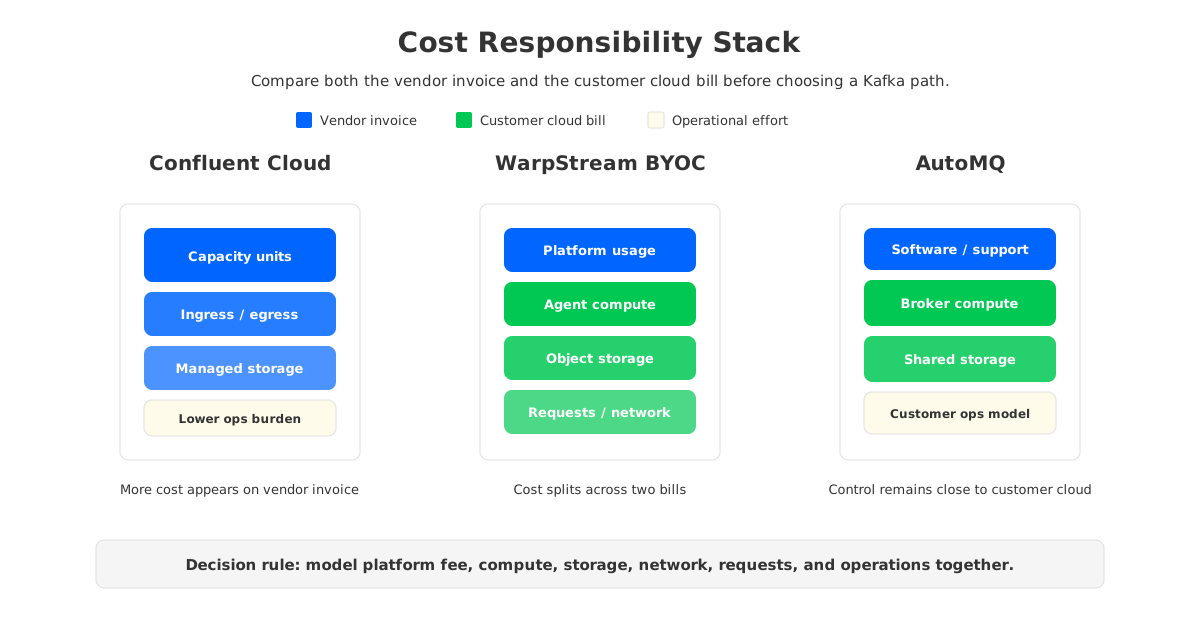
Confluent Cloud pricing depends on cluster type and usage dimensions. Its billing documentation for Dedicated clusters lists CKU price, ingress, egress, and storage, and notes that Confluent measures storage and throughput in binary gigabytes. Basic, Standard, Enterprise, and Freight clusters use eCKUs that scale elastically against dimensions such as throughput, connections, and requests. The unit model is easier to consume than operating Kafka yourself, but real cost still depends on workload shape and cluster choice.
WarpStream shifts more infrastructure cost into the customer's cloud account. The vendor bill may be only one part of the total. The customer still pays for Agent compute, object storage capacity, object storage requests, data retrieval, private endpoints, monitoring, logs, Kubernetes or VM overhead, and operational labor. Object storage can materially change the retention and replication economics, but high read fan-out, replay-heavy workloads, small batches, or misrouted network traffic can move cost into request and network lines.
Treat the cost model as five stacked layers:
- Platform fee: vendor consumption, subscription, support, or minimum commits.
- Compute: Confluent-managed capacity units or customer-operated Agent capacity.
- Storage: managed Kafka storage or customer object storage capacity and lifecycle policy.
- Network and request path: private connectivity, egress, object storage requests, NAT avoidance, cross-zone traffic.
- Operations: incident response, upgrades, observability, capacity planning, security review, and migration work.
The biggest difference is accountability. With Confluent Cloud, more cost is visible on the vendor invoice. With WarpStream BYOC, more cost is split between that invoice and the customer's cloud bill. Finance teams often prefer a single invoice; platform teams often prefer direct infrastructure levers. The worksheet has to show both.
4Kafka Compatibility Is a Surface Area, Not a Checkbox
Both Confluent Cloud and WarpStream present Kafka-compatible interfaces, but compatibility should be tested at the edges the workload uses. Apache Kafka defines a broad ecosystem, not only Produce and Fetch. Applications may depend on idempotent producers, transactions, consumer groups, compaction, ACLs, quotas, AdminClient behavior, Kafka Connect, Schema Registry APIs, MirrorMaker, Cluster Linking, Flink, ksqlDB, or monitoring integrations.
Confluent Cloud has an advantage when the workload is already tied to Confluent services. A team using Confluent Schema Registry, managed connectors, Cluster Linking, governance, and Flink can reduce integration work by staying inside that ecosystem. The tradeoff is dependence on proprietary service behavior and account-level packaging, not only Kafka protocol behavior.
WarpStream's compatibility discussion is more workload-specific. Its Schema Registry documentation says its BYOC Schema Registry exposes a REST server that is API-compatible with Confluent's Schema Registry. Its Agent guidance also says client configuration is important for throughput and cost. Confluent's Freight client guidance is similarly explicit that high-throughput relaxed-latency clusters may require client tuning and may not support idempotent producers or transactions. "Kafka-compatible" does not always mean "all Kafka workloads behave identically without tuning."
Before standardizing, run a compatibility matrix that includes:
- Producer semantics: idempotence, transactions, acks, retries, batching, compression, partitioning.
- Consumer semantics: group rebalancing, offset commits, long replay, fan-out, lag behavior.
- Admin APIs: topic creation, configs, ACLs, quotas, delete records, metadata refresh.
- Ecosystem services: Schema Registry, Kafka Connect, Flink, MirrorMaker, Cluster Linking, observability.
- Failure cases: Agent or broker loss, object storage throttling, private networking failure, metadata endpoint disruption.
The test should include the exact client libraries and versions used in production. A small demo with a happy-path producer is not enough evidence for a platform decision.
5Lock-In Is About Exit Cost, Not Only APIs
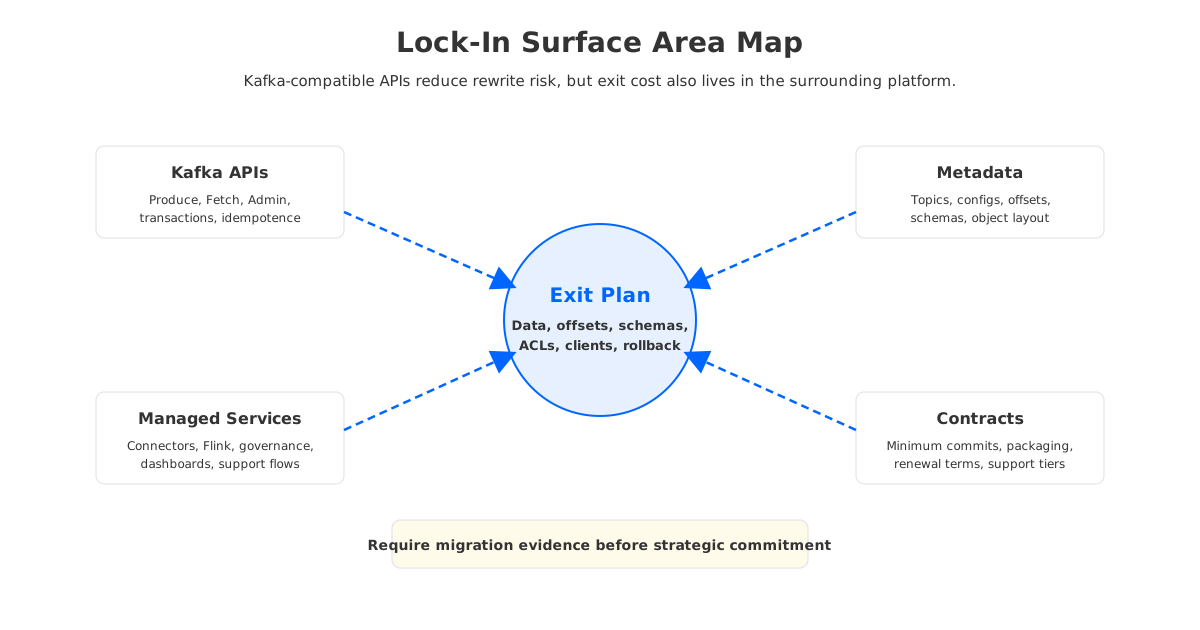
Confluent Cloud lock-in often comes from ecosystem depth. Managed connectors, Flink jobs, governance, audit logs, Schema Registry, networking, RBAC, and account-level agreements are useful precisely because they are integrated. Exit work is proportional to how much of that integration the team adopts. If Confluent Cloud is only a Kafka endpoint, the exit path is different from a platform that also owns schemas, stream processing, connectors, access policies, and data products.
WarpStream lock-in has a different shape. The Kafka API may remain familiar, and raw data can reside in the customer's object storage bucket, but the system still depends on WarpStream's virtual cluster model, metadata/control-plane behavior, Agent deployment model, object layout, and administrative workflows. The object storage bucket is not necessarily a generic archive another streaming engine can read without migration logic.
A practical exit review should ask for proof, not promises:
- Can we replicate or export topic data into another Kafka-compatible system?
- Can we preserve consumer offsets, schemas, ACLs, topic configs, and service identities?
- Which migration tools are vendor-supported, and which are customer-built?
- Can we run dual-write, mirror, or topic-by-topic cutover without breaking ordering assumptions?
- What contractual rights apply if packaging, pricing, support, or roadmap commitments change?
The healthiest vendor relationship is one where leaving is understood. Exit clarity does not mean the team plans to leave. It means the architecture decision is reversible enough for a critical platform.
6Where AutoMQ Belongs in the Shortlist
Once the comparison is framed around deployment boundary, cost responsibility, compatibility surface, and exit cost, another category becomes relevant: Kafka-compatible shared-storage systems that use object storage to reduce broker-local state while allowing customer-controlled deployment patterns. AutoMQ fits in that category. Its documentation describes AutoMQ as a Kafka-compatible streaming system that uses S3Stream shared storage to offload Kafka log storage to object storage and make brokers stateless.
AutoMQ should not be inserted into the decision as a slogan. It belongs in the shortlist when the team wants Kafka protocol compatibility, object-storage-backed durability, stateless broker operations, and a BYOC or private deployment model that keeps infrastructure control closer to the customer. It is especially relevant when the team likes object-storage-backed streaming but wants an architecture whose write path, broker behavior, and source visibility can be evaluated separately from Confluent's product portfolio.
The comparison still has to be evidence-driven. If your organization already depends heavily on Confluent governance, managed connectors, Flink, and enterprise support, Confluent Cloud may have the stronger ecosystem fit. If your workload is high-throughput, latency-tolerant, and the customer-cloud boundary is central, WarpStream or Confluent Freight-style options deserve testing. If you want Kafka-compatible shared storage with stateless brokers and object storage as the capacity layer, include AutoMQ in the proof.
7Decision Checklist
Use the final architecture review to make the tradeoffs explicit.
| Choose this path when... | Strong fit | Main risk to validate |
|---|---|---|
| Confluent Cloud | You value fully managed operations, integrated services, governance, and a single vendor platform | Service dependency depth, pricing dimensions, private networking, exit path |
| WarpStream BYOC | You want stateless Agents in your cloud account and object storage as the primary data layer | Client tuning, object storage behavior, metadata/control-plane dependency, migration portability |
| AutoMQ | You want Kafka-compatible shared storage, stateless brokers, and customer-controlled deployment options | Workload proof, operational maturity, ecosystem integration fit |
The responsible answer is not to crown a universal winner. Run the same workload through the same tests: peak produce, peak consume, replay, fan-out, retention, failover, private networking, schema workflow, connector workflow, and rollback. Add the vendor bill and the cloud bill to the same worksheet, then attach the exit plan to the architecture decision record.
For teams exploring the shared-storage approach, start with the AutoMQ architecture overview and validate it with the same workload replay you use for Confluent Cloud and WarpStream. The comparison becomes much clearer when every option has to explain cost, compatibility, control, and reversibility in the same language.
8FAQ
8.1Is WarpStream part of Confluent Cloud?
Confluent acquired WarpStream in 2024, but buyers should still distinguish the deployment models. Confluent Cloud includes multiple managed Kafka cluster types and services. WarpStream BYOC uses customer-deployed Agents with object storage and WarpStream control or metadata services.
8.2Is WarpStream BYOC the same as Confluent Cloud private networking?
No. Private networking connects customer environments to Confluent Cloud without public endpoints in supported configurations. BYOC places the WarpStream Agent data plane in the customer's environment and uses customer object storage.
8.3Which option is lower cost?
There is no reliable answer without a workload model. Confluent Cloud concentrates more cost in vendor usage dimensions such as capacity units, ingress, egress, and storage. WarpStream shifts more cost to customer cloud resources such as Agent compute, object storage, requests, and networking.
8.4Does Kafka compatibility eliminate lock-in?
No. Kafka compatibility preserves many client and ecosystem assumptions, but lock-in can still appear in schemas, metadata, connectors, stream processing jobs, dashboards, IAM/RBAC models, networking, billing commits, and migration tooling.
8.5When should AutoMQ be evaluated?
Evaluate AutoMQ when the target architecture is Kafka-compatible shared storage with stateless brokers, object-storage-backed capacity, and customer-controlled deployment. It is useful as an independent comparison point outside the Confluent Cloud versus WarpStream frame.
9References
- Confluent: Confluent Acquires WarpStream
- Confluent Cloud Overview
- Confluent Cloud Kafka Cluster Types
- Confluent Cloud Billing Units
- Confluent Cloud Networking Overview
- Confluent Cloud Freight Clients
- WarpStream Agent Deployment
- WarpStream Agent Groups
- WarpStream Object Storage Configuration
- WarpStream Hosted Metadata Endpoint
- WarpStream BYOC Schema Registry
- Apache Kafka Documentation
- AutoMQ Architecture Overview
- AutoMQ S3Stream Overview


