
Table of Contents
Table of Contents
After Confluent completed its acquisition of WarpStream, the budget question changed shape. A buyer comparing WarpStream and Confluent is no longer only comparing two independent vendors. The more useful comparison is between two cost architectures that may sit inside the same commercial conversation: Confluent Cloud as a managed SaaS data streaming platform, and WarpStream as a BYOC, object-storage-first Kafka-compatible system.
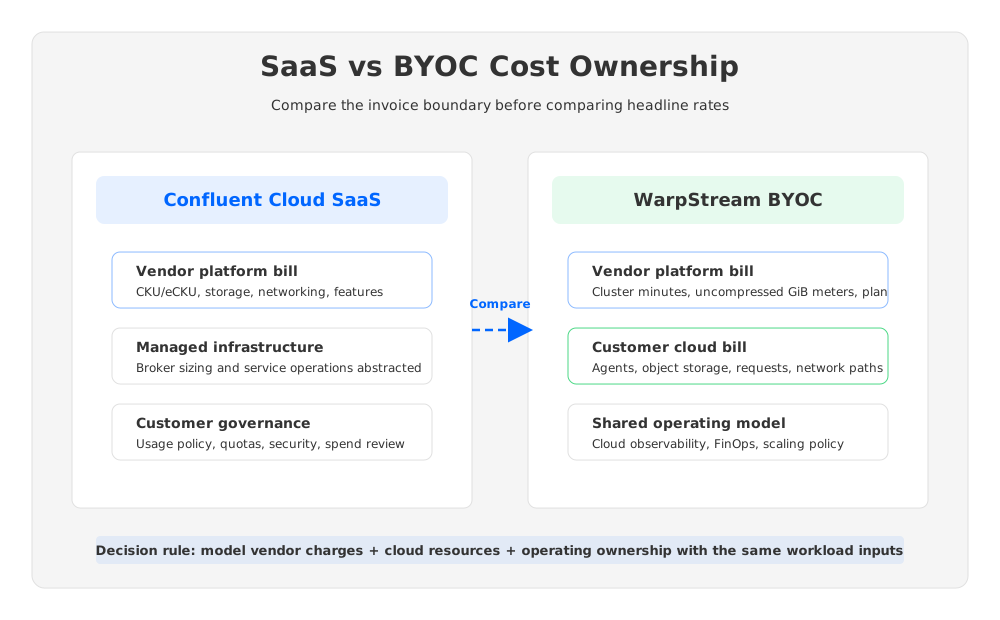
That distinction matters because the invoice boundary is different. In a SaaS model, the vendor hides more infrastructure and exposes higher-level billing units. In a BYOC model, more of the data plane runs in the customer's cloud account, so the platform bill and the cloud bill must be modeled together. Object storage changes retention and replication economics, but it does not remove compute, network paths, request patterns, operational ownership, or contract terms.
1Why the Comparison Changed After the Acquisition
Confluent announced in September 2024 that it would acquire WarpStream, describing WarpStream as a bring-your-own-cloud streaming platform using object storage to reduce inter-zone networking costs associated with traditional Kafka deployments. Confluent later announced completion. For procurement and platform teams, that makes "WarpStream vs Confluent cost" a category question rather than a simple vendor-versus-vendor spreadsheet.
Confluent Cloud has several managed-service billing concepts: cluster types, CKUs and eCKUs, networking charges, storage, connectors, stream processing, support, and committed-use arrangements. Its pricing page and cluster documentation make clear that the commercial unit depends on cluster type and workload envelope. Dedicated clusters use CKUs, while Freight clusters use elastic CKUs for higher-throughput workloads.
WarpStream's public pricing and billing reference expose a different boundary. Its BYOC model includes platform charges such as cluster minutes and usage dimensions including uncompressed GiB written and stored. The customer also pays the cloud provider for the resources in their own account: compute for agents, object storage capacity, object storage requests, networking, observability, and related infrastructure. That is not a weakness by itself. It is a different accounting model.
The mistake is treating the two pages as if they answer the same question. SaaS pricing asks, "What does the vendor charge for a managed streaming service?" BYOC pricing asks, "What does the vendor charge, and what does my cloud account now absorb?" A real comparison needs both views.
2Cost Categories to Compare
The cleanest way to compare Confluent Cloud and WarpStream is to separate cost into ownership layers. Each layer has a different owner, variance source, and negotiation path.
| Cost category | Confluent Cloud SaaS lens | WarpStream BYOC/object storage lens |
|---|---|---|
| Vendor/platform charges | Cluster capacity units, data transfer, storage, features, connectors, support, commitments | Cluster minutes, usage meters, support, plan tier, commercial terms |
| Compute | Mostly abstracted into the service bill | Customer cloud resources for data-plane agents and orchestration |
| Storage | Confluent Cloud storage billing, including post-replication volume where applicable | Object storage capacity plus request classes, retention, lifecycle, and layout effects |
| Networking | Service networking, egress, private connectivity, and deployment geography | Client placement, object storage endpoint placement, PrivateLink or equivalent, inter-AZ and inter-region paths |
| Operations | Vendor operates the managed service; customer still owns usage governance | Customer owns more cloud-account observability, resource policy, and FinOps review |
| Contract risk | Commit levels, product packaging, feature entitlements | BYOC resource assumptions plus vendor terms and post-acquisition roadmap clarity |
2.1Vendor and Platform Charges
Confluent Cloud pricing starts with the service shape. Basic, Standard, Enterprise, Dedicated, and Freight clusters are not interchangeable cost envelopes. They differ in capacity model, isolation, networking, SLA posture, and workload fit. A small development topic and a regulated production stream with private networking belong in different parts of the price sheet.
Dedicated capacity is especially important for cost reviews because the unit is not only data written or stored. CKUs represent capacity for dedicated clusters, while Freight uses eCKUs for elastic capacity. A buyer should ask whether the workload is steady enough to benefit from committed capacity, bursty enough to need elasticity, or feature-heavy enough that the cluster tier is determined by governance and networking requirements before throughput is even considered.
WarpStream's public billing terminology points in another direction. The buyer has to normalize cluster minutes, uncompressed GiB written, uncompressed GiB stored, and plan or support requirements. "Uncompressed" is the word that deserves attention. Kafka operators often observe compressed producer batches, compressed broker log segments, or cloud-object bytes. A pricing unit based on uncompressed logical data can differ from a storage line item based on compressed physical objects.
2.2Customer Cloud Resources
The biggest practical difference is where infrastructure appears. In Confluent Cloud, the customer does not usually size broker VMs, tune object storage request patterns, or operate the underlying service infrastructure. The tradeoff is that more of those choices are embedded in the service bill and service contract.
In WarpStream BYOC, agents run in the customer's cloud account. That means compute size, autoscaling floor, Kubernetes overhead, storage classes, request volume, network topology, monitoring, logging, and policy enforcement show up in the customer's own cloud bill. This can be attractive for data control, private networking, and cloud-account visibility, but it raises the standard for internal cost modeling. A low vendor line item can still produce a high total cost if the cloud account is under-modeled.
Object storage deserves its own worksheet. AWS S3 pricing, for example, includes storage by class and region, request charges for operations such as PUT, COPY, POST, LIST, and GET, and additional retrieval or lifecycle charges depending on class. Kafka-like streaming systems do not use object storage like a passive archive. Object size, batching, cache hit rate, replay behavior, and metadata access can all change the cloud bill.
2.3Networking and Operations
Traditional Apache Kafka durability relies on partition replicas: each partition has one leader and zero or more followers, and followers copy data from the leader. In cloud deployments, especially multi-AZ deployments, that replication and client placement can create meaningful network transfer. Object-storage-first systems attempt to move durable storage away from broker-local disks and reduce some broker-to-broker replication patterns, but the result is not "networking disappears."
Networking shifts. Producers and consumers still connect somewhere. Agents still access object storage. Private connectivity, cross-AZ endpoints, NAT gateways, inter-region replication, disaster recovery, and replay jobs still need placement rules. A cost model that removes Kafka replication from one line and forgets object storage access paths in another is incomplete.
Operations shift too. Confluent Cloud lowers the operational surface of the streaming platform, but teams still manage topic design, quotas, consumer behavior, security policy, schema governance, and spend governance. WarpStream BYOC gives more cloud-account control, but the platform team must be ready to observe and explain the customer-side bill. The right question is not "Which one has ops?" Both have ops. The question is which operational responsibilities your team wants to own.
3A Practical Cost Model
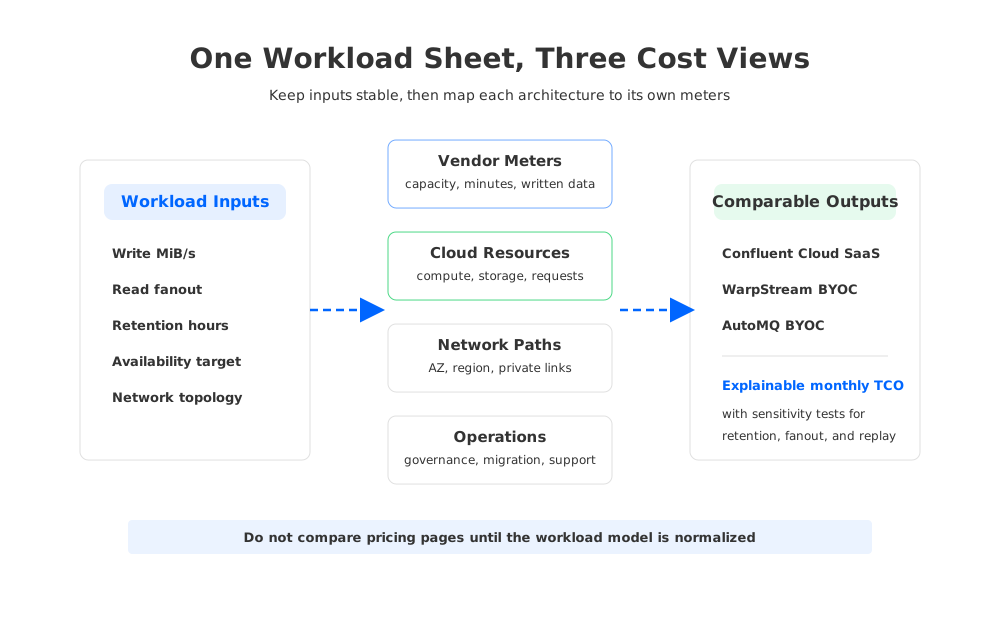
A useful model starts with workload physics, not vendor names. Fill these inputs once, then apply them consistently to Confluent Cloud, WarpStream, self-managed Kafka, AutoMQ, Amazon MSK, or any other candidate.
| Input | What to collect | Why it matters |
|---|---|---|
| Average write throughput | MiB/s, compressed and uncompressed | Drives ingestion, storage growth, and platform meters |
| Peak write throughput | MiB/s | Drives capacity units, agent count, and headroom |
| Read throughput and fanout | MiB/s and consumer groups | Determines replay pressure, egress, cache behavior, and request patterns |
| Retention by topic class | Hours or days | Converts write rate into retained GiB |
| Partition and topic count | Count | Affects limits, metadata, balancing, and operational overhead |
| Availability target | SLA/SLO, AZ, region | Determines cluster tier, support, replication, and networking |
| Connectivity | public, private, cross-account, cross-region | Determines data transfer and private networking charges |
| Contract posture | on-demand, annual commit, marketplace, enterprise | Determines discount, minimum spend, and exit flexibility |
The first formula is intentionally plain:
retained GiB = average write MiB/s x 3600 x retention hours / 1024
If a workload writes 80 MiB/s on average and retains seven days of data, the logical retained volume before compression and replication adjustments is 47,250 GiB:
80 x 3600 x 168 / 1024 = 47,250 GiB
That is not a quote. It is a normalization anchor. For Confluent Cloud, you then map the workload to the appropriate cluster type, capacity unit, storage, networking, and service features. For WarpStream, you map it to cluster minutes, uncompressed written and stored data, BYOC compute, object storage capacity, object storage requests, networking, and operational overhead. For both, you keep a source column next to every rate because public list pricing, private offers, marketplace contracts, and committed-use discounts age differently.
The model should also include sensitivity tests. Move retention from seven to thirty days. Change fanout from 2x to 8x. Change compression from 4:1 to 2:1. Add a replay-heavy incident day. These tests often reveal the real decision driver.
4Lock-In and Contract Considerations
Cost is not only what appears on the invoice this month. It is also the cost of changing your mind. Confluent Cloud can reduce operational burden and consolidate streaming features, but it may also concentrate spend into a broader platform contract. WarpStream BYOC can keep data-plane resources in the customer's cloud account, but after the acquisition buyers should ask how roadmap, support, procurement, and renewal terms will be handled across the combined Confluent portfolio.
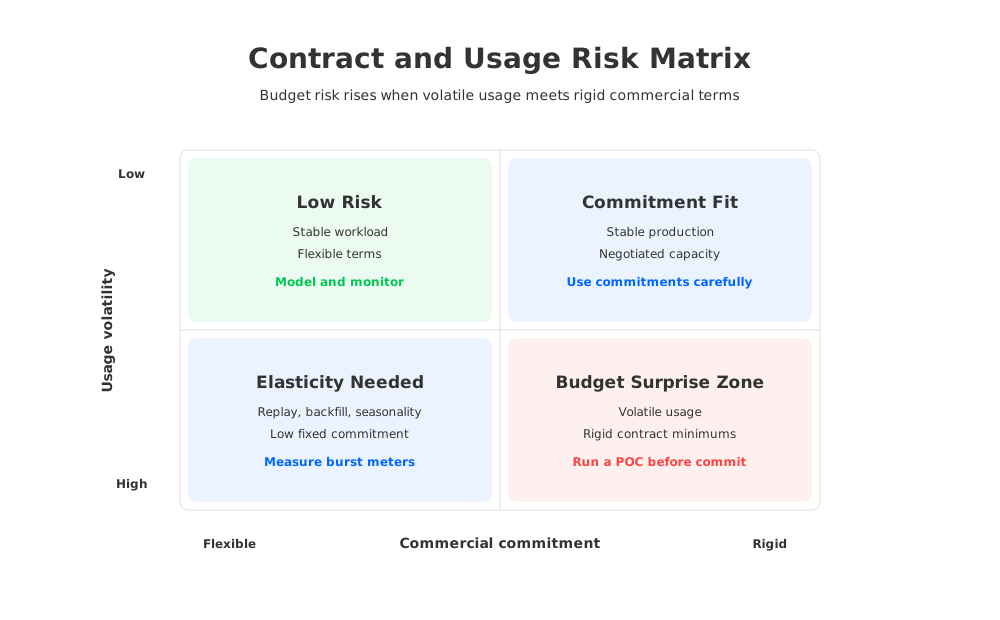
The risk matrix has two axes: usage volatility and commercial commitment. High volatility with high commitment is where budgets surprise teams. Irregular replay, backfill, seasonal peaks, or unpredictable retention growth needs more flexibility, observability, or negotiated headroom.
Ask these questions before approving a budget:
- Which pricing units are fixed, usage-based, or contract-minimum based?
- Are bytes metered compressed, uncompressed, post-replication, or as another vendor-specific representation?
- Which components run in the customer account, and who owns their cloud budget?
- Which network paths remain billable after the architecture removes or reduces traditional Kafka broker replication?
- What happens during migration, dual-write, backfill, disaster recovery testing, and rollback?
- Which features are required for production: private networking, multi-region, governance, support response, audit, and workload isolation?
- How portable are the data, clients, operational runbooks, and contracts if the team changes direction?
The point is not to make every buyer avoid commitments. Commitments can be rational when workload shape is stable and service fit is proven. The point is to avoid using a pricing page as a substitute for a workload model.
5Where AutoMQ Fits in Cost-Sensitive Evaluations
Once the comparison is framed this way, AutoMQ belongs in the evaluation as another Kafka-compatible, object-storage-backed option rather than as a generic vendor alternative. AutoMQ keeps Kafka protocol compatibility while moving durable stream storage to S3-compatible object storage and using stateless brokers. In AutoMQ BYOC, the buyer can separate managed service fees from cloud infrastructure assumptions and benchmark the architecture against the same workload worksheet.
This is the right place for AutoMQ to enter the conversation: after the buyer has decided that the core problem is Kafka cost architecture, not only Kafka feature packaging. If the main pain is broker-local disk over-provisioning, slow data movement during scaling, cross-AZ replication economics, or long-retention cost, then object-storage-backed shared storage is a relevant category. WarpStream and AutoMQ both sit in that category, while Confluent Cloud SaaS may fit broader platform consolidation and managed-service goals.
The practical evaluation is straightforward. Use one workload sheet. Run the same representative traffic pattern. Record vendor meters, cloud compute, object storage capacity, object storage requests, network transfer, p95 and p99 latency, failure recovery behavior, and operator time. The architecture that wins should make the cost model easier to explain under normal load and under stress, not only produce a lower estimate in a static spreadsheet.
AutoMQ's pricing calculator and documentation provide a planning baseline for write throughput, read throughput, retention, availability-zone mode, and cluster tier; validate those outputs with your own workload and cloud metrics.
6Cost Evaluation Checklist
Use this checklist before you turn a vendor comparison into a purchase request:
- Normalize all data units: compressed bytes, uncompressed bytes, retained physical bytes, and billable bytes.
- Split every estimate into vendor bill, customer cloud bill, and internal operations.
- Model object storage requests, not only object storage capacity.
- Include private connectivity, cross-AZ, cross-region, NAT, and replay-related network paths.
- Run sensitivity tests for retention, fanout, replay, compression, and peak traffic.
- Separate steady production workloads from dev/test and batch backfill workloads.
- Keep public pricing, private quote, and contract assumptions in separate columns.
- Require a proof of concept for any workload where one meter dominates the estimate.
Cost comparisons between WarpStream and Confluent now sit at the intersection of architecture and procurement. Confluent Cloud can be the simpler operational envelope for managed SaaS. WarpStream BYOC can be compelling when the buyer wants object-storage economics and customer-cloud data-plane control. AutoMQ should be considered when the same Kafka-compatible category is attractive and the team wants an independent BYOC architecture to benchmark. The winning option is the one whose cost behavior remains explainable when the workload stops behaving like a pricing-page example.
7References
- Confluent Cloud Pricing
- Confluent Cloud Cluster Types
- Confluent Completes Acquisition of WarpStream
- WarpStream Pricing
- WarpStream Billing Reference
- AWS S3 Pricing
- Apache Kafka Documentation: Replication
- AutoMQ Pricing
- AutoMQ Architecture Overview
8FAQ
8.1Is WarpStream part of Confluent now?
Yes. Confluent announced the acquisition of WarpStream in September 2024 and later announced completion. Buyers should still model Confluent Cloud SaaS and WarpStream BYOC separately because their cost boundaries are different.
8.2Is WarpStream always lower cost than Confluent Cloud?
Not automatically. WarpStream's object-storage-first BYOC model changes the cost structure, especially around retention, cloud resources, and data-plane ownership. Confluent Cloud may reduce operational burden and bundle broader platform capabilities. The answer depends on workload shape, cloud resource assumptions, support needs, and contract terms.
8.3What is the biggest hidden cost in BYOC Kafka pricing?
The usual candidates are customer-cloud compute, object storage requests, network placement, observability, and the operational time required to explain and govern the cloud bill. BYOC can improve control, but it should be modeled as vendor plus cloud plus operations.
8.4How should FinOps teams compare Confluent Cloud and WarpStream?
Use one workload model and map it to both pricing systems. Keep compressed, uncompressed, retained, and billable bytes separate. Then add cluster capacity, storage, networking, support, commitments, object storage requests, and operational ownership.
8.5Where does AutoMQ fit in the comparison?
AutoMQ fits when the buyer wants a Kafka-compatible, object-storage-backed architecture with BYOC-style data control and a cost model that can be tested against production workload metrics. It should be compared with the same worksheet rather than treated as a separate category.


