
Table of Contents
Table of Contents
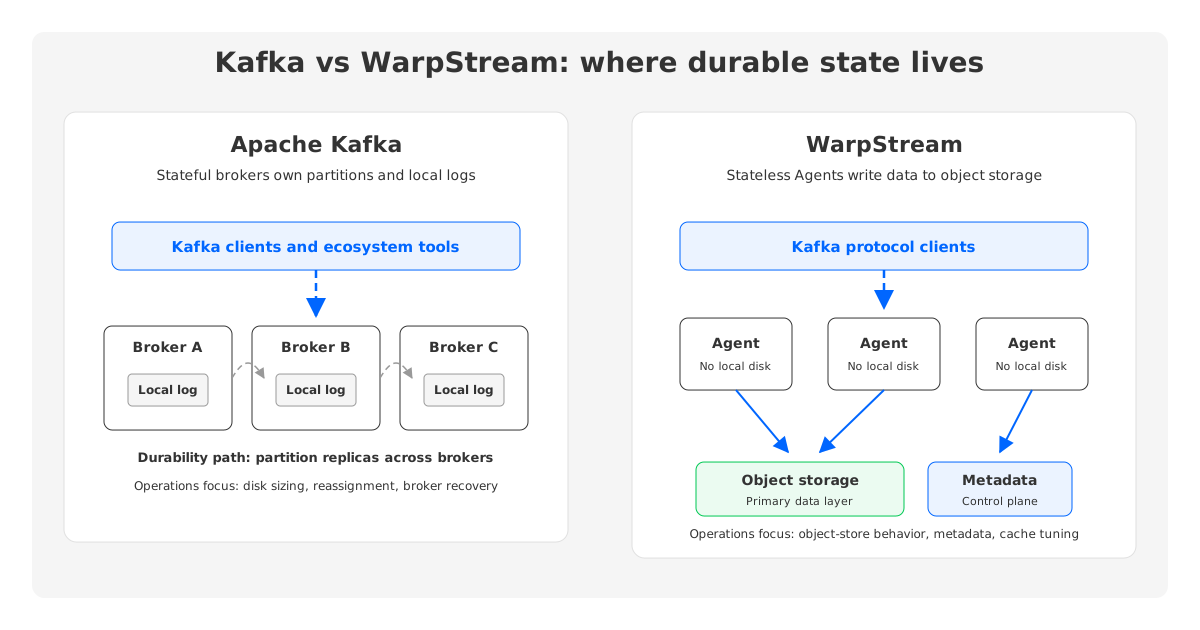
Most Kafka platform debates start with a symptom: the cluster costs too much, broker replacement takes too long, partition reassignment is risky, or scaling requires too much idle capacity. WarpStream enters that conversation because it changes the physical shape of the system. Apache Kafka keeps durable logs on broker-local storage and replicates partitions across brokers. WarpStream presents a Kafka-compatible interface, but its Agents are stateless and write data to object storage while coordination metadata lives outside the Agents.
That difference is large enough that "WarpStream vs Kafka" should not be treated as a feature checklist. It is an architecture decision about where durable state lives, who operates coordination, how latency is absorbed, and which parts of the cloud bill become visible. A team that only compares storage price per GiB can miss the harder questions: Can the workload tolerate object-storage behavior? How much Kafka ecosystem behavior is required? What happens during object storage throttling, metadata disruption, or Agent replacement?
1Quick Comparison
| Dimension | Apache Kafka | WarpStream |
|---|---|---|
| Storage model | Broker-local append-only logs, usually replicated across brokers | Stateless Agents write stream data to object storage |
| Coordination model | Kafka metadata quorum with KRaft in current Kafka versions | WarpStream Cloud Metadata Store and control plane coordinate virtual clusters |
| Data path ownership | Brokers store and serve partition replicas | Agents serve Kafka protocol requests and use object storage as the primary data layer |
| Main cost drivers | Broker compute, local disks, provisioned IOPS, replication traffic, operator time | Agent compute, object storage capacity, object storage API operations, metadata service usage, cache behavior |
| Scaling motion | Add brokers, move partition leadership and replicas, rebalance load | Add or remove Agents more like stateless services |
| Latency profile | Strong fit for low-latency local-log workloads when properly provisioned | Sensitive to batching, object storage requests, cache locality, and metadata commit path |
| Migration risk | Lowest if already on Kafka and operations are acceptable | Requires compatibility testing, workload latency testing, and runbook changes |
Kafka is still the reference implementation for the Kafka protocol and ecosystem. WarpStream is not "Kafka with a different disk"; it is a Kafka-compatible system with a different storage and coordination design. The real question is whether the new durability path matches the workload's service-level objectives.
2How Apache Kafka Stores and Replicates Data
Kafka's core abstraction is the partition log. Producers append records to a partition leader, consumers fetch from the log, and Kafka replicates each partition across brokers according to the topic's replication factor. The Apache Kafka documentation describes a common production configuration as a replication factor of three, which means three copies of the data exist across brokers. This model keeps the hot log close to compute and gives Kafka direct control over ordering, durability acknowledgments, leader election, and catch-up behavior.
The operational cost comes from the same design. Brokers are not interchangeable stateless workers; they hold partition replicas and local storage. When a broker fills up, fails, or needs replacement, the cluster has to move or rebuild replica state. KRaft removes ZooKeeper from the metadata path, but the broker still owns log segments and must be capacity-planned around local storage and replica movement.
This is why Kafka can be excellent and difficult at the same time. For workloads that need mature semantics, broad ecosystem support, and predictable low-latency behavior from local logs, Kafka remains a strong default. For cloud teams paying for over-provisioned disks, cross-zone replication traffic, and slow data movement during scaling, the shared-nothing storage model becomes the pressure point.
3How WarpStream Changes the Storage Model
WarpStream replaces the stateful broker fleet with a stateless Agent binary. In its architecture documentation, WarpStream describes Agents as speaking the Apache Kafka protocol while communicating with object storage and WarpStream's Cloud Metadata Store. Instead of maintaining local broker disks and inter-broker replica logs, Agents write data into object storage and commit file metadata to the metadata store before acknowledging produce requests.
That design has three important consequences:
- Agents can be scaled more like a stateless service because no Agent owns a durable local partition replica.
- Object storage becomes the primary data plane, so cloud object-store behavior is now part of the streaming system's performance profile.
- Metadata coordination moves into a managed control plane, changing the operational boundary between the customer's environment and WarpStream's service.
WarpStream's write-path documentation is explicit that data is written to object storage with no intermediary disks or WAL. That is a clean architecture for reducing broker-local state, but it also means the system must solve batching, metadata commits, compaction, object layout, caching, and read amplification in a different way from Kafka. On the read path, WarpStream documents large chunk loading and zone-aware cache behavior to reduce object storage GET requests and maintain cost efficiency.
For teams comparing WarpStream and Kafka, the useful mental model is not "diskless is automatically better." It is "durable state moved from brokers to object storage plus a metadata service." That move can reduce some Kafka pain, especially around broker disks and replica traffic, while introducing new dependencies that need to be measured under production-like load.
4Cost Tradeoffs: Which Bill Changes?
Kafka cost analysis gets distorted when teams look only at storage price per GiB. In production, the bill is usually shaped by compute sized for peak throughput, disks sized for retention and IOPS, replication traffic between zones, idle headroom for broker failure, operational time, and managed service premiums where applicable. Object-storage-backed systems change the mix, but they do not remove cost engineering from the problem.
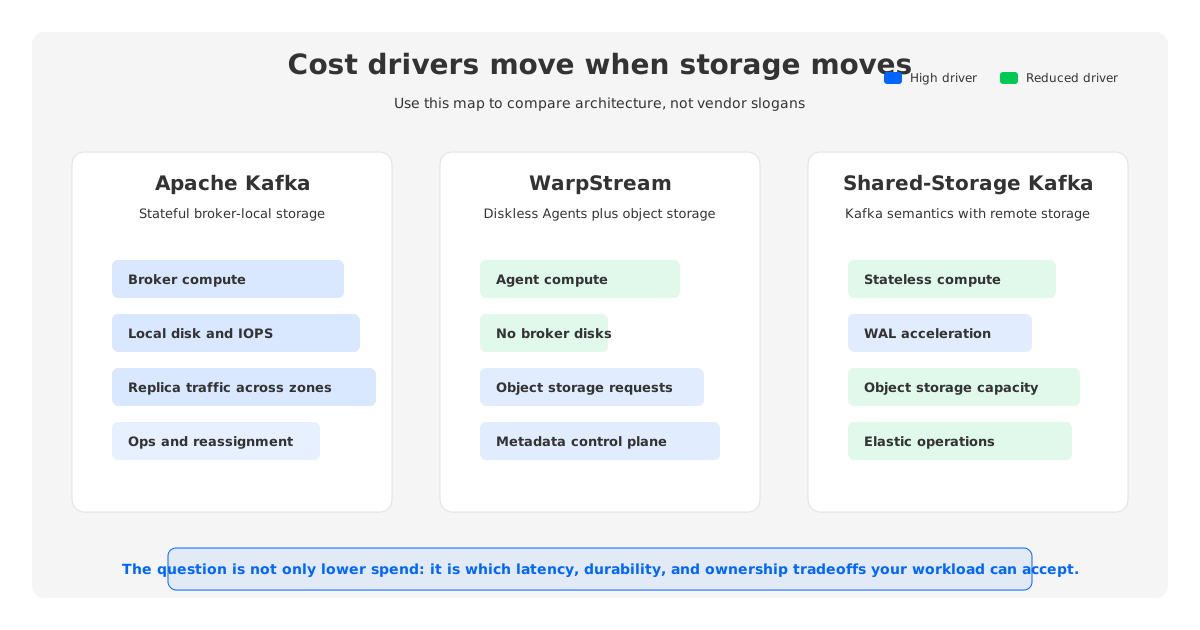
With Kafka, durable replication normally means writing multiple copies across brokers. In multi-AZ cloud deployments, that can create cross-zone traffic, plus broker disks that have to be large enough for retention and fast enough for throughput. With WarpStream, the design aims to avoid broker-local disks and reduce inter-zone replication traffic by using object storage as the durability layer. AWS S3 pricing also highlights that S3 charges are multidimensional: storage, requests, data retrieval, management features, replication, and data transfer can all matter depending on the access pattern.
Use a workload-specific cost model:
- Write-heavy workloads need to estimate object PUT behavior, batching, flush settings, and metadata commits.
- Read-heavy workloads need to estimate cache locality, object GET volume, fan-out, and replay behavior.
- Long-retention workloads need to compare broker disk capacity against object storage capacity and lifecycle requirements.
- Multi-AZ workloads need to compare Kafka replication traffic with object-store access patterns and endpoint or NAT routing choices.
- Operations teams need to include the labor and risk cost of broker replacement, partition movement, upgrades, and incident response.
WarpStream's object storage configuration guidance recommends using VPC endpoints or equivalent cloud-provider mechanisms so Agent-to-object-storage traffic does not accidentally incur avoidable transfer cost through services such as NAT gateways. That detail is small but important: architecture changes can shift cost from one line item to another.
5Latency, Failure Domains, and Operations
Kafka's local-log design is valuable when latency targets are strict. A properly provisioned Kafka cluster can offer low produce and fetch latency because the broker controls the append path, page cache, segment files, replication, and consumer reads in one system. The tradeoff is that locality also binds state to brokers, so scaling and recovery become data movement problems.
WarpStream moves durability to object storage and coordination metadata to its managed metadata store. That can reduce operational state on Agents, but latency now depends on batching, object-store request behavior, metadata commit latency, cache hit rate, and the distance between clients, Agents, object storage, and control-plane endpoints. The Agent configuration reference exposes tuning around how much data is buffered before flushing to object storage, noting the tradeoff between reducing object storage API cost and increasing latency.
The failure domains also differ. In Kafka, operators reason about broker failure, disk failure, ISR health, controller quorum, leader election, and replica catch-up. In WarpStream, durable data is in object storage and coordination relies on WarpStream's metadata/control-plane services. That can simplify customer-side broker operations while making object storage availability, throttling, IAM configuration, bucket lifecycle settings, and metadata service reachability part of the platform review.
The runbooks change accordingly. Kafka dashboards center on broker disks, ISR, under-replicated partitions, controller state, request latency, and consumer lag. WarpStream adds object-store request patterns, metadata behavior, Agent cache health, and bucket hygiene. A serious evaluation should include incident drills for object storage permission errors, lifecycle misconfiguration, high replay traffic, metadata service reachability, and misrouted network paths.
6Where AutoMQ Fits in the Architecture Map
Once the problem is framed as "how do we keep Kafka compatibility while reducing broker-local state?", another category becomes relevant: Kafka-compatible shared-storage systems that retain Kafka semantics while replacing the broker log storage layer. AutoMQ belongs in this category. It is a cloud-native, Kafka-compatible streaming platform built on object storage, and its documentation describes S3Stream as the storage layer that offloads Kafka log storage to cloud storage while making brokers stateless.
The architectural distinction matters. WarpStream's public docs describe a diskless Agent design with no intermediary disks or WAL, backed by object storage and a Cloud Metadata Store. AutoMQ's S3Stream design uses object storage as the actual data location and includes WAL storage for low-latency persistence and recovery before data is uploaded to object storage. Both approaches move beyond broker-local disks. They make different choices about the write path, metadata ownership, and latency/cost balance.
For Kafka teams, AutoMQ is most relevant when the evaluation criteria include Kafka ecosystem compatibility, stateless broker operations, object-storage-backed retention, a WAL-based write path, and BYOC or private deployment patterns where infrastructure ownership matters.
This does not make AutoMQ a universal answer to every WarpStream vs Kafka question. If a team has a stable Kafka estate with strict local-log latency goals and manageable operations, staying on Kafka may be the right decision. If the team wants a diskless Agent model with a managed metadata service and has validated the latency/cost profile, WarpStream may fit. If the team wants Kafka-compatible shared storage with a WAL-accelerated write path and stateless brokers, AutoMQ deserves a proof alongside the other options.
7Migration Checklist
A credible migration plan starts before any data moves. First, test producers, consumers, Kafka Connect connectors, stream processing jobs, schema registry usage, ACLs, quotas, transactions if used, idempotent producers, offset commits, consumer group behavior, monitoring integrations, and administrative tooling. "Kafka-compatible" should be proven at the API surfaces your applications actually use.
Next, replay production-shaped traffic into the candidate system and compare p50, p95, and p99 produce and fetch latency under normal load, peak load, backfill, long replay, consumer fan-out, and failure injection. Track object storage request volume and metadata behavior, not only application latency. A cost estimate built without request and replay behavior is incomplete.
Finally, write new runbooks for scaling, rollback, bucket permissions, retention, backup assumptions, disaster recovery, observability, and vendor/control-plane escalation. Decide what rollback means: dual-write, mirror, cutover by topic, or application-level routing. The migration is not complete when clients connect; it is complete when the platform team can explain how the new architecture fails.
8Decision Guidance
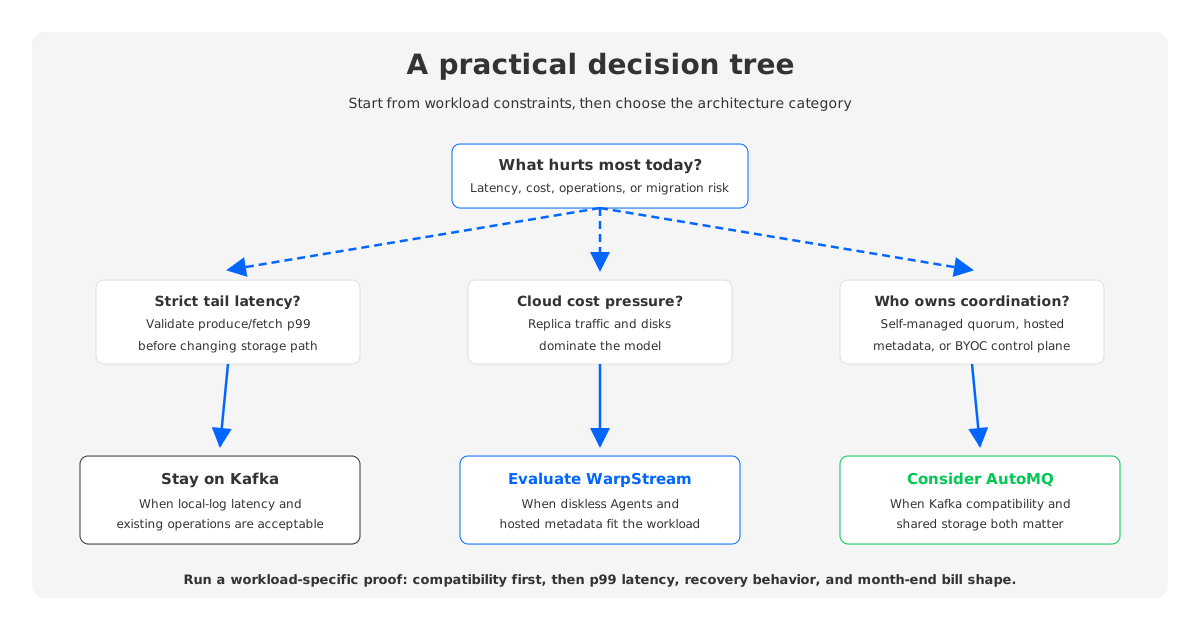
Stay on Apache Kafka when the current cluster meets cost and reliability goals, your team has strong Kafka operations muscle, and low tail latency from local logs is a hard requirement. Kafka remains the deepest ecosystem bet, especially when operational maturity already exists.
Evaluate WarpStream when the main pain is broker-local state, disk capacity, cross-zone replication cost, and slow scaling, and when your team is comfortable with object storage plus a managed metadata/control-plane dependency. Give special attention to tail latency, object-store request volume, network routing, and read-cache behavior.
Evaluate AutoMQ when the target is Kafka-compatible shared storage with stateless brokers, object-storage-backed retention, and a WAL-based write path. The strongest evaluation compares Kafka, WarpStream, and AutoMQ against the same traffic shape and failure drills.
The architecture decision should end with a table your SREs can operate, not a slogan your procurement team cannot validate. Put cost, latency, failure domains, compatibility, and ownership in the same review. That is the practical way to compare WarpStream vs Kafka.
For a deeper look at the shared-storage approach, see the AutoMQ architecture documentation and run a proof with your own Kafka workload rather than a synthetic average. Start with AutoMQ S3Stream architecture and validate the assumptions that matter to your platform.
9FAQ
9.1Is WarpStream the same as Apache Kafka?
No. WarpStream is Kafka-compatible, meaning applications can use Kafka protocol clients, but its internal architecture is different. Kafka uses stateful brokers with local logs and partition replication. WarpStream uses stateless Agents, object storage, and a metadata/control-plane service.
9.2Is WarpStream tiered storage?
WarpStream says it is not tiered storage. In a tiered-storage Kafka design, brokers still keep a hot local log and offload older segments to object storage. WarpStream's architecture writes stream data directly to object storage without broker-local disks.
9.3Does WarpStream remove all operational work?
No. It removes or reduces some Kafka broker operations, especially around local disks and replica movement, but teams still need to operate networking, IAM, object storage configuration, Agent pools, observability, incident response, and migration workflows.
9.4When is Apache Kafka still the better choice?
Kafka is often the safer choice when a team already operates it well, needs mature ecosystem behavior, and has strict latency requirements that are well served by local broker logs. It is also the baseline for compatibility testing because Kafka defines the reference behavior.
9.5How should teams compare WarpStream and AutoMQ?
Compare them as two different ways to reduce broker-local state while preserving Kafka compatibility. WarpStream uses diskless Agents and a managed metadata/control-plane architecture. AutoMQ uses stateless Kafka-compatible brokers with S3Stream, object storage, and WAL acceleration. Test both against the same workloads, failure drills, and cost model.
10References
- WarpStream Architecture
- WarpStream Write Path
- WarpStream Read Path
- WarpStream Object Storage Configuration
- Apache Kafka Documentation
- Apache Kafka Design: Replication
- Apache Kafka KRaft Operations
- AWS S3 Pricing
- AWS EBS Pricing
- Confluent Acquires WarpStream
- AutoMQ Architecture Overview
- AutoMQ S3Stream Overview
- AutoMQ WAL Storage
- AutoMQ Stateless Broker


