
Table of Contents
Table of Contents
Kafka cost problems rarely start with a single outrageous line item. They start with a reasonable cluster that grows into a set of coupled commitments: brokers sized for peak traffic, local disks sized for retention, replicas sized for availability, network paths sized by placement, and operations sized for the day something needs to move. By the time a FinOps team asks whether WarpStream is lower cost than Kafka, the real question is more specific: which parts of the Kafka cost model are architectural, and which parts will reappear under a different name?
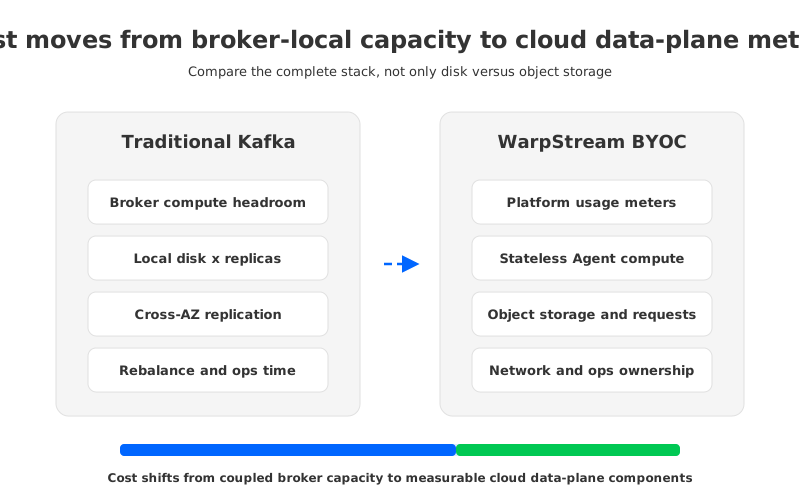
WarpStream changes that model by replacing broker-local disks with cloud object storage and by running stateless Agents in the customer's cloud account. Confluent's documentation describes WarpStream as a Kafka-compatible BYOC system where Agents write data to object storage and coordinate through metadata services. That design attacks some of the most stubborn Kafka cost drivers, especially over-provisioned disks, partition movement, and broker-to-broker replication traffic. It does not remove compute, platform fees, object storage requests, read amplification, networking, or operational ownership.
1Traditional Kafka Cost Drivers in the Cloud
Apache Kafka's storage model was designed around partition logs on brokers. Each partition has a leader, followers replicate from that leader, and durability depends on replica placement and acknowledgments. That design is durable and well understood, but in cloud environments it turns storage, compute, and availability into a tightly coupled package. To retain more data, you provision more disk. To survive broker or zone failure, you replicate more data. To rebalance hot partitions or resize the cluster, you move data between brokers.
The cost stack usually has five layers:
- Broker compute: instances are sized for peak produce, fetch, compaction, replication, and recovery work, not only average traffic.
- Local or attached disk: retained data is multiplied by replication factor and then padded for headroom, segment behavior, and recovery safety.
- Cross-AZ replication: multi-AZ Kafka deployments often copy follower traffic across availability zones, creating data transfer exposure.
- Operational headroom: teams keep spare disk, spare network, and spare broker capacity because partition movement during incidents is expensive.
- People and tooling: reassignment, upgrades, broker replacement, quota tuning, and noisy consumer behavior all require operational time.
The important point is that these layers compound. A seven-day retention requirement is not only a storage decision; it affects disk size, broker shape, rebalance duration, recovery windows, and network volume. A workload with 80 MiB/s of average writes and 168 hours of retention has a logical retention anchor of about 47,250 GiB before compression, replication, filesystem overhead, and safety headroom:
80 MiB/s x 3600 x 168 / 1024 = 47,250 GiB
With replication factor 3, the logical broker-side storage footprint becomes roughly 141,750 GiB before compression and overhead assumptions. That number is not a quote; it is a way to see why traditional Kafka clusters become expensive when retention and availability are both non-negotiable.
2Where WarpStream Changes the Cost Equation
WarpStream's central cost move is to separate the durable storage layer from the compute layer. Agents can be treated as stateless data-plane workers while the durable bytes live in object storage. WarpStream's pricing and billing references also make clear that the commercial model is different from a self-managed Kafka cluster: public billing concepts include cluster time, uncompressed GiB written, and uncompressed GiB stored, while the customer still pays the underlying cloud provider for BYOC infrastructure.
That separation can save money in workloads where traditional Kafka is carrying too much local-disk and replication baggage. Long retention, high ingest volume, and frequent broker scaling are natural candidates because durable capacity can move to object storage instead of attached disks. If a Kafka team is keeping large brokers alive mainly because they hold historical data, a diskless architecture can turn part of the problem into an object storage and request model.
The strongest fit often appears in these patterns:
| Workload pattern | Why diskless Kafka can help | What still needs modeling |
|---|---|---|
| High ingest with long retention | Object storage capacity can be separated from broker shape | Stored GiB, request volume, lifecycle behavior |
| Many partitions with uneven heat | Stateless Agents reduce some partition movement pressure | Metadata scale, caching, consumer locality |
| Multi-AZ production clusters | Broker-to-broker replica traffic can be reduced or reshaped | Client placement, object-store access paths, private connectivity |
| Periodic scaling or replacement | Agents do not own durable logs in the same way brokers do | Autoscaling floor, failure recovery, control-plane dependencies |
| Logging and observability streams | Storage-heavy workloads often tolerate more latency variance | Tail latency, replay behavior, read fanout |
This is why the phrase "diskless Kafka" is useful but incomplete. Removing broker disks changes the largest mechanical constraint in many Kafka clusters, yet the workload still has physics. Bytes are written, read, indexed, cached, retained, and recovered. The difference is where those actions land on the bill.
3Where Diskless Does Not Mean Lower Cost
The easiest mistake is to compare Kafka broker disk cost with object storage capacity cost and stop there. Object storage has capacity pricing, but it also has request pricing, data transfer behavior, storage class rules, and operational side effects. AWS S3 pricing, for example, separates storage from request categories such as PUT, COPY, POST, LIST, GET, lifecycle transition, and retrieval operations. A streaming engine uses object storage as an active data plane, not a passive archive.
WarpStream therefore needs a total-cost worksheet with at least three invoices in mind: the vendor platform bill, the customer cloud bill, and the internal operating cost. The vendor bill may look attractive while the cloud account absorbs compute, object storage requests, logs, metrics, PrivateLink or equivalent connectivity, and network transfer. That is not a hidden flaw in BYOC; it is the point of BYOC. More ownership moves into the customer's account, so the model must follow it.
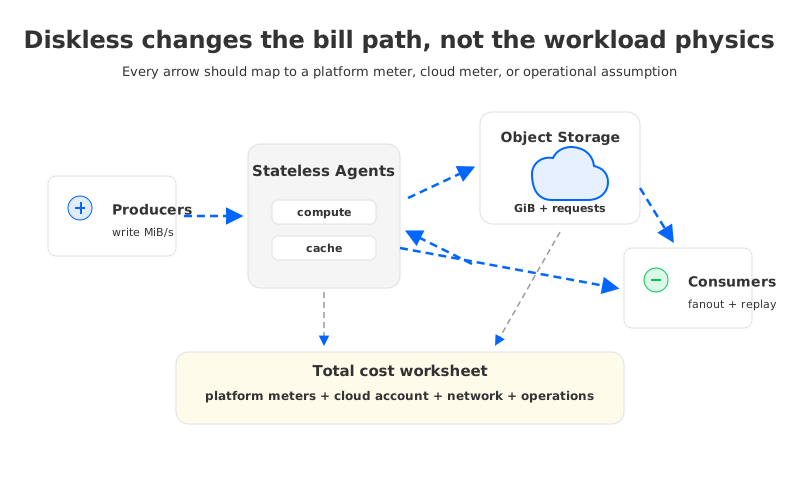
Read patterns are the other place where static estimates fail. A tailing consumer may be served from hot caches, while a lagging consumer, a backfill job, or a disaster recovery test may touch older objects. WarpStream's read-path documentation describes per-AZ caching that reduces object storage GET pressure for Kafka Fetch requests. That design claim is exactly what a proof of concept should measure with production-like fanout, not a number to assume from a generic benchmark.
The less obvious costs are often timing costs. A traditional Kafka cluster may force expensive over-provisioning because recovery and reassignment are slow. A diskless architecture may reduce that over-provisioning, but it may also introduce sensitivity to object storage request patterns, metadata dependencies, and cache warmup after disruption. The right comparison is not "disk versus bucket." It is "which system keeps cost predictable during the workload events we actually experience?"
4A Side-by-Side Cost Model
Use one workload sheet for both systems. If the inputs differ between Kafka and WarpStream, the comparison becomes a vendor story instead of an engineering model. Start with workload physics, then apply architecture-specific multipliers and meters.
| Input | Traditional Kafka interpretation | WarpStream interpretation |
|---|---|---|
| Average write throughput | Broker ingest, follower replication, retained segments | Uncompressed GiB written, Agent work, object writes |
| Peak write throughput | Broker sizing and headroom | Agent sizing and autoscaling headroom |
| Retention | Local disk multiplied by replica factor | Object storage GiB plus platform stored GiB meter |
| Read fanout | Broker fetch load and possible cross-AZ traffic | Cache behavior, object GETs, Agent egress paths |
| Partition count | Metadata, leaders, rebalancing, file handles | Metadata scale, object layout, cache locality |
| Availability target | Replica factor, ISR, rack or AZ placement | Agent placement, object store durability, metadata/control plane |
| Migration path | Dual-write, MirrorMaker, reassignment risk | Dual-run, compatibility testing, cutover and rollback |
For a first-pass Kafka storage anchor, use:
broker-side logical GiB = average write MiB/s x 3600 x retention hours x replication factor / 1024
For a first-pass object-storage-backed anchor, split the estimate:
retained logical GiB = average write MiB/s x 3600 x retention hours / 1024
total cost = platform meters + Agent compute + object capacity + object requests + network + operations
These formulas are intentionally plain. Precision comes later, after compression ratio, physical object layout, cache hit rate, storage class, cloud region, committed-use discounts, and support terms are known. The early goal is to keep teams from comparing a complete Kafka estimate with an incomplete WarpStream estimate, or the reverse.
5Where AutoMQ Fits in the Same Category
Once the cost model is framed around architecture, AutoMQ belongs in the comparison as another Kafka-compatible, object-storage-backed design rather than as a generic "Kafka alternative." AutoMQ keeps Kafka protocol compatibility while moving durable stream storage to S3-compatible object storage and using stateless brokers. Like WarpStream, it should be evaluated against the same workload worksheet: written bytes, retained bytes, read fanout, object request behavior, network placement, recovery behavior, and operator time.
The architectural difference to examine is implementation detail, not category label. WarpStream uses stateless Agents and object storage as the durable data plane. AutoMQ uses stateless Kafka-compatible brokers and an S3Stream storage layer, with WAL and object storage paths documented as part of the write and recovery design. Traditional Kafka keeps durable logs on broker-local storage and uses replication to maintain availability. All three can serve Kafka clients, but they produce different cost curves when retention, scaling, and recovery pressure rise.
AutoMQ is most relevant when a team wants Kafka compatibility, BYOC-style data control, and a shared-storage model that can be benchmarked independently from WarpStream. The evaluation should remain concrete: run the same traffic, keep the same retention, preserve the same partition count, and record vendor meters plus cloud-account counters. A lower spreadsheet estimate is useful; a lower estimate that remains explainable during replay, zone impairment, and scaling is better.
If the model shows that broker-local disks and partition movement dominate your Kafka cost, compare multiple object-storage-backed options instead of stopping at one vendor page. AutoMQ's pricing and documentation can be used as a second architecture baseline for that exercise.
6Workload-Based Decision Framework
The winner depends on the workload, not the product category. Traditional Kafka can still be rational when the team already operates it well, retention is short, traffic is stable, and the cost of architectural change is higher than the infrastructure savings. WarpStream can be attractive when retention-heavy streams, broker scaling, and multi-AZ replica traffic are the main pain. AutoMQ can be attractive when the same object-storage-backed economics are desired with a Kafka-compatible architecture that the team wants to validate separately.
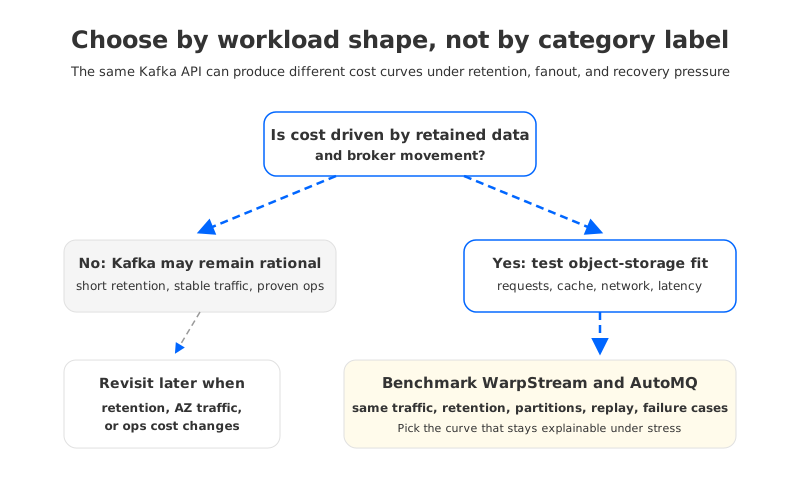
Use this checklist before committing to a cost answer:
- Normalize byte basis: compressed producer bytes, uncompressed logical bytes, retained logical GiB, physical stored bytes, and billable bytes.
- Separate vendor bill, customer cloud bill, and internal operations.
- Model object storage requests, not only object storage capacity.
- Include cross-AZ, cross-region, private connectivity, NAT, and replay-related network paths.
- Test retention sensitivity from hours to days or weeks.
- Test read fanout, lag recovery, and historical replay rather than only steady tailing consumers.
- Include migration cost: dual-run capacity, validation, rollback, and team time.
- Compare failure behavior because recovery is where over-provisioning usually proves whether it was justified.
The most useful result is not a single total. It is a curve. If the curve improves as retention grows, diskless Kafka is solving the right part of the problem. If the curve bends upward under read fanout, object requests, or cloud networking, the savings may be narrower than the headline suggests. Cost architecture is still architecture; it has failure modes, not only rates.
7References
- Apache Kafka Documentation: Replication
- WarpStream Architecture
- WarpStream Billing Reference
- WarpStream Pricing
- Confluent Completes Acquisition of WarpStream
- AWS S3 Pricing
- AWS Data Transfer Pricing
- AutoMQ Architecture Overview
- AutoMQ Pricing
8FAQ
8.1Is WarpStream always lower cost than Kafka?
No. WarpStream can reduce cost when broker-local disks, replication traffic, and operational headroom dominate the Kafka bill. It may be less compelling when retention is short, read fanout is heavy, latency requirements are strict, or the BYOC cloud bill is under-modeled.
8.2What is the biggest cost difference between WarpStream and Kafka?
Traditional Kafka couples compute, local disk, and replication. WarpStream separates durable storage into object storage and uses stateless Agents. That changes how retention, scaling, and broker replacement affect cost.
8.3Does diskless Kafka eliminate cross-AZ cost?
It can reduce some broker-to-broker replication paths, but it does not make networking disappear. Client placement, Agent placement, object storage endpoint access, private connectivity, replay jobs, and multi-region recovery still need to be modeled.
8.4Which workloads fit diskless Kafka economics?
Storage-heavy workloads with long retention, high ingest volume, relaxed latency requirements, and expensive broker scaling are strong candidates. Logging, observability, and analytical replay streams often deserve a close look.
8.5How should I compare WarpStream, Kafka, and AutoMQ?
Use the same workload sheet for all three. Measure write throughput, retention, read fanout, partition count, object storage requests, network transfer, recovery behavior, and operator time. Then compare cost curves under steady state, replay, scaling, and failure scenarios.


