
Table of Contents
Table of Contents
The hard part of comparing WarpStream and Amazon MSK cost is deciding which bill you are comparing. Amazon MSK is an AWS-managed Apache Kafka service with broker, storage, data transfer, and optional tiered storage dimensions. WarpStream is a diskless, Kafka-compatible streaming platform built on cloud object storage, with BYOC billing dimensions such as cluster-minutes and logical data written or stored.
That difference is why a static "MSK price vs WarpStream price" table misleads teams. MSK Standard cost is shaped by broker count, storage, throughput, replication, retention, and cross-AZ traffic. WarpStream cost is shaped by usage meters plus customer-owned AWS resources: agents, S3, network paths, observability, and operations. The right comparison starts from the workload.
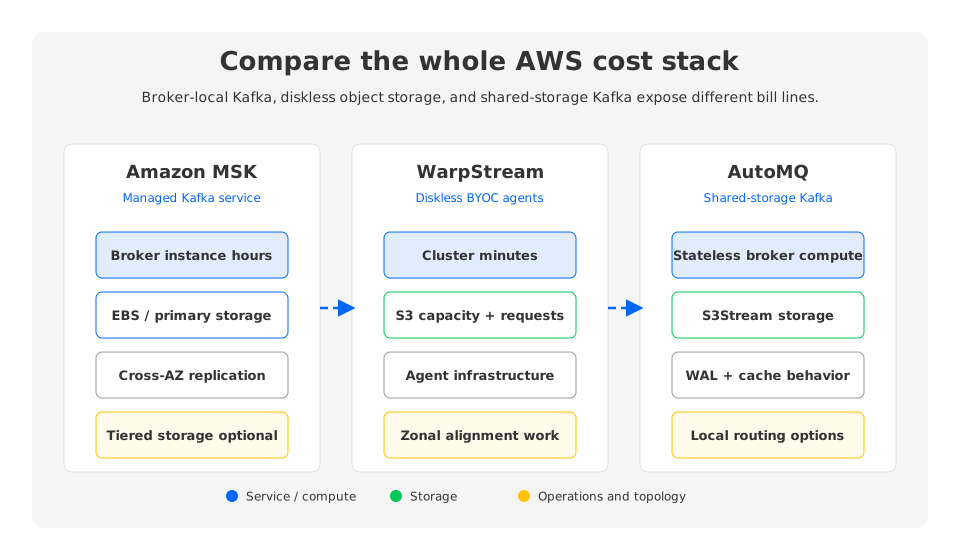
1AWS Kafka Cost Categories
Every AWS Kafka cost model should begin with the same categories:
- Compute: brokers, agents, controllers, Kubernetes nodes, autoscaling headroom, and failover capacity.
- Storage: EBS or local broker storage, S3 or tiered storage, logical retained bytes, physical compressed bytes, and replication or region multipliers.
- Network: producer and consumer placement, broker replication, S3 access paths, cross-AZ transfer, cross-region replication, PrivateLink, NAT, and internet egress.
- Operations: cluster upgrades, storage scaling, rebalancing, observability, incident response, capacity planning, tagging, and FinOps review.
- Vendor or service fees: MSK service pricing, WarpStream cluster tier and usage billing, support, marketplace terms, and committed spend.
These categories matter because cost can move without disappearing. Moving data from broker-local EBS to S3 can reduce some disk and replication pressure, but it introduces object storage capacity, request, lifecycle, and access-path questions. The accounting boundary changes; the workload physics do not.
2MSK Cost Model: EBS, Brokers, Replication, and Tiered Storage
Amazon MSK Provisioned runs open-source Apache Kafka versions while AWS manages control-plane operations. In MSK Standard, you choose broker nodes per Availability Zone, broker type, storage, and configuration. The cost model still reflects Kafka's local-storage design.
The basic MSK Standard worksheet has several lines:
| MSK Standard cost line | What drives it | What to verify |
|---|---|---|
| Broker instance hours | broker type, broker count, AZ count, steady headroom | peak throughput, partition count, failover capacity |
| Broker storage | EBS GiB per broker, storage throughput if provisioned, retention | logical bytes, compression, replication factor, utilization target |
| Data transfer | client placement, inter-broker replication, cross-AZ reads/writes | producer AZ affinity, consumer rack awareness, VPC topology |
| Tiered storage | remote retention, read-back behavior, topic eligibility | retention split, replay frequency, unsupported topic patterns |
| Operations | scaling, monitoring, rebalancing | staffing model, automation maturity |
The storage line is where many first-pass estimates go wrong. Kafka topic retention is not the same as EBS allocated capacity. If a workload writes 80 MiB/s on average and retains seven days of data, the logical retained volume before compression and replication adjustments is:
80 MiB/s x 3600 x 168 hours / 1024 = 47,250 GiB
For a Kafka-style replicated log, planning then adjusts for compression, replication factor, compaction policy, reserved free space, and per-broker distribution. MSK Standard storage can be increased, but AWS documents a cooldown period of at least six hours, optimization work that can take up to 24 hours or more, and an increase-only model. Storage headroom is therefore both a financial and operational decision.
MSK tiered storage changes part of this equation. AWS describes it as a lower-cost tier that scales to virtually unlimited storage while primary storage remains performance-optimized. It can reduce the need to keep all retained data on broker storage, but it is not a universal replacement for local broker storage: AWS documents constraints around provisioned mode, topic-level behavior, minimum retention, and compacted topics.
Cross-AZ traffic needs the same discipline. Apache Kafka durability relies on replicas across brokers, so leader placement, follower replication, producer placement, and consumer reads can all create inter-zone paths. AWS pricing pages also state that standard AWS data transfer charges can apply to data transferred in and out of MSK clusters. Broker hours plus EBS is only half a model.
3WarpStream Cost Model: S3, Agents, Logical Usage, and Zonal Alignment
WarpStream's documentation describes it as a diskless, Apache Kafka-compatible data streaming platform built directly on top of cloud object stores such as S3. Instead of treating broker-local disks as the durable log, WarpStream uses agents in the customer's environment and object storage as the durable storage foundation. BYOC billing includes cluster-minutes, uncompressed GiB written, and uncompressed GiB stored.
That cost model has two layers: the WarpStream platform bill and the AWS bill in the customer account. For AWS FinOps, the second layer is where surprises hide if the evaluation only reads the vendor pricing page.
| WarpStream BYOC cost line | What drives it | What to verify |
|---|---|---|
| Cluster-minutes | cluster tier and active agent deployment window | non-production uptime, minimum deployment footprint |
| Uncompressed GiB written | logical write volume, not physical compressed object bytes | producer compression ratio, batching, schema growth |
| Uncompressed GiB stored | logical retained volume and retention duration | topic retention, multi-region multiplier, delete behavior |
| Agent infrastructure | agent count, sizing, autoscaling floor | CPU, memory, network overhead |
| S3 capacity and requests | object layout, PUT/GET/LIST patterns, replay behavior | request classes, object size, cache hit rate, retention |
| Networking | client-to-agent, agent-to-S3, private endpoints, inter-AZ paths | zonal alignment, VPC endpoints, NAT, cross-region |
| Operations | deployment, alerts, IaC, bill attribution | team ownership and observability |
WarpStream's zone-aware client guidance is important because it speaks directly to the AWS network line. Its documentation says WarpStream has no AZ networking costs between agents and provides client configuration patterns to keep Kafka clients connected to agents in the same Availability Zone. Network savings therefore depend on deployment and client alignment, not only on the label "diskless."
Multi-region changes the arithmetic. WarpStream's billing documentation states that for multi-region clusters, uncompressed GiB written and stored are multiplied by the number of control-plane regions, while cluster minutes are not. That durability choice belongs in the worksheet.
4Data Transfer Path Map
The biggest architectural contrast is where durable replication happens. In MSK Standard, Kafka replication happens across brokers, often across Availability Zones. In WarpStream, durable data is placed in object storage, while agents and clients should be placed so hot traffic stays zone-local where possible. Neither model eliminates every network charge. They make different paths expensive.
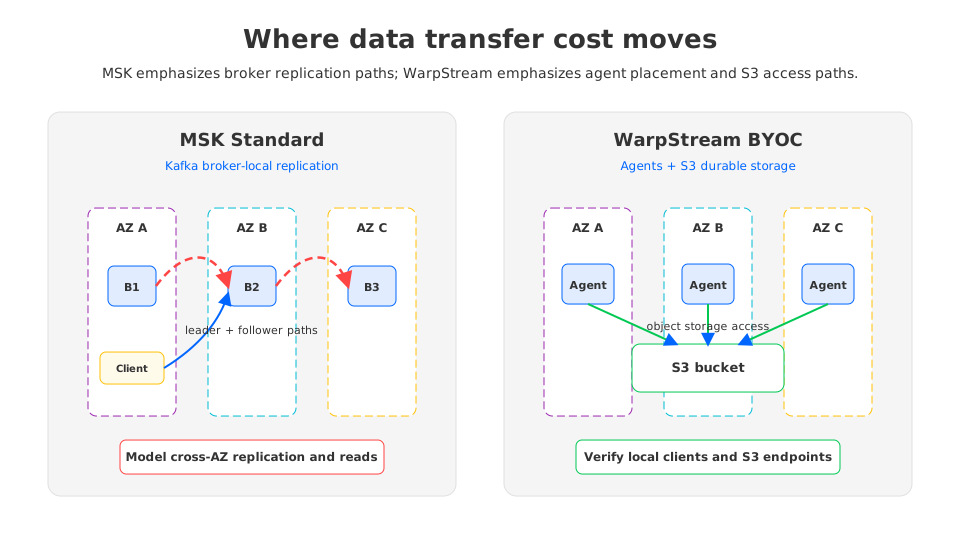
For MSK, model producer-to-leader traffic, leader-to-follower replication, consumer reads, connector paths, and tiered-storage reads during replay or backfill. For WarpStream, model producer and consumer traffic to local agents, agent access to S3, object storage request volume, hosted metadata paths, and multi-region replication if regional redundancy is enabled.
WarpStream can reduce the inter-broker replication pattern that often hurts Kafka-on-AWS budgets, but the team must still verify S3 access, agent placement, client placement, and replay behavior. MSK can be predictable and AWS-native, but multi-AZ replication, EBS headroom, and storage scaling rules need to be visible before approval.
5A Workload-Based TCO Worksheet
A defensible comparison should use one worksheet for both systems. Start with workload inputs, calculate logical data volume, then apply each architecture's meters. Do not start from a vendor headline rate.
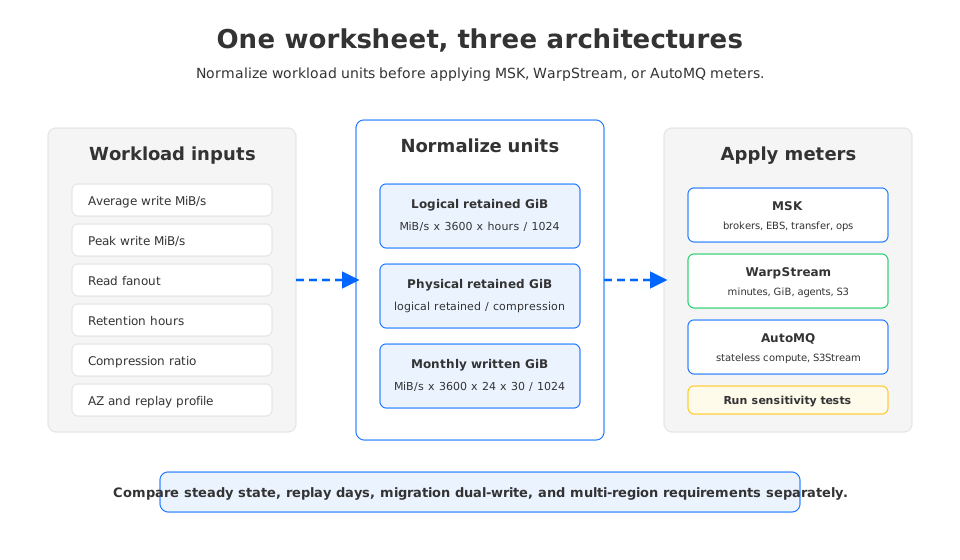
Use this core input set:
| Input | Unit | Why it matters |
|---|---|---|
| Average write throughput | MiB/s | drives retained data and written-data meters |
| Peak write throughput | MiB/s | drives broker or agent sizing and headroom |
| Average read fanout | multiplier | drives network, cache, and replay pressure |
| Retention | hours or days | turns write rate into retained GiB |
| Compression ratio | logical:physical | separates logical billing from physical storage |
| Replication or region factor | count | affects Kafka storage, network, or multi-region billing |
| Topic and partition count | count | affects metadata, broker sizing, limits, and operations |
| AZ placement | topology | determines cross-AZ paths and client routing work |
| Replay profile | GiB/day or incidents/month | exposes remote storage and request sensitivity |
Keep the formulas plain enough for engineering and finance to audit:
logical retained GiB = avg write MiB/s x 3600 x retention hours / 1024
physical retained GiB = logical retained GiB / compression ratio
replicated Kafka storage GiB = physical retained GiB x replication factor
monthly logical written GiB = avg write MiB/s x 3600 x 24 x 30 / 1024
Those formulas do not produce a quote. They produce normalized units. For MSK, map the outputs to broker count, EBS capacity, tiered storage, data transfer, and operations. For WarpStream, map them to cluster-minutes, uncompressed GiB written and stored, agent infrastructure, S3, data transfer, and operations.
Sensitivity tests are where the model becomes useful:
- Increase retention from seven days to thirty days.
- Change read fanout, compression ratio, or replay volume.
- Move producers or consumers into a different AZ from the serving endpoint.
- Add dual-write migration traffic or multi-region disaster recovery.
These tests reveal which architecture is more cost-resilient for the actual workload. A long-retention, replay-heavy workload may care more about storage layout and request behavior than broker hourly rates. A low-latency, high-fanout workload may care more about cache, local read paths, and predictable p99 latency.
6Operations: The Cost Line That Rarely Fits in a Table
MSK and WarpStream also differ in who owns operational complexity. Amazon MSK manages the Kafka service control plane and supports AWS-native integrations, but platform teams still manage topic configuration, partition growth, client behavior, quota discipline, monitoring, and incident response. MSK Standard keeps storage planning visible because broker storage can be expanded but not reduced.
WarpStream BYOC shifts more of the data-plane environment into the customer's AWS account. That can improve data control and cloud-account visibility, but it means the team must operate agents, compute infrastructure, IAM policies, object storage policy, observability, alerting, and cost allocation. The useful question is which responsibility already fits your platform team.
Migration costs should not be hidden. A move from MSK to WarpStream, or from WarpStream to another Kafka-compatible target, can require dual writes, replication, schema validation, connector testing, offset handling, rollback windows, and temporary over-capacity. If migration doubles network and compute for a month, include it.
7Where AutoMQ Fits in the AWS Cost Discussion
Once the evaluation is framed by architecture rather than brand, AutoMQ belongs in a specific category: Kafka-compatible, object-storage-backed streaming with shared storage and stateless brokers. AutoMQ is not a generic "lower cost" claim pasted onto the comparison. It is relevant when the buyer is already questioning the economics of broker-local storage, cross-AZ replica traffic, slow partition reassignment, and over-provisioned capacity on AWS.
AutoMQ documentation describes S3Stream as a storage layer that offloads Kafka log storage to object storage and combines WAL options with S3 for stream storage. AutoMQ also documents an inter-zone routing approach designed to reduce Kafka inter-zone traffic through S3-based shared storage and local client routing. That puts AutoMQ in the same architectural conversation as WarpStream, while preserving Kafka protocol compatibility.
For an AWS buyer, the evaluation path is simple: include AutoMQ as a third column in the same worksheet. Use the same write rate, retention, fanout, compression, replay, and AZ placement assumptions. Measure cloud infrastructure, object storage, request behavior, network transfer, latency, recovery, and operator time.
8Decision Checklist for AWS FinOps and Platform Teams
Before you choose between WarpStream and MSK, ask these questions in order:
- What is the workload's logical write rate, physical compressed size, retention, fanout, and replay profile?
- Which costs are vendor charges, which are AWS charges, and which are internal operations?
- For MSK Standard, how much EBS headroom is reserved because storage can only grow?
- For MSK tiered storage, which topics qualify, and how often will the application read from the lower-cost tier?
- For WarpStream, are clients and agents correctly aligned to avoid unnecessary cross-AZ traffic?
- For WarpStream, how many S3 requests will normal tailing reads, catch-up reads, and replay jobs generate?
- For both, what happens during migration, backfill, disaster recovery testing, and rollback?
- Which team owns the bill when a cost spike appears: AWS platform, Kafka platform, application team, or vendor manager?
A sound purchase decision is rarely the one with the shortest pricing page. It is the one whose cost drivers match the workload and whose operational responsibilities match the team. MSK is often attractive when teams want an AWS-managed Kafka service. WarpStream is attractive when object-storage-first economics and BYOC control fit the workload. AutoMQ should be evaluated when the team wants Kafka compatibility with shared S3-backed storage and stateless broker operations in the same AWS cost model.
9References
- Amazon MSK pricing
- Amazon MSK Developer Guide: What is Amazon MSK?
- Amazon MSK storage management for Standard brokers
- Amazon MSK manual storage scaling
- Amazon MSK tiered storage
- Amazon S3 pricing
- Amazon EBS pricing
- Amazon EC2 On-Demand pricing and data transfer
- WarpStream documentation introduction
- WarpStream billing documentation
- WarpStream: Configure clients to eliminate AZ networking costs
- Apache Kafka documentation
- AutoMQ S3Stream shared streaming storage
- AutoMQ inter-zone traffic overview
- AutoMQ Kafka compatibility
10FAQ
10.1Is WarpStream always less expensive than Amazon MSK?
No. WarpStream can reduce cost drivers associated with broker-local storage and inter-broker replication, but the total depends on platform billing, AWS agent infrastructure, S3 capacity, S3 requests, network placement, and operations. Compare it with a workload worksheet, not a single pricing line.
10.2Is Amazon MSK only expensive because of EBS?
No. EBS is one visible cost line for MSK Standard, but broker hours, replication, cross-AZ paths, provisioned throughput, tiered storage behavior, monitoring, and operational headroom all matter. Long retention makes storage more visible, while high fanout or poor AZ placement can make network more visible.
10.3Does object storage remove cross-AZ traffic?
Object storage changes the traffic pattern; it does not remove every network path. Verify client placement, endpoints, NAT, PrivateLink, and replay behavior in your own AWS account.
10.4Should MSK tiered storage be compared directly with WarpStream?
Only for the specific part of the workload it addresses. MSK tiered storage moves older data to a lower-cost tier while keeping the MSK/Kafka broker model. WarpStream uses object storage as the core durable storage architecture. Both can help retention economics, but their latency, operations, topic eligibility, and billing models are different.
10.5Where does AutoMQ fit in a WarpStream vs MSK cost evaluation?
AutoMQ fits as a Kafka-compatible, S3-backed shared-storage option with stateless brokers. It is relevant when the buyer is evaluating broker-local storage, cross-AZ replica traffic, elastic scaling, and long retention against the same workload worksheet.


