
Table of Contents
Table of Contents
Teams usually compare WarpStream and Redpanda after they have already decided that a default Kafka cluster is not the end state. The shortlist is not really asking whether Kafka is useful. It is asking which parts of the Kafka operating model still deserve to exist in a cloud environment where storage, networking, and failure domains are priced differently from the data centers Kafka originally grew up in.
That makes "WarpStream vs Redpanda" a more useful question than a feature checklist. WarpStream is a diskless, Kafka-compatible streaming platform built on object storage with stateless Agents and a managed metadata/control plane. Redpanda is a Kafka API-compatible streaming platform that runs as a high-performance broker and can offload older log segments through tiered storage. Both can sit behind Kafka clients. They make opposite bets about where the hot path should live.
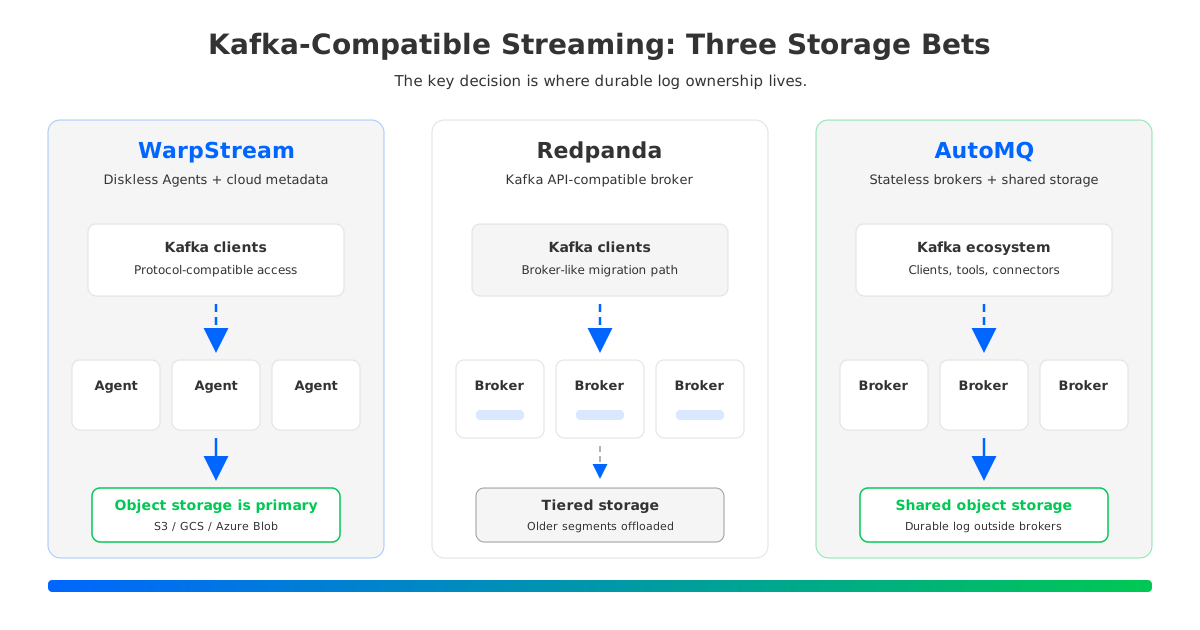
The useful comparison starts with the workload. A fraud detection pipeline with strict tail-latency budgets, a log ingestion platform with long retention, and a multi-tenant internal event backbone do not need the same storage model. Storage placement decides the cost curve, the failure mode, the scaling workflow, and the migration risk.
1The Core Architectural Difference
WarpStream removes local disks from the broker-like layer. Its documentation describes a stateless Agent that speaks the Apache Kafka protocol, writes data directly to object storage, and coordinates through WarpStream's cloud metadata store. Any Agent can serve any topic or partition because durable data is not owned by a specific node.
Redpanda keeps the broker as the center of the system. Its compatibility page states support for Apache Kafka versions 0.11 and later, with documented exceptions. Redpanda's tiered storage can offload log segments to object storage and fetch them back when needed, but local storage remains part of the hot-data and broker lifecycle model.
The distinction matters because object storage can play different roles:
- Primary storage: Data is durably written to object storage as the system of record. Compute nodes can be replaced without moving partition data between them.
- Remote tier: The broker still owns local hot segments, while older segments move to object storage to reduce local disk pressure.
- Shared storage with a Kafka protocol surface: The system keeps Kafka clients and semantics, but rethinks broker state so scaling and recovery depend less on partition rebalancing.
AutoMQ belongs to the third category: a Kafka-compatible streaming system with stateless brokers and object-storage-backed shared storage. It is worth mentioning here because it exposes a middle path in the decision space, not because every WarpStream or Redpanda evaluation should end with the same answer.
2Compatibility Is Necessary, Not Sufficient
Kafka compatibility is a floor, not a finish line. Most teams want to keep Kafka clients, Kafka Connect, Schema Registry patterns, monitoring habits, ACL expectations, and runbooks where possible. A platform that accepts the Kafka protocol but changes enough edge behavior can still create migration drag.
Redpanda's compatibility story is direct: Kafka clients developed for Kafka 0.11 or later are generally compatible, with Redpanda documenting unsupported Kafka features and validated clients. That is attractive when the estate already assumes broker-like Kafka behavior. It also matters for tools that lean on admin APIs, consumer groups, and partition-level visibility.
WarpStream also speaks the Apache Kafka protocol, but its storage and metadata path differ more sharply from traditional Kafka. The upside is operational: stateless Agents, object storage as primary durable storage, and fewer broker-local data movement tasks. The tradeoff is that teams should test feature usage carefully, especially less common admin operations, very low-latency expectations, or broker-local assumptions.
| Dimension | WarpStream | Redpanda | What to Test |
|---|---|---|---|
| Kafka protocol | Kafka-compatible Agent layer | Kafka API-compatible broker | Clients, admin APIs, transactions, ACLs |
| Storage model | Object storage-first, diskless Agents | Local broker storage plus tiered storage | Produce latency, historical reads, restore behavior |
| Scaling model | Add or remove stateless Agents | Scale brokers and stateful capacity | Partition movement and autoscaling workflow |
| Cost shape | Usage plus object storage and API costs | Compute, local storage, cloud service pricing | Write-heavy, read-heavy, idle workloads |
| Operational risk | Managed metadata/control plane dependency | Broker fleet and local storage operations | Failure tests and upgrade process |
This table is not a winner table. A team moving hundreds of services with strict compatibility constraints may prefer a broker-shaped migration. A team whose Kafka bill is dominated by replication, retention, and overprovisioned disks may care more about removing broker-local storage from the critical path.
3Cost Is a Function of Data Movement
Cloud Kafka cost is often misdiagnosed as "storage is expensive." Storage matters, but Kafka's traditional durability model makes the broker replicate data across nodes and zones before the cloud provider's durable storage systems get involved. Compute, disk throughput, cross-zone traffic, and operational headroom all show up in the bill.
WarpStream attacks that cost structure by writing directly to object storage and avoiding broker-to-broker data replication for durability. Its billing documentation describes consumption-based billing for BYOC and Serverless clusters, metered hourly and invoiced monthly. Published pricing exposes dimensions such as cluster minutes, uncompressed GiB written, and uncompressed GiB stored.
Redpanda attacks a different part of the problem. It reduces Kafka operational complexity with its own broker implementation while preserving Kafka API compatibility. Tiered storage can lower local storage pressure, and Redpanda Cloud shifts more management to the provider. The cost profile still depends on compute sizing, hot storage, throughput headroom, deployment model, and cold-read behavior.
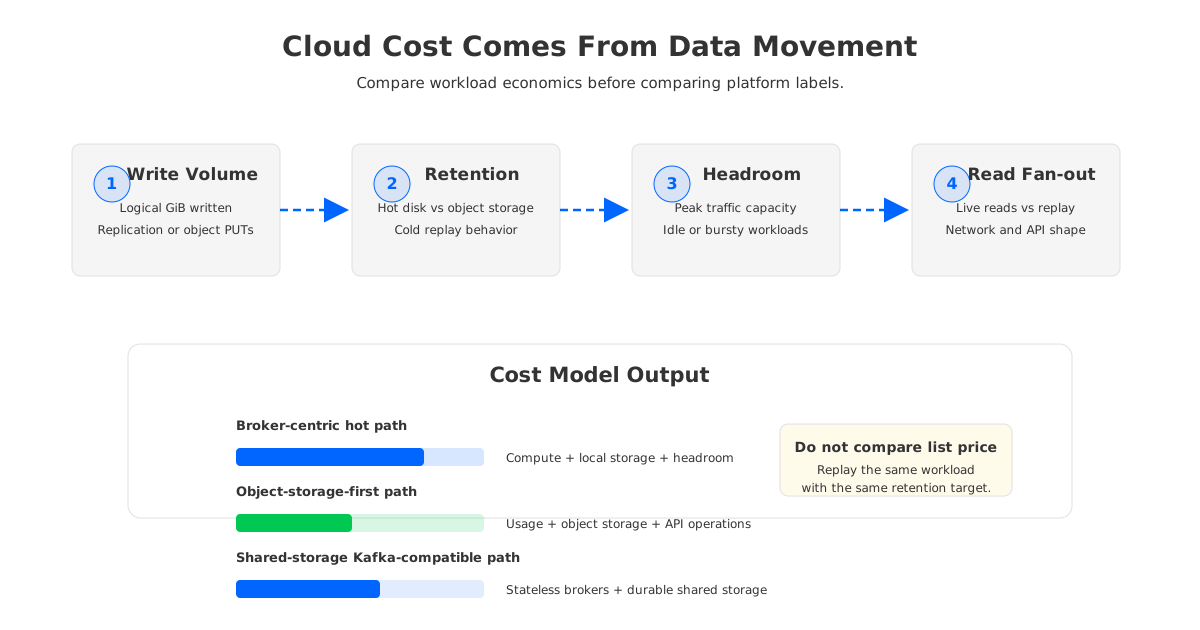
The practical cost model should separate four questions:
- How much data is written per month? Write volume drives broker network, object storage writes, and platform usage metrics. Compression helps infrastructure, but some platforms bill on logical uncompressed volume for predictability.
- How long is data retained? Long retention favors object storage-backed designs, but historical read patterns can turn object storage API and retrieval behavior into real cost.
- How spiky is traffic? Stateless compute has an advantage when traffic changes quickly and idle capacity is waste. Stateful brokers need more careful headroom planning.
- Where do reads happen? A workload that constantly replays cold data is different from one that mostly consumes the live head of the log.
The wrong comparison is monthly list price versus monthly list price. The right comparison is a workload replay: same retention, write rate, consumer fan-out, availability target, cloud region, and staffing assumptions.
4Latency: Hot Path Versus Storage Path
Redpanda is usually considered when low latency is a first-order requirement. A broker-centric architecture can keep the hot path close to local disk and memory. If your workload is a real-time control loop, online trading signal, or user-facing application path where milliseconds matter, Redpanda deserves a serious benchmark in your own environment.
WarpStream makes a different tradeoff. Its architecture documentation says naive object-storage streaming can create either high latency or high API operation cost. WarpStream's answer is batching, compaction, and a metadata architecture that makes object storage practical for many streaming workloads.
The important question is not "does object storage add latency?" It does. The question is whether that latency matters for the workload and whether the cost reduction, simpler recovery, and scaling model are worth the trade. Many Kafka deployments are operationally critical, high-throughput, retention-heavy systems where predictable cost and recovery behavior matter more than squeezing every millisecond out of the append path.
5Operations and Failure Modes
Architecture shows up most clearly during incidents. In a broker-centric system, a failed node or full disk is a data ownership problem. The cluster needs to recover replicas, move partitions, maintain quorum, and avoid turning recovery traffic into a second incident. Redpanda improves many parts of the broker experience, but it is still a stateful distributed system with local capacity and lifecycle concerns.
WarpStream changes that failure mode by making Agents stateless. If an Agent disappears, another Agent can serve requests because durable data lives in object storage and metadata coordination is handled separately. That reduces a whole class of broker-local recovery work. It also introduces a different dependency: the WarpStream control plane and metadata store are central to cluster behavior, so buyers should understand connectivity, regional design, private networking, and account-level control requirements.
AutoMQ's shared-storage design follows the same broad cloud-native principle of reducing broker-local state, while keeping a Kafka-compatible architecture that can be deployed in the customer's cloud environment. The right implementation depends on how much control, openness, and operational responsibility the team wants to keep.
6Migration Risk Checklist
Migration risk is where demos are least useful. A happy-path producer and consumer can pass in an afternoon. The real work is proving that the edges of your Kafka estate behave the same way under failure, upgrade, reprocessing, and rollback.
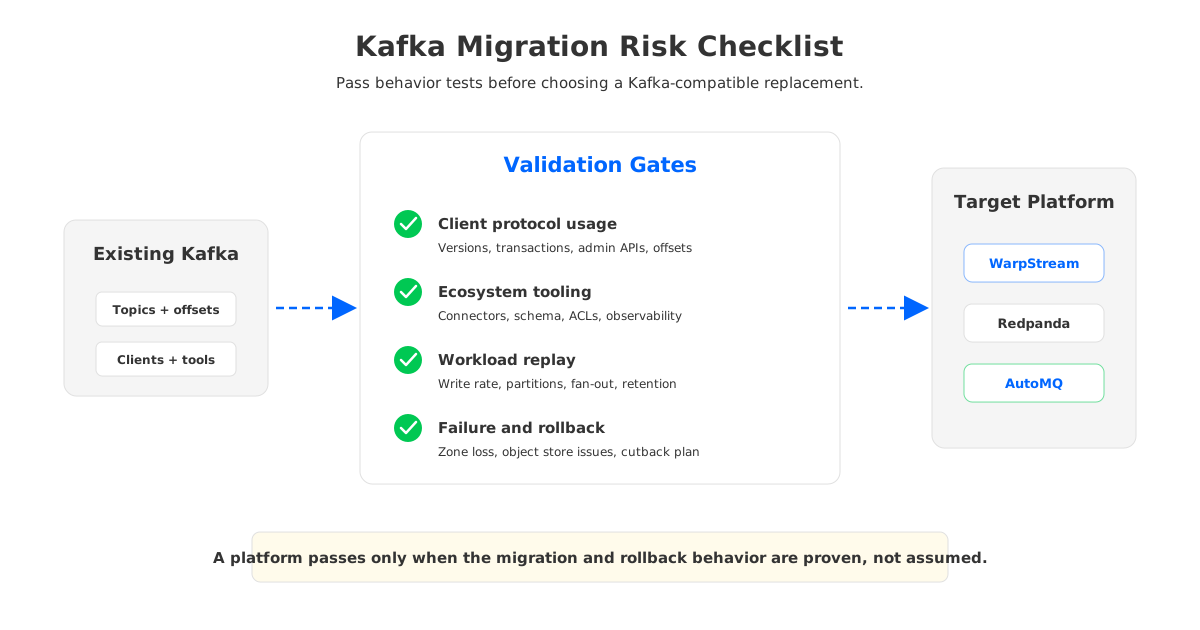
Use a checklist that covers behavior, not only connectivity:
- Client protocol usage: Inventory client libraries, admin APIs, transactions, producer behavior, consumer groups, and offsets.
- Ecosystem tools: Test Kafka Connect, Schema Registry, replication, monitoring exporters, ACL automation, and incident tooling.
- Workload shape: Replay write rates, message sizes, partition counts, fan-out, retention windows, and cold reads.
- Failure behavior: Kill nodes or Agents, interrupt object storage, simulate zone failures, and measure recovery.
- Rollback path: Prove offset preservation, topic configuration mapping, and a clean cutback plan.
If the migration plan cannot answer these five areas, the platform decision is premature.
7Workload Fit Matrix
The cleanest way to choose is to map workloads to architectural pressure. The matrix below is a starting point, not a substitute for benchmarking.
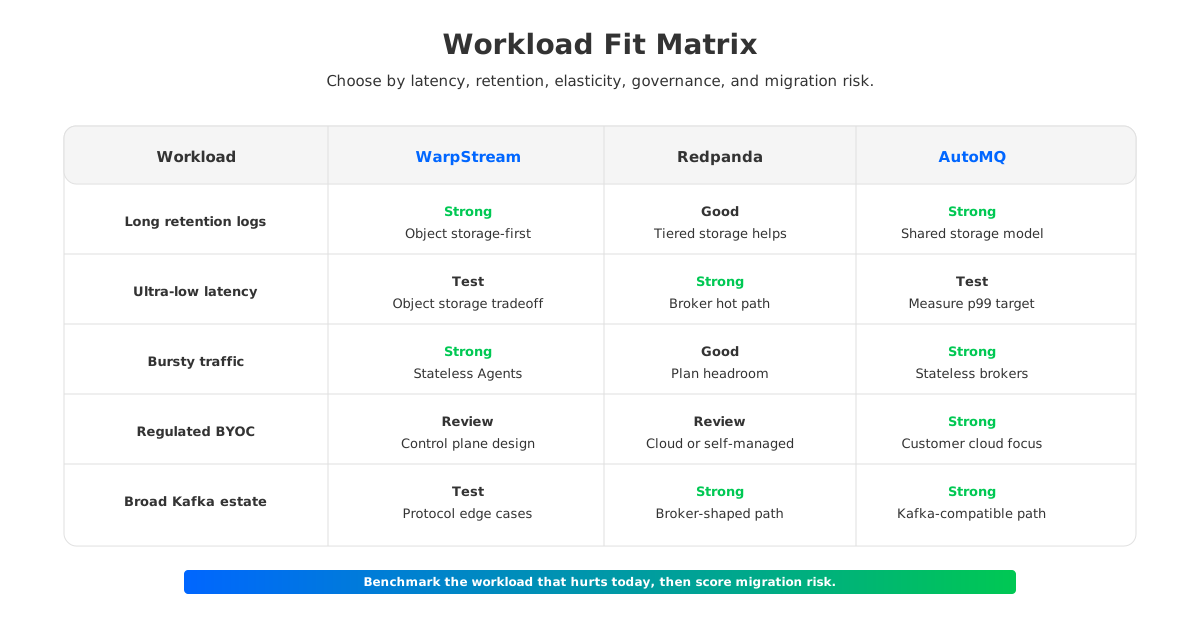
| Workload Pattern | WarpStream Fit | Redpanda Fit | AutoMQ Fit |
|---|---|---|---|
| Long-retention logs | Strong when object-storage economics matter | Good when hot ingest latency dominates | Strong for shared storage with cloud cost focus |
| Ultra-low-latency serving | Requires workload-specific testing | Strong for broker-centric hot path | Requires workload-specific testing |
| Bursty internal backbone | Strong if stateless scaling matters | Good with capacity planning | Strong where stateless brokers reduce overprovisioning |
| Regulated BYOC | Data plane stays in customer environment; control plane needs review | BYOC and self-managed options need governance review | Fits teams wanting data in their own cloud |
| Broad Kafka migration | Test compatibility edges carefully | Strong when broker-like behavior reduces risk | Strong when compatibility and storage modernization both matter |
This is where the decision becomes less ideological. If the team has extreme latency requirements and a mature stateful platform practice, Redpanda can be the natural option. If the team has high write volume, long retention, spiky usage, and a mandate to reduce Kafka operational overhead, WarpStream's diskless model is compelling. If the team wants Kafka compatibility, stateless broker operations, object-storage-backed shared storage, and BYOC control in one architecture, AutoMQ belongs on the same evaluation slate.
8A Practical Evaluation Plan
Run the evaluation like a production rehearsal. Pick one representative workload, one painful workload, and one edge workload. The painful workload shows whether the architecture fixes the reason this project exists. The edge workload protects you from a platform that passes common tests but fails your messiest reality.
For each platform, measure:
- Producer acknowledgement latency at p50, p95, and p99.
- Consumer catch-up time for live reads and historical replay.
- Cost under identical retention, write volume, partition count, and read fan-out.
- Operational steps for scale, failure, upgrade, and rollback.
- Compatibility gaps against the APIs and tools your teams use.
Do not hide operational labor from the scorecard. Managed services can shift responsibility from your team to a vendor, but the team still owns architecture, governance, migration, incident response, and application behavior.
9References
- WarpStream Architecture
- WarpStream Billing
- WarpStream Pricing
- Redpanda Architecture
- Redpanda Kafka Compatibility
- Redpanda Tiered Storage
- Redpanda Cloud Billing
- Apache Kafka Documentation
- AutoMQ Documentation
10FAQ
10.1Is WarpStream the same as Redpanda with tiered storage?
No. WarpStream is object-storage-first and diskless: the Agent does not use local disks as the durable log. Redpanda tiered storage offloads log segments to object storage, but the broker and local storage remain central to the hot path.
10.2Which is more Kafka-compatible, WarpStream or Redpanda?
Both are Kafka-compatible, but compatibility should be tested against your clients and tooling. Redpanda documents compatibility with Kafka clients from version 0.11 onward, with exceptions. WarpStream speaks the Kafka protocol through Agents, but its storage and metadata architecture differ more from traditional Kafka.
10.3Which option has lower cloud cost?
It depends on write volume, retention, read fan-out, idle time, cloud region, deployment model, and operational labor. WarpStream's object-storage-first model is designed to reduce broker-local storage and replication costs. Redpanda can reduce operational complexity and use tiered storage for retention, but hot-path compute and local storage still matter.
10.4When should Redpanda be preferred?
Redpanda is a strong candidate when low latency, Kafka-like broker behavior, and a high-performance stateful streaming engine are primary requirements. It is also attractive when migration risk favors a broker-shaped architecture.
10.5When should WarpStream be preferred?
WarpStream is a strong candidate when the workload is retention-heavy, cost-sensitive, bursty, or operationally painful under stateful Kafka brokers. Its stateless Agent model is especially relevant when scaling and recovery without partition data movement are high priorities.
10.6Where does AutoMQ fit in this comparison?
AutoMQ fits as a Kafka-compatible shared-storage architecture with stateless brokers and object-storage-backed durability. It is most relevant for teams that want Kafka ecosystem compatibility while reducing broker-local state, storage overprovisioning, and cloud cost pressure in a BYOC-friendly model.


