
Table of Contents
Table of Contents
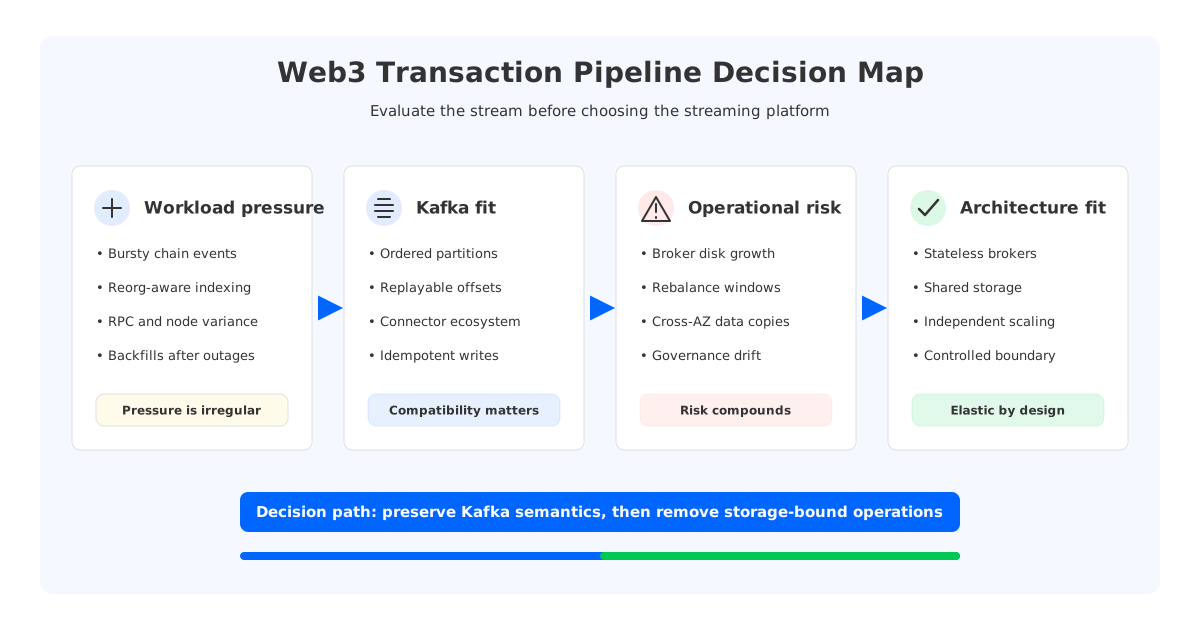
A team usually searches for web3 transaction pipeline kafka after the first version of an indexer has already become too important to treat as an application queue. Blocks arrive with uneven cadence, RPC endpoints disagree, backfills compete with live ingestion, and downstream consumers want the same transaction stream for analytics, risk scoring, wallet activity, tax reporting, and user-facing notifications. The pipeline is no longer only moving events from a node client to a database. It has become the coordination layer between an eventually consistent blockchain world and systems that expect replay, ordering, and operational accountability.
Kafka fits that shape because it gives teams a durable log, partitioned ordering, consumer groups, offset-based replay, and a connector ecosystem that many data teams already understand. The harder question is whether the chosen Kafka-compatible infrastructure can absorb Web3-specific stress without turning every traffic spike, chain reorganization, or retention change into a broker-storage operation.
1Why teams search for web3 transaction pipeline kafka
Web3 transaction indexing looks simple on a whiteboard: read blocks, parse transactions, publish normalized events, and update serving databases. Production systems are less tidy. A single transaction can feed address balances, token transfers, contract interactions, compliance signals, NFT metadata updates, and user activity timelines. Each view may tolerate different lag, but all of them depend on the same question: what transaction history did the pipeline observe, and can it replay that history deterministically?
Kafka is attractive because it gives application teams a clean separation between ingestion and consumers. A block reader can publish canonicalized records into topics, while analytics jobs, stream processors, and database sinks consume at their own pace. Consumer group offsets make progress explicit, and retention gives teams a window for replay after parser bugs or downstream outages. For teams already running data platforms around Kafka, this is a familiar way to turn chain data into a product-grade data asset.
The search intent becomes sharper once the pipeline carries financial or user-visible consequences. If an indexer misses a transfer, duplicates a deposit event, or replays an old contract state into a serving table, the failure is not only a data quality issue. It can show up as an incorrect wallet balance, a stuck settlement workflow, a noisy alert, or a delayed risk decision. A useful architecture must therefore handle three pressures at the same time:
- Ordering pressure. Events need stable partitioning keys, usually by chain, contract, wallet, or entity, so consumers can reason about local ordering without forcing all activity through one serial bottleneck.
- Replay pressure. Backfills and bug recovery need retained history, predictable offsets, and consumer isolation, so one recovery job does not disrupt the live path.
- Governance pressure. Transaction data often crosses application, analytics, and security teams, which means schema management, access control, audit logs, and ownership boundaries matter from the first production release.
These requirements make Kafka a strong conceptual fit, but they also expose the cost of treating the Kafka cluster as a static disk appliance. Web3 traffic is uneven by nature. NFT mint events, token launches, liquidation waves, bridge incidents, and application campaigns can all change write rate and read fan-out faster than a quarterly capacity plan expects.
2The production constraint behind the problem
The first constraint is not throughput in isolation. It is the relationship between throughput, retention, reprocessing, and broker-local storage. A traditional shared-nothing Kafka deployment stores partitions on broker disks. When a topic grows, retention expands, or partitions move, durable state moves with brokers. That model is well understood, and it remains valid for many workloads, but it becomes operationally heavy when the pipeline alternates between quiet periods, bursty ingestion, and large backfills.
Consider a Web3 indexer that keeps raw blocks, decoded transaction events, enriched application events, and error streams in separate topics. The raw stream may need longer retention for parser replay, while the enriched stream may have higher fan-out for analytics, search, and customer-facing features. If all of this state is bound to broker disks, capacity planning has to reserve for the worst combination of live ingestion, historical retention, and recovery activity.
This is where cloud economics enters the architecture discussion. In a multi-AZ deployment, replication, client placement, connector placement, and consumer fan-out can all affect network traffic. Cloud provider pricing for storage, data transfer, and private connectivity is specific to the provider and region, so teams should calculate it from official pricing pages before committing to a design. The important engineering point is more stable than any single price number: a log architecture that repeatedly copies durable data between broker-local disks is sensitive to topology, scaling, and rebalancing events.
There is also a human constraint. The same team often has to operate chain clients, indexer code, schema evolution, Kafka topics, stream processors, databases, and observability. When the streaming layer demands frequent partition reassignment, disk expansion, broker replacement, and retention tuning, it competes with the work that actually differentiates the Web3 product. Kafka is supposed to decouple producers and consumers; the infrastructure should not reintroduce coupling through storage operations.
3Architecture options and trade-offs
The practical options fall into four categories. Teams can run self-managed Apache Kafka, use a managed Kafka service, adopt a Kafka-compatible streaming platform, or build a domain-specific pipeline around databases and queues. The right answer depends on team boundaries as much as raw performance. A protocol-compatible streaming layer may be valuable when the team needs Kafka clients and tools, while a managed service may be attractive when the team wants to avoid cluster operations and accepts the provider's deployment model.
| Option | Where it works well | Main trade-off for Web3 indexing |
|---|---|---|
| Self-managed Apache Kafka | Maximum control over versions, configs, networking, and deployment topology. | The team owns broker storage, upgrades, partition movement, recovery drills, and capacity buffers. |
| Managed Kafka service | Reduced operational surface and familiar Kafka APIs. | Cost, scaling granularity, network placement, and feature availability follow the service model. |
| Kafka-compatible cloud-native streaming | Kafka client compatibility with a storage model designed for cloud infrastructure. | Requires compatibility testing for clients, connectors, operational tooling, and migration paths. |
| Custom queue or database pipeline | Tight fit for one application path and fewer moving parts at small scale. | Replay, fan-out, schema governance, and multi-team consumption often become custom engineering work. |
Kafka compatibility is necessary but not sufficient. A Web3 transaction pipeline depends on producer idempotence, consumer group behavior, offset replay, connector support, security integration, and operational predictability. Compatibility testing should include normal ingestion, backfills, chain reorganization handling, consumer restarts, connector failures, schema changes, and disaster recovery exercises. A platform that passes a quick producer-consumer smoke test can still fail the operating model test.
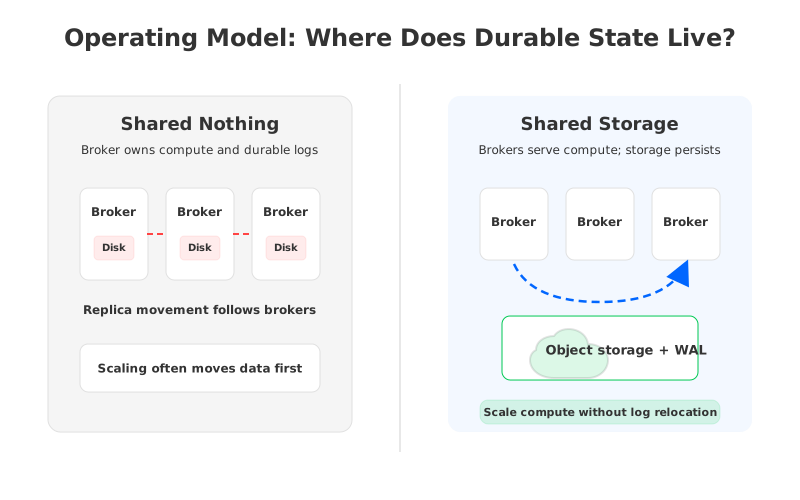
The storage model is the second distinction. In a shared-nothing model, brokers combine compute and durable log storage, so scaling compute can imply moving data. In a shared storage model, brokers can become more stateless because durable log data is persisted outside the broker fleet. Operations do not disappear, but the work changes: the team manages compute elasticity, network boundaries, and storage durability as separate concerns instead of treating broker disks as the center of the system.
For Web3 pipelines, this separation maps well to the workload. Live block ingestion needs stable writes, historical replay needs retained data without an oversized broker fleet, and analytics fan-out needs consumers that can recover without pressuring the live producer path. The architecture should preserve Kafka semantics while reducing the broker-local state moved during scale-out, maintenance, and recovery.
4Evaluation checklist for platform teams
A good evaluation starts with the transaction lifecycle, not the vendor comparison. Pick one chain or product flow and trace it from block observation to every downstream system that acts on the transaction. Then test the streaming platform against the failure modes that actually hurt the business: node lag, duplicate observations, chain reorgs, parser bugs, consumer lag, connector outages, schema changes, and a full backfill while live traffic continues.
The checklist below is intentionally operational. It asks what evidence the team should collect before treating a Kafka-compatible platform as production-ready for Web3 transaction indexing and analytics.
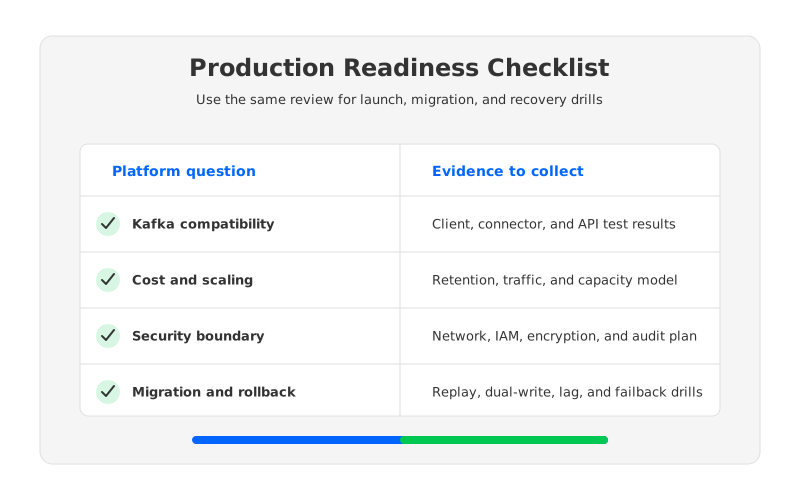
- Client and API compatibility. Test the exact producer, consumer, admin, schema, and connector clients used by the pipeline. Include idempotent producer settings, transactions if the application uses them, consumer group rebalances, offset commits, and topic administration.
- Partitioning and ordering model. Define keys before load testing. A chain-level key may preserve global order but limit parallelism, while a wallet, contract, or entity key improves throughput but requires downstream logic to understand the ordering boundary.
- Retention and replay policy. Separate raw events, normalized events, enriched events, and dead-letter streams. Each topic should have a retention rationale tied to recovery, audit, or product requirements.
- Cost model. Estimate storage, compute, cross-zone traffic, private connectivity, connector runtime, and observability costs. Use provider pricing pages for the target region and model both normal traffic and replay days.
- Security and governance. Decide where encryption keys, network endpoints, IAM roles, ACLs, audit logs, and schema ownership live. Transaction pipelines often become shared infrastructure, so access control should not be retrofitted after adoption.
- Migration and rollback. A credible migration plan includes dual publishing or mirroring, consumer cutover criteria, lag thresholds, validation queries, and a failback path. The rollback path matters because indexer bugs often appear only after downstream reconciliation.
- Observability. Track producer error rates, end-to-end lag, consumer group lag, connector health, broker health, storage behavior, and application-level reconciliation metrics. Kafka lag alone does not tell you whether wallet balances or analytics tables are correct.
This evaluation can feel heavy for an early-stage pipeline, but the weight is proportional to the blast radius. If a transaction stream feeds only one internal dashboard, a simple managed setup may be enough. If it feeds user balances, compliance reviews, trading decisions, or revenue analytics, the platform deserves the same readiness discipline as a payment or ledger-adjacent system.
5How AutoMQ changes the operating model
Once the evaluation framework is clear, AutoMQ enters the discussion as a Kafka-compatible cloud-native streaming platform that separates broker compute from durable storage. The design goal is not to teach teams a different event-streaming model. It is to preserve Kafka APIs and operational semantics that data teams already use, while moving the storage center of gravity away from broker-local disks and into shared storage backed by object storage and a write-ahead log layer.
That distinction matters for Web3 transaction pipelines because it changes what happens when the workload changes. If a chain event causes a temporary write spike, the platform team wants to add serving capacity without launching a data relocation project. If a parser fix requires a large replay, the team wants historical data to remain available without turning broker disks into the limiting resource. If a consumer group falls behind during an analytics incident, the team wants isolation between the recovery path and the live ingestion path.
AutoMQ's shared storage architecture uses stateless brokers with storage persisted through its S3Stream design and WAL options documented by AutoMQ. In practical terms, compute and storage can be scaled more independently than in a broker-local storage model. AutoMQ also documents customer-controlled deployment patterns, Kafka compatibility, and approaches to eliminating inter-zone traffic in supported architectures. For platform teams, those are evaluation criteria to test against the checklist above.
The migration story should still be treated as engineering work. Kafka-compatible does not mean every client behavior, plugin, connector, or operational script can be assumed identical without testing. A careful team will run compatibility tests, mirror representative topics, compare consumer lag and reconciliation outputs, rehearse rollback, and validate observability before switching production traffic. The value of compatibility is that this testing happens against familiar Kafka concepts rather than a separate messaging abstraction.
The strongest fit is usually a pipeline with long-lived retained streams, bursty ingest, and multiple downstream consumers. That describes many Web3 transaction pipelines because raw chain data is useful beyond the first feature. The same transaction event may later support fraud detection, user segmentation, compliance review, or product analytics. When the stream becomes a shared data product, reducing storage-bound operations helps keep the platform team focused on correctness and availability.
For teams evaluating AutoMQ, the next step should be concrete rather than promotional. Take one representative transaction pipeline, model its retention and fan-out, run a compatibility test with existing Kafka clients, and compare the operating model against the shared-nothing baseline. If the current Kafka cluster is already dominated by disk expansion, partition movement, and replay planning, a shared storage architecture is worth serious evaluation.
Explore the AutoMQ architecture and deployment options through the verified product contact path: talk to AutoMQ. Bring your current topic layout, retention targets, and replay requirements; those inputs will make the conversation architectural instead of generic.
6References
- Apache Kafka documentation: https://kafka.apache.org/documentation/
- Apache Kafka Connect documentation: https://kafka.apache.org/documentation/#connect
- Apache Kafka Streams core concepts: https://kafka.apache.org/documentation/streams/core-concepts/
- AutoMQ architecture overview: https://docs.automq.com/automq/architecture/overview
- AutoMQ WAL storage documentation: https://docs.automq.com/automq/architecture/s3stream-shared-streaming-storage/wal-storage
- AutoMQ inter-zone traffic documentation: https://docs.automq.com/automq/eliminate-inter-zone-traffics/overview
- AWS S3 pricing: https://aws.amazon.com/s3/pricing/
- AWS PrivateLink pricing: https://aws.amazon.com/privatelink/pricing/
7FAQ
7.1Is Kafka a good fit for Web3 transaction pipelines?
Kafka is a strong fit when the pipeline needs durable replay, ordered partitions, consumer isolation, and multiple downstream consumers. The fit is weaker when the application has only one short-lived queue path and no replay or fan-out requirement. The decision should start from transaction lifecycle, retention, and recovery needs rather than from a generic streaming checklist.
7.2How should a team choose partition keys for blockchain transaction events?
Start with the ordering boundary that downstream systems actually require. Chain-level keys provide simple ordering but can limit parallelism, while wallet, contract, pool, or entity keys improve throughput and localize processing. Many teams keep raw block topics closer to chain order and publish derived topics with application-specific keys.
7.3What is the biggest operational risk in a Kafka-backed Web3 indexer?
The largest risk is usually recovery under load. A parser bug, node outage, or chain reorganization can require replay while live ingestion continues, and that stresses retention, consumer lag, storage capacity, and connector behavior at the same time. Testing only the steady-state write path misses the failure mode that matters.
7.4Does Kafka compatibility remove migration risk?
No. Kafka compatibility reduces migration surface because clients, offsets, topics, and operational concepts remain familiar, but production migration still needs evidence. Teams should test exact clients and connectors, mirror representative topics, validate downstream reconciliation, and rehearse rollback before cutover.
7.5Where does AutoMQ fit in this architecture?
AutoMQ fits when a team wants Kafka-compatible APIs with a cloud-native storage model that separates broker compute from durable storage. That can be useful for Web3 transaction pipelines with bursty ingestion, long retention, and heavy replay needs. The evaluation should compare the operating model against the existing Kafka baseline, using the team's own topics, consumers, and recovery drills.


