
Table of Contents
Table of Contents
A webhook dispatcher looks simple until it becomes the integration backbone. One service accepts events, puts them on a queue, and delivers HTTP callbacks to downstream systems. Then the business adds tenants, retries, regional routing, schema changes, SLAs, audit requirements, and replay requests. At that point, the search query becomes more specific: webhook dispatcher kafka.
Kafka is attractive because webhooks are durable delivery promises, not only HTTP calls. A dispatcher must absorb bursty producers, preserve ordering where it matters, retry without losing the original event, and replay safely after a receiver is fixed. Kafka solves the event log problem, but the platform team still owns the operating model around that log.
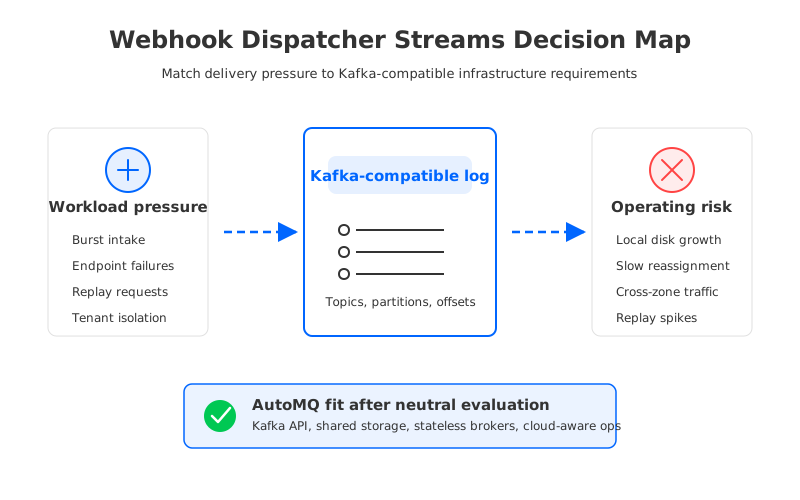
The architecture decision is therefore less about whether Kafka can buffer webhook events. It can. The harder question is whether the chosen Kafka-compatible platform lets the integration team operate dispatcher streams without turning every new connector, tenant, or failure domain into a capacity planning exercise. That is where storage architecture, cloud networking, governance, and migration risk matter as much as producer and consumer code.
1Why teams search for webhook dispatcher kafka
Webhook dispatchers sit between two reliability models. On the input side, applications produce events inside a controlled environment, where authentication, schemas, and retry policies are known. On the output side, the dispatcher calls HTTP endpoints that may rate-limit, timeout, reject payloads, change certificates, or fail in ways the producer cannot see. Kafka gives the dispatcher a durable middle layer so the system can decouple event creation from delivery.
That middle layer needs several properties that are easy to underestimate:
- Durable buffering: Events must survive restarts, receiver outages, and deployment mistakes long enough for recovery.
- Replay with control: Teams need to replay by tenant, endpoint, event type, time range, or offset without flooding healthy receivers.
- Backpressure isolation: One slow destination should not consume all dispatcher workers or block unrelated tenants.
- Operational visibility: Lag, retry count, dead-letter volume, delivery latency, and endpoint error classes need to be visible early.
- Governance boundaries: Webhook payloads often carry customer or payment-adjacent data, so retention, encryption, access control, and audit trails cannot be bolted on later.
Kafka maps naturally to this shape because topics and partitions can model dispatch domains, consumer groups can model worker pools, offsets provide replay position, and the log gives operators a source of truth after a failed delivery attempt. The trap is treating the dispatcher as a coding problem. Once traffic grows, most incidents come from the operating model around Kafka: uneven partitions, full disks, lag spikes after a retry storm, cross-zone traffic, schema drift, or worker fleets that scale differently from the brokers below them.
2The operational constraint behind connector-heavy platforms
Webhook platforms are connector-heavy by nature. A single event stream may fan out to CRMs, fraud systems, search indexes, data warehouses, customer endpoints, and internal automation tools. Some outputs want low latency. Others tolerate batch delivery but require strict auditability. A few endpoints will be fragile enough that the dispatcher becomes a shock absorber for another team's operational problems.
Traditional Kafka can support these patterns, but its shared-nothing storage model ties persistent data to broker-local disks. When a broker owns local replicas for many partitions, scaling the cluster is not only a matter of adding compute. The system has to move partition data, rebalance leaders, and preserve replication guarantees while traffic continues. In a dispatcher platform, this matters because spikes often come from unpredictable events: a partner outage, an incident replay, or a tenant onboarding that creates more delivery attempts than expected.
The constraint shows up in three places. Capacity is provisioned for peaks because storage and compute grow together. Recovery depends on how fast partition data can be replicated or reassigned. Cloud cost includes broker instances, disks, inter-zone replication, and catch-up traffic. Webhook workloads amplify these costs because retries and replays are normal operation, not rare maintenance.
| Design area | What the dispatcher needs | What to evaluate in Kafka infrastructure |
|---|---|---|
| Partitioning | Tenant or endpoint isolation | Partition count limits, reassignment speed, leader balance, metadata scale |
| Retry handling | Delayed retry, dead-letter routing, and replay | Topic design, consumer lag behavior, storage retention cost |
| Worker scaling | More workers during recovery or bursts | Consumer group behavior, broker throughput headroom, connection limits |
| Governance | Payload security, audit trails, retention windows, and controlled access | ACLs, encryption, observability, topic ownership model |
| Cost control | Elastic capacity during burst and lower idle waste | Compute/storage decoupling, cross-zone traffic, object storage economics |
This is why a dispatcher platform should be designed from the operational boundary inward. The HTTP worker code can be rewritten. The event log is harder to change after dozens of teams depend on it.
3Failure handling, schema, and replay trade-offs
Webhook delivery failures are not binary. A 500 response might be transient. A 400 response might be a payload contract problem. A timeout might mean the receiver processed the request but failed to respond. If the dispatcher retries blindly, it can duplicate side effects. If it stops too early, it violates delivery expectations. Kafka helps by preserving event and delivery state, but the architecture still has to model the difference between event durability and HTTP idempotency.
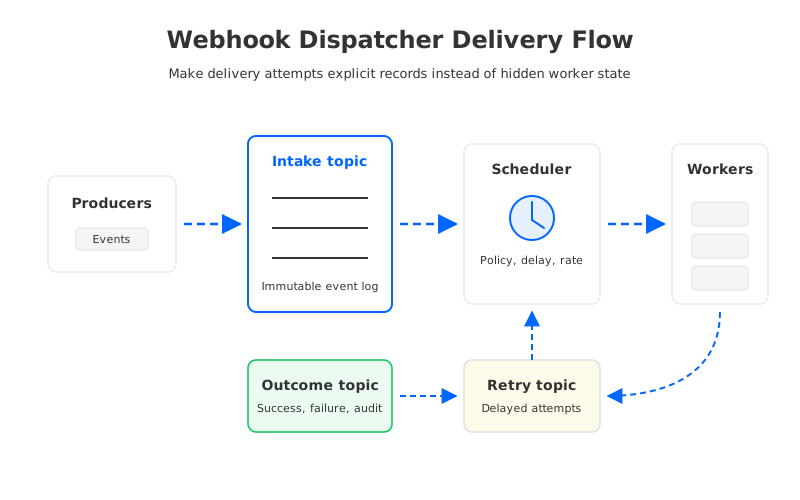
A common pattern is to split the dispatcher into event intake, delivery scheduling, HTTP execution, and outcome recording. The event topic stores the original event. A scheduling topic or state store tracks the next delivery attempt. Worker consumer groups execute callbacks and write outcomes. Dead-letter topics preserve events that need remediation. This keeps the log authoritative while treating webhook delivery as a state machine rather than a consume-and-call loop.
Schema governance deserves the same attention. Webhook payloads often evolve faster than backend event contracts because consumers ask for new fields, renamed attributes, or format-specific envelopes. Without compatibility rules, a producer deployment can create a long-lived replay problem: the event remains in Kafka, but the receiver can no longer understand it. A production dispatcher should define expectations for payloads, headers, idempotency keys, trace identifiers, and CloudEvents-style metadata before many teams start publishing.
Replay separates a toy dispatcher from a platform. Replaying from Kafka offsets is powerful, but replaying too broadly can overload receivers or duplicate already-processed actions. Mature teams build replay controls around scoped filters, rate limits, endpoint allowlists, dry-run validation, and operator approval. Kafka provides the durable history; the dispatcher platform provides the safety rails.
4Evaluation checklist for platform teams
The platform decision should start with a neutral checklist. This keeps the conversation grounded in operating requirements instead of vendor preference. For a webhook dispatcher, the useful questions connect application semantics to infrastructure behavior.
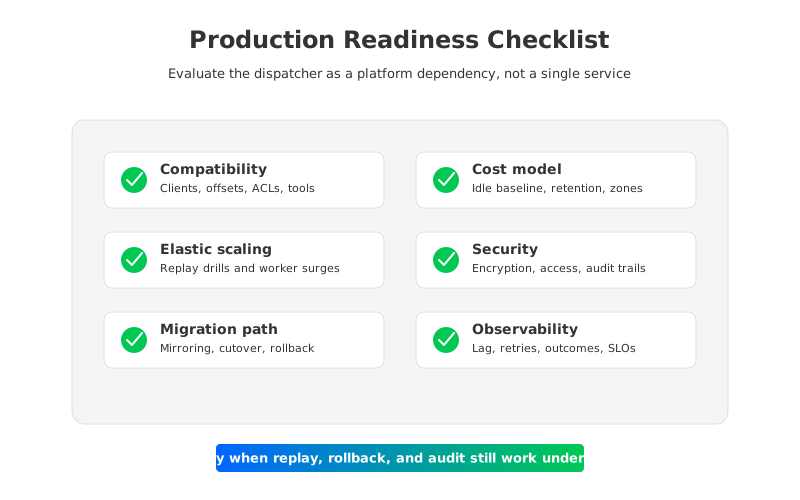
Start with compatibility. If your dispatcher already uses Kafka clients, Kafka Connect, Debezium, MirrorMaker 2, schema tooling, or observability integrations, protocol and semantic compatibility reduce migration risk. Compatibility is not only about producing and consuming records. It includes consumer group behavior, offset management, ACLs, tooling, and how existing scripts behave during failure.
Then test elasticity under the failure modes the dispatcher will see. A normal throughput benchmark does not answer what happens when one endpoint family is down for an hour and then recovers. Run a replay drill, increase consumer workers, scale brokers during the test, and measure whether the platform moves large amounts of data to absorb new capacity.
The cost review should be concrete:
- Idle baseline: How much compute, disk, and networking capacity stays allocated when webhook volume is low?
- Burst behavior: Does a traffic spike require pre-provisioned broker storage, or can compute scale independently?
- Retention cost: What does it cost to keep enough history for audit, replay, and delayed delivery?
- Cross-zone traffic: How much replication or consumer traffic crosses availability-zone boundaries under normal and recovery conditions?
- Operational labor: How often do engineers rebalance partitions, expand disks, tune retention, or repair uneven broker load?
Security and governance come next because webhook dispatchers frequently carry data that belongs to other teams or customers. The checklist should cover encryption, topic-level access control, tenant isolation, audit logs, secret handling for endpoint credentials, and private network paths for internal receivers. It should also define who can replay events, who can inspect payloads, and how long failed messages remain accessible.
The last item is migration reversibility. A dispatcher stream becomes a dependency for many systems. Before switching infrastructure, the team should know how to mirror data, preserve offsets, validate consumer behavior, cut over producers, and roll back if downstream delivery metrics degrade. A solid migration plan treats compatibility and observability as gates, not optimism.
5How AutoMQ changes the operating model
If the evaluation points toward Kafka compatibility but away from broker-local storage constraints, the architecture requirement becomes clear: keep the Kafka protocol and ecosystem, but separate compute from persistent storage. AutoMQ fits this category as a Kafka-compatible cloud-native streaming platform built around shared storage and stateless brokers.
In AutoMQ, brokers keep the Kafka-facing compute role while persistent stream data is stored through S3Stream on object storage with a WAL layer for durable writes. The important operational change is that partition ownership and traffic can move without treating broker disks as the long-term source of truth. For a webhook dispatcher, a replay-heavy week should not force the same storage expansion pattern as a traditional cluster. A worker surge should be evaluated as compute and network pressure, not as a broker-local data migration event.
This does not remove the need for topic design, idempotent webhook handlers, schema governance, or observability. It changes the infrastructure failure mode below those decisions. Stateless brokers and shared storage make it easier to replace nodes, rebalance load, and scale capacity around bursty integration traffic. AutoMQ also emphasizes Kafka compatibility, which matters when teams want to keep existing clients and tooling rather than rewrite the dispatcher around a different event API.
Cloud networking is another reason this architecture matters. Traditional replicated Kafka deployments can generate inter-zone traffic when clients, leaders, and followers are spread across availability zones. AutoMQ documents an approach for reducing that traffic with object storage-backed durability and zone-aware routing. For dispatcher platforms, network topology becomes a design lever.
The deployment boundary also matters. Many integration teams cannot send customer event payloads through an external control plane. AutoMQ BYOC and software deployment models are relevant when the data plane must stay inside the customer's cloud account or private environment. The dispatcher can keep Kafka-compatible event streams close to the applications and endpoints it serves, while the platform team still gets a cloud-native operating model.
6A practical architecture for webhook dispatcher streams
A robust dispatcher can be built as streams and services with explicit ownership. Producers write canonical events to an intake topic. A scheduler reads those events, applies delivery policy, and emits delivery tasks. Worker groups consume tasks, call receivers, and write outcomes. Failed attempts flow into retry topics or dead-letter topics with remediation metadata.
The topic model should avoid two extremes. One topic for everything makes isolation and replay painful. A topic per endpoint creates too much overhead. A practical middle ground is to partition by tenant, endpoint class, or delivery policy, then use headers and payload metadata for finer routing. The exact choice depends on replay frequency, ordering requirements, and noisy-tenant isolation.
For teams evaluating webhook dispatcher kafka, the reference architecture is not a product SKU. It is a set of invariants:
- The original event remains immutable and replayable.
- Delivery attempts are explicit records, not hidden in worker memory.
- Endpoint credentials and delivery policy are governed outside payload data.
- Dead-letter topics include enough context for remediation without exposing more data than needed.
- Infrastructure can scale workers and brokers around bursts without making data movement the bottleneck.
AutoMQ becomes useful when those invariants meet cloud cost and operations pressure. It lets the team keep Kafka as the integration contract while changing the storage and scaling assumptions underneath. That lasts longer than optimizing a single retry loop.
7Migration and rollout checklist
Treat the migration as a platform rollout, not a cluster swap. First, inventory producers, consumers, topics, schemas, ACLs, retention settings, dashboards, and replay procedures. Then run a shadow path where events are mirrored to the target platform and consumers validate behavior without sending external callbacks. Compare offsets, lag, payload shape, and outcome metrics before customer-visible delivery depends on the new path.
The cutover should be staged by risk. Internal endpoints and low-volume tenants can move first. High-volume or payment-sensitive webhooks should move after the team has rehearsed rollback. During the cutover, monitor delivery latency, HTTP error classes, consumer lag, broker saturation, dead-letter volume, and duplicate suppression. A successful migration is not the moment producers switch bootstrap servers; it is the point where replay, rollback, and audit procedures still work.
Keep the final decision tied to the original search. A team looking for webhook dispatcher kafka is usually trying to make integrations more reliable without building a bespoke delivery log. Kafka gives them the right abstraction. The remaining question is whether the infrastructure below Kafka helps or fights the dispatcher as tenants, retries, and replay requirements grow.
If your team is evaluating Kafka-compatible infrastructure for connector-heavy or webhook-heavy platforms, review AutoMQ's shared storage architecture and run the checklist against failure modes. Start from the verified AutoMQ entry point at go.automq.com and compare the architecture against your dispatcher workload.
8References
- Apache Kafka Documentation
- Apache Kafka Connect documentation
- Apache Kafka delivery semantics
- CloudEvents specification project
- AutoMQ architecture overview
- AutoMQ compatibility with Apache Kafka
- AutoMQ S3Stream shared streaming storage
- AutoMQ inter-zone traffic overview
- AutoMQ migration overview
9FAQ
9.1Is Kafka a good fit for a webhook dispatcher?
Kafka is a strong fit when the dispatcher needs durable buffering, replay, backpressure isolation, and independent worker scaling. It is less useful for best-effort HTTP fan-out with no audit or replay requirement.
9.2How should a webhook dispatcher partition Kafka topics?
Most teams partition around the unit that needs isolation, such as tenant, endpoint class, or delivery policy. The right key keeps required ordering without creating a model that is hard to operate.
9.3Do webhook retries require separate Kafka topics?
Separate retry and dead-letter topics often make operations clearer because they expose delivery state as records instead of hiding retry state inside worker memory.
9.4Where does AutoMQ fit in this architecture?
AutoMQ fits below the dispatcher as Kafka-compatible streaming infrastructure. It is relevant when the team wants Kafka clients and semantics plus shared storage, stateless brokers, and more flexible scaling.
9.5What should teams test before migrating an existing dispatcher?
Test client compatibility, offset preservation, lag behavior, replay controls, rate limits, dead-letter handling, observability, ACLs, and rollback. Use real failure drills, not only throughput tests.


