
Table of Contents
Table of Contents
Teams usually search for agent tool telemetry kafka after a prototype has crossed an uncomfortable line. The agent workflow still looks like application logic, but the telemetry around it has started to behave like production data infrastructure. Every tool call, retrieval step, permission check, model response, retry, exception, human approval, and downstream action becomes an event that someone will want to query, replay, audit, or use for evaluation.
That is where Kafka enters the conversation. Agent telemetry is not only a log stream, and it is not only an observability feed. It is the operational memory of an AI system: fresh enough to drive real-time dashboards, durable enough for incident review, structured enough for governance, and portable enough to feed evaluation pipelines. The useful question is not whether Kafka can ingest those events. It can. The harder question is whether the Kafka operating model you choose will survive the way agent workloads grow.
The core thesis is simple: platform teams should validate compatibility, scaling behavior, governance boundaries, and cost mechanics before agent telemetry becomes a retained system of record. If those checks happen after traffic arrives, every architecture trade-off becomes harder to reverse.
1Why teams search for agent tool telemetry kafka
Agent tool telemetry has a different shape from ordinary application logs. A web service log line usually describes what one service did. An agent trace describes a decision path: the prompt, the selected tool, the tool input, the response, retries, fallbacks, policy decisions, and the final action. That path may need to be consumed by several systems at once, each with a different tolerance for delay.
A real-time AI data pipeline usually has at least four readers. SRE wants operational signals such as error rate, tool latency, timeout patterns, and queue depth. AI platform teams want traces for evaluation, prompt tuning, and regression analysis. Security and governance teams want evidence of which tool accessed which system and whether sensitive data moved through an approved path. Product analytics teams want behavior-level events, but often with masking or aggregation. One telemetry stream becomes many downstream contracts.
Kafka is attractive here because the application contract is already familiar. Producers write records to topics, consumers track progress with offsets, and Consumer groups let independent applications process the same stream at their own pace. Kafka Connect can bridge source and sink systems, and transactions exist for applications that need stronger write semantics across multiple partitions. Those are good reasons to start with Kafka-compatible streaming instead of a pile of point-to-point log shippers.
The trap is that agent telemetry volume rarely grows in a neat line. A single user request may fan out into multiple tool calls. One failed tool can trigger retries, fallbacks, and compensating actions. Evaluation runs can replay historical conversations at a speed unrelated to user traffic. When the platform team enables more agents, the system does not only add more events; it adds more readers, longer retention expectations, and more governance questions.
2The production constraint behind the problem
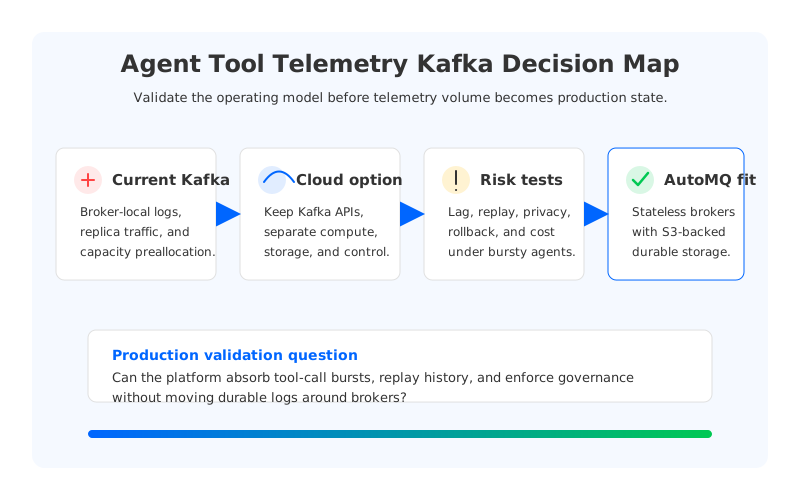
Agent telemetry stresses that model in a specific way. Fresh data needs low-latency tailing reads because dashboards and automated controls depend on it. Older data remains valuable because teams need replay for model evaluation, audit, incident reconstruction, and training-set curation. Hot and cold reads therefore coexist. If all retained data remains coupled to broker-local storage, the platform team must size disks, plan replication, and handle rebalancing around the worst combination of throughput, retention, and replay pressure.
This is why a platform team should avoid treating agent telemetry as "logs, but bigger." Logs can often tolerate best-effort delivery, shorter retention, and delayed batch movement. Agent tool telemetry may become part of the control loop for safety, evaluation, and product behavior. Losing ordering, offsets, replayability, or ownership boundaries can turn a telemetry shortcut into a platform risk.
3Architecture options and trade-offs
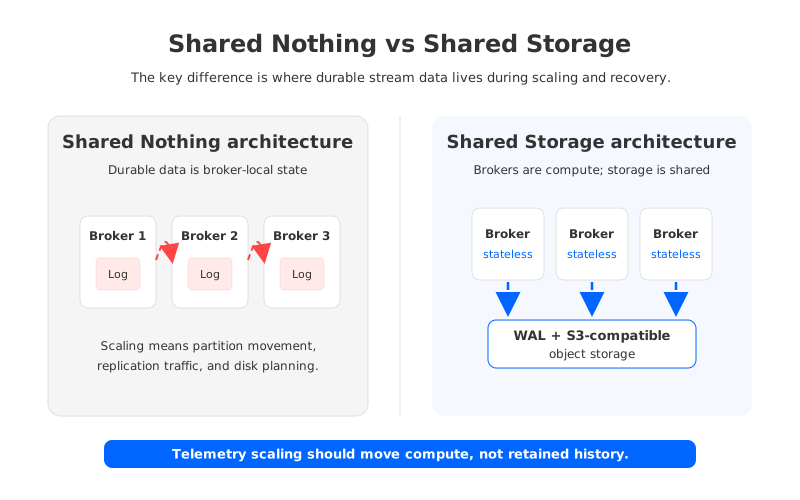
The first valid option is a conventional Kafka cluster with careful capacity planning. It is still a strong choice when traffic is predictable, retention is moderate, and the team already has mature Kafka operations. You get the standard Kafka ecosystem, familiar client behavior, Consumer group semantics, and a well-understood failure model. The trade-off is that elasticity remains tied to broker-local durable state, so scaling and balancing need operational discipline.
Managed Kafka services can reduce staffing burden, especially when the team wants a cloud provider or streaming vendor to operate the control surface. The trade-off is boundary control. Agent telemetry can contain prompts, tool arguments, user identifiers, authorization context, and business actions. Some teams are comfortable sending that to a vendor-operated data plane; others need customer-account deployment, private networking, explicit region control, and direct ownership of storage and keys.
Kafka-compatible Shared Storage architecture is the fourth path. It keeps Kafka protocol and ecosystem compatibility while changing the storage model beneath the broker. Durable stream data moves to shared object storage, and brokers become more like replaceable compute units. That does not remove the need for testing. It shifts the hard questions from "how do we move retained logs between brokers?" to "how do WAL durability, cache behavior, object storage access, metadata correctness, and network placement behave under our workload?"
| Option | What it preserves | What to test hard | Fit for agent telemetry |
|---|---|---|---|
| Conventional Kafka | Standard Kafka behavior and direct broker control | Disk sizing, partition movement, replication traffic, and operational runbooks | Good when traffic and retention are stable |
| Tiered Storage | Kafka APIs with remote storage for older segments | Hot-set sizing, local disk pressure, restore behavior, and remote-read latency | Useful when long retention is the main pressure |
| Managed Kafka | Reduced day-to-day operations | Data-plane boundary, region control, private connectivity, and cost model | Strong when operational delegation matters more than account-level control |
| Shared Storage architecture | Kafka compatibility with separated compute and storage | WAL path, cache hit rate, object storage access, failover, and migration | Strong when elasticity and retained-data movement are recurring constraints |
The table is not a ranking. It is a way to stop the team from asking a vague platform question. If the problem is staffing, a managed service may be the right answer. If the problem is long retention, Tiered Storage may be enough. If the problem is that every scaling or recovery operation drags durable history with it, the storage architecture needs closer scrutiny.
4Evaluation checklist for platform teams
The most useful validation work happens before a vendor proof of concept. Write down what the telemetry stream must guarantee, what it can lose, who owns it, and how it will be replayed. Agent systems can make teams over-focus on inference and under-specify the data plane around inference. That is backwards. Once events are used for safety review, billing analysis, or automated response, the streaming platform becomes part of the product's trust boundary.
Start with compatibility. Use the Apache Kafka documentation as the baseline for Producer and Consumer behavior, offsets, Consumer groups, transactions, Kafka Connect, and KRaft-era operations. Then convert each relevant behavior into a test. Can existing clients produce and consume without library changes? Do idempotent or transactional producers behave as expected? Can evaluation consumers replay from specific offsets? Can Connect-based sinks preserve the fields and schema rules that governance expects?
Governance deserves a separate pass. Agent telemetry can include sensitive prompts, tool inputs, retrieval snippets, and action results. Platform teams should define which topics contain raw traces, which contain masked or normalized records, which consumers can access each class, and how retention differs by sensitivity. The Kafka topic model helps, but topics alone are not a governance program. You still need ACLs, encryption, schema controls, audit logs, and clear ownership of object storage or vendor-managed storage.
Cost validation should follow the same discipline. Avoid unsupported assumptions about "low-cost storage" or "serverless elasticity." Build a workload model with write throughput, average record size, replication or storage durability model, retention period, read fan-out, replay frequency, cross-AZ or inter-zone traffic, private connectivity, and operations staffing. The important number is not a single price per GiB. It is the monthly cost of keeping telemetry fresh, replayable, governed, and available during failure.
5How AutoMQ changes the operating model
After the neutral evaluation, AutoMQ becomes relevant as a Kafka-compatible, cloud-native streaming platform built around Shared Storage architecture. The application-facing contract remains Kafka-compatible: producers, consumers, topics, partitions, offsets, Kafka Connect, and stream-processing ecosystems can be evaluated against familiar Kafka semantics. The architectural change is underneath that contract: AutoMQ replaces broker-local log storage with S3Stream, WAL storage, data caching, and S3-compatible object storage.
That shift matters for agent telemetry because it changes what happens when compute changes. In a traditional broker-local model, durable partition data is tied to brokers. In AutoMQ, brokers are stateless compute nodes, while durable data lives in shared object storage. WAL (Write-Ahead Log) storage provides the persistence path before data is uploaded to object storage, and cache behavior serves hot reads and prefetches cold reads. Scaling or replacing brokers therefore focuses more on metadata, leadership, traffic, and a small amount of WAL recovery than on copying retained logs between broker disks.
The operating model also fits stricter data-boundary discussions. AutoMQ BYOC runs the control plane and data plane in the customer's cloud account, while AutoMQ Software targets private data center deployments. For AI platform teams, that boundary can matter as much as throughput. Tool telemetry may include user data, business actions, authorization context, and retrieval content. Keeping the data plane and storage in a customer-controlled environment makes it easier to align Kafka-compatible streaming with cloud-account ownership, IAM design, regional policy, and audit expectations.
There are still validation requirements. A team should test client behavior, transaction usage, Connect integrations, schema workflows, ACLs, observability, WAL choice, object storage permissions, cache hit ratios, failure recovery, and migration plans. Shared Storage architecture is not a permission slip to skip engineering work. Its value is that it attacks the broker-storage coupling that makes telemetry platforms heavy to scale once retained history becomes large.
AutoMQ also gives teams adjacent options that may matter as the telemetry estate matures. Kafka Linking can help migration planning where byte-level data copy and offset continuity are important. Self-Balancing can reduce manual partition-balancing work as load changes. Table Topic can be evaluated when some streaming data should land directly in Apache Iceberg tables for analytics. None of those should replace the core telemetry validation checklist, but they become useful once the team has decided that Kafka compatibility and cloud-native storage separation belong in the same architecture.
6Readiness scorecard before scaling
A concise scorecard keeps the decision grounded. Give each row an owner and mark it red, yellow, or green based on evidence from tests rather than vendor claims.
| Area | Validation question | Evidence to collect |
|---|---|---|
| Compatibility | Do existing producers, consumers, Connect jobs, and stream processors work without semantic surprises? | Client test results, offset replay checks, transaction tests, and schema validation |
| Elasticity | Can the platform absorb bursty tool-call traffic and replay jobs without destabilizing tailing consumers? | Produce latency, Consumer lag, scaling time, and cold-read measurements |
| Cost | Does the model account for storage, network transfer, private connectivity, replay, and operations? | Workload-based monthly estimate with official cloud pricing assumptions |
| Governance | Are raw traces, masked events, ACLs, encryption, audit, and retention boundaries explicit? | Topic policy, schema rules, access review, and storage ownership map |
| Recovery | What happens when brokers, zones, object storage access, or consumers fail? | Failure drills, recovery timing, and data-integrity checks |
| Migration | Can the team cut over and roll back without losing offsets or writing inconsistent telemetry? | Dual-run plan, producer switch test, consumer offset validation, and rollback rehearsal |
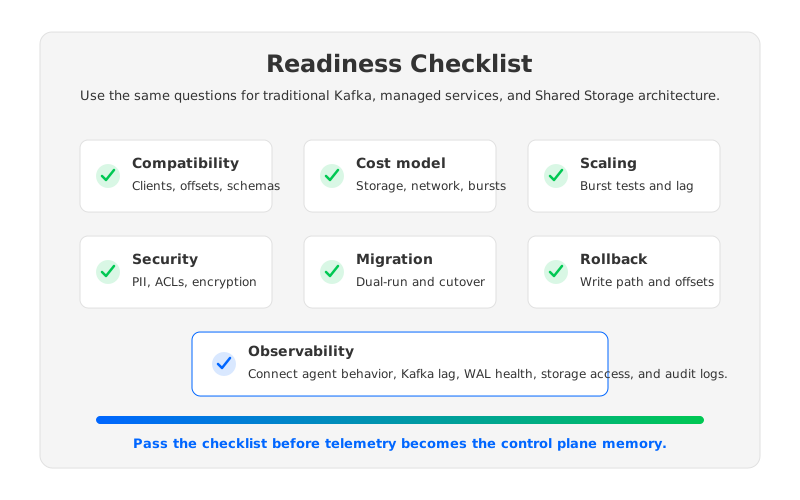
The scorecard also prevents a common AI infrastructure mistake: confusing pipeline success with platform readiness. A prototype can show events flowing from agents to Kafka to a warehouse. Production readiness asks whether that stream remains trustworthy when agents retry, tools fail, evaluators replay history, and auditors ask what happened last quarter.
7FAQ
7.1Is Kafka a good fit for agent tool telemetry?
Kafka is a good fit when telemetry must be durable, ordered within partitions, replayable, and consumed by multiple systems. It is less compelling for short-lived debug logs that do not need replay or independent Consumer groups. The decision should start with retention, replay, governance, and fan-out requirements.
7.2Should agent telemetry use one topic or many topics?
Most teams should avoid a single catch-all topic for production telemetry. Separate raw traces, normalized events, security-sensitive records, evaluation outputs, and product analytics when retention, ACLs, schemas, or consumers differ. The exact topic model should follow ownership and governance boundaries, not only event type names.
7.3Does Tiered Storage solve agent telemetry scaling?
Tiered Storage can help when long retention is the main pressure because older segments can move to remote storage. It does not fully separate broker compute from storage, so teams still need to test hot data behavior, local disk pressure, broker replacement, and recovery. Treat it as one option in the evaluation, not a universal fix.
7.4Where does AutoMQ fit in the decision?
AutoMQ fits when a team wants Kafka compatibility but sees broker-local durable storage as the source of scaling, recovery, or cost friction. It should be evaluated with the same tests as any streaming platform: client compatibility, WAL behavior, object storage access, governance, observability, migration, and rollback.
7.5What is the first practical step?
Start by turning the scorecard into a test plan. Pick one representative agent workflow, one burst scenario, one replay scenario, and one sensitive-data scenario. Run those tests against the platform candidates before telemetry volume becomes hard to move. If Shared Storage architecture belongs in that comparison, review the AutoMQ architecture documentation and try the open-source project through the AutoMQ GitHub short link.


