
Table of Contents
Table of Contents
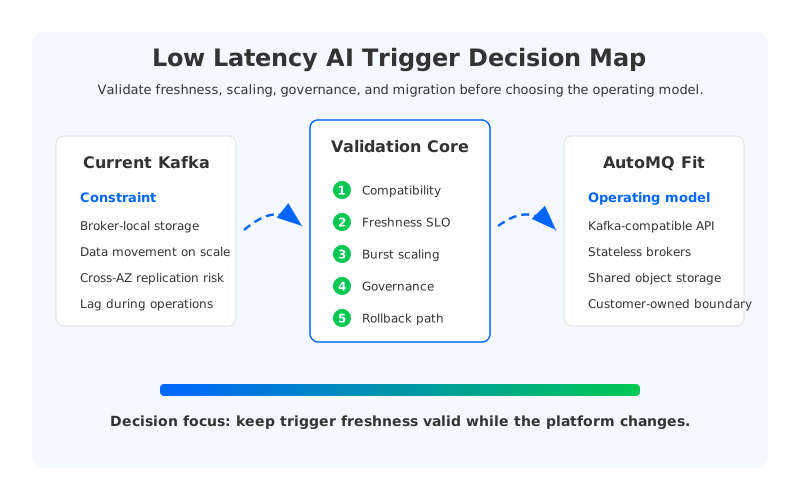
Teams usually search for low latency ai triggers kafka after the prototype has already worked. A fraud signal arrives, an agent workflow wakes up, a customer-support copilot asks for context, or a model-serving tier reacts to a state change. The demo feels convincing because the trigger path is short: produce an event, consume it quickly, call a model or rules engine, and emit the next action. Production changes the shape of the problem. The same path has to survive replay, rolling upgrades, schema mistakes, consumer lag, tenant isolation, and traffic bursts that do not ask for permission.
That is why the platform question is rarely "Can Kafka deliver low latency?" Apache Kafka has been used for event-driven systems for years, and its producer, consumer, offset, and Consumer group model remains a practical foundation for trigger pipelines. The harder question is whether the operating model around Kafka can keep the trigger path fresh when AI workloads scale unevenly. Low latency at 2 p.m. on a clean cluster is useful; low latency during a rebalance, schema rollout, retention expansion, or regional failover is the bar that matters.
1Why teams search for low latency ai triggers kafka
AI trigger systems have a different failure profile from ordinary dashboards. A dashboard can tolerate late data if the operator knows it is late. A trigger often acts as if the world is already true. If an account-risk topic lags behind the transaction stream, the model may approve an action using stale context. If an agent receives duplicate task events without idempotent handling, the workflow may call a tool twice. If a feature update arrives after the inference request, the serving path may produce a decision that is technically fast but operationally wrong.
Kafka helps because it gives teams a durable event log, partition-level ordering, offsets, Consumer groups, and an ecosystem of connectors and stream processors. Those are not minor details. Offsets give you a way to reason about "what has been seen." Consumer groups let you scale readers without every instance processing every partition. Transactions and idempotent producers can reduce duplicate effects when the pipeline is designed for them. Kafka Connect gives platform teams a standardized integration surface instead of a custom ingestion script per system.
The friction starts when the trigger workload becomes bursty. AI systems often create uneven traffic: a marketing campaign, a risk-event surge, a fleet of agents waking up after a batch of documents lands, or a model refresh that changes which events need enrichment. A cluster sized for average throughput may not have enough headroom for trigger freshness, while a cluster sized for peak traffic can carry idle cost most of the day. The capacity conversation then moves from application code to infrastructure: storage, broker placement, partition movement, cross-Availability Zone traffic, and recovery time.
2The production constraint behind the problem
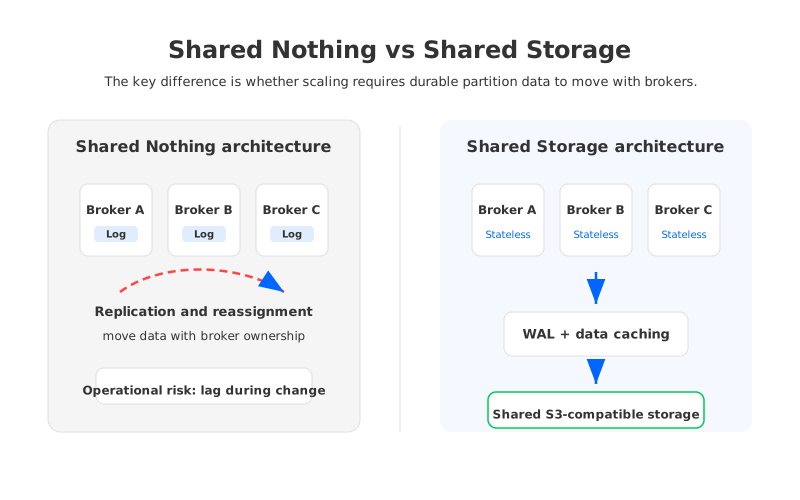
Traditional Kafka uses a Shared Nothing architecture. Each broker owns local storage for the partitions it hosts, and replication keeps follower copies on other brokers. This model is robust and well understood, but it couples compute capacity with broker-local data. When you add brokers, move partitions, replace nodes, or rebalance traffic, the cluster is not only changing compute placement; it is also moving or catching up data. For AI trigger workloads, that coupling turns capacity changes into freshness risk.
The root constraint is not only latency in the broker request path. It is the operational delay around the request path. A trigger pipeline can lose its latency budget when a broker spends resources catching up replicas, when a reassignment moves hot partitions, when retention growth forces larger disks, or when consumers are paused by rebalances they did not initiate. The application sees this as a simple symptom: lag grows. The infrastructure team sees the deeper cause: the storage model made routine operations expensive enough to interfere with the workload.
There are five production checks that expose the problem early:
- Freshness under rebalancing. Measure consumer lag and trigger completion time during controlled partition movement, rolling broker replacement, and consumer group changes. A steady-state benchmark hides the most useful signal.
- Replay and rollback behavior. Confirm that consumers can replay from offsets without triggering duplicate external actions. The log can replay; your action layer must be able to absorb that replay.
- Capacity headroom. Separate average throughput from burst throughput. Low-latency triggers need headroom for arrival spikes, not only storage for retained history.
- Cross-AZ cost and placement. In multi-AZ deployments, replication and client placement can create network traffic that grows with write volume and consumer fan-out.
- Governance latency. Schema validation, access control, auditing, and data residency checks must sit in the path without becoming invisible bottlenecks.
None of these checks argues against Kafka. They argue against treating Kafka as only a client API decision. The platform underneath the API determines whether AI trigger latency remains predictable when the system is doing the unglamorous work of staying alive.
3Architecture options and trade-offs
The common options fall into three patterns. The first is to keep a self-managed Kafka cluster and tune it carefully: partition counts, replication factor, broker size, disk layout, network placement, producer batching, fetch settings, and consumer parallelism. This gives maximum control, and it can be the right answer for teams with strong Kafka operators. It also keeps the team responsible for capacity planning, upgrade choreography, disk growth, and operational guardrails.
The second pattern is a managed Kafka service. This can reduce the burden of provisioning and maintenance, but the underlying architecture may still behave like broker-local storage. Managed operations help, yet they do not automatically remove the coupling between compute, storage, and partition movement. Platform teams still need to test how scaling, retention, failure recovery, and networking work for their trigger-specific SLOs.
The third pattern is a Kafka-compatible streaming platform with Separation of compute and storage. In this model, brokers keep the Kafka protocol surface, while durable data moves to shared object storage through a storage layer designed for streaming. The trade-off changes: you validate compatibility, write-path latency, cache behavior, and storage semantics instead of managing broker-local disks as the durable source of truth.
The decision is not a one-line "managed versus self-managed" choice. It is a map of which failure modes your team wants to own. If your trigger path calls payment, fraud, safety, or customer-facing automation systems, the ownership boundaries matter as much as raw latency. A platform that hides a broker failure but makes rollback opaque may be worse than a platform that exposes the mechanics clearly. A platform that has excellent steady-state latency but slow scaling may fail the exact week your AI adoption succeeds.
| Validation area | Traditional Kafka focus | Cloud-native streaming focus | What to test for AI triggers |
|---|---|---|---|
| Compatibility | Client APIs, serializers, Consumer groups | Kafka-compatible protocol and ecosystem behavior | Existing producers, consumers, Connectors, transactions, and offset tools |
| Freshness | Broker sizing and partition placement | Cache, WAL, object storage, and stateless broker behavior | Trigger completion time during bursts and controlled failure |
| Scaling | Partition reassignment and disk movement | Compute elasticity without moving durable partition data | Add/remove capacity while hot topics keep receiving events |
| Cost | Compute, disk, replication traffic, operations | Compute, object storage, WAL storage, network, operations | Peak headroom cost and multi-AZ traffic cost |
| Governance | ACLs, audit logs, schema workflow | Same controls plus deployment and data-residency boundary | Who can access records, metadata, metrics, and control actions |
The table is deliberately practical. If a vendor or internal platform cannot help you test these rows, the evaluation is still at the slideware stage. Low latency is not a property you buy once; it is a property you preserve across deployment decisions.
4Evaluation checklist for platform teams
Start with the trigger contract, not the infrastructure SKU. Define the maximum acceptable time from source event to action, the freshness requirement for context joins, the duplicate-action policy, the rollback mechanism, and the blast radius of a bad event. A model that only reads context has a different risk profile from an agent that calls external tools. A trigger that can be retried safely has a different platform requirement from a trigger that sends money, changes permissions, or writes back to a customer-facing system.
Then test the data path as a system. A Kafka topic may have healthy produce latency while a downstream enrichment job is stuck, a consumer group is rebalancing, or a feature table is receiving updates out of order. The platform SLO should include the whole path: producer acknowledgment, log durability, consumer fetch, processing, external call, and emitted action. This is where offsets are useful. They give the team a measurable boundary between "the event exists" and "the trigger has acted on it."
The strongest readiness reviews usually include these checks:
- Compatibility review. Run existing Kafka clients, serializers, Connectors, ACL patterns, monitoring agents, and offset tooling against the candidate platform. A Kafka-compatible platform should reduce migration friction, but compatibility is something you verify with your own client mix.
- Latency budget review. Break the latency budget into broker write, durable commit, consumer fetch, processing, external dependency, and action emission. This prevents the platform team from blaming Kafka for a model call or blaming the model for broker backpressure.
- Burst and recovery review. Replay representative bursts, restart brokers or consumers, and measure how long trigger freshness takes to recover. Do not stop at "the cluster recovered"; measure when the trigger SLO recovered.
- Governance review. Confirm topic ownership, schema approval, access control, audit trails, data residency, and separation between business records and observability data.
- Migration review. Plan dual-write, mirroring, offset consistency, cutover, and rollback. Trigger systems are sensitive to partial migration because duplicate or missing actions are visible to users.
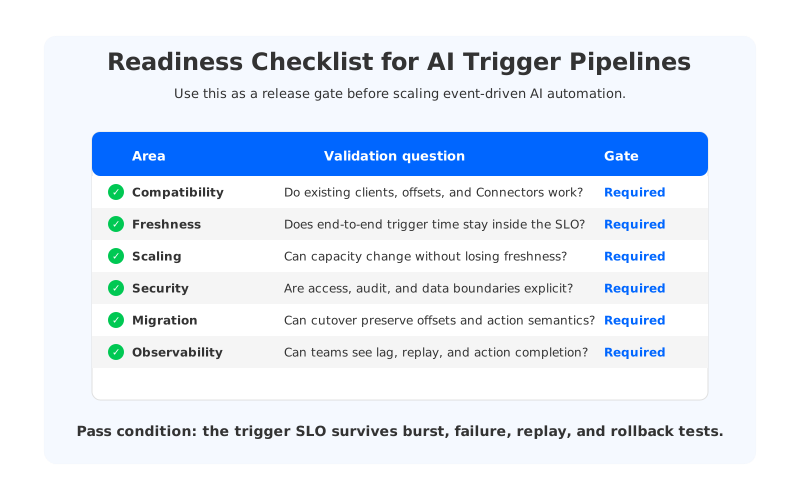
This checklist also protects the team from overfitting on a single number. P99 produce latency matters, but it is not enough. For AI triggers, the more revealing metric is the time it takes the system to return to a valid freshness window after something changes.
5How AutoMQ changes the operating model
Once the evaluation reaches the storage and scaling rows, AutoMQ becomes relevant as a Kafka-compatible, cloud-native streaming platform built around Shared Storage architecture. AutoMQ keeps Kafka protocol compatibility while replacing broker-local durable storage with S3Stream, a streaming storage layer backed by WAL (Write-Ahead Log), data caching, and S3-compatible object storage. The point is not to make Kafka unfamiliar. The point is to change what happens when the platform scales, recovers, or rebalances.
In traditional Kafka, a broker is tied to the data on its local disks. In AutoMQ, brokers are stateless because durable data lives in shared object storage rather than as broker-local partition replicas. WAL storage provides the low-latency durable write path, while object storage serves as the main storage layer. That distinction matters for trigger workloads because adding or replacing compute capacity does not have to mean moving the durable history of every affected partition.
The operating model changes in three concrete ways. First, capacity planning can focus more directly on compute and cache needs instead of pre-provisioning broker-local disks for long retention and peak growth. Second, partition reassignment can avoid large data movement because ownership changes do not require copying all historical data between brokers. Third, multi-AZ architecture can reduce the replication traffic pattern that makes traditional Kafka expensive to run in cloud environments, especially when writes, replicas, and consumers cross zone boundaries.
AutoMQ is not a reason to skip validation. It changes what you validate. You still test producer and consumer behavior, offset handling, schema workflows, replay safety, monitoring, and failure recovery. For AutoMQ BYOC and AutoMQ Software, you also validate deployment boundaries: the control plane and data plane run in the customer's environment, and business data remains inside that environment. For many AI platform teams, that boundary is not a procurement detail; it is part of the governance model for sensitive prompts, features, user events, and model feedback.
The fit is strongest when the trigger workload has uneven traffic, long retention, strict freshness expectations, and a team that wants Kafka compatibility without carrying the full operational weight of broker-local storage. If your workload is small, stable, and already well served by a conventional cluster, the migration may not be urgent. If your roadmap includes many AI trigger paths owned by different teams, the storage and scaling model becomes a platform decision rather than a single-app optimization.
If you are evaluating Kafka-compatible infrastructure for AI trigger workloads, run the checklist above against your own clients and failure modes. To test AutoMQ in your environment, start from the AutoMQ Cloud Console or review the AutoMQ GitHub project.
6FAQ
6.1Is Kafka a good fit for low-latency AI triggers?
Kafka can be a strong fit when the trigger workflow needs durable events, ordering within partitions, replay, Consumer groups, and integration with existing data systems. The key is to validate end-to-end trigger freshness, not only broker produce latency.
6.2What latency number should platform teams target?
There is no universal number. Define the SLO from source event to completed action, then break it into producer, broker, consumer, processing, external dependency, and action-emission budgets. A customer-support copilot and a payment-risk trigger should not share the same target by default.
6.3How is Tiered Storage different from Shared Storage architecture?
Kafka Tiered Storage offloads older log segments to remote storage while brokers still keep local storage in the operating model. AutoMQ's Shared Storage architecture uses shared object storage as the durable data foundation, with stateless brokers and WAL storage changing how scaling and recovery work.
6.4Where should AutoMQ enter an evaluation?
Bring AutoMQ into the evaluation after the team has defined compatibility, freshness, scaling, governance, and migration requirements. It is most relevant when Kafka compatibility is required but broker-local storage creates operational or cost pressure.


