
Table of Contents
Table of Contents
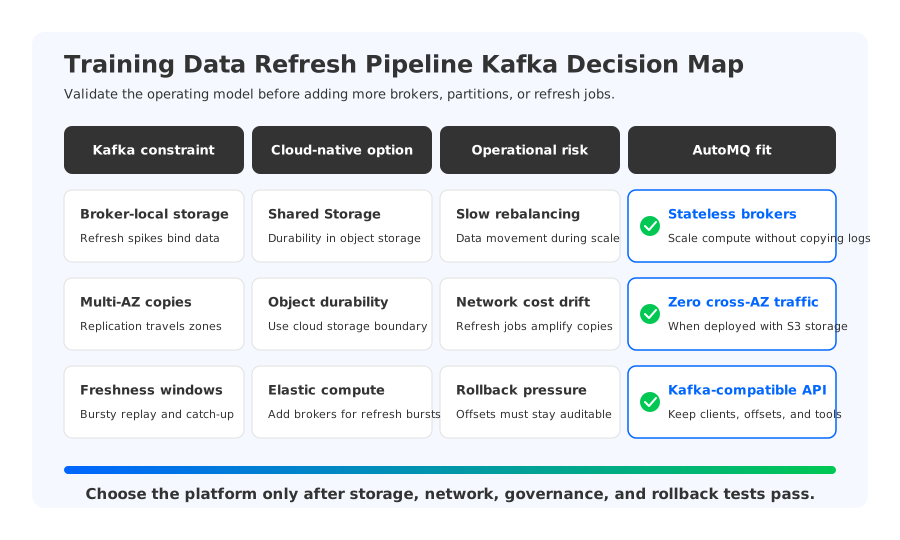
When an AI platform team searches for training data refresh pipeline kafka, the problem is rarely "Can Kafka move events?" Kafka already does that well. The pressure usually comes later, when a weekly or daily refresh pipeline becomes a recurring production workflow: embeddings need fresher source data, model evaluation jobs need replayable context, feature tables need consistent updates, and governance teams want to know which data actually influenced a training run. At that point, the question changes from pipeline design to platform operating model.
The uncomfortable part is that training refresh traffic does not behave like a steady application event stream. It arrives in waves. A backfill can read months of history, a model iteration can trigger a burst of feature recomputation, and a failed data quality gate can force a replay while the regular online stream keeps running. If the Kafka cluster was sized for ordinary producer and consumer traffic, the refresh workload becomes the thing that tests storage layout, broker headroom, replication traffic, and rollback discipline.
1Why teams search for training data refresh pipeline kafka
The search phrase sounds narrow, but it usually hides a broader architecture decision. Teams are not only asking how to wire Kafka into a training workflow. They are asking whether Kafka can be the controlled refresh backbone between operational systems, data lakes, feature stores, vector indexes, model training jobs, and evaluation loops without turning into a separate capacity-planning project every time freshness targets tighten.
That distinction matters because a training refresh pipeline has a different failure profile from a dashboard feed. A stale dashboard is visible quickly. A stale or partially refreshed training dataset can be harder to detect because the model still trains and the job still completes. The impact appears later as drift, lower evaluation quality, unexplained prediction behavior, or a governance review that cannot reconstruct which offsets and source versions entered the run.
Kafka gives platform teams several useful primitives for this job: ordered partitions, offsets, Consumer group coordination, transactions, Kafka Connect integration, and an ecosystem of clients and stream processors. Those primitives make Kafka a strong candidate for event-driven AI architecture. They do not remove the need to validate the platform beneath Kafka, especially when the data refresh path mixes tailing reads, catch-up reads, large replay windows, and multi-team ownership.
The first decision is therefore not which library starts the training job. It is whether the streaming layer can preserve three properties when refresh demand grows:
- Freshness with repeatability. Teams need to consume recent changes while still being able to replay a known offset range for audit, evaluation, or rollback.
- Elastic capacity without operational surprise. Refresh jobs should be able to use extra compute when they need it, but adding compute should not create a long data movement event.
- Clear data boundaries. AI data flows often touch regulated records, customer context, or internal knowledge bases, so the deployment boundary matters as much as throughput.
Once those properties are explicit, a Kafka-based refresh pipeline becomes easier to evaluate. You are no longer comparing marketing labels. You are testing how a platform behaves when the workload asks for freshness, replay, and control at the same time.
2The production constraint behind the problem
Traditional Apache Kafka is built on a Shared Nothing architecture. Each broker owns local log storage, and partition replicas are distributed across brokers for durability. This design has served many production systems well, and it is still a reasonable mental model for stable workloads. The constraint appears when the operational unit you want to scale is compute, but the system couples compute with local persistent data.
In a training refresh pipeline, that coupling shows up in practical ways. If you add brokers to create headroom for replay, the cluster may need to redistribute partitions. If a broker fails during a heavy catch-up window, recovery can compete with the same disks and network paths that the refresh job needs. If the cluster spans multiple Availability Zones, replication and client placement can turn refresh waves into cross-zone traffic that is easy to overlook during a pilot.
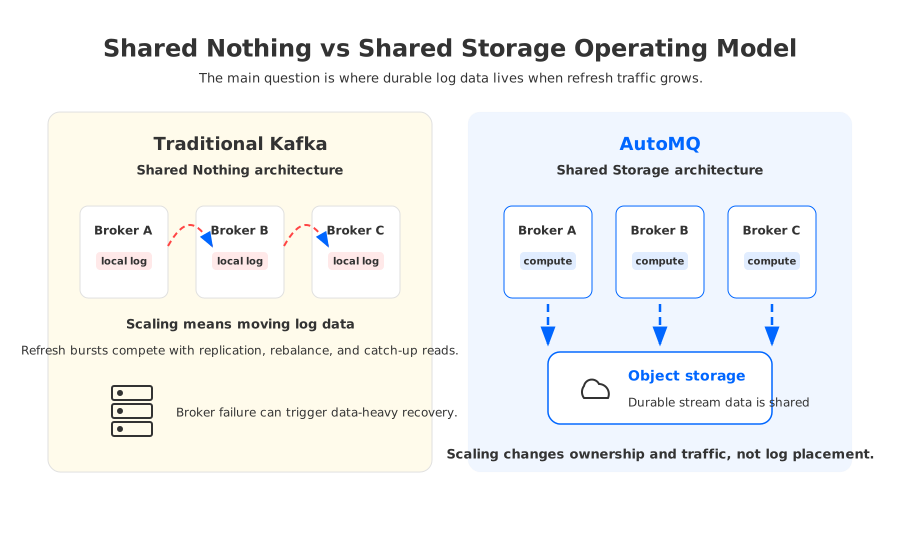
Tiered Storage changes part of this picture, but it should not be confused with a fully diskless operating model. Apache Kafka Tiered Storage moves older log segments to remote storage while brokers still retain local log storage for active data and still operate with the broker-local ownership model. That can help with retention economics and historical reads, but it does not automatically make brokers stateless or make partition reassignment independent of local storage placement.
3Architecture options and trade-offs
There are several defensible ways to build a real-time AI data pipeline on Kafka. The right answer depends on freshness targets, governance requirements, team maturity, and cloud operating constraints. A platform team should evaluate options by failure behavior, not only by the happy-path diagram.
| Option | Where it fits | What to validate |
|---|---|---|
| Existing Kafka cluster | Early refresh pipelines with modest replay volume and stable retention | Broker headroom, partition layout, consumer lag behavior, and whether refresh bursts interfere with online traffic |
| Dedicated Kafka cluster | Workloads that need isolation from application streams | Extra operational ownership, duplication of observability, migration paths, and cross-cluster governance |
| Kafka with Tiered Storage | Long retention and historical replay pressure | Local hot-set sizing, remote read behavior, restore expectations, and whether scaling still depends on broker-local data |
| Kafka-compatible Shared Storage architecture | Elastic refresh traffic, cloud object storage economics, and tighter compute/storage separation | Compatibility coverage, WAL behavior, object storage permissions, observability, and rollback workflow |
The table is deliberately not a product ranking. It is a risk map. If the refresh workload is small and predictable, adding a few guardrails to the existing cluster may be enough. If refresh jobs are becoming a standing platform service for multiple AI teams, isolation and a more elastic storage model become more attractive. If the organization already has strong Kafka operations but weak AI governance, the first bottleneck may be offset lineage and dataset registration rather than broker capacity.
The mistake is to treat "Kafka-compatible" as the end of the evaluation. Compatibility reduces application migration risk, but it does not answer questions about storage cost, failure recovery, operational boundaries, or data ownership. A platform that accepts Kafka clients can still behave very differently under replay, retention, rebalancing, and cloud network pressure.
4Evaluation checklist for platform teams
Before scaling the pipeline, run a readiness review that forces engineering, data, ML, security, and SRE teams to make their assumptions visible. The value of the review is not the checklist itself. It is the uncomfortable conversation about who owns each failure mode.
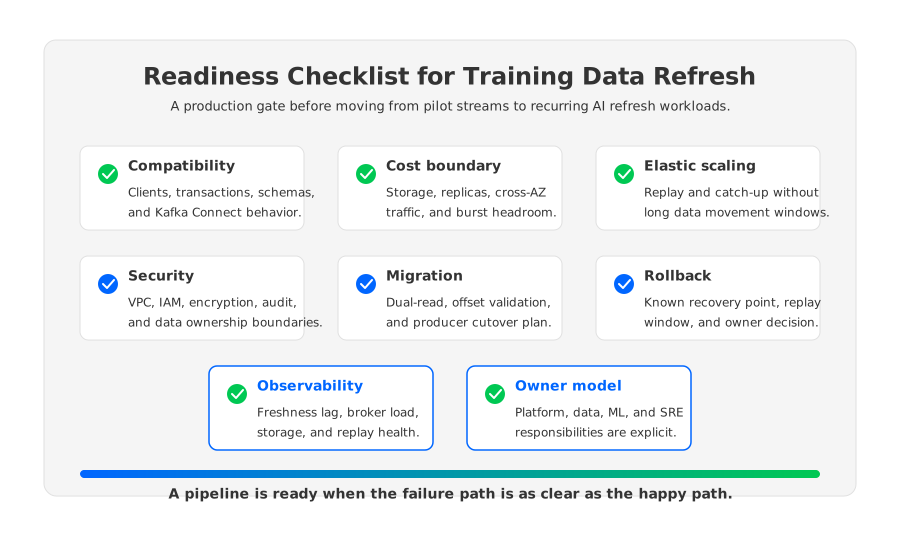
Start with compatibility. Confirm that the platform supports the Kafka client versions, authentication model, serialization formats, transaction usage, and Kafka Connect connectors you depend on. If the refresh pipeline uses exactly-once processing, idempotent producers, or transactional writes into derived topics, test those paths directly. A simple produce-and-consume smoke test does not cover the semantics that matter during training data refresh.
Then map cost to workload shape. Avoid unsupported claims such as "the pipeline will be lower cost because it uses object storage." The real cost boundary includes retained data, write amplification, replication, cross-AZ data transfer, object storage requests, compute headroom, private connectivity, and observability. For cloud deployments, validate current prices against the cloud provider's official pricing pages before committing to a design, because storage and network charges vary by region and service.
Scaling deserves its own test. Do not only ask whether the cluster can handle peak throughput. Ask what happens when the team adds brokers, removes brokers, changes retention, replays a large offset range, or loses a broker during the refresh window. The most useful test is often a controlled failure during a replay, because it shows whether the platform can recover without turning a data refresh into an incident for unrelated workloads.
Governance is equally concrete. A production training data refresh pipeline should record topic names, partitions, offset ranges, schema versions, transformation versions, source snapshots, and job identifiers. That metadata lets teams answer a simple question later: "Which data did this model see?" If the platform cannot make that answer practical to produce, the AI workflow may pass throughput tests while still failing auditability.
A practical scorecard can be simple:
- Green: The test has a named owner, a repeatable command or runbook, a pass/fail threshold, and an observable metric.
- Yellow: The risk is understood, but the team still needs a runbook, threshold, or cross-team owner.
- Red: The team is relying on intuition, vendor claims, or a pilot result that did not exercise the failure path.
The scorecard works because it treats platform selection as an engineering validation process. It also prevents a common trap: optimizing for the first successful refresh job instead of the hundredth refresh job under pressure.
5How AutoMQ changes the operating model
If the evaluation points toward compute/storage separation, the relevant architectural category is a Kafka-compatible streaming platform with Shared Storage architecture. The goal is to keep Kafka protocol and ecosystem compatibility while moving durable stream storage away from broker-local disks and into shared object storage. That is where AutoMQ enters the discussion.
AutoMQ keeps the Kafka API and protocol model while replacing broker-local log storage with S3Stream, a storage layer designed around WAL (Write-Ahead Log) storage, data caching, and S3-compatible object storage. In this model, AutoMQ Brokers are stateless brokers for persistent data: they handle Kafka requests, leadership, routing, caching, and scheduling, while durable data lives in shared storage. That changes the scaling unit from "broker plus its local data" to "compute capacity plus shared durable log."
For training data refresh pipelines, the operational consequence is more important than the component diagram. Adding or replacing brokers does not have to mean copying large local logs as the primary scaling operation. Partition reassignment can focus on ownership and traffic rather than bulk data movement. Refresh bursts can be handled with a model that better matches cloud elasticity, where compute expands for the workload and durable storage remains in a shared layer.
AutoMQ also gives platform teams deployment boundaries that matter for AI data. AutoMQ BYOC runs the control plane and data plane in the customer's own cloud account and VPC, and AutoMQ Software targets customer-managed private environments. That boundary is useful when training data includes sensitive customer records, internal documents, or regulated event streams. It does not remove the need for IAM, encryption, audit logging, and network review, but it gives security teams a clearer place to inspect the data path.
The architecture does not excuse teams from validation. WAL type, object storage configuration, cache behavior, client settings, and migration tooling all need to be tested against the actual workload. For example, a pipeline that is dominated by tailing reads has different concerns from one that repeatedly performs catch-up reads over long retention windows. A team using Kafka Connect for ingestion has a different readiness checklist from a team writing custom consumers into a feature store.
AutoMQ's migration guidance can help with scenarios where teams need message synchronization and consumption progress continuity during cutover. Table Topic can also be relevant when a refresh pipeline needs to write streaming data directly into Apache Iceberg tables for lakehouse consumption. Those capabilities are useful only after the core platform questions are answered: compatibility, cost boundary, elasticity, governance, observability, and rollback.
6A practical validation sequence
Run the pilot in four passes. First, prove semantic compatibility by validating producers, consumers, transactions, schemas, and offset behavior. Second, measure the cost drivers without overfitting to a single day of traffic; include retained data, object storage requests where applicable, compute headroom, and network paths. Third, perform scaling and failure drills during refresh traffic. Fourth, review lineage and rollback: a platform engineer, ML engineer, and security reviewer should all be able to explain what happened without reverse-engineering logs.
Return to the original search: training data refresh pipeline kafka. The answer is not a single architecture diagram. It is a validation path that turns a search query into a production decision. If your team is evaluating Kafka-compatible infrastructure for AI refresh workloads, use the checklist above as the first conversation, then test the operating model under replay, scale, and rollback pressure. To compare that model with AutoMQ's cloud-native Kafka-compatible architecture, join the AutoMQ Slack workspace through this short link: https://go.automq.com/slack?utm_source=blog&utm_medium=cta&utm_campaign=training-data-refresh-pipeline-kafka.
7FAQ
7.1Is Kafka a good fit for training data refresh pipelines?
Kafka can be a strong fit when the pipeline needs ordered event streams, replayable offsets, Consumer group coordination, and integration with existing data systems. The key is to validate the operating model around storage, scaling, governance, and rollback, not only the event API.
7.2What is the difference between a streaming AI pipeline and a training data refresh pipeline?
A streaming AI pipeline often focuses on continuous inference, feedback, or online features. A training data refresh pipeline focuses on producing repeatable datasets or feature snapshots for model training and evaluation. The refresh path usually needs stronger replay, lineage, and rollback controls.
7.3Does Kafka Tiered Storage solve the scaling problem?
Kafka Tiered Storage can help move older log segments to remote storage and reduce pressure from long retention. It does not automatically make brokers stateless or remove the operational effects of broker-local hot data, partition ownership, and failure recovery.
7.4Where does AutoMQ fit in this architecture?
AutoMQ fits when a team wants Kafka compatibility with a Shared Storage architecture, stateless brokers, object-storage-backed durability, and customer-controlled deployment boundaries. It should be evaluated after the team defines compatibility, cost, scaling, governance, migration, and rollback requirements.
7.5What should teams test before migrating a refresh pipeline?
Test client compatibility, offset behavior, schema handling, replay windows, failure recovery, cost drivers, access control, observability, and rollback. A pilot that does not include replay and failure drills is usually too optimistic.


