
Table of Contents
Table of Contents
The moment a team searches for "Confluent Cloud too expensive," the problem has usually moved past casual cost tuning. Kafka is important enough that outages are unacceptable, but the bill is large enough to show up in renewal meetings, FinOps reviews, or CTO-level platform discussions. The platform works, the ecosystem is familiar, and nobody wants migration risk for a service that moves production events.
The right answer is not to jump from a high bill to a vendor shortlist. A Kafka-compatible replacement only makes sense after the team understands which cost driver is under pressure and which platform behaviors must remain stable. Producer and consumer behavior, ordering, consumer groups, security controls, data residency, and incident response all matter. A lower monthly quote can be a bad trade if it breaks Kafka assumptions.
So the replacement question should start with a disciplined version of the complaint: what exactly became too expensive? For some teams it is sustained throughput. For others it is retention, replay-heavy analytics, private networking, managed connectors, or the gap between committed capacity and utilization. Once those drivers are visible, the decision becomes less emotional: optimize, renegotiate, or evaluate a different Kafka-compatible architecture.
1Signs your Confluent Cloud cost is becoming a platform risk
A growing Confluent Cloud bill is not automatically a reason to migrate. Managed services absorb operational work, and paying a premium can be rational when the alternative is hiring, operating, patching, and debugging Kafka yourself. The warning sign is different: cost starts changing system design. When teams avoid retention, reduce environments, postpone streaming use cases, or route data around Kafka, the platform is constraining architecture.
The risk is easier to see during renewal cycles because the conversation moves from technical fit to business justification. Architects are asked why the platform must grow with event volume. SREs are asked whether spikes need provisioned headroom. Data teams are asked why replay and retention should live in the streaming layer. Those questions are fair, but they reveal a deeper issue: Kafka is shared infrastructure, while pricing is evaluated application by application.
Three patterns usually mean the team should build a replacement business case, even if migration is not yet the preferred outcome:
- The bill grows faster than the business metric Kafka supports, so the team needs to isolate the multiplier.
- Cost controls require product compromises such as shorter retention, fewer test environments, or delayed replay features.
- Procurement pressure appears before technical confidence, and renewal timing starts driving architecture.
That fact base starts with cost anatomy.
2What actually drives Confluent Cloud spend
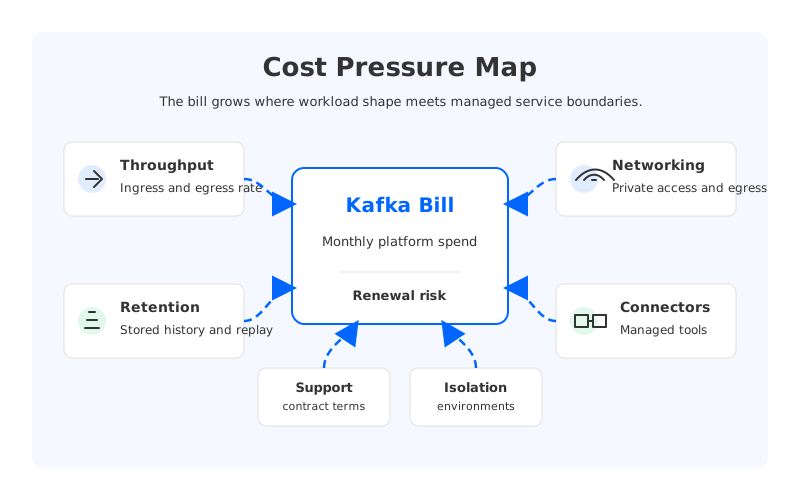
Confluent publishes current pricing and billing documentation, and teams should use those pages rather than old spreadsheets or screenshots. There is no universal price because spend depends on cloud provider, region, cluster type, negotiated terms, features, and usage. Confluent Cloud spend is multi-dimensional: Kafka clusters, throughput, storage, networking, connectors, governance, stream processing, support, and contracts can all affect the final bill.
That is why "Kafka is expensive" is too vague to act on. Short-retention operational events differ from replayable event history. Same-region consumers differ from cross-network consumers. Central clusters differ from isolated clusters for every business unit, environment, or regulated workload.
| Cost driver | What to inspect | Why it matters before replacement |
|---|---|---|
| Throughput | Ingress, egress, peak ratio, consumer fan-out | Rates and burst headroom shape service cost and replacement capacity. |
| Retention | Hot retention, replay frequency, topic growth | Long-lived Kafka data changes storage economics. |
| Networking | Public access, private networking, region, egress paths | Ignoring topology can move cost from Kafka to cloud networking. |
| Connectors and ecosystem | Connectors, Schema Registry, governance, Flink | Replacing brokers may not replace the platform. |
| Isolation | Environments, clusters, tenants, compliance zones | More boundaries can mean more resources. |
| Support and contract | Commit, discount, term, support tier | Technical fit still needs a commercial path. |
This table is a map of where to calculate. Use your own traffic, retention, region, client placement, and support requirements, then compare the current bill with two alternatives: optimized Confluent Cloud and a Kafka-compatible replacement.
2.1Throughput, retention, networking, and managed service premiums
Throughput is often the first suspect because producers write more, consumers read more, and the platform grows. But throughput rarely acts alone. Kafka cost becomes uncomfortable when it combines with fan-out, retention, and network placement.
Retention changes the role of Kafka. Short retention treats Kafka as a transport layer. Long retention treats Kafka as operational history for replay, backfills, incident analysis, and new consumers. The cost question is whether the streaming platform's storage model is efficient enough for that role.
Networking is the quiet line item that surprises teams late. Private connectivity, cross-region movement, cloud egress, and producer or consumer placement can all change the economic picture. A replacement must model the same topology, or the team may move cost from the platform bill to interconnect, NAT, PrivateLink-style endpoints, or downstream transfer.
2.2Why Kafka growth makes small pricing assumptions matter
Kafka workloads compound. More producer traffic can create more consumer traffic. A compliance requirement can turn seven-day retention into thirty-day retention. An analytics team can turn occasional replay into routine replay.
The danger is treating next year's Kafka budget as this year's bill plus a flat growth percentage. That shortcut hides workload mechanics. A better model separates write throughput, read fan-out, retained bytes, partition count, peak capacity, network path, and operational ownership. It also marks which assumptions are measured and which are guessed.
For example, a team might model average write throughput of 200 MiB/s, three consumer groups reading the full stream, 30 days of retention for selected topics, private connectivity from application VPCs, and separate production, staging, and regulated environments. This is not a benchmark; it shows that the model must follow the data path, not only the invoice.
3Replacement criteria beyond the monthly bill
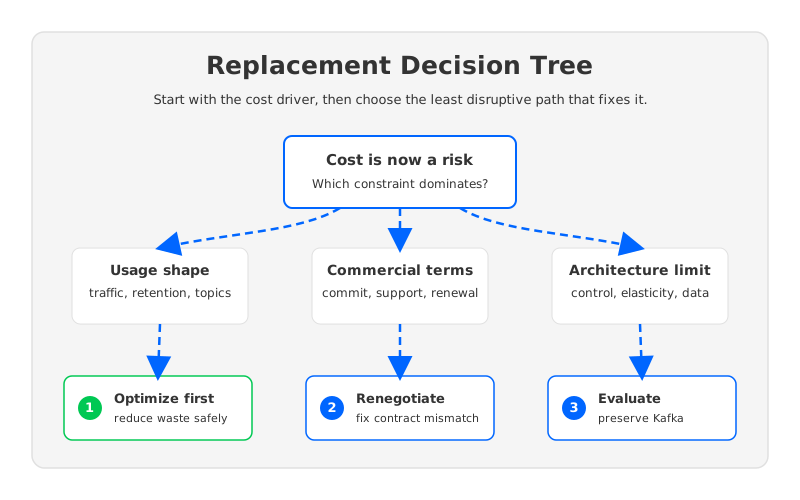
Once the cost anatomy is visible, the team can decide whether replacement is the right lever. Some problems are better solved inside the existing platform: remove unused topics, tune retention, consolidate environments, adjust client placement, or renegotiate terms. Other problems are architectural, especially when the driver is broker-local storage, data movement during scaling, long retention, or limited data control.
Avoid a false binary between "stay" and "migrate." A platform team usually has four options:
- Optimize the current deployment when waste is measurable and the architecture is still a good fit.
- Renegotiate when the workload is stable but commercial terms no longer match usage.
- Replace the Kafka platform when compatibility can be preserved and the cost driver is structural.
- Redesign the data architecture when Kafka is being asked to do work that belongs in a lakehouse, warehouse, cache, or workflow system.
Compatibility is the first gate. Kafka is more than a wire protocol in production; it is a set of client libraries, delivery expectations, authentication patterns, ACLs, consumer group behavior, offsets, observability conventions, and failure runbooks. Apache Kafka's protocol documentation anchors the conversation in concrete client-broker behavior rather than vague "Kafka-like" claims. A replacement that requires broad application rewrites is no longer Kafka-compatible in the practical sense.
The second gate is migration risk. Teams should test mirroring strategy, offset translation, schema and connector behavior, rollback paths, and performance under catch-up reads. A producer sending messages to a new endpoint proves little by itself. Consumers must resume correctly, lag must be manageable, dashboards must remain meaningful, and rollback must stay within the application's tolerance.
The third gate is ownership. A managed service, BYOC deployment, and self-managed Kafka distribute responsibility differently. A lower platform bill may come with more operational work, while BYOC may satisfy data residency and network control requirements that a SaaS model cannot.
4How BYOC and shared storage change the Kafka cost model
Traditional Kafka couples compute and storage inside brokers. Brokers serve client traffic, own partitions, store logs on attached disks, replicate data, and rebalance when capacity changes. That model has served the industry well, but it creates cloud cost friction: scaling compute often implies moving data, and increasing retention often implies more broker-attached storage.
Shared-storage Kafka-compatible architectures move durable log storage out of individual brokers and into cloud object storage or another shared layer. Brokers can become more stateless because long-lived data is no longer trapped on a specific node's disk. This does not make Kafka free or remove design work for latency, durability, metadata, and failure handling. It changes which resources scale with traffic and which scale with retained history.
BYOC changes control. In a bring-your-own-cloud model, the data plane runs inside the customer's cloud account or VPC, depending on product architecture. That can help teams that need control over data locality, security boundaries, private networking, cloud commitments, observability, or procurement. The economic argument is not "lower price because different vendor." It is "different cost structure because storage, compute, network, and operations are separated differently."
5Where AutoMQ fits as a Confluent Cloud replacement
After the cost drivers and replacement gates are clear, AutoMQ fits into the evaluation as a Kafka-compatible, shared-storage option rather than as a generic lower-cost Kafka service. AutoMQ is designed around object storage and stateless brokers while maintaining Kafka API compatibility for existing Kafka clients and ecosystem tools. The evaluation question is whether that architecture can preserve required Kafka behavior while improving the cost and control profile that triggered the search.
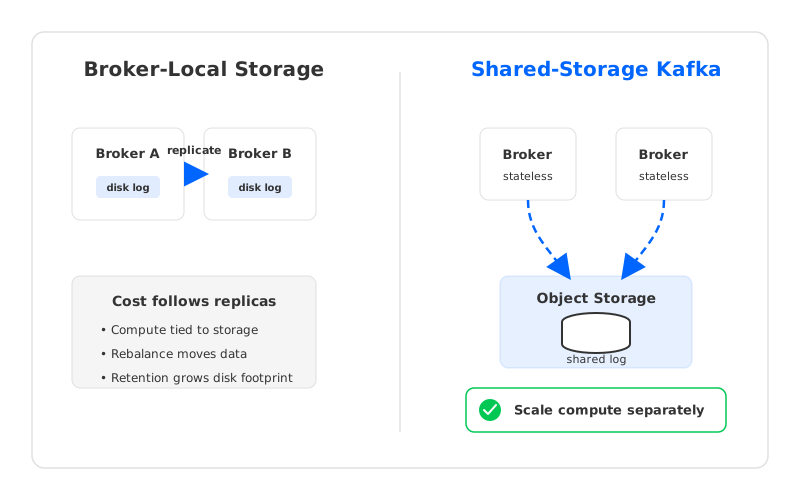
The main architectural difference is that AutoMQ uses object storage as the primary storage layer instead of treating broker-local disks as the long-term home of Kafka data. Brokers are designed to be stateless, which changes scaling, recovery, and partition movement. Under cost pressure, retained data and compute capacity no longer have to grow together. Under governance pressure, BYOC can align the data plane with the customer's cloud account, network, and security controls.
That does not remove the need for a serious proof of concept. A Confluent Cloud replacement evaluation should test real client libraries, producer batching, consumer group behavior, ACLs or identity integration, observability, topic and partition counts, catch-up reads, failure recovery, migration, traffic spikes, consumer lag, broker replacement, object storage assumptions, and rollback.
AutoMQ is most relevant when the current pain is structural rather than incidental:
- Long retention is valuable, but broker-attached storage economics make the platform hard to justify.
- Traffic is bursty, but the current deployment requires expensive headroom or slow scaling decisions.
- Data control matters, and the team wants the Kafka data plane closer to its own cloud network and governance model.
- Kafka compatibility matters, but the team wants an architecture designed for object storage and cloud elasticity.
For some teams, the right answer will still be to optimize or renegotiate Confluent Cloud. For others, the replacement business case becomes credible once they can show that the cost problem comes from architecture, not from a few inefficient topics. That is where AutoMQ belongs in the comparison.
6Confluent replacement readiness checklist
A replacement project should produce an engineering decision record, not a slide with logos. The checklist below forces the team to connect cost, compatibility, migration, and ownership.
| Area | Questions to answer before migration |
|---|---|
| Workload baseline | What are average and peak ingress, egress, retained bytes, partition count, and fan-out? |
| Cost model | Which costs are measured, calculated, or assumed? |
| Compatibility | Which clients, security settings, ACLs, and admin workflows must work unchanged? |
| Ecosystem | What happens to Schema Registry, Kafka Connect, stream processing, governance, and monitoring? |
| Migration | How will data be mirrored, offsets validated, producers switched, consumers resumed, and rollback executed? |
| Operations | Who owns upgrades, incidents, capacity, cloud quotas, object storage policies, and network changes? |
| Commercial path | How does migration timing interact with renewal, commits, support, and procurement? |
Strong replacement cases include both a technical proof and a financial model. The proof shows that applications can move without changing Kafka assumptions. The model shows why the architecture remains attractive under realistic growth, not only today's traffic. When those artifacts agree, the conversation becomes: this workload needs a Kafka-compatible platform with a different storage, network, and ownership model.
If your team is at that point, start with a cost audit rather than a migration date. Pull the latest Confluent Cloud pricing and billing pages, export usage, map data paths, and separate optimization from structural constraints. Evaluate replacements against the behaviors production systems rely on. AutoMQ can be part of that evaluation when shared storage, stateless brokers, and BYOC data control match the problem.
7References
- Confluent Cloud pricing
- Confluent Cloud billing documentation
- Confluent Cloud networking documentation
- Apache Kafka protocol guide
- AutoMQ documentation
- AutoMQ architecture overview
- AutoMQ compatibility with Apache Kafka
- AutoMQ stateless broker documentation
8FAQ
8.1Is Confluent Cloud always more expensive than running Kafka yourself?
No. A managed service can be rational when it reduces operational burden and meets reliability requirements. Include engineering time, incident risk, upgrades, security, support, and opportunity cost. Replacement is worth evaluating when the cost driver is structural.
8.2What does Kafka-compatible mean in a replacement evaluation?
It should mean more than accepting produce and consume requests. For production teams, it includes client behavior, consumer groups, offsets, admin operations, security integration, observability, topic operations, and ecosystem fit.
8.3Should we optimize Confluent Cloud before evaluating alternatives?
Usually yes. Remove unused topics, validate retention, check network paths, review environment sprawl, and understand connector and governance usage. That gives any replacement project a clean baseline.
8.4When does BYOC matter most?
BYOC matters when data control, private networking, cloud commitments, security boundaries, or cost transparency are central requirements. It is strongest when the organization wants the data plane aligned with its own cloud account and controls.
8.5Where does AutoMQ fit in the shortlist?
AutoMQ fits when the team wants Kafka compatibility, object-storage-based shared storage, stateless brokers, and BYOC deployment options after identifying storage, elasticity, network placement, or data control as major drivers.


