
Table of Contents
Table of Contents
A team usually searches for connector infrastructure cost kafka after the easy knobs have stopped working. They have reduced task counts, moved some workers to smaller instances, tuned batch size, and argued about whether a sink connector needs its own worker pool. The bill still looks wrong because the cost is no longer only the price of Kafka Connect workers. It is the cost of running connectors against a Kafka architecture where storage, broker capacity, replication, network paths, and recovery are tightly coupled.
Connector traffic behaves differently from a simple producer and consumer benchmark. Source connectors create steady ingest pressure from databases, object stores, SaaS APIs, and file systems. Sink connectors fan data into warehouses, lakes, search systems, caches, and operational databases. One connector decision can change broker write load, consumer lag, cross-Availability Zone traffic, object storage requests, PrivateLink or NAT paths, and idle capacity.
The practical question is not "How do we make Kafka Connect lower cost?" It is: when does connector infrastructure cost become a signal that the streaming platform architecture is doing too much work in the wrong layer?
1Why Teams Search for connector infrastructure cost kafka
Connector cost conversations often start in FinOps and end up in the platform team's backlog. Finance sees compute, storage, network, managed service, observability, and support line items. Engineering sees task parallelism, partition count, retention, consumer lag, retry policy, dead-letter queues, and target-system throttling. Both views are correct, but neither is complete by itself.
Kafka Connect moves data between Kafka and external systems through connectors and tasks. Apache Kafka's official documentation describes it as a framework for scalable, reliable streaming between Kafka and other systems. In production, that reliability has a cost shape. Workers need CPU and memory. Internal topics need retention and replication. Sink connectors read like consumers, source connectors write like producers, and destination slowdown turns lag into broker pressure.
The first mistake is treating connectors as an isolated fleet. When a source connector writes into a replicated topic, the broker layer replicates that data according to Kafka's storage model. When a sink connector reads across zones, placement and routing can create cross-zone paths. When teams add workers to clear lag, the bottleneck can move from connector CPU to broker disk, broker network, target API quotas, or partition imbalance.
The second mistake is optimizing for average load. Connectors follow external rhythms: database changes, warehouse windows, API rate limits, outage backfills, and replay requests after schema fixes. A cluster sized for average throughput can be fragile during catch-up. A cluster sized for peak throughput can be stable but financially uncomfortable.
2The Production Constraint Behind the Problem
Traditional Kafka uses a Shared Nothing architecture. Each broker manages local storage, and partitions are assigned to brokers. Durability comes from replication across brokers, with leaders and followers coordinated by the cluster. The model is mature, but it couples compute capacity, persistent storage, and data placement. Connector workloads expose that coupling because they add sustained ingress and egress pressure without always increasing business-visible application traffic.
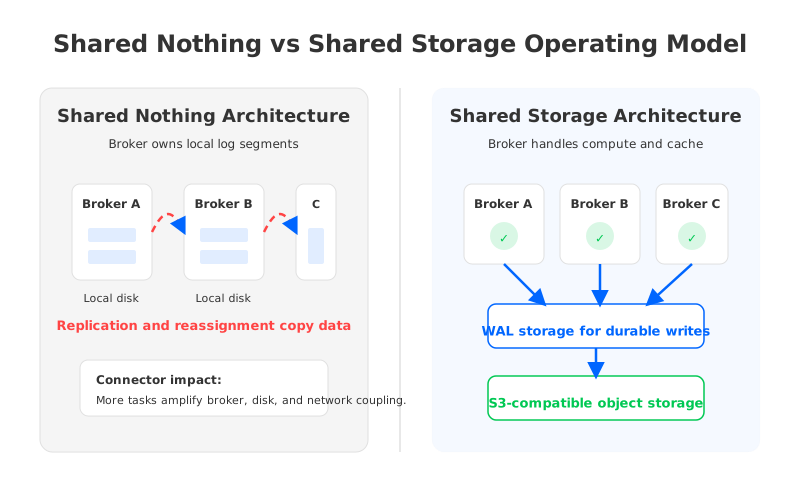
The coupling shows up in five places. Retention increases can force larger disks or more brokers even when CPU is not the constraint. Partition reassignment can require data movement because data is tied to broker-local storage. Replication creates broker-to-broker network traffic, sometimes across Availability Zones. Backfills turn historical reads into a broker and storage event, not only a worker event. Recovery must account for data placement because replacing a broker is not the same as replacing stateless compute.
Tiered Storage changes part of this picture by moving older log segments to remote storage. It can be valuable for long retention and historical reads, and Apache Kafka documents Tiered Storage as a way to separate local and remote log storage. But Tiered Storage does not make brokers stateless. The active log, leadership, local disk, and reassignment behavior still matter. For connector-heavy platforms, that distinction is important because the most expensive moments are often active writes, catch-up windows, and operational changes rather than calm archival storage.
Cloud networking makes the architecture discussion sharper. AWS documents data transfer pricing separately from compute and storage pricing, and cross-zone or external paths can become recurring cost centers. Exact prices depend on region, service, direction, and routing design, so teams should validate against current cloud pricing pages. The architecture point is stable: if connector traffic moves the same bytes through multiple billable paths, worker tuning cannot remove the cause.
3Architecture Options and Trade-Offs
The right response depends on the constraint. Some teams have a connector fleet problem: too many small connectors, inefficient transforms, poor task parallelism, noisy retry loops, or target systems that throttle writes. Better worker sizing, plugin governance, task-level observability, and ownership boundaries can reduce cost without changing the Kafka platform.
Other teams have a broker architecture problem. If every workload spike forces broker expansion, every retention request expands local disks, and every topology change creates a reassignment project, the cost driver sits below Kafka Connect.
The evaluation should separate these options before any vendor discussion:
| Question | Worker-layer issue | Platform-architecture issue |
|---|---|---|
| Where does saturation appear first? | Worker CPU, heap, task queue, target quota | Broker disk, network, imbalance, reassignment |
| What happens during backfill? | Workers need scale-out | Brokers, storage, and network limit recovery |
| What drives monthly cost? | Worker compute and connector fees | Broker count, storage, replication, labor |
| How hard is rollback? | Revert connector config | Restore offsets, topology, placement, routing |
| What should be tested? | Task sizing and throttling | Storage model, data movement, AZ design |
This table is intentionally neutral. Managed Kafka services, self-managed Kafka, Kafka with Tiered Storage, diskless Kafka-compatible platforms, and BYOC platforms can all be reasonable. The mistake is choosing by one visible line item. Connector fees can hide broker, network, and operations cost. Broker prices can hide data movement. A managed service can reduce labor but limit boundary control. A BYOC model can improve data control but requires ownership of cloud resources, IAM, networking, and observability.
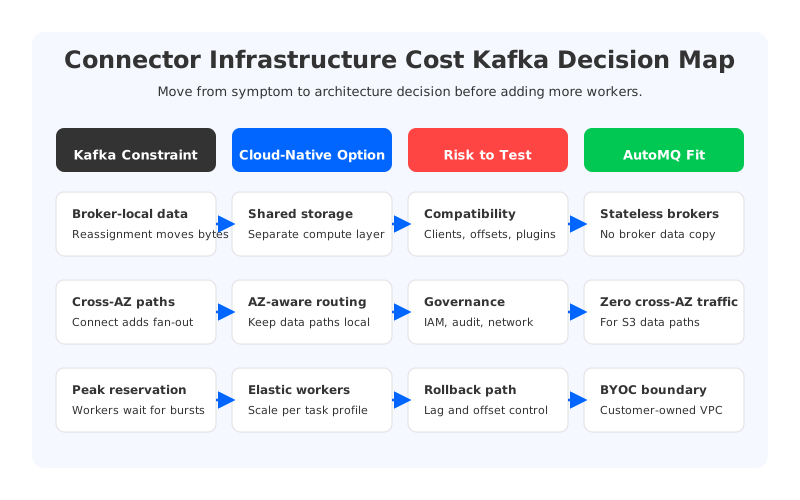
The platform decision should answer a sharper question: which architecture lets the team change connector throughput, retention, and recovery behavior without turning every change into a broker storage project?
4Evaluation Checklist for Platform Teams
The checklist should start with compatibility because connector ecosystems are unforgiving. Kafka clients, Kafka Connect plugins, converters, schema handling, Consumer group behavior, Offset management, transactions, and security settings all have to behave as expected. A platform that lowers infrastructure cost but breaks connector compatibility is not a cost optimization; it is a migration risk with a different label.
Cost comes next, but it should be modeled as TCO (Total Cost of Ownership), not a single service price. Include worker compute, broker compute, storage, network transfer, observability, support, and operations labor. Separate steady-state cost from catch-up cost. Connector platforms rarely fail financial review because average throughput is expensive; they fail because recovery, backfills, and governance create unpredictable capacity needs.
Security and governance are cost controls. If every connector team creates its own network path, IAM role, secret workflow, and observability convention, the platform inherits a hidden operations tax. Standardizing deployment boundaries, plugin approval, audit logs, encryption, and cost tags can be as important as changing instance sizes.
Migration readiness is the final gate. A connector-heavy Kafka estate contains topic names, retention policies, consumer group offsets, connector internal topics, dead-letter queues, alerts, and runbooks. A migration plan needs a way to mirror data, validate lag, cut over clients, and roll back if a target system or connector plugin behaves differently under load.
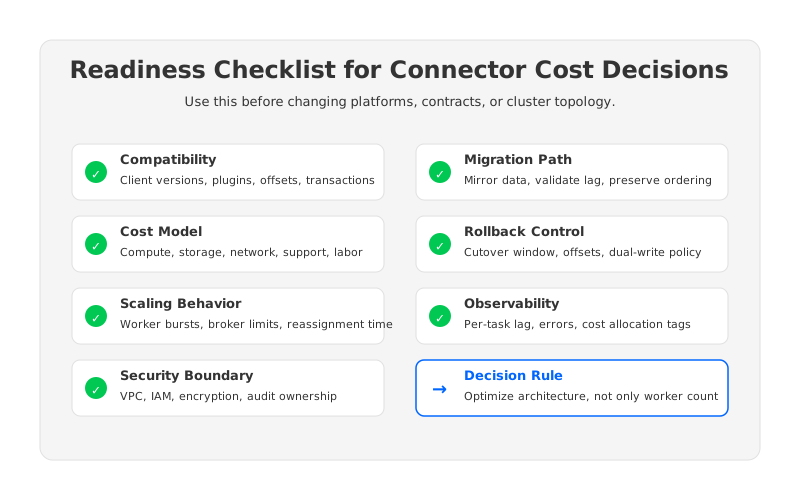
Use the checklist as a scoring exercise rather than a yes-or-no form:
- Compatibility: Do clients, connectors, converters, authentication modes, and offsets work without application rewrites?
- Cost model: Can the team separate compute, storage, network, observability, and labor for steady state and recovery?
- Scaling behavior: Can workers scale without broker-local data movement or long reassignment windows?
- Security boundary: Are VPC, IAM, encryption, audit, and data residency requirements satisfied?
- Migration and rollback: Is there a tested plan for mirroring, lag validation, cutover, and reversal?
- Observability: Can the team attribute lag, errors, retries, storage pressure, and network cost to connector owners?
Teams that cannot answer these questions should pause before buying more capacity. The checklist may reveal a governance problem. It may also reveal that the cluster's storage model is the reason connector economics keep getting worse.
5How AutoMQ Changes the Operating Model
After the neutral evaluation is complete, AutoMQ fits the category where teams want Kafka compatibility without letting broker-local storage define every capacity decision. AutoMQ is a Kafka-compatible streaming platform built around Shared Storage architecture. It keeps Kafka protocol and API compatibility while moving durable storage to S3-compatible object storage through S3Stream and WAL (Write-Ahead Log) storage.
The operating model changes because AutoMQ Brokers are stateless brokers. They still handle protocol processing, routing, leadership, caching, and scheduling, but persistent data is not tied to local disk. Storage durability is backed by shared object storage, while WAL storage provides the durable write path before data is uploaded and organized. In connector cost terms, scaling compute does not imply moving large volumes of broker-local partition data.
That matters during the events that make connector platforms expensive. When a source backfill increases write throughput, the team can evaluate compute scaling separately from storage growth. When sink connectors catch up after a target outage, historical reads use an architecture designed around shared storage and caching rather than broker-local disk ownership. When broker capacity changes, partition ownership and traffic scheduling can change without making reassignment synonymous with large data copies.
AutoMQ's Zero cross-AZ traffic design is also relevant. In cloud Kafka deployments, multi-AZ availability often creates replication and routing paths across Availability Zones. AutoMQ's S3-based Shared Storage architecture is designed to eliminate cross-AZ traffic cost for the data paths it controls. Connector teams still need to validate external paths, targets, and cloud services, but removing broker replication as a cross-zone cost driver changes the baseline.
The BYOC boundary is another practical point. In AutoMQ BYOC, the control plane and data plane run in the customer's cloud account and VPC, with business data remaining in their environment. For teams with strict data residency, IAM, audit, and procurement requirements, this boundary can be as important as cost.
AutoMQ does not remove the need for connector discipline. Poor configuration can still overload a target database, create bad retry loops, or generate unnecessary transformations. What it changes is the cost of changing the streaming substrate underneath those connectors. A connector platform is easier to operate when worker scale, broker compute, durable storage, and data placement can be reasoned about separately.
For teams evaluating this path, a good proof of concept is narrow but realistic. Pick one connector family, one backfill scenario, one recovery scenario, and one production-like security boundary. Measure lag, broker CPU, storage growth, network paths, recovery time, and operational steps. The result should show whether the architecture reduces the hidden coupling behind the cost problem.
6FAQ
6.1Is connector infrastructure cost mainly a Kafka Connect worker problem?
Sometimes. If worker CPU, heap, task parallelism, transforms, or target throttling are the first bottlenecks, optimize the connector layer first. If broker storage, replication traffic, reassignment, and recovery windows dominate, the connector fleet is exposing a platform architecture problem.
6.2Does Tiered Storage solve connector infrastructure cost for Kafka?
Tiered Storage can help with long retention and historical storage economics, but it does not make brokers stateless. Active logs, broker-local storage, leadership, and reassignment still matter. Connector-heavy workloads should test write pressure, catch-up reads, and operational changes.
6.3What should FinOps teams ask before approving more Kafka capacity?
Ask for a TCO model that separates worker compute, broker compute, storage, network transfer, observability, support, and operations labor. Also ask for steady-state and recovery scenarios. Connector economics often look different during backfills.
6.4Where does AutoMQ fit in a connector cost optimization project?
AutoMQ fits after the team confirms that platform architecture, not only connector configuration, is the cost driver. Its Kafka-compatible Shared Storage architecture, stateless brokers, and customer-controlled BYOC boundary help decouple compute, storage, and data placement decisions.
6.5How should a migration be de-risked?
Start with one connector family, mirror a representative data flow, validate offsets and lag, test failure recovery, and define rollback before cutover. A connector migration without offset validation and rollback control is not ready for production.
7Conclusion
The phrase connector infrastructure cost kafka sounds like a purchasing question, but for many platform teams it is an architecture review in disguise. If the bill is driven by connector workers, tune the workers. If the bill is driven by broker-local storage, replication paths, data movement, and recovery labor, the platform needs a different operating model.
If you are evaluating whether Kafka-compatible Shared Storage architecture can reduce the coupling behind your connector costs, start with AutoMQ's BYOC deployment path and architecture materials: explore AutoMQ Cloud.


