
Table of Contents
Table of Contents
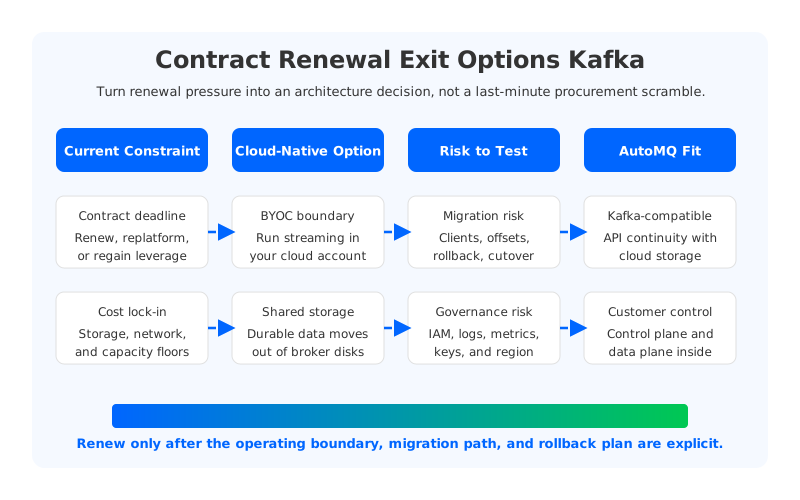
A search for contract renewal exit options kafka usually means the team is already under pressure. The Kafka estate is in production, the renewal clock is visible, and the easy answer is to keep the hosted Kafka contract because switching risk feels larger than price or governance pressure. That can trap the organization into evaluating streaming infrastructure too late. By the time procurement asks for leverage, the platform team may still be proving client compatibility, security may still be asking where data and keys live, and application owners may still be worried about offsets, replay, and rollback.
The useful framing is not "renew or replace." It is "which operating boundary should own Kafka-compatible streaming for the next contract period?" Hosted Kafka can fit when teams value service abstraction above infrastructure control. BYOC (Bring Your Own Cloud) becomes more interesting when the business wants the Kafka API plus the data plane, network paths, cloud resources, and audit evidence inside its own environment.
1Why teams search for contract renewal exit options kafka
Renewal pressure rarely starts with one complaint. It tends to arrive as a bundle of concerns that different teams describe in different language. Procurement sees commitment, overage, and negotiation risk. Platform engineering sees broker capacity, partition movement, retention pressure, and incident load. Security sees data residency, private connectivity, identity, audit logs, and key ownership. Finance sees storage, networking, idle capacity, and vendor terms that no longer match the workload.
Those groups are not arguing about separate systems. They are arguing about the same Kafka boundary. A hosted data plane may simplify operations, but it can also make the team ask hard questions during renewal: Which traffic leaves the customer cloud account? Which logs and metrics are visible to the customer? Which cloud bill absorbs private connectivity and data transfer? Which failure drills are under the customer's control? Which migration path exists if the next contract is not acceptable?
That is why a renewal exit plan has to be technical before it becomes commercial. A discount does not fix a storage model that cannot scale without data movement. A shorter term does not fix a data governance boundary that security cannot approve. A migration clause does not prove that consumer groups, offsets, transactional producers, Kafka Connect workloads, and replay paths will behave under cutover conditions. The contract can create urgency, but the architecture decides whether the organization has a real option.
2The production constraint behind the problem
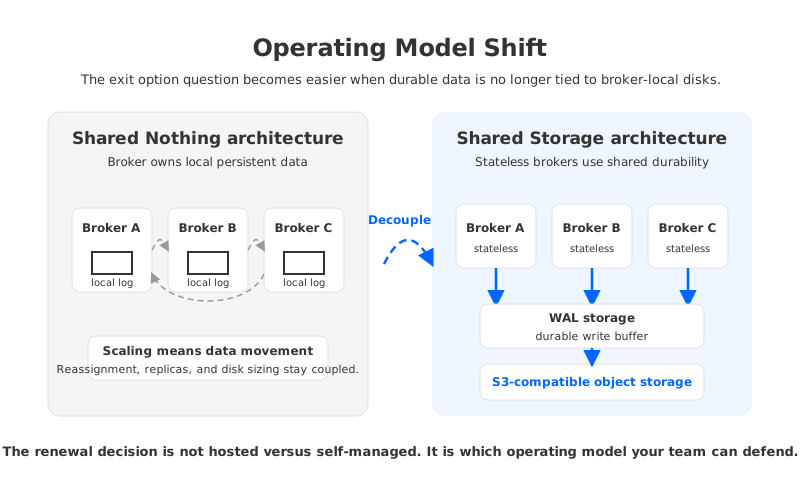
Traditional Apache Kafka is built around a Shared Nothing architecture: brokers own local persistent logs, and partitions are placed across brokers with replication for durability. That model is familiar, battle-tested, and deeply connected to Kafka's behavior around topics, partitions, offsets, consumer groups, and leader/follower roles. It also means that broker lifecycle decisions and storage lifecycle decisions are tightly coupled.
In production, that coupling shows up in places that renewal teams care about:
- Capacity is often reserved ahead of demand. Broker disks, instance sizes, and partition counts are planned around peak write traffic, retention, replica placement, and catch-up reads. When workload shape changes, excess capacity can remain locked into the cluster.
- Scaling can become data movement. Adding brokers or changing placement is not only a compute operation. Partition reassignment can move retained data, consume network bandwidth, and create operational windows that application teams have to understand.
- Failure recovery is tied to local state. A broker replacement is not equivalent to replacing a stateless compute node. The cluster still has to preserve durable logs, replica health, leader election, and consumer-visible behavior.
- Networking cost can hide in the topology. Multi-AZ replication, client placement, private endpoints, and downstream systems can turn architecture choices into recurring cloud line items.
These issues are not defects in Kafka. They are consequences of using broker-local storage as the durable event log. Hosted services may reduce the amount of operational work a team performs directly, but they do not automatically remove the need to reason about storage locality, network paths, retention economics, and migration control. At renewal time, the hidden question is whether the next operating model should keep the same storage assumption.
3Architecture options and trade-offs
A practical evaluation should compare operating models, not slogans. "Hosted" can mean the provider operates most of the platform outside the customer's environment. "Self-managed" can mean the customer owns everything from patching to failure recovery. BYOC sits between those extremes: the service can provide software, automation, and support while the infrastructure boundary stays in the customer's cloud account or private environment. The right answer depends on which constraint is binding.
| Option | What it gives you | What to test before renewal |
|---|---|---|
| Renew hosted Kafka | Operational continuity and fewer immediate migration tasks | Contract flexibility, data boundary, private connectivity, cost transparency, and exit rights |
| Self-manage Kafka | Direct infrastructure control and familiar open-source operations | Staffing, on-call load, upgrade process, storage planning, and reassignment windows |
| Move to BYOC Kafka-compatible streaming | Customer-owned data plane with managed lifecycle patterns | Compatibility, control-plane boundary, cloud IAM, object storage design, and migration drills |
| Rebuild around non-Kafka streaming | Opportunity to change the application contract | Client rewrites, ecosystem impact, connector behavior, and application downtime |
The table makes one thing clear: BYOC is not automatically better. It is sharper when the organization needs control without giving up operational automation. If the workload is small, the governance bar is light, and the current hosted service is healthy, renewal may be right. If the workload is strategic, the renewal amount is material, and security or finance needs stronger evidence, a BYOC option deserves a structured evaluation.
That structure should start with compatibility. Kafka is not only a wire protocol; it is an ecosystem contract. Producers depend on batching, idempotence, retries, authentication, and partitioning behavior. Consumers depend on offsets, group coordination, lag visibility, and rebalance behavior. Connectors depend on Kafka Connect runtime behavior and offset storage. An exit option that passes a simple produce-consume demo but fails these behaviors is not an exit option.
The second test is cost shape. Do not evaluate cost only as a monthly subscription number. Model retained bytes, write throughput, read fan-out, cross-AZ or inter-zone traffic, private endpoints, object storage requests, control-plane fees, support, and engineering time. The goal is to identify which line items change when durable data, compute nodes, and network paths move to a different boundary.
The third test is governance. A customer-owned data plane should make it easier to review buckets, volumes, keys, roles, security groups, logs, metrics, and administrative actions. It also makes cloud resource design more explicit. That is a feature only if the team is ready to own the review. BYOC does not remove security work; it moves the work into the customer's standard cloud controls.
4Evaluation checklist for platform teams
Strong renewal exit plans are boring in a good way. They turn vague risk into evidence. Before the next contract decision, platform teams should be able to answer seven questions with test results, not opinions.
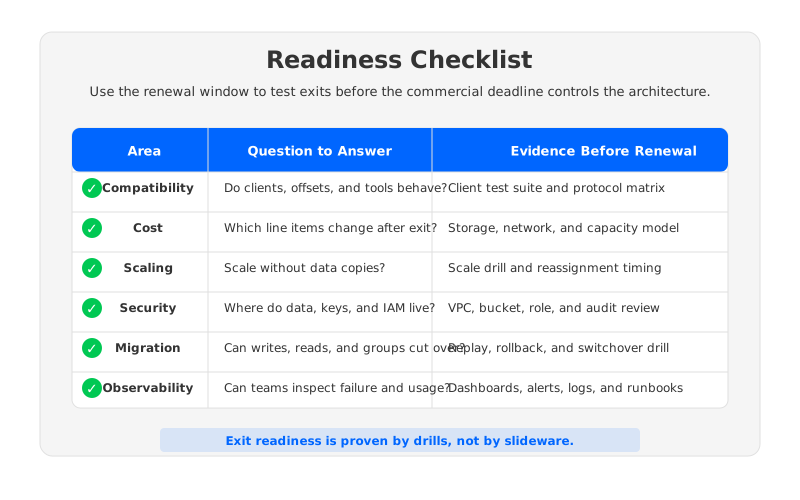
- Compatibility: Which Kafka client versions, authentication modes, producer settings, consumer group patterns, transaction settings, and admin APIs are used in production? Which ones have been tested against the target platform?
- Cost: Which costs are subscription terms, which are cloud infrastructure costs, and which are operational labor? Are storage, network, private connectivity, and idle capacity separated in the model?
- Elasticity: Can the target platform scale compute without turning every change into a large data movement event? What happens during peak traffic, backlog catch-up, and broker replacement?
- Governance: Where do Kafka records, object storage, WAL storage, keys, metrics, logs, and control actions live? Can the security team inspect them through existing cloud controls?
- Migration: How are topics, records, offsets, consumer groups, and producers moved? Is the plan tested with a representative workload instead of a small demo topic?
- Rollback: If the cutover fails, can producers and consumers return to the previous path without data loss, duplicated side effects, or ambiguous offsets?
- Observability: Can SREs see broker health, consumer lag, storage behavior, connector status, cloud resource usage, and migration progress from the same incident workflow?
If any of these answers are missing, renewal becomes less of a choice and more of a default. The organization may still renew, but it will renew without leverage. A stronger approach is to run a narrow proof around one production-like domain: one producer group, one consumer group, one connector or downstream path, one retention profile, and one rollback drill. That scope is small enough to execute, but real enough to expose the risks that matter.
5How AutoMQ changes the operating model
This is where AutoMQ belongs in the discussion: as a Kafka-compatible streaming platform designed around Shared Storage architecture rather than broker-local durable storage. AutoMQ keeps the Kafka protocol and core Kafka ecosystem contract while moving persistent stream data into S3-compatible object storage through S3Stream. Brokers become stateless with respect to durable log ownership, and WAL (Write-Ahead Log) storage provides the durable write buffer for the hot path.
That architectural change matters for renewal exits because it changes what the team is buying control over. In a Shared Nothing architecture, retained data is bound to broker placement. In AutoMQ's Shared Storage architecture, durable data is stored in shared object storage, while brokers handle Kafka protocol processing, leadership, caching, and routing. Scaling and broker replacement can therefore be reasoned about more like compute lifecycle work than like full data relocation work.
The deployment boundary matters as much as the storage boundary. AutoMQ BYOC is designed for customer cloud environments: the control plane and data plane run inside the customer's cloud account or VPC, and Kafka workload data remains in customer-owned infrastructure. AutoMQ Software targets customer-operated private environments. For teams evaluating a contract exit, that distinction gives security, platform, and procurement teams a concrete review surface: cloud account ownership, VPC design, object storage bucket policy, WAL storage choice, IAM roles, logs, metrics, and support access.
AutoMQ also gives migration planning a more specific path than "replace Kafka and hope clients behave." Its Kafka-compatible design is relevant to client continuity, and Kafka Linking is designed for migration workflows that need record synchronization and consumer progress handling. Those capabilities still need to be tested against the customer's real applications. A renewal exit plan should not assume any tool removes the need for cutover discipline. It should use the tool to make the cutover measurable.
The strongest reason to evaluate AutoMQ during a renewal window is not that every team should leave hosted Kafka. It is that teams should understand whether broker-local storage is the constraint behind their cost, scaling, governance, and exit-risk concerns. If the answer is yes, a Kafka-compatible shared storage architecture with a BYOC boundary gives the organization a different operating model to test.
6A renewal scorecard you can take to procurement
Procurement cannot negotiate architecture. It can negotiate better when architecture has already produced options. A useful scorecard separates "nice to have" features from exit-critical evidence:
| Decision area | Green signal | Red signal |
|---|---|---|
| Client continuity | Production client settings pass targeted tests | Only a simple producer and consumer demo exists |
| Data boundary | Data plane, storage, keys, and logs are mapped | Boundary is described only in vendor language |
| Cost model | Cloud and subscription costs are separated | Renewal debate uses one blended number |
| Migration | Cutover and rollback have been rehearsed | Plan depends on a maintenance window no one owns |
| Operations | SRE workflow covers broker, storage, and cloud signals | Observability changes are discovered during incidents |
| Contract leverage | Team can renew, reduce scope, or migrate | Renewal is the default low-risk path |
This scorecard changes the tone of the renewal conversation. Instead of asking whether the hosted Kafka provider is good or bad, the team can ask which boundary is defensible for the next period. Some workloads may stay where they are. Some may move to a customer-owned data plane. Some may need a staged plan because the migration evidence is not ready. That is a better outcome than discovering the real exit conditions after the signature deadline.
If your renewal search started with contract renewal exit options kafka, build the exit plan before the commercial clock decides for you. Start with one representative workload, run the compatibility and rollback drills, model the cloud line items separately, and compare hosted Kafka with a BYOC Kafka-compatible option on operating evidence. To evaluate AutoMQ in that frame, use the AutoMQ BYOC path and test whether Shared Storage architecture changes the constraints your renewal exposed.
7FAQ
7.1Is BYOC Kafka the same as self-managed Kafka?
No. Self-managed Kafka usually means the customer operates the full Kafka lifecycle directly. BYOC means the infrastructure boundary is in the customer's environment, while the platform provider may still provide software, automation, lifecycle management, and support. The exact responsibility split must be reviewed for each platform.
7.2Does BYOC remove all networking costs?
No. BYOC changes where the data plane runs and which paths can stay inside the customer's cloud design. Cloud networking rules still apply, including inter-zone, endpoint, egress, and private connectivity charges depending on provider and topology.
7.3What should be tested first during a Kafka exit evaluation?
Start with compatibility and rollback. Test the actual client versions, authentication modes, producer settings, consumer group behavior, offset handling, and failure paths used by one representative production domain. Cost modeling is useful only after the technical path is credible.
7.4When is hosted Kafka still the right renewal choice?
Hosted Kafka can remain the right choice when the current boundary satisfies security, cost, reliability, and operational requirements, and when the team has enough contractual flexibility. The point of an exit plan is not to force migration; it is to prevent renewal from becoming the default safe option.
8References
- Apache Kafka documentation: https://kafka.apache.org/documentation/
- Apache Kafka Tiered Storage: https://kafka.apache.org/41/operations/tiered-storage/
- AutoMQ compatibility with Apache Kafka: https://docs.automq.com/automq/architecture/technical-advantage/native-compatible-with-apache-kafka?utm_source=blog&utm_medium=reference&utm_campaign=contract-renewal-exit-options-kafka
- AutoMQ Shared Storage architecture overview: https://docs.automq.com/automq/architecture/technical-advantage/overview?utm_source=blog&utm_medium=reference&utm_campaign=contract-renewal-exit-options-kafka
- AutoMQ BYOC environment overview: https://docs.automq.com/automq-cloud/manage-environments/overview?utm_source=blog&utm_medium=reference&utm_campaign=contract-renewal-exit-options-kafka
- AutoMQ Kafka Linking migration overview: https://docs.automq.com/automq-cloud/migrate-to-automq/overview?utm_source=blog&utm_medium=reference&utm_campaign=contract-renewal-exit-options-kafka
- AWS S3 pricing: https://aws.amazon.com/s3/pricing/
- AWS PrivateLink documentation: https://docs.aws.amazon.com/whitepapers/latest/aws-privatelink/what-is-aws-privatelink.html


