
Table of Contents
Table of Contents
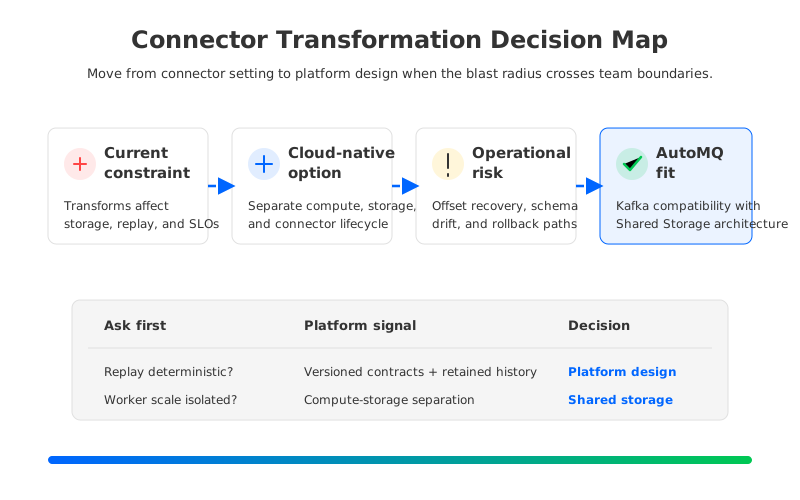
Teams usually search for data transformation connectors kafka after a connector setting has stopped feeling like a connector setting. A source connector is masking fields before writing into a Topic. A sink connector is projecting records into a warehouse schema. A dead-letter Topic is filling because one downstream system cannot tolerate a schema change that the source system considers harmless. The first question sounds tactical: which transformation should run where? The better question is more architectural: when does connector transformation become part of the streaming platform contract?
That distinction matters because Kafka Connect is not an isolated utility. Distributed workers coordinate through Kafka itself, and connector configuration, offsets, status, converters, transformations, retries, and error paths all touch the same durable log producers and consumers depend on. A small transform can be operationally small; a transformation estate that owns routing, masking, enrichment, format conversion, and replay behavior is no longer small.
The practical thesis is direct: connector-level transformation is safe when the transformation is local, deterministic, observable, and built with a clear rollback path. It needs platform-level design when it changes replay semantics, creates shared derived data products, stresses broker storage, crosses security boundaries, or becomes part of a migration plan.
1Why Teams Search for data transformation connectors kafka
The search phrase looks narrow, but the work behind it is rarely narrow. Data integration teams want a way to reshape records near the source or sink without forcing every application team to write custom consumers. Connector and CDC owners want operational consistency: snapshots, offsets, retries, schemas, and failed records should be visible in one place. Platform engineers want the Kafka layer to absorb uneven traffic without turning every connector incident into a broker incident.
Those goals pull in different directions. A connector transform is attractive because it keeps logic close to movement. If the source field name is wrong, rename it before the record spreads. If the sink rejects a column, project it away. If a topic carries extra metadata, drop it at the edge. For simple field-level adjustments, this is reasonable engineering. The alternative, spinning up a stream processing job for every small change, can create more moving parts than the transformation deserves.
The trouble starts when "small" becomes a habit rather than a property. One transform masks data. Another changes key shape. A third routes records by event type. A fourth converts formats for a lakehouse sink. Over time, downstream teams stop consuming the source contract and start consuming whatever the connector estate happens to emit. At that point, the transformation has become a production interface, but it may still be managed like a line in a connector configuration file. That is where teams need a platform decision map, not another list of connector tricks.
2The Production Constraint Behind the Problem
Kafka's strength is that it turns data movement into a durable, replayable log. That strength also makes transformation placement consequential. If the transform runs before data reaches Kafka, the raw event may be lost unless another path stores it. If the transform runs inside Kafka Connect before a sink write, replay can produce a different output when configuration changes. If the transform runs in Kafka Streams or another processing layer, the platform has to operate input topics, output topics, state stores, changelog topics, and failure recovery as one system.
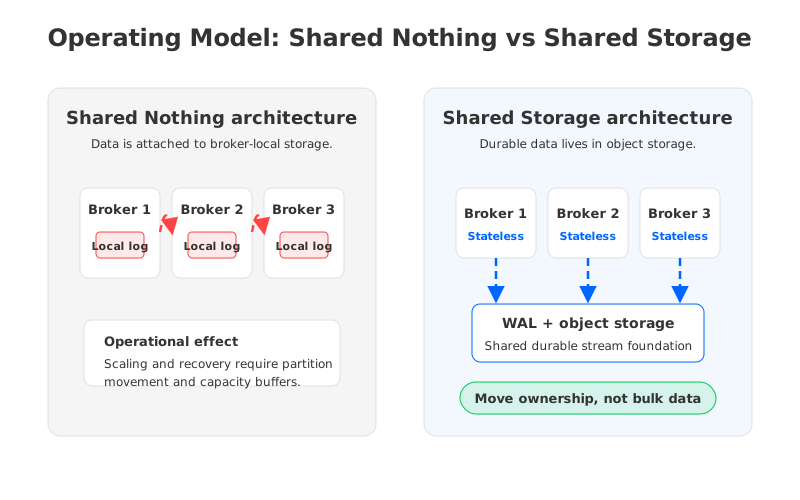
The constraint is not only semantic. It is also operational. Traditional Kafka deployments use a Shared Nothing architecture: each Broker owns local storage, and partition data is attached to the Broker lifecycle. Replication factor, leader/follower placement, partition reassignment, retention, and backfill all affect how much data moves through the cluster. Connector transformation can amplify that pressure because it often creates more topics, more retained history, more catch-up reads, and more Consumer lag during downstream incidents.
Consider a CDC pipeline that writes raw database changes into Kafka, applies light transformations in connectors, and serves two sinks: a search index and a data lake table. When the lake sink is throttled, the connector lags. When the transform changes, the team may need to replay older records. When the search index expects an older schema, the team needs rollback. None of those problems are exotic, but they all ask the same platform question: can the Kafka layer support replay and recovery without making storage, broker compute, and connector workers fight for the same capacity envelope?
3Architecture Options and Trade-Offs
The right architecture depends on what the transformation owns. A useful evaluation starts by separating four layers: extraction, durable log, transformation, and delivery. Kafka Connect is often excellent at extraction and delivery. Stream processors are better when transformation is stateful, involves joins, or produces shared analytical data products. The Kafka-compatible streaming platform underneath both layers should be evaluated on compatibility, storage behavior, recovery, scaling, and governance.
| Pattern | Good fit | Main risk | Platform requirement |
|---|---|---|---|
| Connector-level transform | Field projection, masking, routing, format conversion near source or sink | Hidden business logic inside connector configuration | Versioned configs, failed-record handling, offset visibility |
| Stream processor | Stateful enrichment, joins, deduplication, event-time logic | More jobs, state, checkpoints, and upgrade paths | Replayable input, stable output contracts, observability |
| Table or warehouse sink | Direct ingestion into analytical stores | Sink throttling and schema mismatch can create lag | Backpressure handling, retention, rollback procedure |
| Platform-level shared storage | Long retention, heavy replay, elastic broker operations | Requires validating latency and deployment model | Kafka compatibility, durable object storage, clear network boundary |
This table is a responsibility map. The common mistake is treating connector transformation as a feature checklist while ignoring the operating model underneath it. A transformation that only serves one sink can live near that sink. A transformation that defines a shared contract needs governance. A transformation that depends on replay needs retained source data and a rollback path.
Compatibility is the first gate. Kafka ecosystems are sticky because clients, Connect workers, schema tooling, stream processors, monitoring, and security controls depend on protocol behavior and operational assumptions. A Kafka-compatible platform should preserve the client path so tests can focus on connector plugins, converters, Consumer group progress, ACLs, and replay under failure.
Cost is the second gate, but it should be treated as an architecture property. Connector transformation changes cost through storage growth, worker CPU, retained derived topics, network placement, sink retries, and replay windows. Counting only connector workers or only Broker storage misses the larger system.
Governance is the third gate. Transformations need owners, tests, and a deprecation path. A connector configuration repository is not enough if nobody owns the output contract, and a dashboard is not enough if operators cannot connect a failed sink write back to source offset, transform version, and output record.
4Evaluation Checklist for Platform Teams
Before moving more transformation logic into connectors, run a readiness review around concrete failure modes. The goal is to make sure that the connector estate can fail in ways the platform team understands.
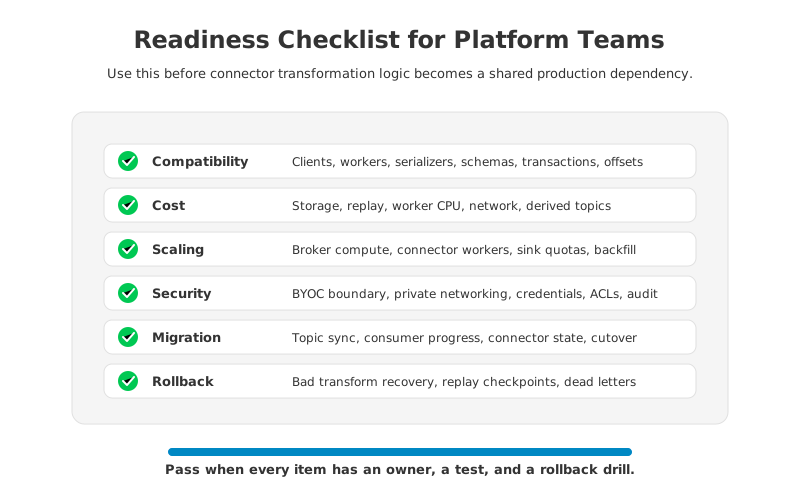
Start with compatibility. Test the actual clients, Kafka Connect distribution, connector plugins, converters, schema formats, authentication mode, authorization rules, and monitoring hooks. Include old-offset replay in the test plan. A happy-path sink write proves very little if the production incident will involve a replay after a schema change.
Then test cost and scaling together. Connector workers can scale independently from Brokers, but derived topics, sink lag, catch-up reads, and backfills still affect the Kafka layer. If the Kafka layer is tied to broker-local storage and slow reassignment, platform teams often compensate by overprovisioning.
Security and governance deserve the same specificity. If transformations mask regulated data, decide whether raw events may be retained, who can read them, and how audit trails prove the policy. In BYOC, validate where the control plane, data plane, connector workers, object storage, credentials, and network endpoints live.
Migration and rollback are the final gates. A Kafka-compatible target reduces application rewrite risk, but topic data, Consumer group progress, connector offsets, task status, schema behavior, and downstream idempotency still affect reversibility. A useful drill asks whether a critical connector can recover after cutover, replay a controlled range, and roll back without inventing a second source of truth.
5How AutoMQ Changes the Operating Model
After the neutral evaluation, the architectural requirement becomes clearer. A connector transformation platform benefits from Kafka compatibility, but it also needs a storage model that does not make every replay, scale-out, or Broker replacement a local-disk operation. AutoMQ fits that category as a Kafka-compatible streaming platform with Shared Storage architecture based on S3Stream, WAL storage, data caching, and S3-compatible object storage.
Connectors do not disappear. Kafka Connect, CDC tools, stream processors, and sinks still need owners, tests, and operational discipline. The change is that durable stream data is no longer tied to a specific Broker's local disk. AutoMQ Brokers handle Kafka protocol requests, leadership, caching, and scheduling, while retained data lives in shared object storage through S3Stream. Scaling and recovery can focus on ownership, leadership, and traffic placement instead of bulk partition data movement.
For connector transformation workloads, that changes several operating assumptions. Long retention becomes easier to reason about because object storage is the durable foundation. Broker replacement is less entangled with retained local logs. Heavy replay still needs testing, but it can be evaluated as object-storage-backed read and cache behavior rather than a pure local-disk pressure event.
AutoMQ BYOC also matters because connectors often cross private systems. In AutoMQ BYOC, the control plane and data plane run inside the customer's cloud account and VPC boundary, so teams can align streaming infrastructure with IAM, networking, audit, and data-location requirements. AutoMQ Managed Connector builds on that model by managing Kafka Connect in the customer environment.
Migration is another place where platform design shows up. AutoMQ's Kafka Linking is designed for Kafka migration scenarios that need message synchronization, Consumer group progress handling, and controlled cutover. That does not remove connector validation; it gives platform teams a migration primitive that respects Kafka-facing continuity while they test the integration estate around it.
Shared Storage architecture is not a reason to put every transformation into a connector. Complex stateful logic still belongs in a processing layer with explicit state, checkpoints, and code ownership. AutoMQ changes the Kafka-compatible data plane underneath those choices, especially when connector transformation exposes the cost and operational rigidity of broker-local storage.
6A Practical Decision Framework
Use connector-level transformation when the rule is close to the integration edge, deterministic, and testable with connector lifecycle controls: dropping fields before a sink write, changing names to match a target schema, adding static headers, or routing records into a small set of destinations. Keep the raw event or a recoverable source when replay correctness matters.
Use a stream processor when the transformation creates a shared product. Joins, deduplication, enrichment, windowing, and business rule evaluation deserve code review, test suites, deployment pipelines, and state recovery. The connector can still move data in or out, but the transformation contract should not be hidden inside a worker configuration.
Evaluate the streaming platform when transformation pressure changes the economics or recovery model of Kafka itself. The warning signs are recognizable:
- Retention is growing because teams need to replay raw and derived topics after transform changes.
- Broker capacity is sized for backfill and catch-up events rather than normal traffic.
- Connector incidents require coordinated action across source owners, platform teams, and sink owners.
- Security reviews focus on where raw and transformed records live, not only on connector credentials.
- Migration plans depend on preserving offsets, schemas, and connector behavior while changing the Kafka substrate.
When those signs appear, compare operating models. Traditional Kafka may still fit teams with stable traffic, mature operations, and predictable retention. A Kafka-compatible shared-storage platform such as AutoMQ becomes attractive when the team wants to keep the Kafka ecosystem while changing the storage, scaling, and recovery assumptions that make connector transformation hard to operate.
7FAQ
7.1Are Kafka Connect transformations enough for production data transformation?
They are enough for simple, local, deterministic record changes near a source or sink. They are not a substitute for platform governance when the transformation defines a shared data contract, requires replay guarantees, or affects multiple downstream teams.
7.2Should complex transformations run in connectors or stream processors?
Complex transformations usually belong in stream processors such as Kafka Streams, Flink, or Spark Structured Streaming because they need code ownership, state handling, tests, and deployment control. Connectors remain useful for extraction and delivery at the edges.
7.3Does Shared Storage architecture remove the need for connector governance?
No. Shared Storage architecture changes the Kafka data plane's storage and operating model. It does not decide schema ownership, transform versioning, error policy, or sink behavior. Those still need explicit governance.
7.4How should teams test a Kafka-compatible platform for connector workloads?
Test real connector plugins, converters, schema behavior, Consumer group progress, old-offset replay, authentication, ACLs, monitoring, sink throttling, and rollback. A producer-only compatibility test is not enough for a connector platform.
7.5Where does AutoMQ fit in a data transformation connector architecture?
AutoMQ fits underneath Kafka Connect, stream processors, and sinks as a Kafka-compatible data plane with Shared Storage architecture and stateless brokers. It is relevant when connector transformation pressure is tied to retention, replay, scaling, storage cost, broker replacement, or BYOC deployment boundaries.
Return to the original search: data transformation connectors kafka. The answer is not one transform class or one connector setting. The answer is a boundary decision. If transformation stays local, keep it local and operate it well. If it becomes a shared contract with replay, governance, and migration consequences, evaluate the platform underneath it. To test that boundary with a Kafka-compatible shared-storage data plane, start with the AutoMQ environment path: evaluate AutoMQ for your connector platform.
8References
- Apache Kafka documentation: Kafka Connect overview
- Apache Kafka documentation: Kafka Connect user guide
- Apache Kafka documentation: Message delivery semantics and transactions
- Apache Kafka documentation: KRaft operations
- Apache Kafka documentation: Tiered Storage operations
- AutoMQ documentation: What is AutoMQ
- AutoMQ documentation: Shared Storage architecture overview
- AutoMQ documentation: S3Stream shared streaming storage
- AutoMQ documentation: Kafka Connect in AutoMQ BYOC
- AutoMQ documentation: Kafka Linking migration overview


