
Table of Contents
Table of Contents
Teams rarely search for event driven api gateway kafka because they want another diagram of producers and consumers. They search for it when a gateway has become the front door for operational data, customer-facing APIs, partner callbacks, webhooks, fraud signals, mobile events, and backend service events. The gateway is no longer only routing HTTP requests. It is deciding how events enter the company.
That shift changes the design problem. A gateway pattern can hide synchronous backend complexity, but it cannot hide the operational reality of a streaming backbone. Once Kafka sits behind the gateway, platform teams have to reason about ordering, offsets, replay, authentication, schema evolution, consumer groups, and recovery. The real question is not "Can Kafka receive events from an API gateway?" It is whether the platform can absorb bursty ingress, govern multi-team access, and recover from infrastructure changes without turning every gateway rollout into a Kafka operations project.
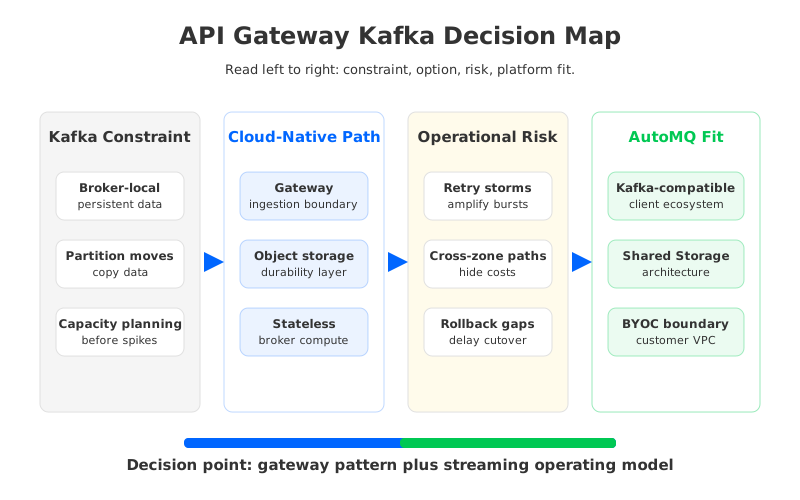
The useful design lens is platform-level, not gateway-level. A production event-driven API gateway needs a Kafka-compatible foundation that treats ingress, storage, scaling, security, migration, and observability as one operating model. Without it, the gateway becomes a neat edge pattern attached to a fragile dependency.
1Why teams search for event driven api gateway kafka
The search intent usually starts with a familiar architecture: keep the API gateway as the single external entry point, validate incoming requests there, and publish accepted events into Kafka. Downstream services consume events through their own consumer groups, commit offsets as they make progress, and replay records when they rebuild state. Apache Kafka's model is attractive because offsets, partitions, retention, transactions, Kafka Connect, and the broader client ecosystem already match how many data teams operate.
But the phrase hides several scenarios. One team may be turning webhooks into durable events. Another may be building a partner API that feeds fraud and risk systems. A third may be replacing point-to-point service calls with asynchronous domain events. They share the same gateway diagram, but their failure modes differ: spikes and retries, auditability and authorization, schema discipline and ownership boundaries.
The common pressure is that the gateway becomes the place where product velocity meets infrastructure limits. Application teams want to add event types quickly. Platform teams want stable topic naming, quotas, access control, retention policies, and observable consumer lag. SREs want to know what happens when a broker fails, a consumer falls behind, or a cloud zone has trouble. Finance teams ask why traffic and storage costs move with each integration. That is broader than choosing an API gateway plugin.
2The production constraint behind the problem
Traditional Kafka is a Shared Nothing architecture. Each broker owns local storage, partitions are placed on specific brokers, and durability is provided through replication between leader and follower replicas. This design remains a strong fit when teams want explicit control over compute, local disks, and replica placement. The constraint shows up when an event-driven gateway turns Kafka into a shared ingress substrate for many teams.
Ingress traffic from a gateway is uneven by nature. A partner import job, mobile app release, or failed webhook retry loop can change write load quickly. In a broker-local storage model, scaling capacity is not only a compute operation. The cluster may also need partition reassignment, replica movement, disk planning, and throttling so background movement does not harm foreground traffic. Teams can automate much of this, but data remains bound to brokers.
Cloud deployment adds another layer. Multi-AZ Kafka clusters use replication to tolerate infrastructure failure, and that replication may create cross-AZ data transfer depending on placement and networking. Longer retention increases local disk or block storage requirements. Tiered Storage can move older data to object storage, but it does not make brokers stateless. Recent data, leader placement, replica movement, and recovery still depend on local storage behavior.
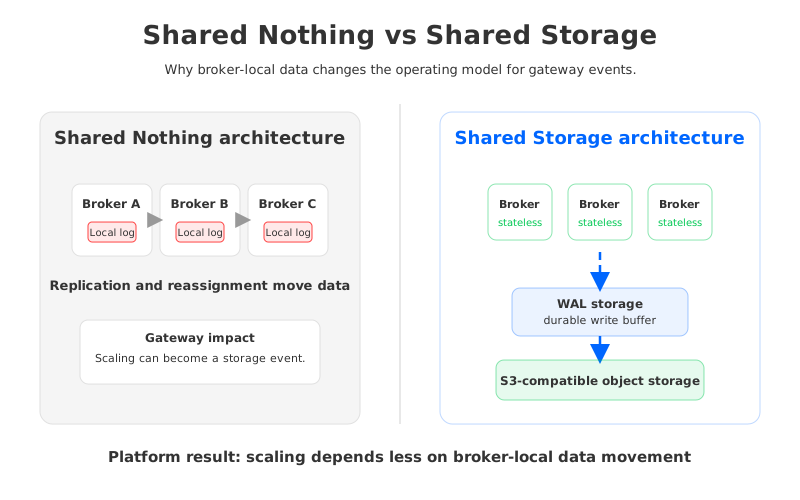
These details matter to gateway teams because they shape product behavior. If the platform team has to pre-provision storage for worst-case traffic, event onboarding slows down. If rebalancing is risky, the team becomes conservative about topic growth. If consumer replay competes with hot reads and writes, incident recovery becomes a capacity planning event. The gateway may look event-driven at the edge while the platform behind it still resists rapid change.
3Architecture options and trade-offs
There are several reasonable ways to build an event-driven API gateway with Kafka. The right choice depends on the team boundary, latency target, cloud constraints, and migration appetite. A neutral comparison should come first.
| Option | Good fit | Main trade-off |
|---|---|---|
| Gateway publishes directly to Kafka | The gateway team owns event validation and the publish path. This keeps the architecture short and easy to reason about. | Gateway availability becomes tightly coupled to Kafka client behavior, authentication, quotas, retries, and broker reachability. |
| Gateway calls an ingestion service | A platform-owned service handles Kafka clients, schema checks, retries, dead-letter handling, and topic routing. | The ingestion service becomes another production system with its own SLO, deployment pipeline, and scaling policy. |
| Kafka Connect or CDC feeds the event backbone | Source systems already emit database or SaaS changes, and the gateway does not need to publish every event itself. | Change capture semantics may not match API-level intent, especially when the event should represent a business action rather than a database mutation. |
| Managed Kafka-compatible platform | The team wants Kafka APIs and ecosystem compatibility while reducing infrastructure operations. | The evaluation moves from broker tuning to deployment boundaries, compatibility, network control, cost visibility, and migration tooling. |
The table usually exposes the same conclusion: the gateway pattern is only one part of the decision. Kafka compatibility matters because teams do not want to rewrite clients, connectors, stream processors, or operational tools. Governance matters because the gateway may serve multiple domains. Cost matters because ingress growth is rarely linear. Recovery matters because the gateway becomes a dependency for customer-facing workflows.
4Evaluation checklist for platform teams
A production checklist should start with platform questions, not product names. The goal is to decide whether the architecture can hold up when the gateway becomes popular, teams add event types, and the system has to recover under pressure.
- Compatibility: Can existing Kafka clients, producers, consumers, Kafka Connect jobs, and observability tools work without application rewrites? Check API compatibility, protocol versions, authentication options, transactions, and consumer group behavior.
- Ingress control: Can the platform enforce quotas, topic ownership, schema policy, and retry behavior at the boundary between gateway teams and Kafka operators?
- Elasticity: Can compute capacity grow and shrink without large data movement, long partition reassignment windows, or manual broker storage planning?
- Cost model: Can the team explain storage, compute, network, cross-AZ traffic, object storage requests, PrivateLink or VPC endpoint charges, and operational labor in one model?
- Failure recovery: What happens when a broker, zone, gateway deployment, connector, or consumer group fails? Recovery should be described as an operational procedure, not as a hopeful diagram.
- Migration and rollback: Can the team move from an existing Kafka cluster while preserving ordering assumptions, offsets, and rollback options?
- Observability: Can operators connect gateway metrics, producer errors, broker health, consumer lag, object storage behavior, and connector status during one incident?
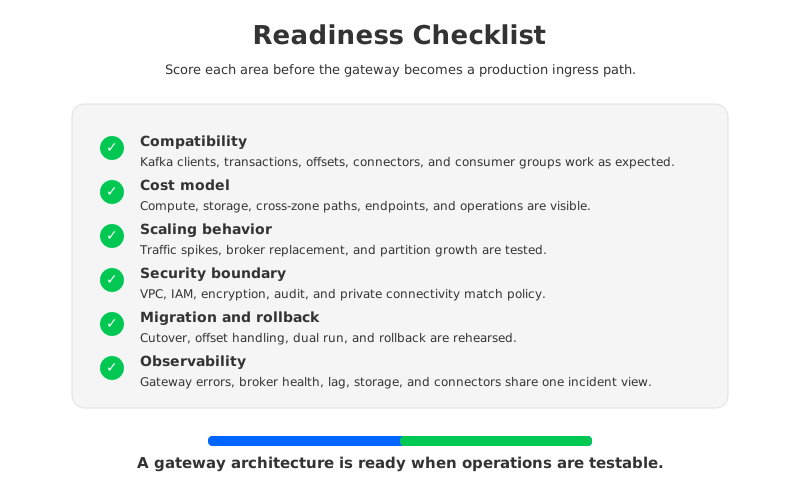
This checklist keeps the discussion honest. A team may accept more operational work for maximum control. Another may choose a managed boundary to spend engineering time on event contracts and domain ownership instead of broker storage operations. Both choices can be valid. The mistake is treating the gateway as the main system when the streaming platform carries the harder failure modes.
5How AutoMQ changes the operating model
After the neutral evaluation, AutoMQ enters the conversation as a Kafka-compatible, cloud-native streaming platform built around Shared Storage architecture. It keeps Kafka protocol and ecosystem compatibility while replacing broker-local persistent storage with S3Stream, WAL (Write-Ahead Log) storage, data caching, and S3-compatible object storage. In practice, the architectural change is that brokers become stateless from the perspective of durable Kafka data.
For an event-driven API gateway, that distinction is practical. When brokers are not the long-term home of partition data, scaling and reassignment are less tied to moving local log segments between machines. AutoMQ Brokers handle Kafka protocol work, request routing, partition leadership, caching, and scheduling, while durable data is written through WAL storage and uploaded to object storage. The platform can focus more on ownership, leadership, and traffic distribution than on copying large volumes of broker-local data.
This does not remove the need for architecture decisions. WAL type still matters. AutoMQ Open Source uses S3 WAL, which keeps deployment simple and object-storage-centric. AutoMQ commercial editions can use additional WAL storage options for workloads with tighter latency requirements. Platform teams should decide based on workload latency, cloud services, failure domains, and operational preference.
AutoMQ BYOC is also relevant for gateway programs that care about network and data boundaries. In BYOC deployments, the control plane and data plane run in the customer's own cloud account and VPC, while customer data remains in that environment. That matters when an API gateway is the ingress point for customer, partner, or regulated events. Teams can align Kafka-compatible streaming with their own VPC design, IAM model, network inspection, and cloud-region constraints instead of routing event data through an external data plane.
Managed Connector support and Kafka ecosystem compatibility help on the integration side. Many gateway programs do not stop at "publish an event." They also need source connectors, sink connectors, schema governance, and downstream analytics. AutoMQ's Kafka compatibility keeps the standard Kafka ecosystem in play, while AutoMQ Managed Connector can reduce the operational burden of running connector workers in a BYOC environment. For teams using lakehouse patterns, Table Topic can also be part of a broader design when streaming data should land directly in Apache Iceberg tables.
The operating-model change is easiest to summarize this way: the gateway team still owns API semantics, event contracts, and client behavior, but the streaming platform no longer has to behave like a fleet of stateful storage nodes for every scaling event. That is the architectural reason AutoMQ can be considered in an event-driven API gateway design. It is not a gateway replacement. It is the Kafka-compatible backbone behind the gateway.
6A readiness scorecard
Use this scorecard before building the first production topic for gateway events. Give each item a score from 1 to 5, where 1 means "unclear or manual" and 5 means "documented, tested, and observable."
| Area | What a 5 looks like |
|---|---|
| Event ownership | Every event type has an owner, schema policy, retention policy, and deprecation path. |
| Gateway publish path | Authentication, retries, idempotency expectations, dead-letter handling, and backpressure are tested. |
| Kafka compatibility | Producers, consumers, connectors, transactions, offsets, and consumer groups are verified against the chosen platform. |
| Scaling behavior | The team has tested traffic spikes, partition growth, broker replacement, and reassignment behavior. |
| Cost visibility | Storage, compute, network, cross-AZ paths, and endpoint costs are visible before traffic grows. |
| Migration path | Cutover, rollback, offset handling, and dual-run behavior are written down and rehearsed. |
| Operations | Dashboards connect gateway errors, publish latency, broker health, consumer lag, storage, and connector status. |
Scores below 3 are not failure. They are design debt made visible early enough to fix. The most dangerous score is a confident 5 that has never been tested under failure. A gateway-driven streaming platform should be evaluated with the same discipline as a database migration or a payment integration, because once external systems depend on it, operational ambiguity becomes product risk.
The phrase event driven api gateway kafka starts as a search query, but it ends as an ownership question. Who owns the event contract? Who owns the publish path? Who owns replay and recovery? Who owns the bill when traffic crosses zones or retention grows? A platform-level design gives those questions a place to live.
If you are evaluating a Kafka-compatible backbone for an event-driven API gateway, start with the checklist above, then test the storage and scaling model under the failures your gateway will actually see. To compare that model with AutoMQ's Shared Storage architecture in your own cloud boundary, visit the AutoMQ BYOC trial path: https://go.automq.com/home?utm_source=blog&utm_medium=cta&utm_campaign=event-driven-api-gateway-kafka-platform-design.
7FAQ
7.1Is Kafka a good fit behind an event-driven API gateway?
Kafka is a strong fit when gateway events need durability, replay, ordered partitions, consumer group fan-out, and integration with stream processing or connectors. It is less useful when the gateway only needs short-lived request buffering or simple task dispatch. The platform decision should include operations, governance, and cost, not only publish latency.
7.2Should the gateway publish directly to Kafka?
Direct publishing can work when the gateway team can safely own Kafka client configuration, authentication, retry behavior, and topic routing. Many organizations prefer an ingestion service between the gateway and Kafka because it gives platform teams a place to enforce schema policy, quotas, dead-letter handling, and tenant isolation.
7.3Does Tiered Storage solve the scaling problem?
Tiered Storage helps move older Kafka data to remote storage, which can reduce pressure from long retention. It does not make brokers stateless, and it does not remove the need to manage recent local data, partition leadership, and reassignment behavior. Gateway programs should evaluate Tiered Storage as one tool, not as a full operating-model change.
7.4Where does AutoMQ fit in this architecture?
AutoMQ fits behind the gateway as the Kafka-compatible streaming platform. It is not an API gateway. Its role is to provide Kafka protocol compatibility with a Shared Storage architecture, stateless brokers, object-storage-backed durability, and customer-controlled deployment boundaries for BYOC scenarios.
7.5What should teams test before production?
Test publish retries, duplicate handling, consumer lag, schema changes, broker replacement, scaling events, zone failure assumptions, connector recovery, and rollback. Also test who gets paged and which dashboard they open first. The incident workflow is part of the architecture.
8References
- Apache Kafka Documentation
- Apache Kafka KIP-405: Kafka Tiered Storage
- AutoMQ: Compatibility with Apache Kafka
- AutoMQ: S3Stream Shared Streaming Storage
- AutoMQ: WAL Storage
- AutoMQ: Eliminate Inter-Zone Traffic
- AutoMQ Cloud: Kafka Connect Overview
- AutoMQ: Table Topic Overview
- AWS PrivateLink Documentation


