
Table of Contents
Table of Contents
Teams rarely search for greenops event streams kafka when the first Kafka cluster is launched. They search for it after the platform becomes shared infrastructure: fraud systems read payment events, analytics teams replay clickstreams, machine learning pipelines ask for longer retention, and compliance teams want evidence that resource usage is controlled. At that point, GreenOps is not a slogan about using fewer servers. It is a question about whether the event streaming architecture can reduce waste without weakening reliability, governance, or recovery.
GreenOps for Kafka means managing streaming infrastructure so that compute, storage, network traffic, and operational work are used deliberately. It overlaps with FinOps, but it is not the same conversation. FinOps asks whether the bill is explainable and optimizable. GreenOps asks whether the architecture avoids unnecessary resource consumption in the first place. For event streams, those questions quickly converge because every retained byte, replica, replay, and cross-zone path has both cost and infrastructure impact.
The hard part is that Kafka workloads do not consume resources in a single dimension. A topic may have modest producer throughput but long retention. Another topic may have short retention but many independent Consumer groups. A third may be quiet most of the day and then replay aggressively after an incident. The useful thesis is blunt: GreenOps for Kafka becomes an architecture problem when the team can no longer separate waste reduction from partition movement, broker recovery, cross-AZ traffic, and migration risk.
1Why Teams Search for greenops event streams kafka
The search usually begins with an uncomfortable mismatch. Cloud reports show rising compute, storage, and data transfer. Kafka metrics show broker CPU, disk usage, fetch throughput, consumer lag, and partition imbalance. Neither view alone explains which product decision, replay workflow, or topology choice created the resource pressure. Platform teams end up stitching together billing exports, broker dashboards, topic inventories, and deployment diagrams to answer what should be a basic operating question: which workloads are consuming resources, and can the platform scale them independently?
Kafka is a natural place for this pressure to accumulate because it is designed for reuse. Producers write durable records to topics. Consumers in different Consumer groups maintain their own offsets and process the same records independently. Kafka Connect, stream processing applications, feature pipelines, audit exports, and lake ingestion jobs can all read from the same backbone. That is exactly why Kafka is valuable, but it also means one business event can become multiple read paths, retention obligations, and recovery scenarios.
The first GreenOps mistake is treating all of that as a right-sizing exercise. Right-sizing helps when brokers are consistently underutilized, partitions are unevenly placed, or retention policies are sloppy. It does not solve the deeper issue when the architecture itself turns useful behavior into repeated data movement. A well-run Kafka platform can still carry avoidable overhead if every availability decision depends on broker-local replicas, every scale event moves partition data, and every long-retention topic expands the state that brokers must own.
2The Production Constraint Behind the Problem
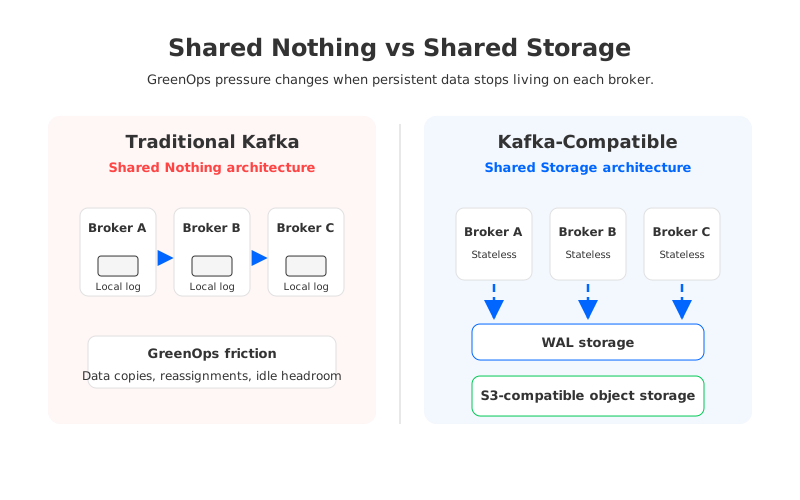
Traditional Kafka uses a Shared Nothing architecture. Each broker owns local storage for its partitions, and durability is achieved through replication between leader and follower replicas. This model is coherent, widely understood, and supported by a mature ecosystem. It also means that storage, compute, and failure recovery are tightly connected. When a broker owns partition data, changing compute capacity is rarely a pure compute operation.
That coupling shows up in several GreenOps failure modes:
- Broker-local storage turns retention into capacity reservation. Longer retention can require larger disks, more headroom, and slower recovery procedures even when the hot workload is not growing.
- Replication turns durability into repeated writes. Replicas are necessary in the traditional model, but they also multiply storage and network activity across the cluster.
- Partition reassignment turns scaling into data movement. Adding brokers can reduce pressure, but moving partitions has to be planned, throttled, monitored, and recovered if something fails.
- Cross-AZ topology turns placement into a billing and resource problem. Cloud providers document storage, requests, and data transfer as separate meters, so the architecture must explain which paths cross boundaries.
Tiered Storage changes part of this picture. Apache Kafka’s Tiered Storage, based on KIP-405, can move older log segments to remote storage while keeping the local log as the active path. That is useful when long retention is the main pressure and historical reads are limited. It does not make brokers stateless, and it does not automatically remove hot-path replication, operational rebalancing work, or every cross-zone network path. For GreenOps, Tiered Storage is a retention tool, not a complete operating model.
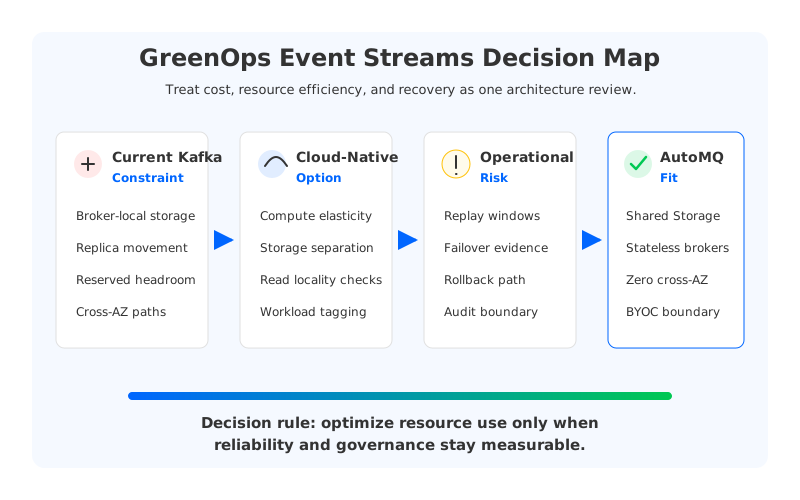
The production constraint is therefore not “Kafka uses too many resources.” That statement is too broad to act on. The real constraint is that traditional Kafka makes several resource decisions together: how much data is retained, where that data lives, which broker serves it, how failure recovery works, and how much data must move when the platform changes shape. A GreenOps review has to separate those decisions before it can optimize them.
3Architecture Options and Trade-offs
A serious evaluation should start with neutral options. Keeping the current Kafka architecture and improving governance is a valid path when workloads are stable, retention is modest, consumers are close to brokers, and the operations team already has strong automation. In that model, GreenOps work focuses on topic lifecycle management, compression, quota enforcement, client placement, lag monitoring, and better tagging between cloud cost and Kafka usage. This is often the lowest-risk first step because it improves evidence without forcing a platform change.
A managed Kafka service can reduce operational burden, but it does not automatically answer the GreenOps question. The service boundary may move patching, broker replacement, and some scaling workflows away from the customer team. The underlying cost model still depends on throughput, retained data, networking, private connectivity, connectors, support, and workload shape. For regulated or data-sensitive environments, the team also has to review where the data plane runs, who can access it, how logs and metrics are handled, and whether procurement convenience changes compliance obligations.
A Kafka-compatible Shared Storage architecture takes a different approach. Brokers continue to handle Kafka protocol work, leadership, caching, and request processing, while durable data is stored in shared object storage through a streaming storage layer. The architectural promise is not that resources become free. The promise is that compute and storage can be scaled, recovered, and reasoned about separately. That separation is the point GreenOps teams should test.
The trade-off is that “object storage backed” is not enough. Object storage has different latency, request, and consistency characteristics from local disks. A streaming platform needs a WAL (Write-Ahead Log) layer for durable low-latency writes, caching for tailing reads and catch-up reads, metadata management, compaction, and clear failure semantics. Platform teams should ask how the write path behaves, how reads are served, how recovery is proven, and how the system keeps Kafka clients and operational tools compatible.
4Evaluation Checklist for Platform Teams
The most useful GreenOps review is a checklist that connects architecture to evidence. It should be specific enough for SRE, FinOps, security, and application teams to discuss the same workload without collapsing into vendor preference.
| Dimension | What to ask | Evidence to collect |
|---|---|---|
| Compatibility | Can current producers, consumers, transactions, offsets, Kafka Connect jobs, and observability tools keep working? | Client versions, protocol requirements, connector inventory, staged test results. |
| Cost and resource model | Can the team attribute write load, read fan-out, replay, retained bytes, and network paths separately? | Cloud tags, broker metrics, topic inventory, retention policy, and billing exports. |
| Elasticity | Can compute capacity change without a large data movement project? | Scale-out tests, reassignment behavior, recovery objectives, and runbook timing. |
| Governance | Does the deployment boundary match security, audit, IAM, encryption, and data residency requirements? | Architecture diagram, access review, logging policy, and customer data boundary. |
| Failure recovery | What happens when a broker, zone, storage path, or migration step fails? | Failure drills, rollback criteria, offset validation, and replay tests. |
This table keeps the conversation honest. A platform can look efficient in a spreadsheet and still create operational waste if every resize requires a maintenance window. Another platform can look flexible but fail the governance review if the data boundary is wrong. GreenOps should not reward the architecture that hides resources from the bill; it should reward the architecture that makes resource use measurable and controllable.
5How AutoMQ Changes the Operating Model
Once that framework is in place, AutoMQ becomes relevant as a Kafka-compatible, cloud-native streaming platform built around Shared Storage architecture. It keeps the Kafka API and ecosystem model while replacing broker-local log storage with S3Stream, WAL storage, data caching, and S3-compatible object storage. In operational terms, AutoMQ Brokers are stateless brokers: they process Kafka traffic, but durable data is not tied to their local disks.
That changes the GreenOps model in a practical way. Storage growth is handled in object storage rather than by expanding broker-local disks. Broker replacement is not the same as rebuilding local partition data. Partition reassignment can focus on ownership and traffic placement rather than bulk data copy. Compute can be scaled more independently from retained data, which is important when demand is bursty, retention is long, or replay-heavy consumers appear after incidents.
AutoMQ also targets the cloud-specific waste that Kafka teams often discover late. Its documentation describes Zero cross-AZ traffic, Shared Storage architecture, WAL storage options, Self-Balancing, seconds-level partition reassignment, and Kafka compatibility. AutoMQ BYOC keeps the control plane and data plane inside the customer’s cloud account and VPC, which matters when GreenOps work is tied to security review, procurement boundaries, and operational control. AutoMQ Software applies the same product boundary to customer-operated private environments.
This is still an engineering decision, not a shortcut. A team evaluating AutoMQ should test producer latency, consumer fetch behavior, replay throughput, connector tasks, offset continuity, failure recovery, monitoring, and rollback. The difference is the unit of evaluation. Instead of asking whether a bigger broker can carry more local state, the team can ask whether a Shared Storage architecture lets the platform add compute, preserve Kafka behavior, and avoid resource waste created by broker-local durability.
6A Readiness Scorecard for GreenOps Migration
Before changing platforms, score one production-like workload. Choose a topic family that has real retention, multiple Consumer groups, at least one replay scenario, and a clear owner. A toy workload will make every architecture look clean. A useful workload will expose the places where cost, reliability, and governance compete.
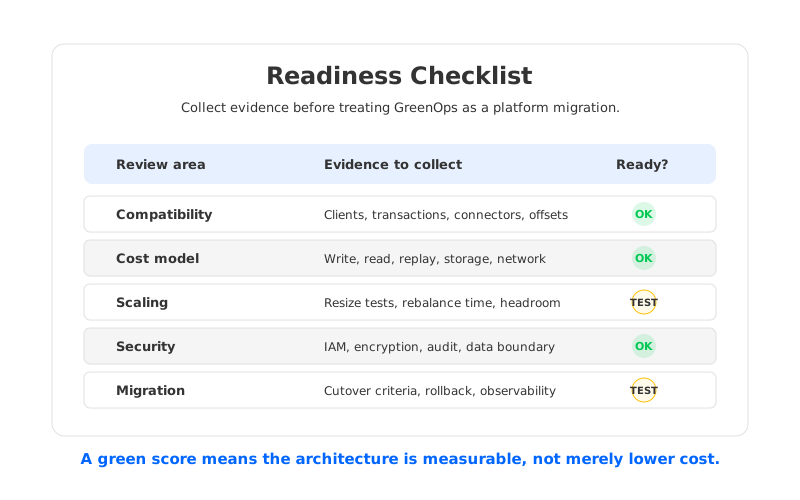
Use a simple red, yellow, and green score:
- Green means evidence exists and the team has tested it.
- Yellow means the design is plausible but one dependency, runbook, or approval is incomplete.
- Red means the migration would rely on hope rather than proof.
The scorecard should cover compatibility, cost attribution, elasticity, security, migration, rollback, and observability. Compatibility includes client versions, transactions, Consumer group offset behavior, Kafka Connect, Schema Registry, and operational tools. Cost attribution includes retained bytes, continuous reads, replay reads, cross-AZ paths, object storage requests, and engineering time. Security includes IAM, encryption, audit access, private networking, and customer data boundaries. Rollback includes the exact criteria for stopping, reversing, or delaying cutover.
This exercise often changes the conversation. GreenOps stops being a request to “reduce Kafka cost” and becomes a set of architecture decisions that can be tested. Some teams will find that disciplined operations on their existing Kafka deployment are enough. Others will find that the root cause is the storage model, and that a Kafka-compatible Shared Storage architecture deserves a proof of concept.
7FAQ
7.1What does GreenOps mean for Kafka event streams?
GreenOps for Kafka means reducing unnecessary compute, storage, network, and operational resource use while preserving reliability, security, and recoverability. It is broader than cost cutting because it asks whether the streaming architecture avoids waste by design.
7.2Is GreenOps the same as Kafka cost optimization?
No. Kafka cost optimization focuses on spend. GreenOps includes spend, but it also looks at resource efficiency, carbon-aware operations, idle capacity, data movement, and the operational work required to keep the platform reliable.
7.3Does Tiered Storage solve GreenOps for Kafka?
Tiered Storage helps when long retention is the main source of broker disk pressure. It does not make brokers stateless, and it does not automatically remove hot-path replication, read fan-out pressure, cross-AZ paths, or data movement during scaling.
7.4When should teams evaluate a Kafka-compatible Shared Storage architecture?
Evaluate Shared Storage architecture when storage growth, replay-heavy consumers, slow partition reassignment, cross-AZ traffic, or broker recovery becomes part of the GreenOps conversation. The strongest signal is a workload where compute and retained data need to scale independently.
7.5How should a team start without creating migration risk?
Start with one high-value topic family and build an evidence pack: client compatibility, retained bytes, read fan-out, replay behavior, network paths, failure tests, and rollback criteria. Then compare the existing architecture against a Shared Storage option using the same workload.
The search that started with greenops event streams kafka should end with an architecture review, not a slogan. If your team wants to test a Kafka-compatible Shared Storage model inside your own cloud boundary, start with the AutoMQ Cloud Console and run the scorecard above against one production-like workload.
8References
- Green Software Foundation: What is green software?
- Apache Kafka documentation
- Apache Kafka Tiered Storage
- Apache Kafka Connect documentation
- AutoMQ compatibility with Apache Kafka
- AutoMQ architecture overview
- AutoMQ WAL storage
- AutoMQ eliminate inter-zone traffic
- AWS EC2 On-Demand pricing: data transfer
- Amazon S3 pricing


