
Table of Contents
Table of Contents
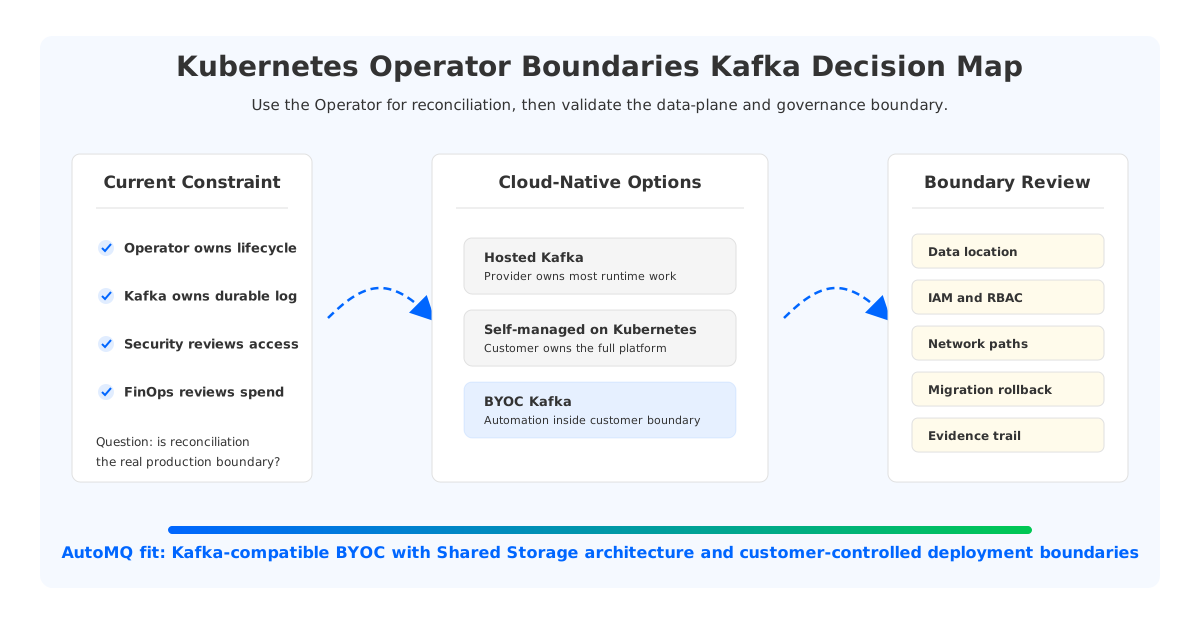
Teams usually search for kubernetes operator boundaries kafka after a platform conversation has become awkward. The application team wants Apache Kafka to behave like the rest of the Kubernetes platform: declared in YAML, reconciled by an Operator, upgraded through GitOps, observed through the same dashboards, and governed by the same admission and policy controls. The security team asks a different question: if the Operator can create brokers, attach storage, open listeners, rotate credentials, and trigger upgrades, where does the Kafka responsibility boundary sit?
That question is not a complaint about Operators. Kubernetes Operators are useful because they turn operational knowledge into reconciliation logic. The problem is that Kafka is not only a set of pods. It is a durable log, a networked client surface, a storage system, a governance target, and an ecosystem anchor for producers, consumers, connectors, schemas, offsets, and transactions. Once those concerns are in scope, the decision becomes "Which operating model gives us the right boundary for production streaming?"
The answer is not always BYOC. Hosted Kafka can be the right fit when the organization wants provider-owned operations, when the data-plane boundary is acceptable, and when platform teams do not need deep control over cloud resources. Self-managed Kafka on Kubernetes can also work when a team has the operational depth to own storage, upgrades, balancing, and incident response. BYOC enters the shortlist when the Operator boundary is too narrow for the real review: data location, cloud account ownership, IAM, network paths, durable storage, evidence collection, migration control, and cost accountability.
1Why Teams Search for kubernetes operator boundaries kafka
Kafka-on-Kubernetes projects often begin with a reasonable goal: reduce bespoke infrastructure work. If databases, batch jobs, stream processors, and internal services already use Kubernetes patterns, Kafka looks like another stateful workload that should fit the same control plane. A custom resource can describe topics, listeners, storage, replicas, certificates, and rolling upgrades. The Operator can reconcile drift and hide some of the manual work that made earlier Kafka operations painful.
The pressure appears when the cluster becomes shared infrastructure. A production Kafka platform is rarely owned by one application. It serves many teams, and each team brings different requirements for client identity, topic lifecycle, retention, consumer group behavior, connector runtime, audit trails, and change windows. Kafka clients also depend on stable bootstrap endpoints, partition leadership behavior, offset continuity, and transactional guarantees. These are not Kubernetes concerns by default, even when the brokers run inside Kubernetes.
Platform teams then face two overlapping boundaries. The first is the Kubernetes boundary: namespaces, service accounts, RBAC, node pools, storage classes, network policies, and custom resources. The second is the Kafka boundary: topics, partitions, leaders, offsets, consumer groups, retention, replication, transactions, Connect workers, and client compatibility. When those boundaries do not align, the Operator can successfully reconcile pods while the streaming platform still fails the enterprise review.
2The Production Constraint Behind the Problem
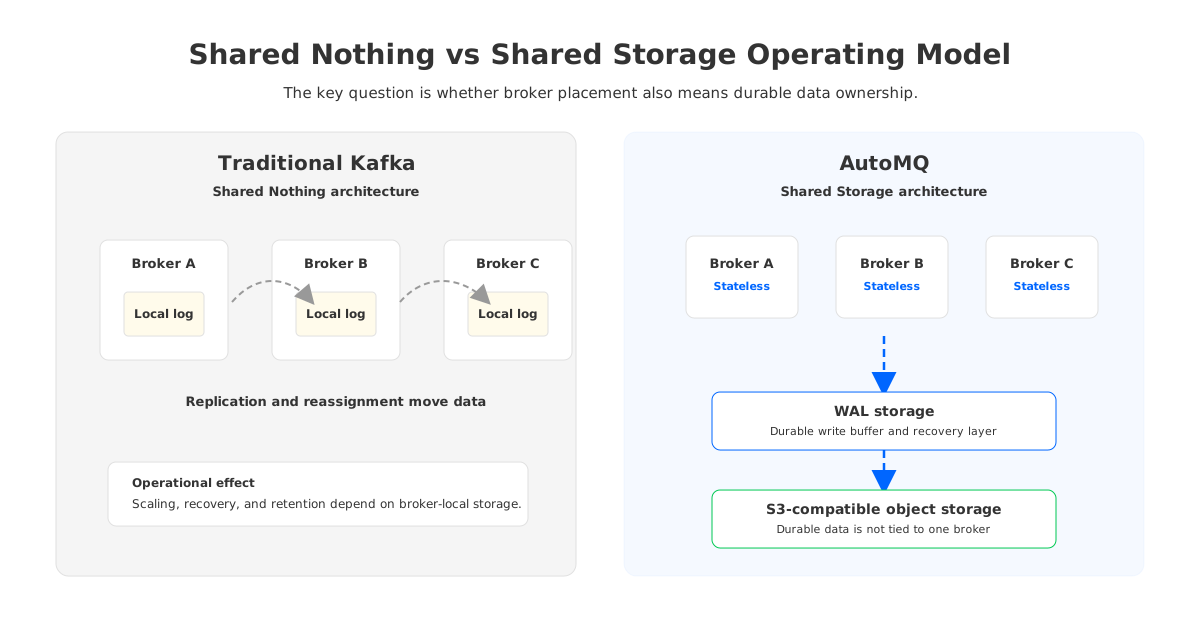
Traditional Kafka stores partition data on broker-local disks and relies on replication between brokers for durability and availability. That Shared Nothing architecture made sense in environments where servers owned their disks and horizontal scale came from adding more brokers. In the cloud, the same model makes storage, compute, and network decisions harder to separate. A broker is not only compute capacity; it is also a data owner.
That ownership shape matters in Kubernetes. Scaling a broker set is not the same as scaling a stateless deployment. Moving partitions can mean moving large amounts of data. Replacing a node can involve local volume attachment, recovery, replication catch-up, and leadership movement. Expanding retention can force storage planning rather than only policy planning. A Kubernetes Operator can automate parts of that lifecycle, but it cannot remove the architectural coupling between broker placement and durable data.
The cost model follows the same pattern. A multi-AZ Kafka design often pays for compute, persistent storage, storage I/O, load balancers, private connectivity, and inter-zone networking. Cloud pricing pages treat those resources separately, while Kafka teams experience them as one cluster. If the architecture requires replicas to move data between failure domains, a YAML-level change can still become a cloud bill or quota discussion.
This is why Operator boundaries become procurement boundaries. A security review asks who can access the runtime, what data can leave the account, which keys protect durable data, how support access is controlled, and how evidence is retained. A FinOps review asks which resources are committed, which are elastic, which network paths are billable, and which costs sit on the provider invoice instead of the customer's cloud invoice. A platform review asks who owns incidents when Kubernetes is healthy but Kafka is rebalancing, lagging, or recovering.
3Architecture Options and Trade-Offs
The useful comparison starts with operating models, not product names. Each model can be correct under the right constraints, and each model can fail when chosen for the wrong reason.
| Operating model | What the team gets | Boundary risk to inspect |
|---|---|---|
| Hosted Kafka | Provider-owned infrastructure and reduced day-to-day operations | Data-plane location, private connectivity, support access, cost visibility, and exit controls |
| Self-managed Kafka on Kubernetes | Maximum local control and familiar Kubernetes automation | Storage operations, rebalancing, upgrades, on-call depth, and broker-local data movement |
| Cloud-provider managed Kafka | Cloud procurement alignment and managed broker operations | Service limits, feature coverage, region support, networking charges, and migration flexibility |
| BYOC Kafka | Managed-style operations with runtime resources in the customer's cloud environment | Shared responsibility, Operator permissions, telemetry scope, upgrade approval, and cloud resource governance |
The table is deliberately neutral. Hosted Kafka reduces operational load, and for many teams that is the main goal. Self-managed Kafka gives deep control, but control has a payroll and incident cost. Cloud-provider managed Kafka can simplify purchasing inside one cloud. BYOC is useful when the organization wants provider automation without moving the streaming runtime away from its own cloud boundary.
The hard part is that Kubernetes does not make this choice for you. A Kafka Operator can standardize installation, enforce configuration drift control, and automate rollouts. It does not decide whether the durable log should live on broker-local storage, shared object storage, or a provider-operated environment. It does not decide whether support access should terminate in your VPC, whether telemetry can leave the environment, or whether private endpoints and object storage policies satisfy your audit model.
4Evaluation Checklist for Platform Teams
A practical review should separate "Can this run?" from "Can we own the boundary?" The first question is a deployment test. The second is a production design review. The difference matters because Kafka failures often show up at the edge of systems: client retries during broker changes, consumer groups after a migration, connector offsets during cutover, or storage pressure during retention growth.
Use these questions before choosing the model:
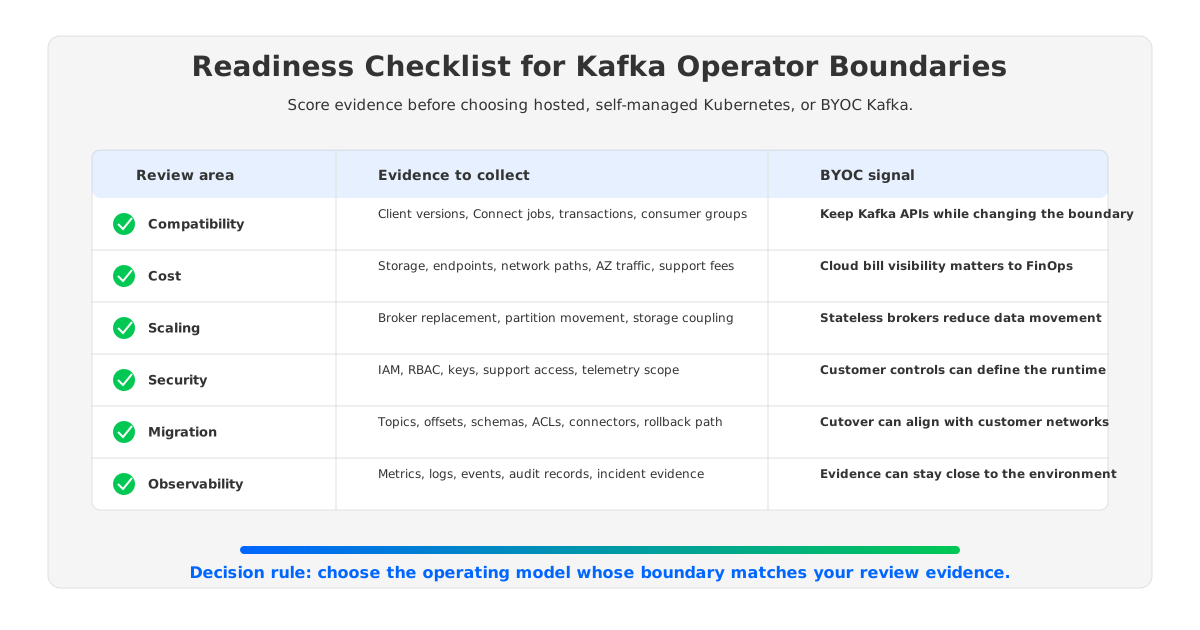
- Compatibility: Can existing producers, consumers, Kafka Connect workloads, transactions, consumer groups, and offset tooling move without application rewrites? A Kafka-compatible platform should be tested against the clients and operational tools that already run in production.
- Storage ownership: Where does durable Kafka data live, who owns the bucket or volume, which keys protect it, and what happens during broker replacement? Storage design is the core difference between a pod lifecycle and a streaming platform lifecycle.
- Network boundary: Which clients reach the cluster, which paths cross VPC, VNet, account, region, or Availability Zone boundaries, and which of those paths are billable? Private connectivity is not the same as customer-owned runtime.
- Operator permissions: What can the Operator create, modify, delete, or observe? Security teams should review cloud IAM, Kubernetes RBAC, secret access, upgrade permissions, and emergency access separately.
- Elasticity and rebalancing: Does scaling add compute capacity, move data, or both? If scaling requires heavy partition movement, automation may hide the workflow without eliminating the operational risk.
- Migration and rollback: How will topics, offsets, schemas, connectors, ACLs, client endpoints, and monitoring move? A migration plan that only copies records leaves too much unresolved.
- Observability and evidence: Which metrics, logs, events, audit records, and support traces are available to the customer? Evidence matters most when a shared platform has to pass review after an incident.
The checklist tends to reveal a pattern. If the main goal is to stop running infrastructure and the external service boundary is acceptable, hosted Kafka remains attractive. If the main goal is to keep runtime resources, data, keys, and cloud evidence in the customer's environment while still reducing manual operations, BYOC deserves a serious review. If the main goal is maximum autonomy and the team has Kafka operations depth, self-managed Kubernetes may remain the right answer.
5How AutoMQ Changes the Operating Model
Once the evaluation reaches storage ownership and scaling behavior, AutoMQ becomes relevant as a Kafka-compatible cloud-native streaming platform built around a Shared Storage architecture. The important shift is not that Kafka runs under a different dashboard. The shift is that brokers do not act as long-term owners of partition data.
AutoMQ preserves the Kafka protocol and client-facing semantics while replacing broker-local log storage with S3Stream, a storage layer backed by object storage and a WAL (Write-Ahead Log). In this model, data is durably written through WAL storage and then stored in S3-compatible object storage. Brokers mainly handle Kafka protocol processing, request routing, leadership, caching, and scheduling. Because durable data is not bound to broker-local disks, brokers can be treated closer to replaceable compute nodes.
That difference changes the meaning of a Kubernetes Operator boundary. The Operator can still manage lifecycle tasks, but broker replacement and scaling no longer imply the same volume of partition data movement. Self-Balancing and seconds-level partition reassignment become possible because the system is changing ownership and traffic placement more than it is copying large local logs. For platform teams, this makes the Kubernetes control plane a better fit for the actual data-plane architecture.
AutoMQ BYOC applies that architecture inside the customer's cloud environment. Both the control plane and data plane are deployed in the customer's cloud account or VPC, and customer data remains within the customer's environment. That model helps security and procurement teams reason about cloud IAM, private networking, object storage policies, encryption keys, observability, and support access using familiar controls. It also keeps the infrastructure bill visible in the customer's own cloud account, which can matter when storage retention, cross-AZ traffic, endpoint design, and data lake integration all affect cost.
AutoMQ Software addresses a different boundary: private data centers and customer-operated environments. The same distinction still applies. Teams that cannot place the streaming runtime in an external hosted service can keep the control plane and data plane inside their own environment while using a Kafka-compatible Shared Storage architecture. The product choice should follow the boundary requirement, not the other way around.
6Readiness Scorecard Before You Decide
A lightweight scorecard can keep the decision from collapsing into a vendor comparison. Score each area as green, yellow, or red, and require evidence for every green answer. The goal is not to make BYOC win by default; the goal is to make the operating boundary explicit before production traffic depends on it.
| Review area | Hosted Kafka is usually enough when... | BYOC becomes stronger when... |
|---|---|---|
| Data control | The provider-operated data plane satisfies policy | Runtime data, keys, and storage must stay in the customer's environment |
| Kubernetes fit | Kubernetes is only a client or connector platform | Kubernetes is part of the approved operations boundary |
| Cost accountability | A provider invoice is acceptable | Cloud resource ownership and cost attribution must stay visible |
| Scaling | Workload growth is predictable or provider-managed | Elastic capacity and low-friction broker replacement are core requirements |
| Migration | Applications can tolerate endpoint and platform changes | Offset continuity, rollback, and ecosystem compatibility need tighter control |
| Audit | Provider evidence satisfies the review | Customer-side cloud logs, IAM, and storage evidence are required |
The most expensive Kafka decision is not choosing the wrong feature set. It is choosing the wrong boundary and discovering it during an audit, migration, incident, or renewal. Kubernetes Operators are valuable when they automate a boundary the organization already accepts. When the real requirement is customer-owned runtime, customer-owned data storage, and cloud-native elasticity, the evaluation has to move beyond Operator mechanics and into the deployment model itself.
If your team is reviewing Kafka platform boundaries for a Kubernetes-heavy environment, evaluate AutoMQ BYOC with your own cloud account, IAM model, networking requirements, and migration constraints: talk to the AutoMQ team.
7FAQ
7.1Is a Kubernetes Operator enough for production Kafka?
It can be, but only if the broader Kafka operating boundary is acceptable. The Operator can automate deployment and lifecycle tasks, while production readiness still depends on storage architecture, client compatibility, rebalancing behavior, security controls, observability, and incident ownership.
7.2Is BYOC Kafka the same as self-managed Kafka on Kubernetes?
No. Self-managed Kafka means the customer owns most operational work. BYOC Kafka means the runtime resources run in the customer's environment while the provider supplies software, automation, lifecycle management, and support under a shared responsibility model.
7.3When should hosted Kafka remain the preferred choice?
Hosted Kafka is a strong fit when speed, provider-owned operations, and reduced infrastructure responsibility matter more than customer-side data-plane ownership. It is also a good fit when security, procurement, and audit teams accept the external service boundary.
7.4What should security teams ask about a Kafka Operator?
They should ask what the Operator can read or change, which secrets it can access, which cloud resources it can create, how upgrades are approved, what telemetry leaves the environment, how support access works, and how actions are audited.
7.5How does Shared Storage architecture affect Kubernetes operations?
Shared Storage architecture reduces the amount of durable data tied to an individual broker. That makes broker replacement, scaling, and partition reassignment less dependent on large broker-local data movement, which aligns better with Kubernetes-style compute lifecycle management.


