
Table of Contents
Table of Contents
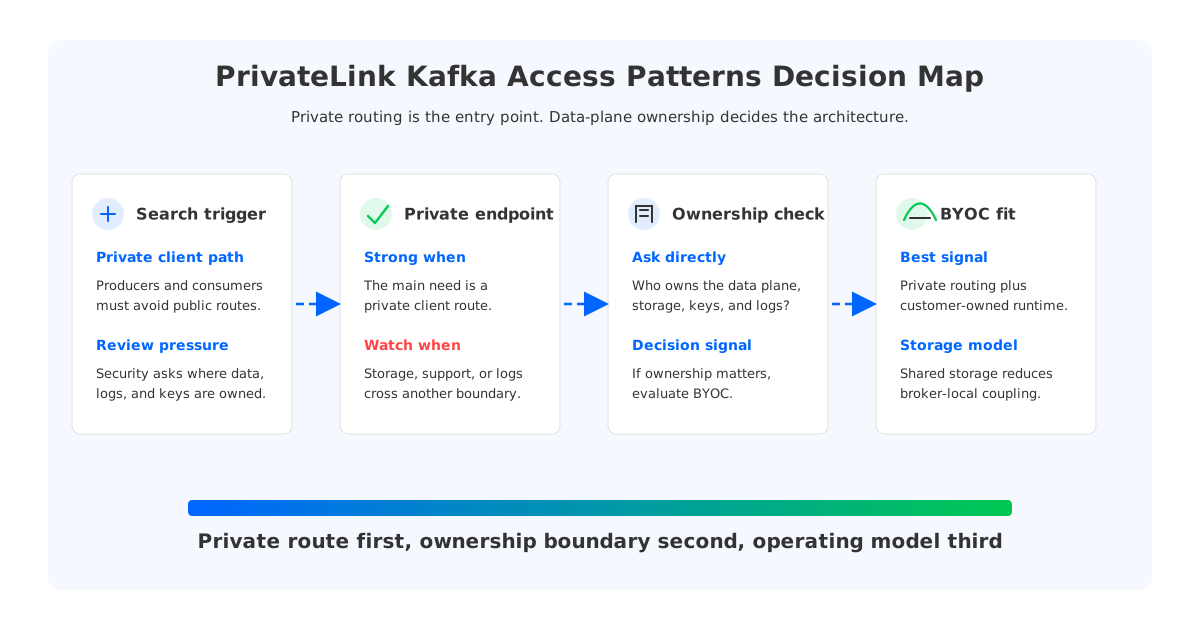
Teams search for privatelink kafka access patterns when a Kafka decision has become a security boundary decision. The first question may sound narrow: how should producers and consumers reach a Kafka endpoint without crossing the public internet? The real question is broader: whether private connectivity to a hosted service is enough, or whether the Kafka data plane should run inside the customer's own cloud account.
That distinction matters because PrivateLink-style connectivity protects one route, not the full operating model. A private endpoint can hide the client path from the public internet while the durable log, broker recovery path, observability export, support workflow, and cloud bill still sit across a provider boundary. For low-risk streams, that may be exactly the right trade-off. For regulated, high-volume, or procurement-sensitive streaming platforms, the endpoint is usually where the review starts, not where it ends.
1Why teams search for privatelink kafka access patterns
Private connectivity for Kafka usually appears late in an architecture review, after teams have already assumed that a managed service will reduce operational work. Then the security review turns concrete. Which VPC owns the endpoint? Which account owns the brokers? Where do records sit after a produce request is acknowledged? Can flow logs, endpoint policies, encryption keys, and audit evidence be reviewed by the customer without asking the provider for screenshots?
Kafka makes this harder than many application services because the bootstrap endpoint is not the whole service. Clients connect to a bootstrap server, receive broker metadata, cache endpoint information, authenticate, and then produce or consume from partition leaders. Consumer groups keep progress through offsets. Transactions and idempotent producers add more continuity requirements. A private route that works during a happy-path test can still fail during broker replacement, DNS rotation, certificate renewal, or a controlled migration.
The search term is therefore a proxy for three concerns that often collide in production:
- Application access: producers, consumers, stream processors, and connectors need predictable private Kafka API connectivity.
- Data ownership: durable event data, metadata, logs, and object storage need to sit in a boundary that satisfies governance and procurement.
- Operational evidence: security teams need proof that routing, identity, encryption, support access, and incident actions match the approved design.
When those concerns stay separate, teams can approve a private endpoint while leaving the storage and operating boundary vague. That is the mistake. PrivateLink-style access patterns should be evaluated as part of the Kafka platform boundary, not as a network feature bolted onto the end.
2The production constraint behind the problem
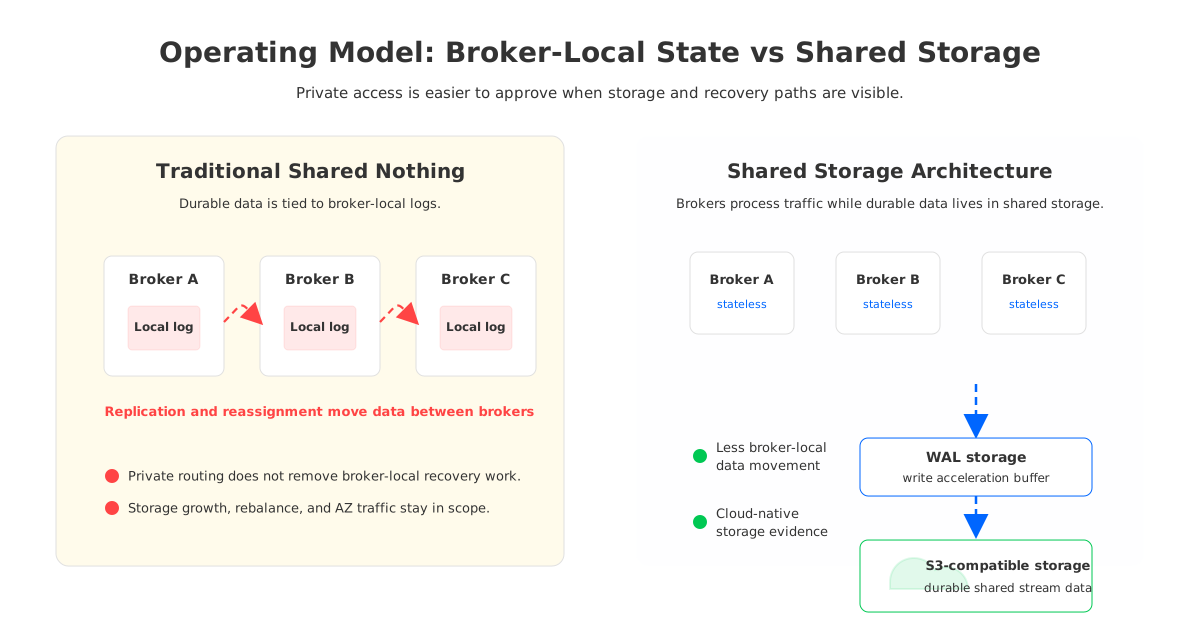
Traditional Apache Kafka uses a Shared Nothing architecture. Each broker owns local log segments for the partitions it hosts, and durability comes from replication between brokers. This model is proven and well understood, but it ties network design to broker-local storage. When brokers fail, scale out, rebalance, or move partitions, the platform may need to move data between brokers and Availability Zones (AZs), not merely reroute clients.
That storage model changes the private-access review. If the Kafka cluster is self-managed in the customer's VPC, the customer can control subnets, security groups, keys, and routing, but the operations team inherits partition reassignment, disk sizing, replication health, and failure recovery. If the cluster is hosted elsewhere, PrivateLink-style connectivity can simplify client access while leaving the provider-operated data plane outside the customer's resource boundary. Neither choice is wrong by default. The risk comes from approving one layer while assuming the other layers follow.
The better framing is to separate access from ownership. PrivateLink, Azure Private Link, and Google Private Service Connect are excellent tools for private service access. They describe how clients reach a service through private networking primitives. BYOC describes where the service runs and who owns the cloud resources around it. A Kafka platform review needs both dimensions because Kafka is not a stateless API endpoint; it is a storage-backed streaming system with clients, brokers, offsets, metadata, connectors, logs, and recovery behavior.
3Architecture options and trade-offs
Most teams compare three patterns. The first is self-managed Kafka in a customer VPC. It gives direct control over network, identity, keys, storage, and logs, which security teams often prefer. The trade-off is operational weight. Platform teams must handle upgrades, broker replacement, partition reassignment, storage growth, hot partition diagnosis, and recovery drills. For organizations with deep Kafka operations experience, that may be acceptable. For teams trying to reduce platform toil, self-management can turn every private-network win into an operations backlog.
The second pattern is hosted Kafka with private connectivity. This can be a good fit when the organization wants managed operations and the data risk allows a provider-operated data plane. The main benefit is speed: teams can connect applications through private endpoints while relying on the provider for platform operations. The review needs to stay precise. Private connectivity does not automatically answer where data is stored, which logs the customer can inspect, how provider support access is governed, or how cross-account networking behaves during incidents.
The third pattern is BYOC Kafka, where runtime resources are deployed in the customer's cloud account or VPC while the vendor supplies software, automation, lifecycle management, or operational support. BYOC is not a magic compliance label. It still requires a responsibility model, IAM design, upgrade plan, evidence trail, and emergency access process. Its advantage is that the review can use the customer's existing cloud controls: VPC flow logs, object storage policies, endpoint policies, encryption keys, private DNS, audit logs, and procurement workflows.
The decision becomes clearer when the team maps each pattern against the same questions:
| Question | Hosted Kafka with private access | BYOC Kafka |
|---|---|---|
| Client path | Private endpoint to provider-operated service | Private endpoint or VPC-local access inside customer boundary |
| Data plane ownership | Provider-operated boundary | Customer cloud account or VPC boundary |
| Storage evidence | Depends on provider reports and contractual controls | Can align with customer-owned object storage, keys, logs, and policies |
| Operations burden | Lower for the customer | Shared through software automation and customer-side governance |
| Security review focus | Provider controls, network path, and support access | Cloud permissions, runtime boundary, and operating responsibility |
| Migration risk | Client endpoint and feature compatibility | Client endpoint, resource provisioning, and lifecycle ownership |
The table does not crown one pattern. It exposes the trade-off. Hosted Kafka with private access can be the right answer when operations reduction matters more than resource ownership. BYOC becomes the stronger fit when PrivateLink-style access is part of a larger requirement: keep the streaming runtime, durable data, cloud controls, and audit evidence in the customer's environment.
4Evaluation checklist for platform teams
The most useful review artifact is a path map. Pick one producer, one consumer group, one connector, one administrator, one monitoring export, one broker replacement scenario, and one support action. Trace each path across accounts, VPCs, subnets, endpoints, DNS records, certificates, IAM roles, Kafka principals, object storage, and logs. If the team cannot draw the path, it cannot approve the path.
Use this checklist before selecting a deployment pattern:
- Define the private boundary with cloud primitives. Name the account, region, VPC, subnet classes, endpoint policies, security groups, private hosted zones, IAM roles, and encryption keys that apply to Kafka.
- Separate bootstrap access from broker metadata. Kafka clients discover brokers after bootstrap. Validate private DNS, advertised listeners, certificate names, and client behavior during endpoint rotation.
- Trace durable storage and recovery. Include broker-local disks, WAL storage, object storage, backups, partition reassignment, catch-up reads, and failover flows. Private client access does not prove private recovery behavior.
- Bind network access to Kafka authorization. SASL, mTLS, and Kafka ACLs should map principals to topics, consumer groups, transactional IDs, and administrative actions. Network controls reduce exposure; they do not replace Kafka permissions.
- Review observability and support paths. Metrics, logs, audit trails, maintenance actions, and emergency support access need the same rigor as the client data path.
- Rehearse migration and rollback. Test endpoint changes, ACL parity, offset continuity, consumer group behavior, DNS rollback, monitoring, and incident escalation before production cutover.
This is where PrivateLink access patterns often turn into a procurement decision. A network team may be satisfied with endpoint design, while security asks who owns the data plane and finance asks which account carries storage, traffic, and marketplace charges. The architecture must be explainable to all three groups without changing vocabulary in each meeting.
5How AutoMQ changes the operating model
Once the requirement becomes Kafka-compatible streaming inside a customer-controlled operating boundary, the architecture needs more than private endpoints. It needs a storage model that reduces the amount of broker-local state tied to the network layout. AutoMQ is a cloud-native streaming platform that keeps Apache Kafka protocol compatibility while using a Shared Storage architecture to separate compute from storage.
In AutoMQ, brokers remain responsible for Kafka protocol handling, partition leadership, request routing, caching, and coordination. Durable stream data is written through S3Stream, which combines WAL (Write-Ahead Log) storage for write acceleration with S3-compatible object storage as the primary storage layer. The practical effect is that brokers are no longer permanent owners of all persisted partition data. Broker replacement, scaling, and reassignment become less dependent on moving large volumes of broker-local log segments.
That change matters for PrivateLink Kafka access patterns because the platform boundary becomes easier to describe. Client access can be designed through private networking. The durable storage path can be governed through customer-controlled object storage and encryption policies. The data plane can run in the customer's environment through AutoMQ BYOC, while AutoMQ Software addresses private data center deployments. The control plane and data plane responsibilities still need review, but the architecture gives security and platform teams a clearer way to separate access, storage, and operations.
AutoMQ BYOC is most relevant when hosted Kafka with private access leaves too many unanswered ownership questions. For example, a platform team may need Kafka API compatibility for existing applications, private connectivity for producers and consumers, customer-owned cloud resources for storage and logs, and a deployment model procurement can evaluate through the customer's cloud account. In that scenario, BYOC is not a preference for one acronym over another. It is a way to make the Kafka operating boundary match the risk boundary.
This does not remove the need for careful design. Teams still need to choose the right WAL storage option for latency and durability requirements, configure private networking, manage IAM permissions, plan observability, and rehearse migration. The difference is that the review starts from a cloud-native Kafka-compatible model rather than a broker-local storage model stretched across private endpoints.
6Decision scorecard before you commit
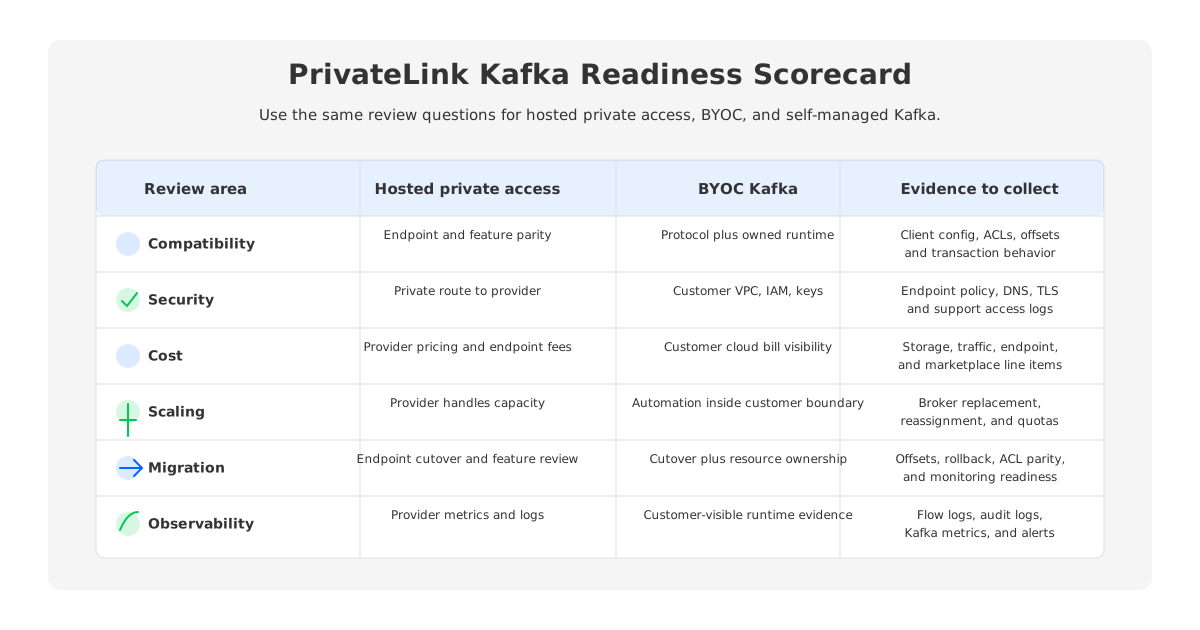
Before approving a hosted Kafka or BYOC design, score the architecture against the actual review pressure. A team that mostly needs private client connectivity can often use hosted Kafka with private access. A team that needs customer-side control over runtime resources, durable storage, encryption evidence, and operational logs should evaluate BYOC seriously. A team with specialized operations requirements and strong Kafka staff may still prefer self-managed Kafka, especially when vendor automation is not allowed.
The practical scorecard is simple:
| Review pressure | Hosted private access is often enough when... | BYOC becomes important when... |
|---|---|---|
| Client privacy | The main concern is avoiding public internet paths | Endpoint design must align with customer-owned runtime resources |
| Data residency | Provider-side controls satisfy the policy | Durable data, logs, and keys must remain in the customer account |
| Operations evidence | Provider reports and APIs satisfy audit needs | Flow logs, storage policies, IAM changes, and metrics must be customer-visible |
| Migration | Applications can tolerate endpoint and feature differences | Offset continuity, rollback, and Kafka compatibility need tighter control |
| Procurement | Contract review accepts provider-operated infrastructure | Procurement wants resource ownership, cloud billing alignment, and explicit boundaries |
PrivateLink-style access is a strong tool, but it is not a full Kafka architecture. The key question is whether private routes are enough, or whether the business also needs private control. When the answer is private control, the Kafka platform should be evaluated as a data-plane ownership problem, not merely a networking problem.
If your team is mapping private Kafka access, data ownership, and migration risk at the same time, start with the path map and scorecard above. When that review points toward Kafka compatibility plus customer-controlled cloud resources, talk to the AutoMQ team with your VPC, endpoint, storage, and governance requirements.
7FAQ
7.1Is PrivateLink the same as BYOC Kafka?
No. PrivateLink-style connectivity describes a private route to a service endpoint. BYOC describes a deployment boundary where runtime resources run in the customer's cloud account or VPC, depending on the platform architecture. Many teams evaluate both because private access and customer-side data control solve related but different problems.
7.2When is hosted Kafka with private access enough?
Hosted Kafka with private access is often enough when the organization mainly wants managed operations and private client connectivity, and the provider-operated data plane satisfies security, procurement, and audit requirements. The review should still cover data location, support access, observability exports, and failure behavior.
7.3Why does Kafka storage architecture affect private access design?
Kafka is a storage-backed streaming system. In traditional Shared Nothing architecture, brokers own local log data and replicate partitions for durability, so scaling, recovery, and reassignment affect network and storage planning. A Shared Storage architecture changes that operating model by moving durable data away from broker-local ownership.
7.4Where does AutoMQ fit in this decision?
AutoMQ fits when teams want Apache Kafka protocol compatibility, customer-controlled deployment boundaries through AutoMQ BYOC or AutoMQ Software, and a Shared Storage architecture that separates brokers from durable object storage. It should be evaluated alongside hosted Kafka with private access and self-managed Kafka, based on the team's governance and operations requirements.
8References
- Apache Kafka documentation
- Apache Kafka security documentation
- Apache Kafka KRaft documentation
- Apache Kafka Connect documentation
- AWS PrivateLink documentation
- Azure Private Link documentation
- Google Cloud Private Service Connect documentation
- AutoMQ architecture overview
- AutoMQ S3Stream overview
- AutoMQ BYOC environment overview


