
Table of Contents
Table of Contents
Searches for retention policy right sizing kafka rarely start as architecture exercises. They usually start with a topic that is growing faster than expected, a broker disk alert that keeps coming back, or a FinOps review asking why a Kafka cluster needs so much reserved storage for data that only a few teams may replay. The first instinct is to tune retention.ms, retention.bytes, compaction, segment size, and quota settings. Those controls matter, but they only answer the first half of the question: how long should Kafka keep data?
The harder question is where the cost and risk of that decision land. In traditional Kafka, retention is not an abstract policy attached to a topic. It becomes broker-local disk allocation, replica placement, rebalance duration, consumer recovery behavior, cross-Availability Zone (AZ) network traffic, and operational headroom. A policy that looks reasonable in a topic review can still be expensive when multiplied across partitions, replicas, cloud storage volumes, and failure scenarios. That is why retention right-sizing becomes an architecture problem before it becomes a configuration problem.
1Why teams search for retention policy right sizing kafka
Retention settings sit at the intersection of several teams that do not optimize for the same thing. Application teams want enough history to replay bad deployments, rebuild downstream state, or investigate incidents. Security and compliance teams want defined evidence windows and deletion behavior. Platform teams want predictable disks, stable brokers, and fewer emergency rebalances. FinOps teams want the bill to reflect actual usage rather than fear-driven overprovisioning.
Kafka gives you direct controls for time-based and size-based retention. A topic can retain records for a configured time window, a configured byte limit, or both. Log compaction can keep the latest value for each key when the workload is state-like rather than event-history-like. These are useful primitives, and Apache Kafka's configuration model documents them clearly. The problem is that real production estates rarely have one retention profile. They have audit topics, clickstream topics, transactional event topics, machine learning feature streams, observability topics, and connector offset topics, each with different replay expectations.
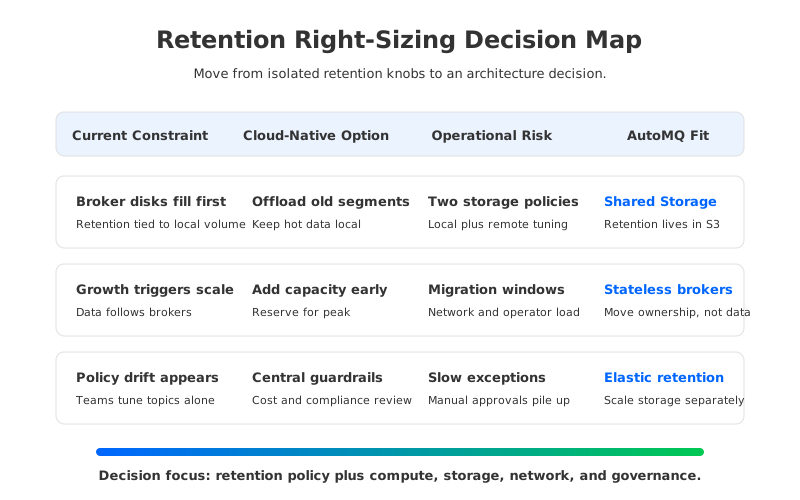
That variety creates a practical trap. If every team asks for the largest plausible replay window, the platform becomes a storage reservation system. If the platform team pushes retention down too aggressively, the business loses the ability to recover from downstream failures. The right answer is not "keep less data" or "buy more disk." The right answer is a decision model that separates workload need from infrastructure side effects.
2The production constraint behind the problem
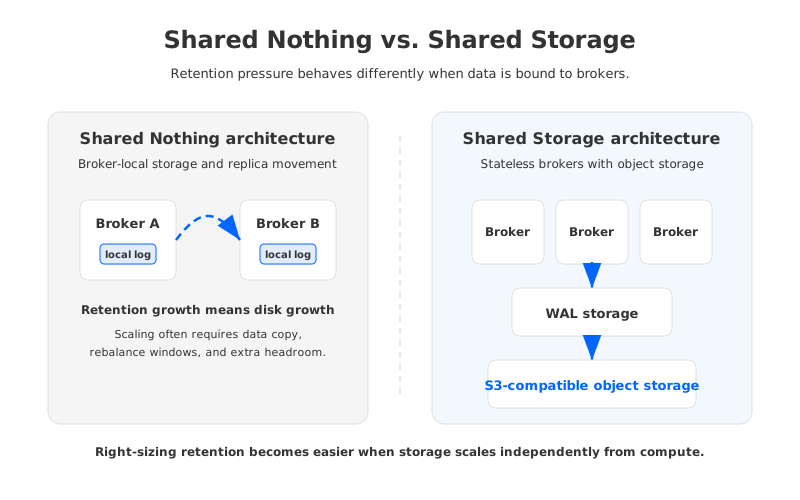
The production constraint is not retention itself. The constraint is the coupling between retention and broker ownership of data. Traditional Kafka uses a Shared Nothing architecture: each broker owns local log segments for the partitions assigned to it, and replication keeps additional copies across brokers for durability and availability. That design has served the Kafka ecosystem well because it gives strong locality and a clear operational model. It also means storage growth follows partition placement.
When retention grows, broker disks grow. When disks approach limits, operators add brokers, expand volumes, reduce retention, or rebalance partitions. Each option has a cost. Larger volumes can strand capacity on brokers that do not need it. More brokers add compute and network footprint even if the bottleneck is storage. Lower retention moves risk to application teams. Rebalancing can consume bandwidth and operator attention, especially when partitions carry large retained histories.
Tiered Storage changes part of this equation by moving older log segments to remote storage while keeping local storage for the active log. That is valuable for workloads where historical reads are occasional and local hot data still matters. It does not fully remove the architecture question, because operators still need to reason about local retention, remote retention, fetch behavior, metadata, and failure recovery. For retention right-sizing, Tiered Storage is a useful option, not an automatic escape from capacity planning.
This is why a retention review should start with the shape of demand rather than the current disk graph. A replay-heavy audit stream, a compacted state topic, and a high-throughput observability stream may all show up as "retention" in a ticket, but they stress the platform differently. One needs long durability with low read frequency. Another needs key-level history semantics. Another may need short retention with high ingest throughput. Treating them as one storage problem hides the trade-off.
3Architecture options and trade-offs
A useful evaluation framework compares options by operating model, not by feature names. Self-managed Kafka with broker-local disks gives maximum control, mature ecosystem behavior, and familiar tooling. Its trade-off is that retention growth remains coupled to broker storage and partition placement. Managed Kafka services reduce operational burden, but teams still need to understand how retention affects provisioned capacity, networking, regional availability, and the service's pricing model.
Tiered Storage sits between local-disk Kafka and a more deeply storage-separated architecture. It can reduce pressure from older segments, especially when long retention exists mainly for infrequent replay. The trade-off is operational duality: hot data and remote data have different performance paths, and teams need to validate restore, cold fetch, and tooling behavior. That may be the right compromise for many clusters, but it should be tested against actual replay and incident workflows rather than assumed from the presence of object storage.
Shared Storage architecture takes a different path. Instead of treating object storage as an archival tier behind broker-local logs, it makes shared object storage the durable storage layer and turns brokers into compute nodes that handle protocol, routing, caching, and scheduling. This can reduce the need to scale compute whenever retained data grows. It also changes recovery behavior: replacing a broker is less about moving its local data and more about reassigning ownership and traffic.
The decision is easier when the team scores each option against the same questions:
| Evaluation area | What to test | Why it matters for retention |
|---|---|---|
| Compatibility | Producers, consumers, transactions, compacted topics, Kafka Connect, stream processors, and ACL behavior | Retention changes are risky if client semantics change at the same time |
| Cost model | Compute, storage, cross-AZ traffic, operations, support, and reserved capacity | A lower storage unit price can be offset by compute or network side effects |
| Elasticity | Scale-out, scale-in, partition movement, and broker replacement behavior | Longer retention should not force slow data movement during every capacity event |
| Governance | Topic ownership, exception approvals, deletion policy, and audit needs | Teams need a durable policy process, not one-off ticket negotiation |
| Failure recovery | Broker loss, zone failure, replay from history, and cold read paths | Retention is valuable only if recovery drills prove it works |
| Migration risk | Offset continuity, dual-running, rollback, and connector behavior | A better target model still needs a controlled path from the current cluster |
This matrix prevents a common mistake: comparing a retention setting in one platform with an architecture in another. The fair comparison is the whole operating model that surrounds the setting. If a team can keep its current platform, reduce topic sprawl, enforce ownership, and right-size retention without changing architecture, that may be the most pragmatic path. If the repeated pain is storage-driven scaling, broker replacement, and cross-AZ data movement, the architecture itself deserves scrutiny.
4Evaluation checklist for platform teams
The checklist starts with inventory. List topics by purpose, owner, ingest rate, partition count, current retention, compaction mode, average replay frequency, and the largest replay window the business has actually used. The phrase "we may need 30 days" is not enough. Ask which incident, audit, model rebuild, or downstream outage requires that window, and what happens if recovery starts from a snapshot plus a shorter event history.
The second step is separating policy classes. Most Kafka estates can define a small number of retention tiers instead of negotiating every topic separately: short-lived operational streams, compacted state topics, business event history, audit evidence, and temporary migration or backfill topics. A small tier catalog gives application teams a menu while giving platform teams a capacity model they can forecast.
The third step is measuring side effects. Retention policy changes should be reviewed alongside disk utilization, broker skew, leader distribution, consumer lag, remote fetch behavior if applicable, and network traffic between AZs. If a proposed policy increases the retained bytes on a small set of hot partitions, it may create broker imbalance even when total cluster storage looks fine. If a policy extends retention for replay but no team monitors cold read latency or consumer catch-up time, the policy is only half designed.
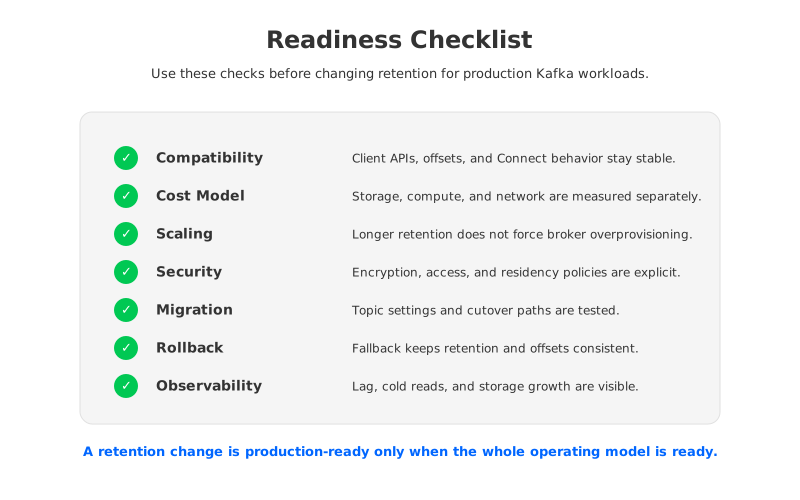
Before approving a major retention increase, the platform team should be able to answer these questions in plain language:
- Which workload needs the longer window, and what failure or audit scenario does it support?
- Which topics can use compaction, snapshots, or downstream storage instead of longer Kafka retention?
- What is the expected storage growth by topic tier, partition count, and replication model?
- What happens to broker replacement, scale-out, and rebalance time under the proposed retained data volume?
- What metrics will prove that the policy is working without creating hidden risk?
- What is the rollback path if the cost or recovery behavior does not match the plan?
This is also where procurement and architecture teams should align. A cloud Kafka TCO model that includes only broker instances and storage volumes is incomplete. Retention can drive object storage, block storage, data transfer, private connectivity, monitoring, backup, and human operations. It can also affect incident cost: long retention with untested replay is a comforting number, not a recovery capability.
5How AutoMQ changes the operating model
After that neutral evaluation, AutoMQ belongs in the discussion when the root issue is Kafka's broker-local storage model rather than the Kafka API. AutoMQ is a Kafka-compatible streaming platform that uses Shared Storage architecture, S3Stream, WAL storage, and stateless brokers to separate compute from durable storage. The application-facing contract remains Kafka-compatible, while the storage and scaling model changes underneath it.
That distinction matters for retention right-sizing. In a broker-local model, longer retention tends to increase the storage responsibility of specific brokers and the operational cost of moving partitions. In AutoMQ's Shared Storage architecture, durable stream data is stored in S3-compatible object storage, while brokers focus on Kafka protocol handling, cache, scheduling, and traffic ownership. WAL storage serves the hot write path before data is organized into object storage. The result is not "retention becomes free"; storage still costs money, and policy still needs governance. The change is that retention growth is less likely to force broker-local disk expansion as the primary response.
Stateless brokers also change the failure and scaling conversation. If a broker does not own irreplaceable local log data, replacing it or scaling the compute layer is a different operation than copying large retained logs between machines. AutoMQ documentation describes this as a stateless broker model, and its Self-Balancing capability is aimed at continuously redistributing traffic after scaling or load changes. For retention-heavy clusters, that can turn a capacity discussion from "how much data must move?" into "how should ownership and traffic be reassigned?"
Zero cross-AZ traffic is another retention-adjacent issue. Traditional replicated Kafka deployments often create cross-AZ traffic through replication and client access patterns. When retained data grows, those traffic patterns can become more expensive during rebalance, recovery, or replay events. AutoMQ's object-storage-backed design is built to reduce cross-AZ traffic in its data path, which is relevant when FinOps is evaluating not only stored bytes but the network movement caused by those bytes.
AutoMQ BYOC and AutoMQ Software are also relevant to governance boundaries. In BYOC, the data plane runs in the customer's cloud environment, which helps teams keep data, network, and cloud-account control aligned with internal policies. For teams evaluating retention through a compliance lens, that boundary can matter as much as the storage mechanics. The point is not that every Kafka estate should move platforms to tune retention. The point is that teams hitting the same storage-driven constraint every quarter should evaluate whether the underlying architecture is still the right fit.
6FAQ
6.1What is retention policy right-sizing in Kafka?
Retention policy right-sizing means choosing time-based, size-based, and compaction settings that match the business purpose of each topic while accounting for storage, recovery, governance, and cost. It is not only a topic configuration exercise, because the retained data affects brokers, replicas, scaling, networking, and operations.
6.2Should every topic have the same retention period?
No. A uniform retention period is straightforward to govern but usually wasteful. A better pattern is to define a small number of retention classes, map each topic to a class, and require explicit approval rationale for exceptions.
6.3Does Tiered Storage solve Kafka retention cost?
Tiered Storage can reduce pressure from older log segments by moving them to remote storage while keeping hot data local. It is useful, but teams still need to validate local retention, remote fetch behavior, recovery workflows, and the total cost model.
6.4When should retention right-sizing trigger an architecture review?
Start an architecture review when retention changes repeatedly force broker expansion, long rebalances, cross-AZ traffic surprises, complex exception handling, or uncomfortable trade-offs between recovery needs and platform stability. Those are signs that the storage model, not only the policy, is under pressure.
6.5How does AutoMQ help with retention-heavy Kafka workloads?
AutoMQ keeps Kafka compatibility while using Shared Storage architecture and stateless brokers. Durable data is stored in S3-compatible object storage, and compute can scale separately from storage. That can make retention planning less dependent on broker-local disk capacity and partition data movement.
7Closing thought
The next time a retention request appears, treat it as a design review rather than a number change. The policy should say how long data stays; the architecture should decide whether keeping that data creates avoidable pressure on brokers, networks, operators, and budgets. If your team wants to evaluate a Kafka-compatible shared-storage model for retention-heavy workloads, start with the AutoMQ Cloud Console and test the checklist against your own topic inventory.


