
Table of Contents
Table of Contents
Teams usually search for schema aware cdc kafka after a pipeline has already become important. A database change stream that once fed one analytics job is now feeding search indexes, fraud rules, customer dashboards, feature stores, and lakehouse tables. The connector still reads committed changes, and Kafka still stores ordered records, but the production question has changed: can the platform keep schema evolution, offsets, retention, security, and recovery aligned when the data contract keeps moving?
Schema-aware CDC is attractive because it promises a cleaner boundary between database changes and downstream consumers. Instead of treating every change event as opaque bytes, the platform understands the structure of the record, the schema version, the operation type, and often the relationship between a row-level change and a governed data product. That extra awareness can reduce consumer guesswork. It can also create a sharper failure mode: when schema compatibility, replay, or governance breaks, more teams are affected at once.
The useful framing is not "CDC tool versus streaming platform." A production CDC architecture has at least three contracts: the source database contract, the Kafka event contract, and the consumer replay contract. A schema-aware design only works when the platform beneath those contracts can absorb retention growth, catch-up reads, connector restarts, broker maintenance, and migration without turning every schema change into an incident.
1Why teams search for schema aware cdc kafka
The search query sounds specific, but the underlying pressure is broad. A platform team wants database changes in Kafka, but it does not want downstream systems to reverse-engineer table schemas forever. A data integration team wants schema validation and evolution rules, but it also needs to preserve source-system semantics such as primary keys, deletes, transaction order, and offsets. An SRE team wants lag and failure signals that mean something beyond "a connector task stopped."
Those pressures often appear in the same meeting. Application teams ask whether adding a nullable column will break consumers. Analytics teams ask whether a replay will use the historical schema or the latest schema. Security teams ask whether raw CDC topics expose fields that should be masked before broad consumption. Finance or platform leadership asks why retained Kafka data keeps growing even when the number of connectors looks modest.
A schema-aware CDC design should answer four questions before it becomes a shared service:
- What is the record contract? The platform needs a clear schema format, compatibility policy, delete representation, key model, and versioning process.
- What is the replay contract? Consumers need to know whether they can rebuild from raw CDC topics, curated topics, table outputs, or another source of truth.
- What is the operational contract? Connector offsets, schema metadata, Kafka Connect metadata topics, and consumer group offsets need backup, monitoring, and recovery owners.
- What is the platform contract? Broker storage, cross-zone traffic, scaling behavior, and migration tooling must be tested under snapshots, backfills, lag, and schema changes.
The last point is where many CDC plans become thin. Teams spend weeks evaluating converters, schema registries, and connector configuration, then assume the Kafka layer is a solved substrate. That assumption holds for small workloads. It becomes expensive when long retention, high fanout, and replay-heavy consumers make storage and rebalancing part of the CDC failure domain.
2The production constraint behind the problem
Traditional Kafka uses a Shared Nothing architecture: each broker owns local storage, and partition replicas are distributed across brokers for durability and availability. This design is proven and deeply understood. It also means durable bytes are attached to broker placement. When a schema-aware CDC platform expands retention or adds more table-level topics, it is increasing the amount of state that brokers must store, replicate, rebalance, and recover.
CDC workloads amplify that constraint in a few specific ways. Initial snapshots can write a large baseline before the connector switches to incremental changes. Backfills can produce traffic patterns that look very different from normal OLTP change rates. Long consumer outages can turn retained CDC topics into the only practical rebuild source. Schema changes can force a controlled replay to prove that older records and later records still deserialize correctly.
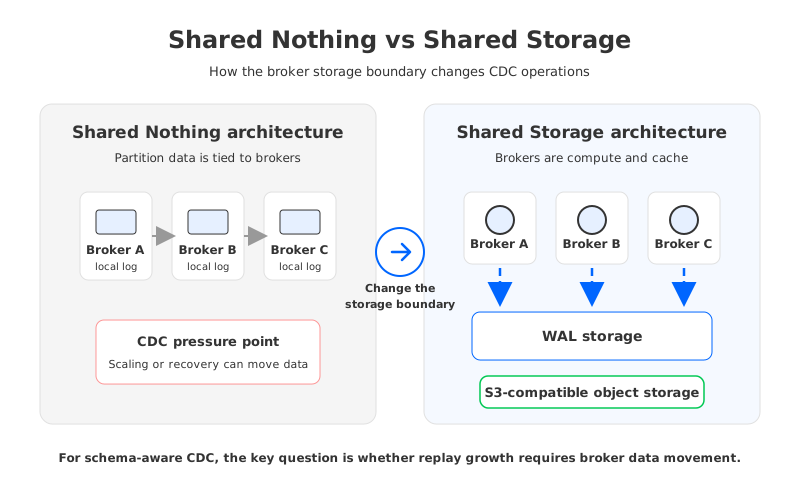
The broker-local model converts those events into infrastructure work. More retained data requires more disk headroom. More replicas require more broker-to-broker traffic. Partition reassignment may copy data across nodes. Replacing a broker can become a storage recovery event rather than a compute replacement event. In cloud deployments, the cost model also includes provisioned block storage, inter-Availability Zone traffic, and the operational buffer required to survive bursts without exhausting disk.
Tiered Storage can help by moving older Kafka log segments to remote storage while recent data remains local. That is useful for some retention-heavy workloads, and it is part of Apache Kafka's direction. But Tiered Storage does not automatically make brokers stateless. The platform still needs to manage local hot data, leadership, metadata, remote fetch behavior, and the operational boundary between local and remote storage. For schema-aware CDC, the question is whether this hybrid model is enough for your replay and migration requirements.
3Architecture options and trade-offs
A neutral evaluation starts by separating the connector layer from the Kafka data plane. Connector choices decide how changes are captured, serialized, transformed, and delivered. The Kafka data plane decides how records are stored, replicated, fetched, retained, and migrated. Schema awareness touches both, but it cannot compensate for weaknesses in either.
Most teams compare three architecture paths. The first is self-managed Kafka with self-managed Kafka Connect and schema tooling. This gives the highest control, but it keeps the team responsible for worker deployment, plugin isolation, metadata topics, schema governance, broker capacity, storage growth, and recovery drills. It is a good fit when the team already has strong Kafka operations and wants maximum implementation freedom.
The second path is managed Connect or managed CDC on top of an existing Kafka-compatible platform. This reduces connector operations and can standardize task deployment, credentials, retries, and monitoring. The trade-off is that teams must verify plugin coverage, network placement, schema format support, source permissions, and replay semantics. Managed connector convenience does not remove the need to design retained topics and consumer recovery.
The third path is Kafka-compatible platform modernization. In this path, the team keeps Kafka clients, Kafka Connect patterns, topic semantics, and consumer group behavior, but evaluates whether the underlying broker architecture should change. This is relevant when the problem is not "can we run a connector?" but "can the platform absorb CDC growth without turning storage into the limiting factor?"
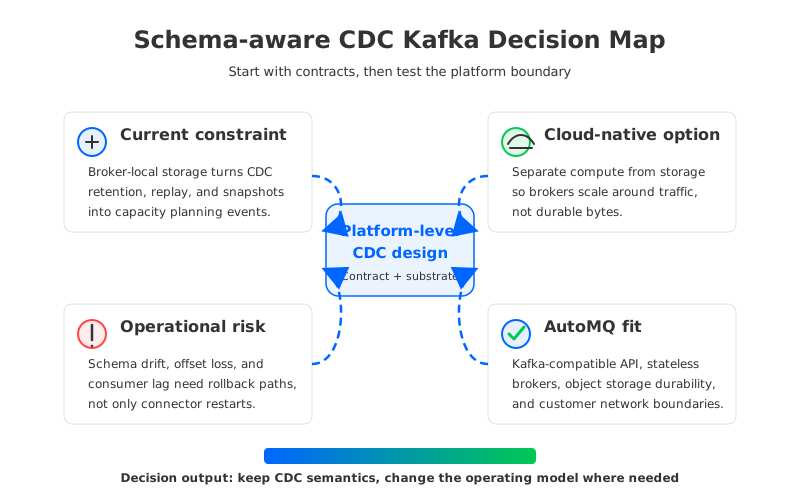
The trade-off table should be explicit:
| Decision area | What to evaluate | Why it matters for schema-aware CDC |
|---|---|---|
| Compatibility | Kafka protocol, clients, Connect, transactions, ACLs, topic configs | CDC consumers often depend on existing Kafka behavior and offset continuity. |
| Schema governance | Format, compatibility rules, registry integration, ownership | The platform must prevent accidental schema drift from becoming a consumer incident. |
| Storage model | Broker-local disk, Tiered Storage, or Shared Storage architecture | Retention, replay, and snapshots can dominate the infrastructure profile. |
| Elasticity | Broker replacement, scaling, partition movement, catch-up reads | Backfills and snapshots are operational events, not average-load events. |
| Security boundary | VPC, IAM, PrivateLink or private networking, audit scope | CDC connectors often need access to private databases and sensitive fields. |
| Migration | Topics, offsets, ACLs, producer path, rollback plan | A platform change is only credible if consumers can resume safely. |
This table avoids a common mistake: treating schema-aware CDC as a serialization feature. Serialization is necessary, but the platform decision is bigger. A schema-aware pipeline must preserve meaning over time, and time is exactly where retention, replay, and migration architecture show up.
4Evaluation checklist for platform teams
Start with a representative workload, not a generic proof of concept. Pick one source database with real schema changes, one table with high update volume, one table with deletes, one topic that needs compaction, and one consumer group that must rebuild state from Kafka. If the platform cannot explain this workload, it will not explain the next 200 tables.
Then test the awkward paths. Add a column, remove or deprecate a field through the approved process, replay older records, pause a consumer until lag is visible, restart the connector, run a snapshot or backfill, and replace a broker during catch-up reads. The goal is not to break the system for sport. The goal is to learn whether the contracts survive when more than one layer is moving.
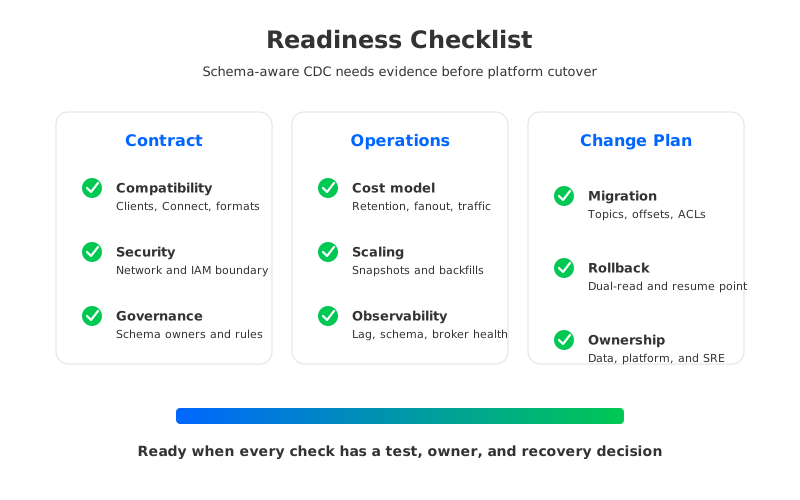
A practical readiness review should produce evidence in seven areas:
- Compatibility: Existing producers, consumers, Kafka Connect workers, security settings, and operational tools must work with the target platform.
- Cost model: Retention, replication, cross-zone traffic, connector workers, object storage, and catch-up reads need workload-based estimates.
- Scaling: The team should know what happens during snapshots, backfills, broker replacement, partition reassignment, and consumer catch-up.
- Security: Source database access, topic ACLs, field-level controls, network boundaries, and audit logs need named owners.
- Migration: Topic data, offsets, ACLs, schema metadata, and client routing need a tested sequence.
- Rollback: The team needs a decision point where it can resume from the previous platform without corrupting offsets or duplicating writes.
- Observability: Lag, connector health, schema errors, broker storage, remote fetch behavior, and consumer group progress should be visible in one incident view.
Each item should have an owner and a test result. A checklist without tests is only documentation. A test without an owner becomes shelfware after the first incident.
5How AutoMQ changes the operating model
Once the evaluation reaches broker storage, partition movement, and cloud cost, AutoMQ fits a specific category: a Kafka-compatible, cloud-native streaming platform based on Shared Storage architecture. AutoMQ preserves Kafka protocol compatibility while replacing broker-local persistent storage with S3Stream, where data is written through WAL storage and persisted in S3-compatible object storage. The practical result is an operating model where brokers are closer to stateless compute and cache than durable storage owners.
For schema-aware CDC, that change matters because the storage-heavy parts of the workload become less tied to broker lifecycle. Longer retention does not have to mean the same broker-local disk planning model. Broker replacement and scaling do not have to revolve around copying partition data from one local disk to another. Catch-up reads and replay still require capacity planning, but the durable data boundary moves to shared object storage rather than individual brokers.
AutoMQ does not replace the need for schema governance. Teams still need to choose serialization formats, compatibility policies, schema ownership, and downstream contracts. It also does not remove the need to validate connector behavior. What it changes is the substrate on which Kafka-compatible CDC runs: stateless brokers, object-storage-backed durability, Self-Balancing, and deployment models that keep the data plane inside the customer's environment.
That deployment boundary is important for CDC. AutoMQ BYOC places the control plane and data plane in the customer's cloud account and Virtual Private Cloud, while AutoMQ Software supports private data center environments. For connectors that need access to databases, private services, object stores, and governed networks, this model lets platform teams reduce operational burden without moving the data path into a vendor-hosted network boundary.
AutoMQ BYOC also provides a Managed Connector capability for Kafka Connect workloads. That matters when the same team wants to reduce worker and task management while keeping connector execution close to private sources and sinks. In a schema-aware CDC architecture, this can pair connector lifecycle management with a Kafka-compatible shared-storage data plane, but it should still be evaluated with the same tests: schema changes, offsets, snapshots, replay, rollback, and access control.
Migration deserves the same discipline. Kafka Linking can help teams move Kafka workloads by replicating topics and consumer group progress while preserving Kafka-oriented semantics, but a CDC migration is not finished when bytes are copied. The platform team still needs to prove that schema metadata, connector offsets, consumer offsets, ACLs, and rollback decisions are aligned. Schema-aware CDC is a contract migration, not only a storage migration.
6FAQ
6.1Is schema-aware CDC only about using a schema registry?
No. A schema registry or equivalent schema management layer is part of the design, but schema-aware CDC also includes source semantics, delete handling, key design, compatibility policy, replay behavior, governance ownership, and platform recovery. The registry stores schema information; the platform still has to operate the pipeline safely.
6.2Does Kafka Connect solve schema-aware CDC by itself?
Kafka Connect provides the framework for running connectors and moving data between Kafka and external systems. It does not automatically define your schema compatibility policy, retention model, consumer replay contract, or broker storage architecture. Those decisions belong to the platform design.
6.3When should a team evaluate Shared Storage architecture for CDC?
Evaluate Shared Storage architecture when CDC retention, snapshots, backfills, replay, or broker replacement are putting pressure on broker-local storage and partition movement. If the main pain is connector configuration, start with connector operations. If the main pain is storage and scaling, the Kafka data plane deserves attention.
6.4Can schema-aware CDC run on traditional Kafka?
Yes. Many teams run CDC on traditional Kafka successfully. The question is not whether it can work, but whether the operating model remains acceptable as retention windows, topic counts, consumer fanout, and migration requirements grow. Traditional Kafka is a valid option when the team is comfortable owning the broker storage and rebalancing model.
6.5How should platform teams plan a migration?
Plan migration around contracts. Inventory topics, schemas, ACLs, connector offsets, consumer group offsets, and rollback points. Run a representative CDC workload through the target platform before cutover, including schema changes and consumer replay. A successful migration should prove that consumers can resume with the expected data meaning, not only that records arrived.
7References
- Apache Kafka documentation
- Apache Kafka documentation: Kafka Connect
- Apache Kafka documentation: consumer groups
- Apache Kafka documentation: transactions
- Apache Kafka documentation: Tiered Storage
- AutoMQ documentation: compatibility with Apache Kafka
- AutoMQ documentation: architecture overview
- AutoMQ documentation: managed Kafka Connect overview
- AutoMQ documentation: migration overview
If schema-aware CDC is becoming a platform decision for your team, use one representative workload to validate contracts, offsets, replay, and broker operations before you choose the final architecture. You can start that evaluation in AutoMQ through the AutoMQ Cloud Console.


