
Table of Contents
Table of Contents
Teams search for stream processing state recovery kafka when a stream job has stopped being an application problem and has become an infrastructure problem. The Flink job can checkpoint. The Kafka Streams application can rebuild a state store from a changelog topic. Consumer offsets are available, and the platform has dashboards for lag. Yet the uncomfortable question remains: if a broker, node pool, or availability zone is replaced during peak traffic, how long does it take before the stream processor is useful again?
That question is not about one framework. It sits between Kafka, stateful stream processing, storage layout, network cost, and operational boundaries. Recovery depends on where authoritative state lives, how much log data must be read, whether consumers can resume from valid offsets, and whether the platform can add capacity without turning recovery into data relocation. A team can tune checkpoint intervals for weeks and still be blocked by a Kafka cluster whose storage model treats failed compute as failed data placement.
The practical thesis is this: stream processing state recovery improves when the durable stream is closer to the processing state than the broker disk is. Not closer in network hops, but closer in responsibility. The streaming platform should make replay, restore, and failover predictable enough that application teams can treat state recovery as a contract, not as an emergency exercise.
1Why teams search for stream processing state recovery kafka
Search intent usually starts with an incident. A stateful job falls behind after a deployment, a rebalance takes longer than expected, or a recovery drill exposes that changelog topics are not as recoverable as the runbook assumed. Kafka has the primitives: records are ordered within partitions, consumers commit offsets, consumer groups coordinate partition ownership, and transactions can help applications combine writes and offset commits into atomic units. Those primitives are powerful, but they do not remove replay cost.
State recovery is expensive because the system must rebuild confidence, not merely reload bytes. A stream processor needs to know which input offsets have been processed, which output records have been produced, which state updates are durable, and whether any downstream system saw partial progress. Kafka gives the application a stable log and offset model. The platform team still has to supply enough read throughput, retention, and storage availability for restore traffic to coexist with live traffic.
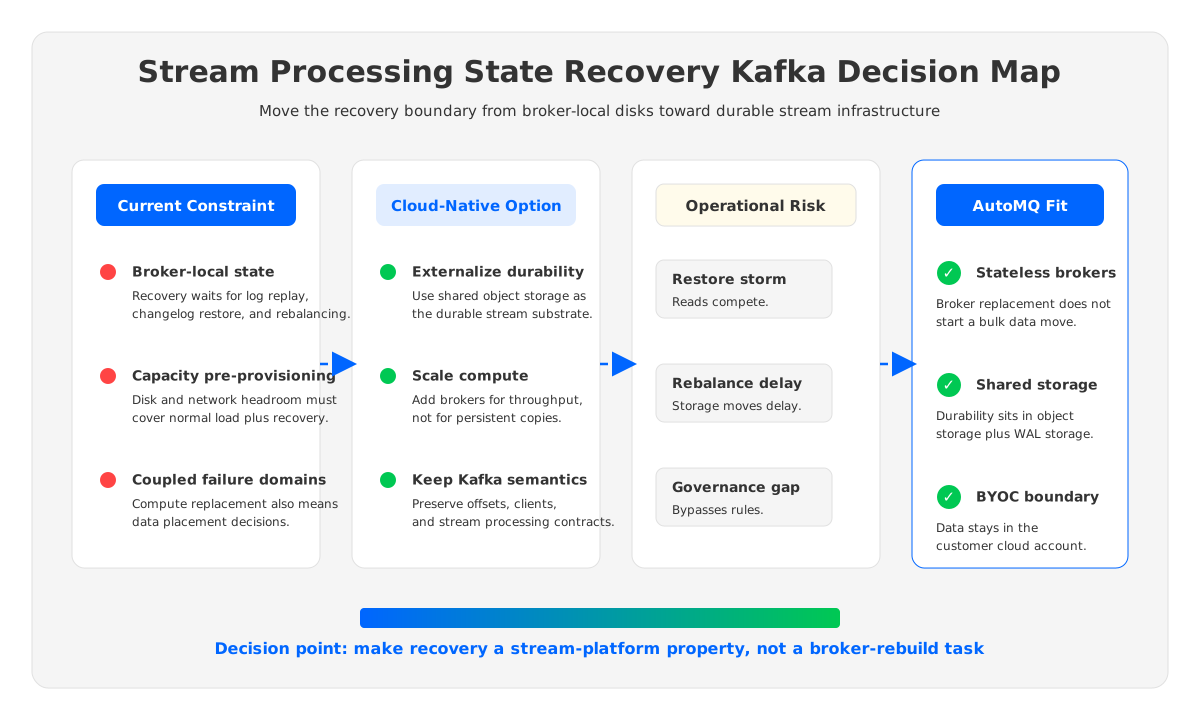
The hidden trap is that recovery traffic often arrives when the cluster has the least spare capacity. During normal operation, changelog reads and catch-up reads may be occasional. During a restore, they become concentrated, parallel, and latency-sensitive. If the same broker disks and network paths are also handling producers, consumers, replication, and partition movement, the restore path competes with the workload it is trying to protect.
2The production constraint behind the problem
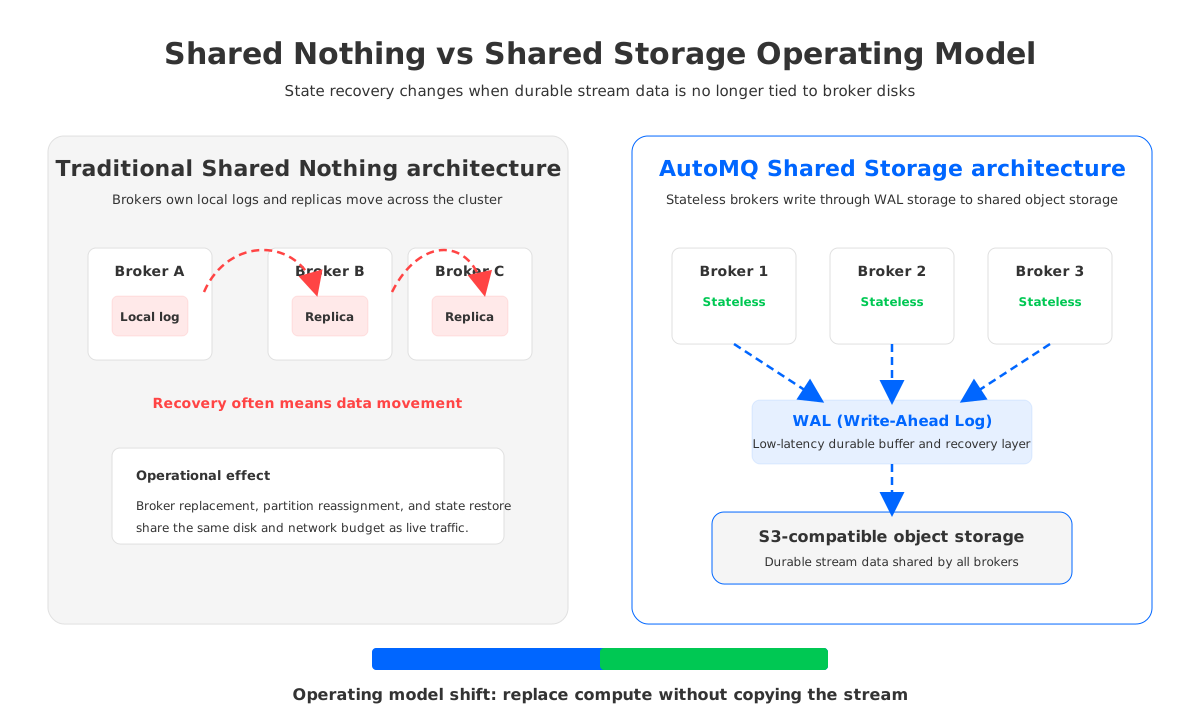
Traditional Kafka uses a Shared Nothing architecture: each broker owns local storage, and durability comes from replicating partition data across brokers. This design fit a data-center era where local disks were the natural persistence layer and machine-to-machine replication was part of the cluster's job. In cloud deployments, the same model creates a tight coupling between compute, storage, and failure recovery.
That does not make traditional Kafka wrong. It means its recovery model has a specific shape. If a stateful stream processing application depends on changelog topics, restore speed is bounded by the Kafka cluster's ability to serve historical reads while maintaining live writes. If the cluster is also rebalancing partitions or recovering replicas, the application and the platform are both asking the same broker-local storage layer to do extra work.
Tiered Storage changes part of this picture, but not the whole operating model. Apache Kafka Tiered Storage moves older log segments to remote storage while brokers retain local log segments for active data. That can help with long retention and broker disk pressure. It does not make brokers stateless, and it does not turn broker replacement into a pure compute event. For state recovery, the distinction matters: keeping older bytes in object storage is useful, but recovery still depends on how the platform coordinates local logs, remote reads, leadership, offsets, and live traffic.
3Architecture options and trade-offs
The first evaluation step is to separate application state recovery from stream infrastructure recovery. Application recovery asks whether the job can rebuild state from checkpoints, changelog topics, source offsets, and output guarantees. Infrastructure recovery asks whether Kafka can keep the durable log available, serve replay traffic, and replace failed capacity without forcing data movement into the critical path. Treating these as one problem leads to vague runbooks; separating them exposes the bottleneck.
For platform teams, the architecture choices usually fall into a few patterns:
The neutral test is not whether one option sounds more cloud-native. The test is whether the recovery path becomes more deterministic under load. If a stateful job has to rebuild 24 hours of state, the platform should make it clear which component serves those reads, which metrics show progress, what happens if a broker is replaced mid-restore, and how traffic is isolated from unrelated tenants or workloads.
A useful decision matrix has four columns: current constraint, cloud-native option, operational risk, and fit. Current constraints include broker-local data, recovery traffic spikes, and capacity pre-provisioning. Cloud-native options include shared durable storage, elastic compute, and managed migration paths. Operational risks include restore storms, governance gaps, and rollback ambiguity. Fit should be judged by evidence: compatibility tests, failure drills, cost model, and operational ownership.
| Evaluation area | What to verify | Why it matters for state recovery |
|---|---|---|
| Kafka compatibility | Producer, consumer, Admin API, transactions, offsets, and client behavior | Stream processors depend on Kafka semantics more than on a broker brand |
| Retention and replay | Hot reads, catch-up reads, object storage reads, and quota behavior | Restore speed depends on replay capacity during stress |
| Compute elasticity | Scale-out, scale-in, and broker replacement behavior | Recovery should not wait for large partition data relocation |
| Cost model | Storage, cross-AZ traffic, recovery reads, and reserved headroom | A recovery design that works only with permanent overcapacity is fragile |
| Governance | IAM, network isolation, encryption, audit, and data residency | Recovery traffic must follow the same controls as production traffic |
| Migration and rollback | Mirroring, offset validation, dual-running, and return path | A better target architecture still needs a reversible adoption plan |
The table is intentionally operational. The mistake is to evaluate state recovery by reading a feature list. A team needs to ask what happens at 02:00 when one stateful job restores, another job is redeployed, and Kafka is handling live traffic for producers that cannot pause. The architecture that wins is the one whose failure behavior is understandable before the failure.
4Evaluation checklist for platform teams
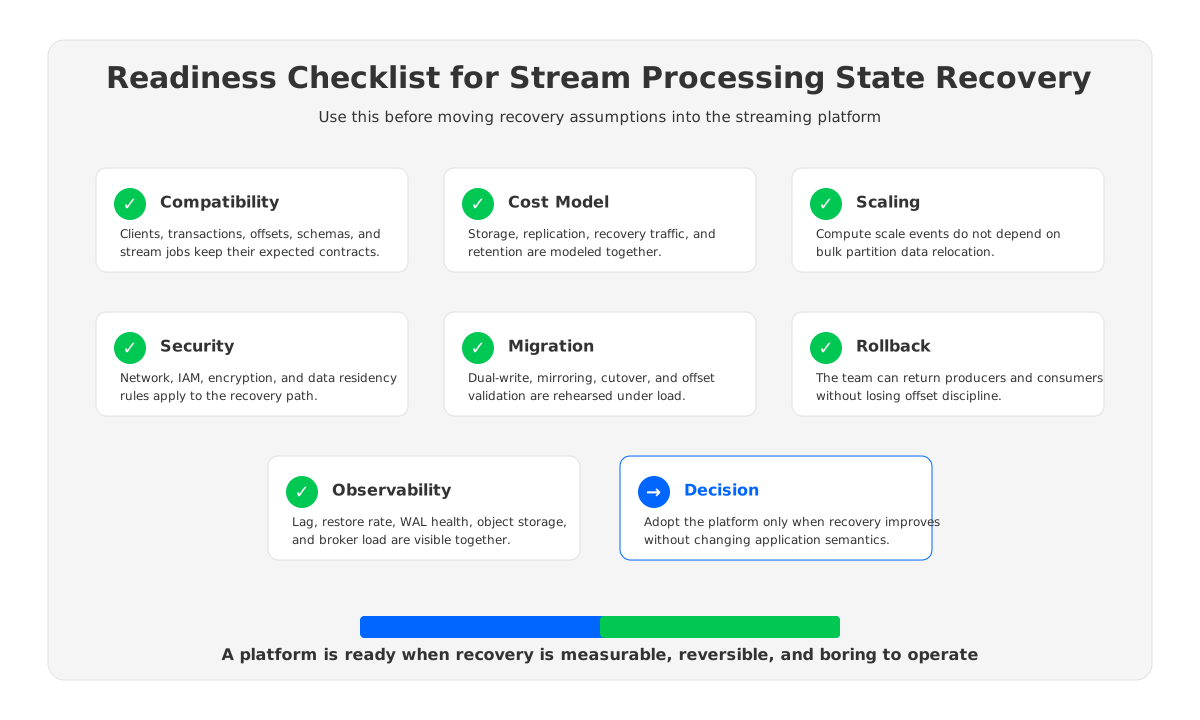
A checklist turns the architecture discussion into a go/no-go decision. It should be run before a platform migration, before increasing retention for stateful workloads, and before moving a critical Flink or Kafka Streams application to a larger shared Kafka cluster. The goal is not to eliminate every risk. The goal is to find risks that are still invisible.
Start with compatibility. Kafka-compatible streaming is not useful for state recovery if client behavior changes where the state processor relies on offsets, idempotent producers, transactions, or consumer group behavior. Compatibility testing should include the real client versions, serialization stack, transaction configuration, and operational tools used for offset inspection and reset.
Then model restore capacity as a workload, not as a rare exception. A state restore has read amplification, network demand, and object storage or disk behavior that can be different from normal tailing reads. The platform should expose metrics for consumer lag, restore throughput, broker load, WAL health where applicable, object storage access, and throttling. If the team cannot see recovery progress and platform pressure in the same view, the incident channel will become the monitoring system.
The migration plan deserves the same discipline. A streaming platform migration is not complete when bytes replicate. It is complete when producers, consumers, offsets, stateful jobs, observability, security controls, and rollback work as one movement. That is especially important for stateful processing because a partial cutover can create the worst possible state: the old cluster is no longer the clear source of truth, and the target cluster is not trusted as the recovery baseline.
Use this readiness checklist as a release gate:
5How AutoMQ changes the operating model
Once the evaluation framework is clear, the architectural requirement becomes precise: keep Kafka semantics for applications, but stop making broker-local disks the center of recovery. AutoMQ is a Kafka-compatible streaming platform built around Shared Storage architecture. It keeps the Kafka protocol and ecosystem surface while moving durable stream data into S3-compatible object storage through S3Stream and WAL storage.
The important shift is not that object storage exists somewhere in the architecture. The shift is that AutoMQ Brokers are stateless brokers. A broker handles Kafka protocol traffic, leadership, caching, and scheduling, but durable stream data is not owned by its local disk. That changes recovery math. Replacing compute does not require the platform to copy the stream from one broker's disk to another broker's disk before the cluster can settle.
For stream processing state recovery, this can reduce the number of moving parts competing in the same failure window. A restore still has to read data. The application still has to respect offsets, checkpoints, and output semantics. But the platform can treat broker replacement and compute elasticity as metadata, ownership, and traffic-placement work rather than as bulk storage relocation. That is a different operating model from tuning a broker-local storage system to survive every restore spike.
AutoMQ's WAL (Write-Ahead Log) layer also matters because shared object storage alone is not a complete low-latency write path. WAL storage provides the durable write buffer before data is uploaded and organized in S3 storage. Different AutoMQ editions and deployments can use different WAL types, so production evaluation should be explicit about the chosen WAL storage, latency target, failure domain, and cloud environment. The right conclusion is not "object storage solves state recovery." The right conclusion is that durable stream storage, WAL design, stateless brokers, and Kafka compatibility must be evaluated together.
The deployment boundary is part of the recovery story. In AutoMQ BYOC, the control plane and data plane run in the customer's cloud account, and customer message data stays in that environment. In AutoMQ Software, the platform runs in the customer's private environment. For teams with governance requirements, this matters because recovery traffic, object storage, observability, and operational access must fit the same control model as production traffic. A recovery architecture that bypasses governance will be rejected during the first serious review.
AutoMQ also fits adjacent state-heavy patterns. Table Topic can write streaming data into Apache Iceberg tables for lakehouse ingestion, while Kafka Linking supports migration paths that preserve consumption progress. Those capabilities are not substitutes for testing state recovery, but they show a broader direction: make the stream substrate durable, elastic, and compatible enough that application teams do not have to rebuild their state assumptions for every infrastructure change.
6A practical decision scorecard
The final decision should be made with a scorecard, not with a slogan. Give each category a rating of pass, partial, or blocker. A blocker in compatibility or rollback should stop the migration even if the cost model looks attractive. A partial in observability should trigger a monitoring work item before production. A shared storage pass should still include a documented WAL storage choice and failure drill evidence.
| Category | Pass signal | Blocker signal |
|---|---|---|
| Application semantics | Stateful jobs restore with expected offsets and outputs | Restore produces ambiguous output or offset ownership |
| Platform recovery | Broker replacement does not require bulk stream copying | Compute failure triggers prolonged data relocation |
| Replay behavior | Catch-up reads are observable and bounded | Restore traffic starves live producers or consumers |
| Cost and capacity | Recovery headroom is modeled explicitly | The plan assumes permanent overprovisioning without ownership |
| Security boundary | Data, logs, metrics, and access follow approved controls | Recovery requires unreviewed routes or broad permissions |
| Migration safety | Cutover and rollback are rehearsed with real workloads | The team cannot return traffic without losing offset discipline |
If your team is evaluating a Kafka-compatible platform for stateful stream processing, start with a recovery drill before you start with a migration plan. Then compare how the platform behaves when brokers move, restore traffic rises, and offsets must remain trustworthy. To explore AutoMQ for this evaluation, use the AutoMQ Cloud entry point and test the recovery path with your own workloads.
7FAQ
7.1Is Kafka itself enough for stream processing state recovery?
Kafka provides the log, offset, consumer group, and transaction primitives that stateful applications rely on. Recovery quality still depends on platform capacity, retention, broker health, replay throughput, observability, and operational runbooks.
7.2Does Tiered Storage solve state recovery for Kafka workloads?
Tiered Storage can help with long retention and local disk pressure by moving older log segments to remote storage. It does not make brokers stateless, so teams should still test broker replacement, active-segment behavior, replay throughput, and application restore time.
7.3What should teams test before changing Kafka infrastructure?
Test real clients, real stateful jobs, offset behavior, restore throughput, broker replacement during restore, monitoring coverage, security controls, migration cutover, and rollback. Sample producers and consumers are not enough for state recovery validation.
7.4Where does AutoMQ fit in this architecture?
AutoMQ fits when a team wants Kafka-compatible semantics with a Shared Storage architecture, stateless brokers, object-storage-backed durability, and deployment boundaries that can keep data in the customer's environment.
8References
- Apache Kafka Documentation
- Apache Kafka Streams Core Concepts
- Apache Kafka Consumer Rebalance Protocol
- Apache Kafka Tiered Storage
- Apache Kafka Transaction Protocol
- AutoMQ Shared Storage architecture
- AutoMQ S3Stream shared streaming storage
- AutoMQ WAL storage
- AutoMQ native compatibility with Apache Kafka
- AutoMQ continuous Self-Balancing


