
Table of Contents
Table of Contents
Teams do not search for streaming materialized views kafka because they need a vocabulary lesson. They search for it when a real-time application has outgrown the pattern of “write events to Kafka, process them somewhere else, and hope the serving layer stays close enough.” The symptom might be a dashboard that cannot tolerate batch refresh, a fraud model that needs per-account state, a search index that must be rebuilt after schema drift, or an operational service that wants a current view without querying a warehouse on every request. The question behind the search is sharper than the keyword: should Kafka remain only the transport log, or should the streaming platform carry more responsibility for the state that downstream systems serve?
That question is worth taking seriously because materialized views turn stream retention into an operational contract. A view is not only the result of an aggregation or join. It is a rebuild promise. If a downstream store loses data, if a revised projection goes out, or if a team discovers a bug in enrichment logic, the stream has to provide enough ordered history, stable offsets, and predictable replay behavior to rebuild state without turning a recovery exercise into an incident. Kafka is good at being that source of truth, but the production cost of that role depends heavily on the storage architecture underneath it.
1Why Teams Search for streaming materialized views kafka
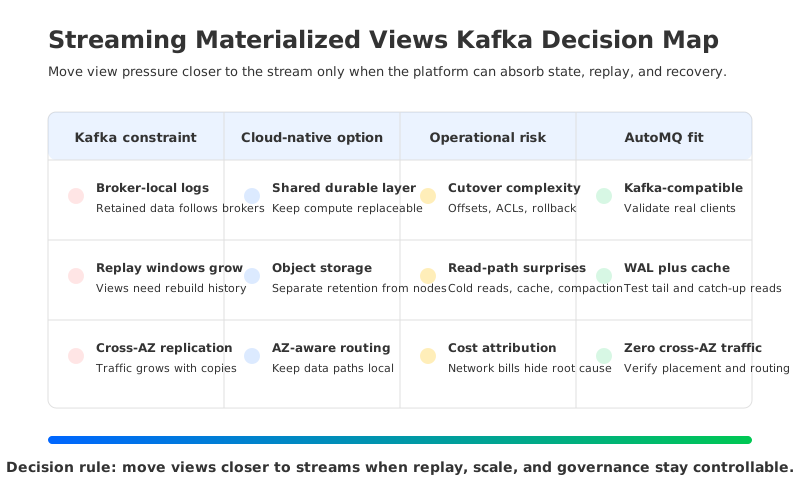
The mistake is to evaluate only the processing API. SQL syntax, joins, aggregations, and window definitions matter, but they are not the hardest production questions. The harder questions show up during rebuilds, failover, retention changes, and platform migrations. Can a consumer group reset safely? Are offsets stable across the migration path? Can historical reads catch up without starving tailing reads? Does a longer retention window force every broker to carry more local disk? Can the platform team explain where cross-Availability Zone traffic comes from? A materialized view strategy that ignores those questions will look elegant in a demo and expensive in production.
2The Production Constraint Behind the Problem
The second constraint is movement. Rebalancing partitions, replacing brokers, expanding the cluster, and recovering from skew all involve data locality. If a broker is both a compute process and a durable storage owner, capacity planning has to account for both responsibilities at once. You cannot resize the compute layer without thinking about stored bytes, and you cannot change retention without thinking about broker fleet shape. That coupling becomes visible when a view rebuild creates catch-up reads while fresh events are still arriving.
The third constraint is network topology. Multi-AZ Kafka deployments are common because production systems need fault isolation, but replication and client placement can produce inter-zone traffic. AWS publishes data transfer pricing for traffic across Availability Zones, and the exact cost depends on service, region, and path. The important architecture point is not a universal dollar figure. It is that stream storage design, replica placement, and client routing can create recurring network cost that the application team does not see in its own service bill.
These constraints do not mean Kafka is the wrong foundation for materialized views. They mean the platform team should stop treating storage as a background detail. The log is the recovery substrate for the view, and its architecture determines how much operational risk appears every time the organization asks for fresher state, longer history, or more consumers.
3Architecture Options and Trade-Offs
There are several reasonable ways to place streaming materialized views around Kafka. None removes the need for a durable log; each moves responsibility to a different team and failure domain.
| Option | Where the view lives | What works well | What to validate |
|---|---|---|---|
| Stream processor state | Kafka Streams, Flink, or another engine maintains state and changelogs | Low-latency updates, close coupling to event-time logic | State recovery, checkpointing, changelog retention, rolling upgrades |
| External serving store | Processor writes to Redis, Elasticsearch, Cassandra, PostgreSQL, or another database | Query model fits application needs | Dual writes, idempotency, rebuild path, schema drift |
| Compacted Kafka topics | Latest value per key is retained in Kafka | Simple replay and Kafka-native consumption | Compaction lag, tombstones, key design, storage pressure |
| Lakehouse table output | Streams write into Apache Iceberg or similar table formats | Analytics and governance-friendly tables | Commit semantics, small files, backfills, freshness expectations |
| Kafka-compatible shared storage | Durable stream data is separated from broker-local disks | Retention and broker compute can scale separately | Compatibility, WAL design, cache behavior, object storage operations |
The table is deliberately not a vendor comparison. It is a responsibility map. A team that needs sub-second key-value reads may still choose a serving database. A team that needs governed analytical tables may prefer direct table writes. A team that mainly suffers from Kafka disk pressure may keep the same processing framework but change the Kafka-compatible storage foundation below it.
The most common trap is to treat Tiered Storage and Shared Storage architecture as the same answer. Apache Kafka Tiered Storage, introduced through KIP-405, offloads older log segments to remote storage while brokers still retain local storage responsibilities for the active log. That can help with longer retention and broker recovery in many cases. It does not make brokers fully stateless for durable data ownership. A Shared Storage architecture changes the operating model more deeply: brokers handle Kafka protocol, leadership, caching, and scheduling, while persistent stream data lives in a shared storage layer.
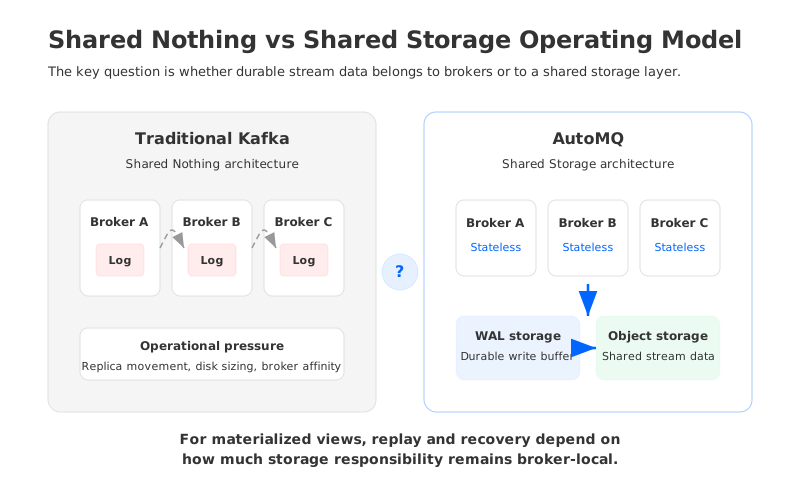
The distinction matters for materialized views because catch-up behavior is not a corner case. Backfills, replay, projection changes, and downstream recovery are normal operations. A broker-local architecture asks the broker fleet to carry those storage and read amplification effects. A shared-storage design asks a different question: how much compute and cache are needed to serve the workload while durable bytes sit outside broker-local disks?
4Evaluation Checklist for Platform Teams
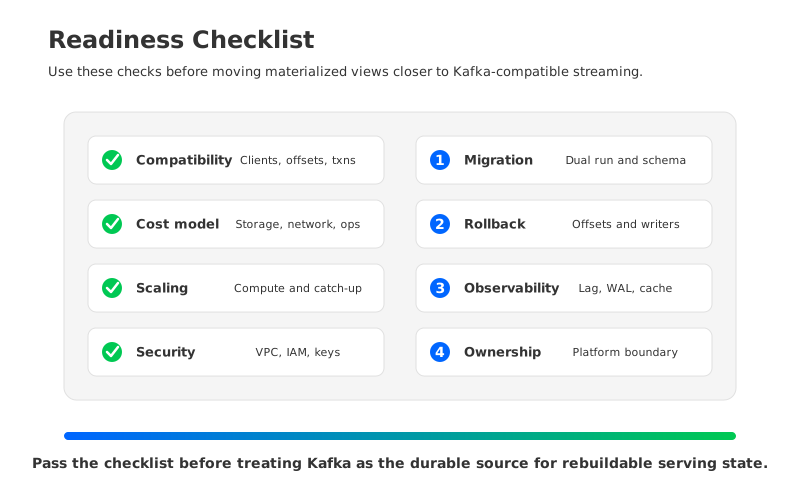
Before moving materialized view responsibility closer to Kafka, evaluate the platform as a state recovery system, not only as a message bus. The checklist should include compatibility, cost, elasticity, governance, failure recovery, migration risk, and ownership boundaries.
Start with compatibility. Kafka-compatible does not only mean producers can connect. Test the exact client versions, serializers, transactions, idempotent producers, consumer group behavior, offset reset paths, ACLs, admin tooling, Kafka Connect jobs, Kafka Streams applications, and observability integrations that your teams use. If a materialized view depends on offsets and changelog topics, compatibility failures show up as state corruption or replay gaps, not as a neat platform error.
Governance deserves its own pass. Materialized views often encode business meaning: customer status, risk score, entitlement state, inventory availability, or account balance. The platform should make ownership visible. Who controls schema evolution? Who can reset a consumer group? Which team approves retention changes? Where are audit logs? How is access managed across VPCs, accounts, and environments? These questions can feel administrative until a view rebuild touches regulated data.
Failure recovery is the point where architecture becomes practical. Write down what happens when a broker disappears, an Availability Zone has trouble, a processor job deploys bad logic, a downstream serving store loses a shard, or a migration has to roll back. For each case, identify the recovery source, the offset boundary, the expected replay volume, and the team that owns the action. If the answer requires copying large amounts of broker-local data before recovery can proceed, that is a meaningful architectural constraint.
5How AutoMQ Changes the Operating Model
Once the evaluation is framed around storage responsibility and recovery behavior, AutoMQ enters the discussion as a Kafka-compatible shared-storage platform rather than as a different application model. It keeps the Kafka protocol and ecosystem surface while replacing broker-local durable storage with a Shared Storage architecture built on S3-compatible object storage, S3Stream, WAL storage, data caching, and stateless brokers. That means the processing layer can keep using Kafka concepts, while the infrastructure layer changes how data is persisted, scaled, and recovered.
The important operational change is that brokers no longer have to be long-term owners of retained stream data. AutoMQ Brokers process Kafka requests, serve reads, manage leadership, and use cache, but durable stream data is backed by shared object storage. WAL storage absorbs the write acknowledgment path and recovery buffer, while S3 storage holds the primary stream data. AutoMQ documentation describes multiple WAL options, including S3 WAL, Regional EBS WAL, and NFS WAL, because the right write path depends on latency, durability, and deployment constraints.
For materialized views, this separation changes three everyday decisions. First, longer retention no longer has to mean that every broker becomes a larger storage appliance. Second, broker replacement and scaling are less tied to copying retained partitions between nodes. Third, catch-up reads and tailing reads can be reasoned about as cache, WAL, and object storage behavior rather than only as broker disk pressure. Those are architecture changes, not API changes, which is why workload validation remains essential.
AutoMQ is also relevant when governance requires customer-controlled infrastructure boundaries. AutoMQ BYOC runs the control plane and data plane in the customer's cloud environment, while AutoMQ Software targets private data center deployments. For teams building materialized views over sensitive operational data, that deployment boundary can matter as much as latency. The stream platform is not only moving records; it is holding the rebuild path for important business state.
There is a second adjacent capability to consider: Table Topic. AutoMQ Table Topic is designed to write streaming data into Apache Iceberg tables directly from Kafka-compatible topics. That does not replace every materialized view pattern, and it should not be confused with an application serving cache. It is useful when the derived state belongs in a governed table format for analytics or lakehouse workflows. The broader point is that once the stream storage layer is cloud-native, platform teams can evaluate operational views, analytical tables, and long-retention replay on the same Kafka-compatible foundation.
Migration should still be treated as a project, not a slogan. A serious proof of concept should include dual-running critical topics, verifying consumer group progress, testing offset resets, checking Connect and stream processing jobs, measuring catch-up reads, and documenting rollback. AutoMQ Kafka Linking is designed for migration scenarios that need byte-level data synchronization and consumer progress continuity, but the right migration plan depends on source version, authentication, network topology, throughput, and cutover tolerance.
6A Practical Decision Matrix
Use this matrix when deciding whether to move streaming materialized views closer to the stream platform.
| If this is true | Keep the view outside Kafka | Move more responsibility toward Kafka-compatible streaming |
|---|---|---|
| Query shape is complex and user-facing | A serving database may fit better | Kafka remains the recovery log behind it |
| View rebuilds are rare and small | Simpler pipelines may be enough | Test replay anyway, but avoid over-engineering |
| Retention pressure dominates broker cost | Broker-local tuning may postpone pain | Shared Storage architecture becomes worth evaluating |
| Governance requires table semantics | Write to lakehouse tables | Consider table-oriented stream output such as Table Topic |
| Migration risk is the blocker | Avoid platform changes until rollback is clear | Choose options that preserve clients, offsets, and tooling |
The matrix does not produce a universal answer because materialized views are not one workload. A per-user feature cache, a fraud scoring table, a search index, and an Iceberg table all deserve different serving choices. What they share is dependence on a stream history that can be replayed, governed, and scaled. That is the part platform teams should standardize first.
7FAQ
7.1Is Kafka itself a database for materialized views?
Kafka is a durable, partitioned event log with retention, offsets, consumer groups, and replication semantics. It can back materialized view patterns through stream processing, compacted topics, changelog topics, and replay. It does not replace every serving database because query models, indexes, transaction boundaries, and point lookup latency may require a dedicated store.
7.2When should a materialized view live in a stream processor instead of an external store?
Keep the view in the stream processor when the main need is continuous event-time computation, local state, and fast update logic close to the processing job. Use an external store when applications need a query model that the processor state store is not designed to expose broadly. In both cases, Kafka-compatible replay remains the recovery foundation.
7.3Does Tiered Storage solve the same problem as Shared Storage architecture?
No. Tiered Storage can offload older log segments to remote storage, which helps retention economics and recovery in specific Kafka deployments. Shared Storage architecture separates durable stream data from broker-local ownership more directly, making brokers closer to stateless compute nodes. The operational impact is different during scaling, broker replacement, and catch-up reads.
7.4How should teams test a platform for streaming materialized views?
Test the full lifecycle: produce, consume, process, rebuild, reset offsets, change schemas, replay historical data, recover a failed processor, replace brokers, and roll back a migration. Include observability for consumer lag, tailing reads, catch-up reads, storage behavior, and network paths. A short write benchmark is not enough.
7.5Where does AutoMQ fit?
AutoMQ fits when a team wants to preserve Kafka-compatible clients and ecosystem tools while reducing the broker-local storage coupling that makes long retention, replay, scaling, and broker replacement difficult. It is most relevant for platform teams evaluating Shared Storage architecture, stateless brokers, BYOC deployment boundaries, and object-storage-backed durability.
The original search starts with materialized views, but the durable decision is about replay ownership. If Kafka-compatible streaming is going to hold the recovery path for important serving state, the storage architecture deserves the same scrutiny as the processing framework. To test that model with a Kafka-compatible shared-storage platform, start with the AutoMQ deployment path.


