
Table of Contents
Table of Contents
A schema can be valid, compatible, and registered while nobody is accountable for what it means in production. The producer team assumes the platform team will catch unsafe changes. The platform team assumes the producer understands the event. Consumers discover a breaking interpretation after a replay or a delayed deployment. Each group followed part of the process, and the process still had no owner.
That is an ownership vacuum. A Schema Registry can check structural compatibility, but it cannot decide whether a field still means the same thing, which consumer must review a change, or who owns the rollback when a technically valid event is operationally wrong. A workable Kafka schema ownership model assigns those decisions to named roles, then puts the assignments inside the registration workflow.
The model uses three roles: a platform steward who owns the guardrails, a producer owner who owns the event contract, and a consumer reviewer who represents downstream impact. They can be teams or named people. The point is to make responsibility visible before a pull request becomes an incident.
1The ownership vacuum behind every bad schema
Most schema programs begin with a technical question: which format should the team use, and which compatibility mode should the registry enforce? Those decisions answer whether a reader and writer can resolve a record under defined rules. The Apache Avro specification describes reader-writer resolution; it does not identify the business owner of a field called status, the consumer that depends on its old meaning, or the team that can coordinate a migration.
The gap appears at the edges of the registry. A producer can register a proposed version without knowing that a consumer treats an optional value as a signal to delete a record. A consumer can approve a structural change without owning the producer's release schedule. A platform engineer can enforce a compatibility mode while having no authority to decide whether a renamed field is a different concept or the same concept with a clearer label. The registry reports a result, but the organization still has to make the decision.
That is why schema ownership should start with the event, not the registry endpoint. The owner is the team that can explain why the event exists, what its fields mean, which changes are safe, and how dependent readers will move. Platform governance then turns those answers into controls that can be checked repeatedly.
A schema is owned when one named team can explain its meaning, its consumers, and its recovery path.
This also separates three kinds of approval that are often mixed together:
- Structural approval: Does the proposed schema satisfy the configured reader-writer compatibility rule?
- Semantic approval: Does the event still mean what downstream users think it means?
- Operational approval: Can the organization release, observe, pause, and recover the change safely?
One role may provide input to all three, but the accountable role should differ according to the decision. A registry is well suited to the first question. The producer owns the second. The platform and affected consumers supply the evidence for the third. The Kafka schema compatibility gate guide covers the structural gate in more detail; the Kafka data contracts guide covers the wider contract boundary. The operational question begins after the check returns: who carries the decision?
2Three roles that end the stalemate
The three-role model is intentionally small. Adding a security approver, data steward, or domain architect may be necessary for regulated data, but those are extensions to the core path. Start with roles that map to the work every schema change already requires.
| Role | Owns | Does not own alone |
|---|---|---|
| Platform steward | Registry policy, subject permissions, automation, audit evidence, and the exception path | The business meaning of another team's event |
| Producer owner | Event meaning, schema intent, producer rollout, and the change record | A unilateral decision to break an active consumer |
| Consumer reviewer | Reader impact, replay behavior, migration readiness, and downstream sign-off | The producer's domain definition or release calendar |
The platform steward keeps the system governable. This role defines the default compatibility policy, maintains subject naming and access rules, and ensures that a rejected request leaves useful evidence. The steward also owns the escalation path when a change does not fit the default policy. That is a control responsibility, not ownership of every data definition.
The producer owner is accountable for the contract's meaning. This team decides what a field represents and records the intent behind a change. It also owns the producer release plan: whether readers go first, whether an additional field has a safe default, and how long old versions remain supported. The owner may request an exception, but cannot approve it alone.
The consumer reviewer makes downstream cost visible. This role checks whether its reader can handle the proposed writer, whether replayed records are covered, and whether a change needs a staged rollout or a code update. Its value is to identify cases where wire compatibility leaves application behavior at risk.
In a small team, one person may fill more than one role. The separation still matters because the change record should show which hat that person wore for each decision. In a large organization, the roles should resolve to a team alias and an escalation owner, so an approval does not depend on finding one engineer in a chat history.
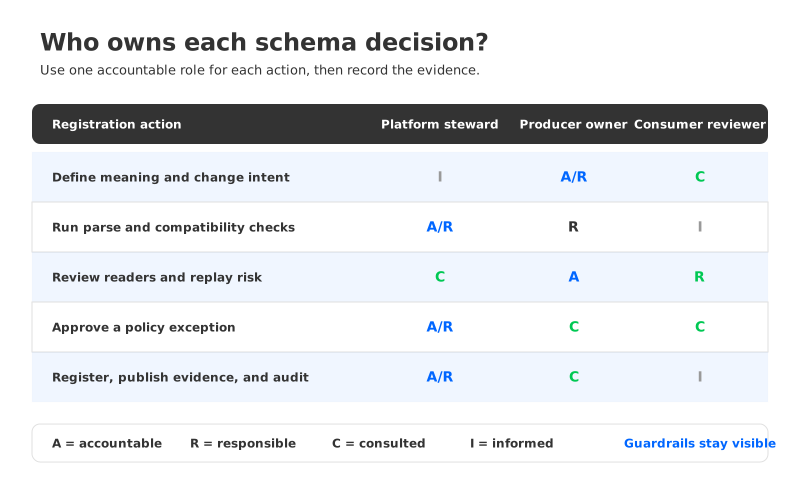
The practical boundary is simple: the platform steward owns the guardrail, the producer owner owns the contract, and the consumer reviewer owns the downstream reading risk. Once those boundaries are explicit, RACI becomes a workflow tool instead of a slide in an architecture review.
3Put RACI inside the registration workflow
RACI works when it is attached to an action. “The platform team governs schemas” is too broad to guide an approval. “The producer owner is accountable for the event meaning” is specific enough to resolve a dispute. For each action, assign one accountable role, name who performs the work, and record who must be consulted or informed.
Here is a starting matrix. It is a template, not a universal answer; adjust it to the way your registry, catalog, and release system work.
| Registration action | Platform steward | Producer owner | Consumer reviewer |
|---|---|---|---|
| Define event meaning and change intent | I | A/R | C |
| Run parse and compatibility checks | A/R | R | I |
| Review affected readers and replay risk | C | A | R |
| Approve a policy exception | A/R | C | C |
| Register, publish evidence, and audit | A/R | C | I |
The matrix makes two useful distinctions. The producer owner remains accountable for the contract decision, even when a consumer reviewer performs the downstream analysis. The platform steward owns exceptions and registration evidence, but not the event's meaning. If a cell has no name or team alias, the request is not ready for registration.
The workflow can then use a fast lane and an exception lane. Both begin with the same request record:
- The producer owner submits the schema diff, reason, compatibility mode, rollout order, named consumer path, and rollback or deprecation plan.
- Automation checks syntax, subject naming, permissions, compatibility, ownership metadata, and the change record.
- The consumer reviewer checks affected read paths. A low-risk addition may need acknowledgement; a removal, type change, key change, or semantic reinterpretation needs active review.
- The platform steward confirms policy, records the registry action and evidence, or opens an exception path.
This arrangement prevents the common stalemate in which every change is treated as a committee decision. A compatible, well-described change can move through the fast lane. A change with a known risk receives human attention because the evidence says it needs attention. The approval system is selective instead of ceremonial.
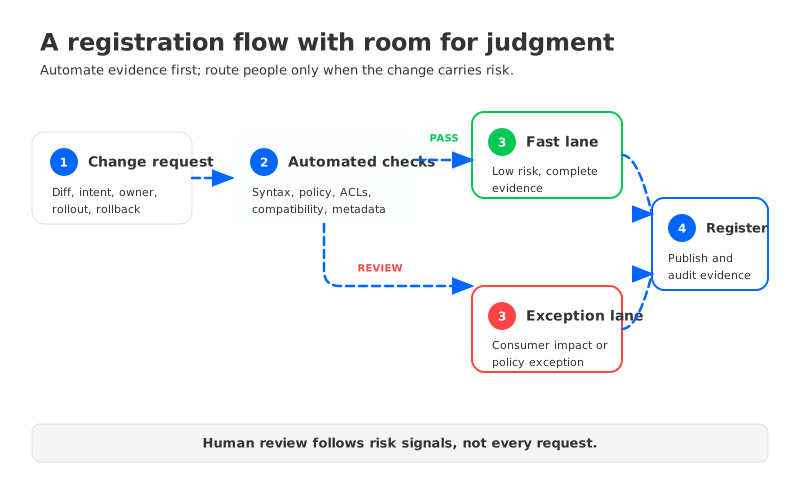
An exception should be temporary and explicit. It should name the affected subject, the reason the default rule does not apply, the accountable producer owner, the consumer reviewer, the expiry or review condition, and the recovery action if the assumption fails. Without those fields, “approved exception” becomes another form of ownership ambiguity.
4Let automation carry the friction
Manual review becomes expensive when people repeat checks a machine can perform. Automate evidence collection and reserve human judgment for meaning, impact, and exceptions.
Useful automation usually covers five areas:
- Request completeness: Require a subject, owner, change intent, compatibility mode, rollout order, and rollback reference before a review can start.
- Structural checks: Run parser validation and reader-writer compatibility against the versions that the policy covers. The result should be attached to the change, not pasted into a separate chat.
- Ownership metadata: Confirm that the producer owner, platform steward, and consumer contact resolve to active team identities. A stale alias is an operational failure waiting to happen.
- Impact evidence: Pull known consumers, connectors, replay windows, or catalog dependencies where those systems expose the data. Mark unknown dependencies as a review condition instead of pretending the inventory is complete.
- Audit packaging: Record the diff, checks, decisions, exception data, registry result, and release reference in one durable change record.
Policy-as-code gives the platform steward a repeatable baseline. It can block an unowned subject, reject a missing compatibility result, or route a breaking change to the exception queue. It should not claim that a field's meaning is safe because a structural test passed. That judgment belongs to the producer owner and affected consumer reviewer.
Automation also reduces consumer fatigue. Instead of asking every consumer team to attend every review, the platform can route a request to teams associated with the changed subject or field. The reviewer sees the diff, compatibility output, rollout, and records that need attention. The review becomes a bounded decision with evidence rather than an open-ended request to “take a look.”
The same evidence helps when a change is rejected. A producer owner can fix the schema, add a default, split a semantic change into an additional field, or submit a documented exception. Faster approvals come from better inputs and narrower decisions.
5A schema ownership manual you can trim
An operating manual should be small enough for a release and specific enough for an incident. Adopt this core, then extend it where risk requires it.
| Trigger | Required record | Accountable role | Exit condition |
|---|---|---|---|
| Subject creation | Meaning, owner, consumers, compatibility default, and data classification | Producer owner | Steward confirms policy and registration path |
| Compatible change | Diff, automated result, rollout order, and affected readers | Producer owner | Reviewer acknowledgement or sign-off is recorded |
| Risky or breaking change | Impact evidence, migration steps, exception reason, and rollback | Platform steward | Named reviewer and expiry condition are recorded |
| Deprecation | Last supported version, consumer migration status, and removal condition | Producer owner | Steward records the retirement decision |
| Incident or bad release | Version, affected records, offsets, containment, and replay plan | Consumer reviewer for read impact; steward for control path | Recovery evidence and follow-up owner are recorded |
Keep the manual operational by writing down the minimum fields every subject must carry:
- a producer owner and an escalation alias;
- a platform steward and the registry policy that applies;
- known consumer reviewers and the supported replay window;
- the compatibility mode and the semantic rules that the mode cannot express;
- the rollout, deprecation, and rollback expectations;
- the location of the decision record and audit evidence.
Teams can trim this list for a low-risk stream or add classification approval, privacy review, or change windows for regulated data. The core follows responsibility rather than a schema format or registry vendor. A good manual tells an engineer what to attach, whom to involve, and what evidence closes the action.
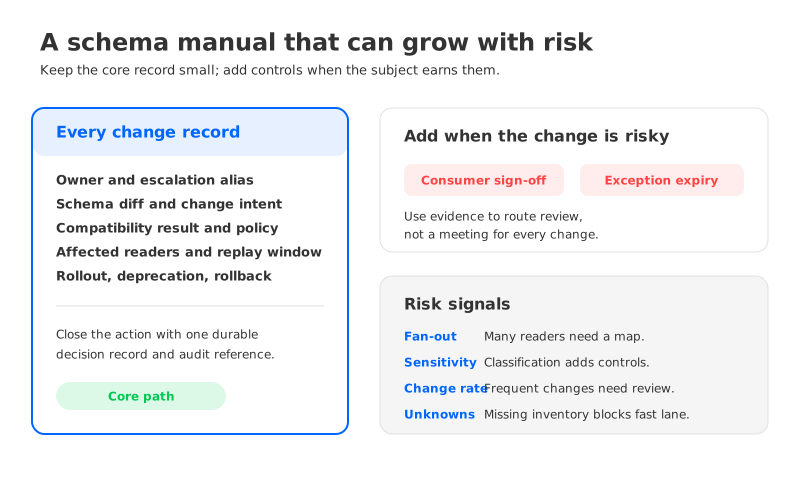
The manual should define a review cadence. A stable subject may need ownership renewal and contact verification; a subject with frequent changes or many readers may need dependency review and a replay test. Follow risk signals such as fan-out, data sensitivity, change frequency, and unknown consumers instead of applying the same meeting to every topic.
6Keep schema governance above the broker
The role model stays portable when schema governance remains at the registry and contract layer. The broker should carry Kafka protocol and data-flow responsibilities; it should not become the place where a platform team tries to decide whether a producer-owned field has changed meaning. That separation keeps the RACI stable as teams change their broker, deployment model, or storage architecture.
This is where AutoMQ fits the neutral mechanism argument. AutoMQ is a Kafka-compatible cloud-native streaming platform. Its broker layer handles Kafka protocol and semantics, while schema ownership remains with the registry, contract, CI, and approval systems chosen by the organization. A producer owner still owns event meaning, a consumer reviewer still checks downstream behavior, and a platform steward still owns policy and evidence.
AutoMQ's Kafka compatibility model keeps that governance boundary above broker implementation. Its Shared Storage architecture changes how durable stream data relates to broker lifecycle, which can reduce storage and replay coordination in a steward's runbook. It does not answer who owns a schema.
That distinction is useful during architecture review. If the problem is an unowned event, another broker architecture will not solve it. If the organization already has ownership and approval discipline but the platform team is carrying heavy broker-local storage, replay, or scaling work, a Kafka-compatible shared-storage design may change the operational workload underneath the same contract model. The decision belongs in the platform section of the manual, after the ownership rules are clear.
7Close the loop before the next change
The next schema incident will not ask which team installed the registry. It will ask who can explain the field, who checked the readers, who approved the exception, and how the affected records will be recovered. If those answers live in different systems or depend on one person's memory, the organization still has an ownership vacuum.
Start with one subject that has real downstream use. Name its producer owner, platform steward, and consumer reviewer. Add the RACI cells to the registration request, automate evidence checks, and run one safe change through the fast lane. Then test the exception path with a change that needs consumer coordination.
When the roles are clear, schema governance becomes a series of bounded decisions. For teams evaluating a Kafka-compatible platform beneath that model, start an AutoMQ evaluation with the same subject, consumer map, approval record, and recovery drill. The platform can change; the ownership you can run should remain explicit.


