
Table of Contents
Table of Contents
Searches for kafka broker replacement recovery usually come from teams that have already felt the pain. A broker host failed, a Kubernetes node drained, an attached disk reached a dangerous state, or a maintenance window expanded because replacing one broker became a data movement project. The cluster may recover correctly, but the recovery path consumes network bandwidth, operator attention, and confidence.
That distinction matters. Kafka reliability is often discussed as a replication problem: keep enough in-sync replicas, avoid unclean leader election, and make sure consumers can resume from committed offsets. Those controls are essential, but they do not answer the operational question behind broker replacement. If a broker disappears, does the platform need to reconstruct large volumes of partition data before the cluster is healthy again, or can replacement be treated mostly as compute recovery?
The answer depends less on whether the deployment is self-managed, cloud-managed, or Kubernetes-based, and more on where durable log ownership lives. Traditional Kafka brokers are stateful because they own local log replicas. A Kafka-compatible Shared Storage architecture changes that recovery shape by moving durable stream data outside broker-local disks. The goal is not to make failure boring by ignoring it. The goal is to make the expensive part of recovery smaller, more testable, and less tied to retained bytes.
1Why Broker Replacement Becomes Data Recovery
Apache Kafka's classic architecture is built around partitions, leaders, followers, and replicated logs. Producers write to partition leaders, followers fetch from leaders, and consumers read from the log using offsets. That model gives Kafka its durability and replay behavior, but it also means each broker is more than a request-processing process. It is a storage owner for the replicas assigned to it.
When a broker fails permanently, the cluster can elect leaders from remaining replicas if the replication and ISR conditions are healthy. Service may continue, yet the replacement work is not finished. The platform still has to restore replica placement, rebuild lost replicas, rebalance partition load, and verify that disk, network, and controller metadata converge without creating a second incident. In practice, broker replacement is often a controlled version of data recovery.
The pain grows with three variables:
- Retained bytes per broker. More local retained data means more data that may need to be rebuilt, copied, rebalanced, or protected during replacement.
- Partition count and skew. Many partitions or uneven leader placement increase the coordination cost of reassignment and catch-up.
- Production headroom. Recovery traffic competes with live produce, fetch, replication, backfill, and consumer catch-up traffic unless it is carefully throttled.
This is why a broker replacement runbook can look healthy on paper and still feel risky in production. The steps are known, but the recovery workload is large enough that every decision has side effects. Throttle too aggressively and the cluster spends longer in a degraded state. Move too quickly and recovery traffic can disturb live workloads.
2The Architecture Pattern Behind the Runbook
A runbook can reduce mistakes, but it cannot remove the storage model underneath it. In a Shared Nothing architecture, brokers own their local data. Replication creates additional copies across brokers, which is exactly what makes failure survivable. The same design also makes replacement stateful: a replacement broker must become a correct participant in the partition layout, and that often means moving or rebuilding local replica data.
Tiered Storage changes part of the story. Apache Kafka KIP-405 introduced remote log storage so older log segments can be copied to a remote tier such as object storage while the broker keeps the active local log. This can reduce local disk pressure and reduce how much historical data must be copied during recovery or rebalancing. It is a meaningful improvement for long-retention topics.
But tiering is not the same as stateless broker replacement. The active log, broker cache behavior, remote log metadata, and local recovery path still matter. For teams whose main pain is historical retention, tiered storage may be enough. For teams whose main pain is that scaling, replacement, and partition movement remain storage events, the evaluation has to go one level deeper.
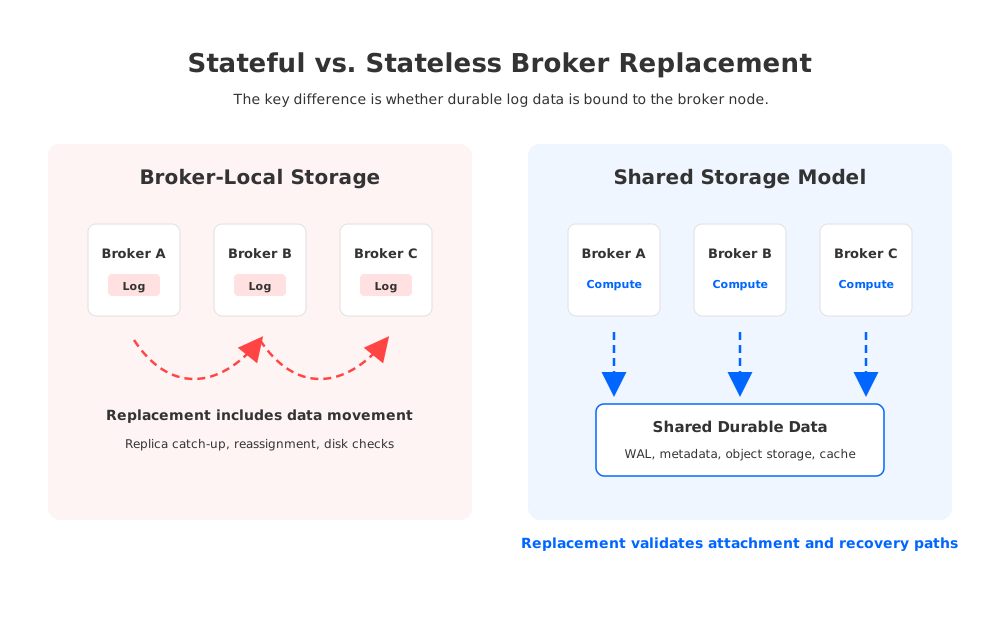
The sharper question is: what must be rebuilt when the broker is replaced?
| Recovery concern | Stateful broker-local storage | Shared Storage architecture |
|---|---|---|
| Durable partition data | Rebuilt or copied to local broker storage as placement changes | Remains in shared storage; replacement broker reattaches through metadata and cache |
| Recovery traffic | Broker-to-broker replica catch-up and reassignment can dominate | Recovery focuses on WAL safety, metadata correctness, cache warm-up, and object-store access |
| Capacity planning | Local disk, replication, and replacement headroom are tightly coupled | Compute and retained data capacity can be evaluated more independently |
| Operational risk | The runbook protects a data movement event | The runbook validates compute replacement and storage-layer correctness |
This table is not an argument that every cluster should abandon broker-local storage. Traditional Kafka remains a strong fit when workloads are predictable, retention is bounded, the operations team has mature automation, and the replacement window is acceptable. The problem appears when replacement cost grows faster than the business can tolerate.
3What Platform Teams Should Measure
Broker replacement should be tested as a workload, not treated as an administrative task. A maintenance test that replaces a broker with little traffic proves little about the production case. The real question is how the cluster behaves when replacement overlaps with normal ingest, consumer lag, backfills, compaction, and observability queries.
Start with recovery evidence that maps to user-visible risk:
- Time in degraded redundancy. Measure how long partitions run with reduced replica availability or uneven leadership during replacement.
- Client-visible impact. Track producer latency, request errors, consumer lag, rebalance behavior, and timeout rates during the replacement window.
- Recovery traffic shape. Separate live application traffic from replica catch-up, reassignment, remote-tier fetches, and backfill reads.
- Controller and metadata stability. Watch controller load, partition state transitions, and leadership churn.
- Rollback clarity. Define what happens if replacement stalls halfway through: continue, pause, reverse, or isolate the broker.
The fifth item is where many runbooks become vague. Rollback is easy to write as a word and hard to execute under pressure. If replacement has already moved a large amount of partition data, reversing the change may not be the safest option. If durable data is externalized, rollback may focus more on excluding compute nodes, validating metadata, and preserving write-ahead durability.
A useful broker replacement test does not ask, "Can the cluster survive one broker failure?" It asks, "How much production work must stop or slow down while the platform proves that it survived?"
That framing moves the discussion from availability slogans to measurable operating cost.
4A Vendor-Neutral Evaluation Framework
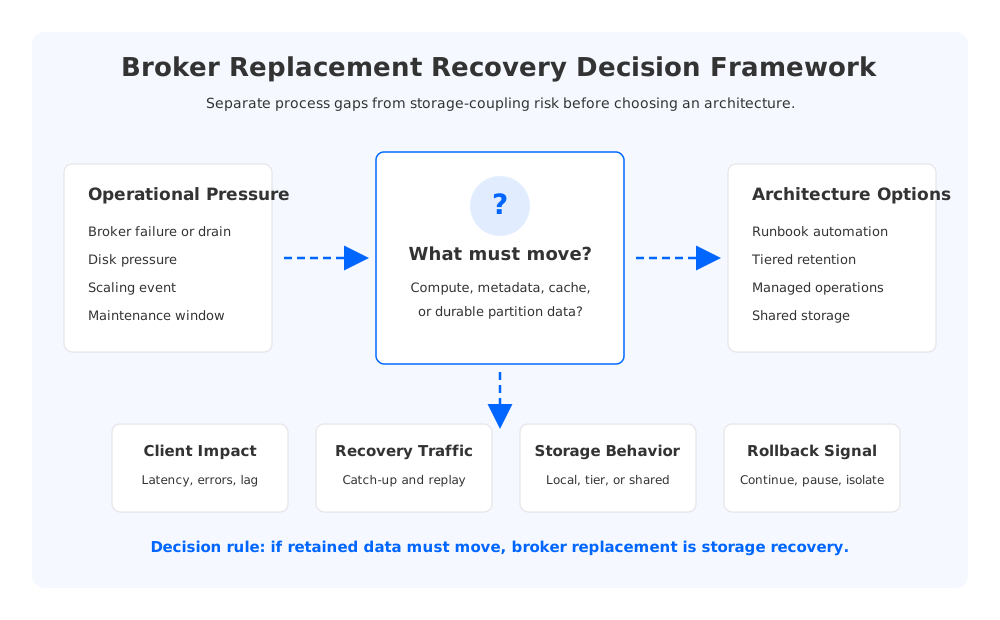
The right architecture depends on why broker replacement hurts. Teams often collapse several problems into one phrase, then compare products too early. A better evaluation separates the recovery bottleneck from the management preference.
Use this sequence:
- If the bottleneck is process discipline, improve automation first. Standardize broker drain, reassignment, throttling, observability, and post-replacement validation before changing architecture.
- If the bottleneck is long local retention, evaluate tiered storage or a retention redesign. Remote log storage may reduce local disk pressure without changing the whole platform.
- If the bottleneck is elastic capacity, evaluate whether broker-local data ownership is the actual constraint. Scaling compute is much easier when adding or removing brokers does not imply moving large retained logs.
- If the bottleneck is governance or deployment boundary, compare self-managed, provider-managed, BYOC, and software deployment models separately from the storage architecture.
- If the bottleneck is application compatibility, keep Kafka protocol behavior, client versions, offsets, consumer groups, transactions, ACLs, schemas, and connectors in the test plan from the beginning.
This framework prevents a common mistake: buying operational convenience when the real issue is storage coupling, or redesigning storage when the real issue is weak automation. Both mistakes are expensive. The first leaves the main pain intact. The second creates migration work without enough payoff.
5Where AutoMQ Changes the Operating Model
Once the evaluation reaches storage coupling, AutoMQ becomes relevant as a Kafka-compatible option built around Shared Storage architecture. It is not a replacement for Kafka semantics or platform discipline. Its architectural claim is narrower: keep the Kafka API and ecosystem surface while changing where durable stream data lives.
AutoMQ's architecture replaces Kafka's broker-local log storage with S3Stream, a shared streaming storage layer backed by WAL storage and S3-compatible object storage. Brokers become stateless in the durable-data sense: they still participate in request handling, leadership, caching, metadata, and recovery workflows, but retained partition data is not bound to a specific broker's attached disk. The recovery burden shifts from copying broker-local replicas toward validating WAL recovery, metadata, object-store access, and cache warm-up.
That shift changes broker replacement in three practical ways. First, a replacement broker does not need to inherit a large local disk full of partition replicas before it can be useful. Second, scaling and replacement can be reasoned about as compute operations with storage-layer checks, not as full data relocation projects. Third, teams evaluating BYOC or software deployments can keep the data plane within a customer-controlled cloud boundary while still asking for Kafka compatibility.
There are still questions to test. Shared Storage architecture must preserve Kafka behavior under real workload pressure. WAL design must match durability and latency goals. Object storage access, IAM policy, network routing, cache behavior, and metadata scale all become first-class operational concerns. A mature evaluation should include failure injection for broker loss, WAL interruption, object-store latency, credential rotation, leader movement, and consumer replay.
The point is not that shared storage removes recovery work. It changes what recovery work is about.
6Production Readiness Checklist
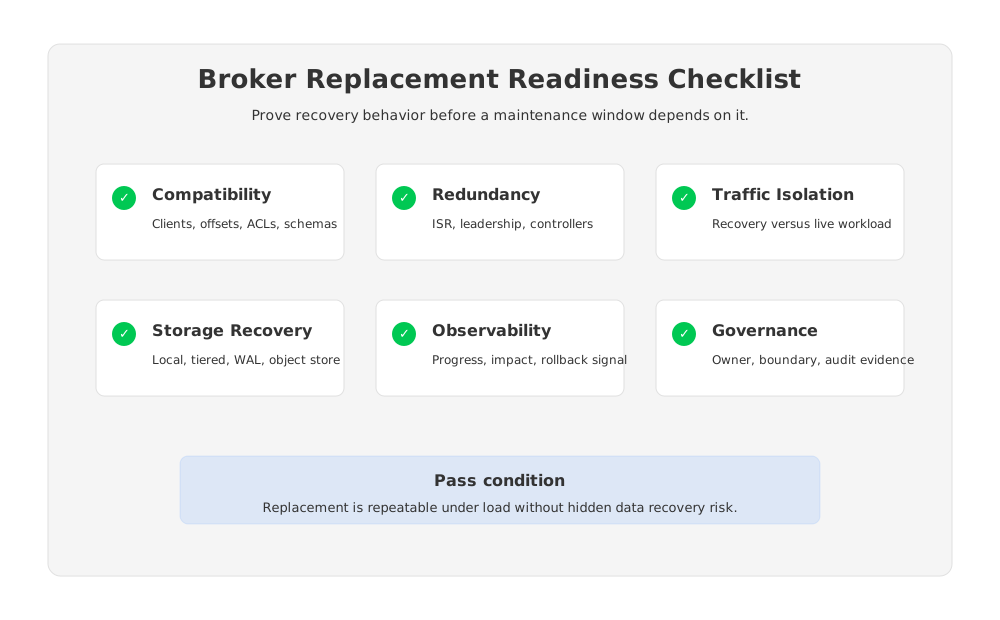
Broker replacement readiness should be a release criterion for the streaming platform, not a document filed after launch. The checklist below works for traditional Kafka, Tiered Storage, managed Kafka, and Kafka-compatible Shared Storage architecture.
| Checklist area | What to prove | Why it matters |
|---|---|---|
| Compatibility | Existing producers, consumers, connectors, schemas, offsets, ACLs, and transactions behave as expected | Broker replacement should not become an application migration |
| Redundancy | Replica, ISR, controller, and metadata behavior remain healthy during replacement | Availability depends on control-plane correctness, not only data copies |
| Traffic isolation | Recovery, reassignment, backfill, and replay traffic are visible and controllable | Operators need to protect live workload SLOs |
| Storage recovery | Local log, remote tier, WAL, object storage, and cache behavior are tested according to architecture | Each storage model fails differently |
| Observability | Dashboards show client impact, partition state, recovery progress, and rollback signals | A silent recovery is not a safe recovery |
| Governance | Ownership, approval, data boundary, and audit requirements are clear | Replacement is an operational event with compliance consequences |
The checklist also helps teams choose the right next step. If most failures are caused by unclear ownership, fix platform governance. If the cluster is healthy but recovery traffic is too large, revisit storage placement. If every replacement test passes technically but still requires a major maintenance window, the architecture may be correct but too expensive for the business workload.
7Decision Table
Use this table to narrow the decision before starting a proof of concept.
| Situation | Likely next step | Evidence to collect |
|---|---|---|
| Broker replacement is rare and predictable | Improve runbooks and automation | Replacement duration, error budget impact, and operator time |
| Replacement is slowed by retained local data | Evaluate tiered storage and retention policy | Local versus remote bytes, replay behavior, and remote fetch impact |
| Replacement and scaling repeatedly trigger data movement risk | Evaluate Kafka-compatible Shared Storage architecture | Broker replacement under load, WAL recovery, metadata correctness, and cache warm-up |
| Applications are sensitive to protocol differences | Prioritize compatibility testing before architecture migration | Client versions, transactions, consumer groups, connectors, and ACL behavior |
| Data control is a buying constraint | Compare BYOC, self-managed, and software deployment boundaries | Network path, IAM model, object storage ownership, and audit evidence |
Returning to the original search: kafka broker replacement recovery is not only an incident-response topic. It is an architecture signal. If replacing a broker means recovering a large amount of broker-owned data, the platform is carrying storage coupling into every failure, maintenance event, and scale change. That may be acceptable. It should be explicit.
If your Kafka roadmap includes more elastic capacity, longer retention, Kubernetes scheduling, cloud cost control, or frequent broker maintenance, test broker replacement as an architecture requirement. For teams evaluating a Kafka-compatible Shared Storage architecture, AutoMQ's architecture overview and GitHub project are practical places to start that evaluation.
8References
- Apache Kafka Documentation
- Apache Kafka KIP-405: Kafka Tiered Storage
- AutoMQ Architecture Overview
- AutoMQ Compatibility with Apache Kafka
- AutoMQ S3Stream S3 Storage
9FAQ
9.1Does Kafka broker replacement always require data recovery?
Not always in the same way. A healthy replicated Kafka cluster can continue serving traffic after a broker failure, but restoring the intended replica layout often requires data movement, catch-up, and validation. The operational question is how much data must move and how much live workload impact that movement creates.
9.2Is tiered storage enough to make broker replacement lightweight?
Tiered Storage can reduce local disk pressure by moving older closed log segments to remote storage. That helps many long-retention workloads, but it does not automatically make brokers stateless. The active log, local recovery path, metadata, and remote-tier behavior still need to be tested.
9.3What should a broker replacement test include?
Test replacement under production-shaped traffic, not in an empty cluster. Include producer latency, consumer lag, controller behavior, partition state transitions, recovery traffic, backfill reads, throttling, observability, and rollback criteria.
9.4How does Shared Storage architecture change the recovery model?
Shared Storage architecture moves durable stream data outside broker-local disks. Replacement then focuses more on compute scheduling, metadata, WAL safety, object-store access, and cache warm-up than on rebuilding large local replicas on a replacement broker.
9.5When should AutoMQ be evaluated?
Evaluate AutoMQ when Kafka compatibility matters and the recurring pain is broker-local storage coupling: replacement, scaling, partition movement, retention growth, or cloud operating cost. The proof should be workload-specific and should include failure injection, client compatibility, and recovery behavior under load.


