
Table of Contents
Table of Contents
A brief registry wobble can still leave an Apache Kafka producer timing out much longer. The first symptom is often rising send() latency, followed by retries and a queue of records that never reaches a broker. The broker may be healthy throughout because the producer is waiting on a schema lookup before the produce request is ready to leave the process.
Consider a common, anonymous failure pattern. Warm producers have already resolved a stable event schema, so traffic continues while a registry instance returns slow responses during a deployment or storage hiccup. A process starts, a schema changes, or a client evicts its entry. Several producers then miss the cache together, wait on the registry, and report a Kafka-looking outage while broker request latency stays normal.
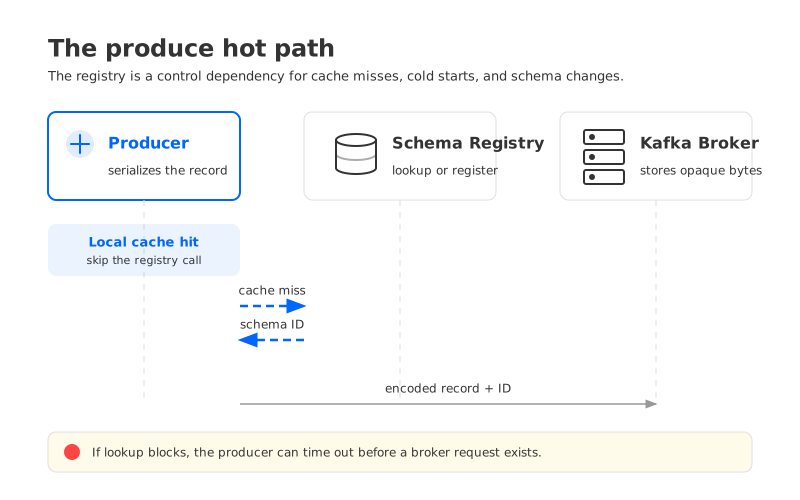
The distinction is simple: a schema registry governs how application bytes are encoded and decoded, while a Kafka broker accepts, stores, and serves records. The broker does not need to call the registry to append opaque bytes. A producer may still need the registry to turn a schema into the ID its serializer places beside the payload. That dependency sits on the hot path for cache misses, cold starts, and schema changes.
1Why a registry blip freezes the produce path
A schema-aware producer does more work than “serialize, then send.” The exact sequence varies by serializer and wire format, but the operating shape is usually:
- The application gives an event and writer schema to the serializer.
- The serializer checks a local mapping from schema or subject to registry-assigned ID.
- On a hit, it encodes the record with the known ID and hands bytes to the Kafka client.
- On a miss, it looks up or registers the schema before the Kafka client can produce it.
- The Kafka client sends the encoded record to the broker, which stores the bytes without resolving the schema.
The ID is the handoff token. It identifies a schema in the registry’s namespace, not a Topic, Partition, or broker object. A producer with the correct ID can often keep sending while the registry is unreachable. A producer with an unknown schema, empty cache, or invalid mapping must wait, fail, buffer, or use an explicitly supported fallback.
That is why “the registry is not in the data path” needs care. It is not required for every broker append, but it can be required to prepare a record for that append. Treat the lookup as a control dependency wrapped around the data path. Its failure mode determines whether the wrapper is transparent, slow, or blocking.
Broker metrics alone cannot explain this incident. Compare time spent in serialization and lookup, the Kafka client’s produce wait, and broker processing. If registry latency rises while broker latency stays flat, adding brokers will not repair the producer. Track lookup attempts, registrations, cache hits, evictions, unknown-schema failures, and time to first successful produce.
2The hot path has two different failure boundaries
The registry and the broker answer different questions. The registry answers, “What schema does this ID refer to, and may this version be registered?” The broker answers, “Can I accept, replicate, and serve these record bytes under Kafka’s delivery rules?” Keeping those questions separate prevents a registry outage from being treated as a broker durability incident.
| Component | Owns | Does not own |
|---|---|---|
| Producer serializer | Lookup, registration, encoding, and the schema ID in the record format | Broker replication, retention, or Partition leadership |
| Schema registry | Subjects, versions, compatibility checks, and ID resolution | Offsets, record durability, or consumer groups |
| Kafka broker | Produce requests, record storage, replication or shared-storage persistence, and Fetch requests | Payload meaning or schema validity |
| Consumer deserializer | ID lookup, schema resolution, decoding, and business validation | Whether a producer may publish a proposed contract |
A healthy broker cannot serve an old schema by itself. It stores the ID and payload but does not become a registry replica. Restoring Kafka topics without restoring registry history can leave consumers unable to decode retained records.
Cold starts expose this boundary. A process without a warm cache must resolve its schema before its first produce. Autoscaling, rolling restarts, failover, and container churn can turn a short registry disturbance into a fleet-wide event because many clients lose warm state at once. Make cache misses visible and test them separately from broker failures.
The same separation matters for consumers. A consumer that already holds an ID-to-schema mapping may continue decoding retained records, while a consumer rebuilding its cache can fail before it reads its first useful record. Producer and consumer caches therefore need separate alarms and recovery tests. A registry policy that protects only producer registration still leaves replay and cold-start reads exposed.
3Caching is the line between resilience and staleness
A local cache buys time by reusing a known schema ID. It must preserve the exact relationship between subject, schema fingerprint, and assigned ID. It should never guess an ID for another subject, format, or version.
A useful cache policy has three controls:
- Admission: Cache only a successful lookup or registration result, including subject, fingerprint, ID, and relevant format assumptions.
- Lifetime: Use a bounded lifetime or eviction policy that matches the recovery objective and tolerance for stale configuration. The cache may be size-bounded, time-bounded, or both.
- Invalidation: Quarantine mappings when endpoint, credentials, subject rules, serializer format, or restored registry state changes. A failed lookup should not erase every known mapping.
TTL is a client policy, not the lifetime of a schema ID. It says how long an entry may be used before revalidation. Many serializers use size-based caches without a time-based TTL, so document the actual behavior. When a known schema expires during a short, bounded outage, policy may allow stale use. An unknown schema has no safe ID to invent; fail it, buffer it, route it to an outbox, or enter a documented degraded mode.
Invalidation has a dangerous edge. If an administrator restores an older registry backup, an ID may no longer identify the same schema in the restored namespace. Do not reuse an ID from memory. Restore and verify subject and ID mappings, then revalidate clients. IDs are stable only within the registry history that assigned them.
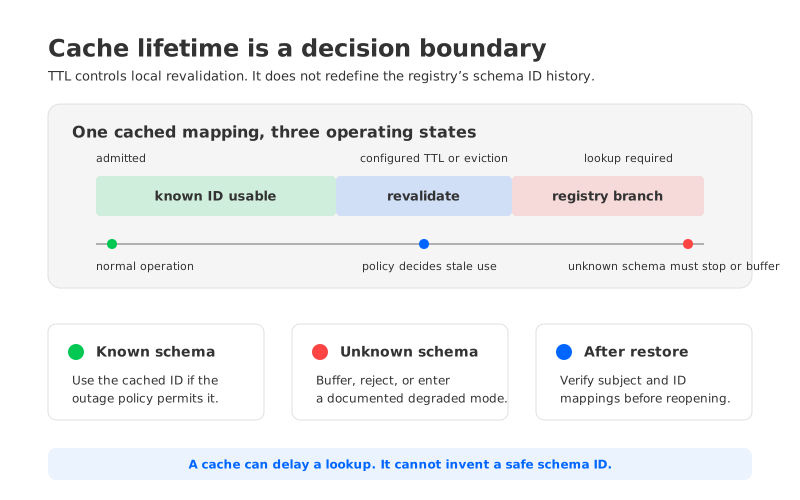
Test the cache as a failure component: warm and cold producers, registry loss, eviction, credential rotation, and restore. Define the expected result for every branch. “The producer usually has a cache” is not a recovery design.
Cache policy should also match the cost of a stale decision. For a telemetry event whose writer schema is already approved, a short stale window may be preferable to losing the event. For a payment or entitlement event, the safer choice may be to buffer or reject when the client cannot prove which contract it is using. The cache layer cannot make that business decision; it can expose the state needed for the application to make it.
Keep the decision visible in logs. Record whether a record used a fresh registry response, a warm cache, a bundled mapping, or a degraded path. Include the subject and schema fingerprint, but avoid logging payload data. After recovery, compare the set of cached mappings used during the outage with registry history and replay any buffered records through the normal serializer. That turns a vague availability event into a finite reconciliation task.
4Three degraded modes that keep the system honest
There is no universal fallback that makes an unknown schema safe. The choice depends on whether an approved schema can continue, whether the registry can serve reads while rejecting writes, and whether the business can buffer records. Three patterns cover the useful options.
4.1Continue from a local cache
This is the least disruptive mode for an established schema. The producer sends records whose fingerprint matches an approved local entry during a bounded outage. A versioned schema bundle beside the application can improve cold-start behavior if it is versioned, access-controlled, and checked against the registry during normal operation.
The cache authorizes known schemas only. It must not authorize an unapproved schema because serialization succeeded. Expose a “produced from cached registry state” metric and force revalidation after recovery. Use this mode when a stable contract matters more than immediate registry freshness.
4.2Switch to read-only registry behavior
A read-only posture separates lookup from mutation. Producers resolve approved subjects and IDs, while registration is disabled until the registry accepts writes again. The mechanism may be a read-only replica, an exported subject and ID map, or a client-side no-registration policy. The invariant is the same: known schemas proceed, unknown schemas stop or enter a buffer, and no client creates an ungoverned contract.
This gate also makes recovery clearer. Operators can inspect attempted registrations and reopen writes deliberately. Without it, clients may race to register versions while the incident is still being diagnosed.
4.3Enter an application-level degraded mode
Some workloads must preserve an event instead of publishing bytes that consumers cannot decode. An outbox, bounded buffer, quarantine Topic, or business-level backpressure can hold records until registration and compatibility checks succeed.
A fixed-schema mode can work when the application has a stable approved shape. Additional fields must be handled by an explicit product decision, because silently dropping them creates a data-quality incident. The mode must state what happens to ordering, duplicates, memory pressure, and deadlines. Recovery should define how records are revalidated and released.
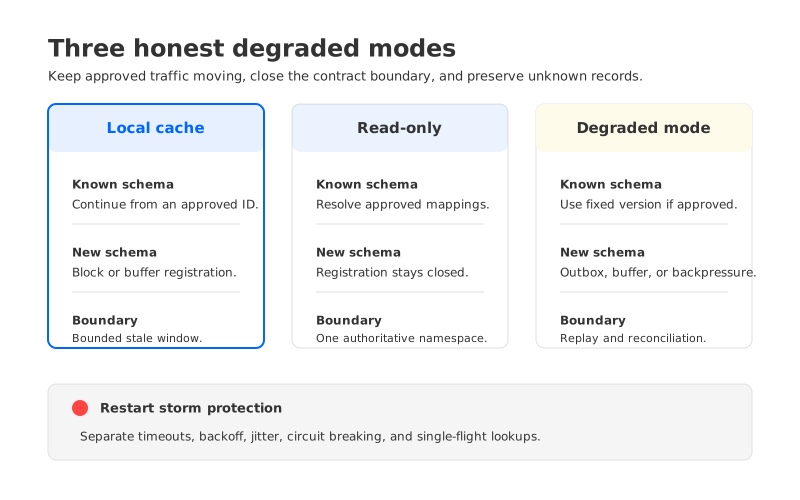
These modes complement one another. Local cache protects known traffic, read-only behavior protects the contract namespace, and application-level degradation protects data when lookup and registration are unavailable. None is permission to publish an unregistered schema.
5Protect the registry without creating a restart storm
A registry outage becomes worse when every producer treats a timeout as process-fatal. Restarting clears its cache, repeats the lookup, and adds another cold client to the failing service. A small dependency incident becomes a synchronized recovery problem.
Use failure isolation around the registry call:
- Give registry operations a bounded timeout separate from the Kafka produce deadline.
- Retry with exponential backoff, jitter, a cap, and a circuit breaker.
- Single-flight identical lookups so one schema does not create hundreds of calls.
- Keep process readiness separate from registry reachability when known cached schemas remain usable.
- Bound buffers and concurrent registration work so backpressure has an explicit limit.
Put registry request rate, errors, latency, cache ratio, serialization failures, Kafka produce latency, and broker errors on one view. Ask first whether a broker request exists, then whether known IDs still move, then where unknown schemas go.
Test a cold client, warm client, proposed schema, registry timeout, and broker timeout. If every case produces the same alert, operators will restart the wrong process. Distinct signals and bounded actions let the registry recover without a fleet-wide cache purge.
6What changes on a Kafka-compatible platform?
The resilience logic survives a change in the Kafka data plane because the registry and serializer remain application-side components. A separately deployed registry can serve clients connected to Apache Kafka or another Kafka-compatible endpoint. The producer still needs a known schema ID, and the broker still stores the resulting bytes.
That boundary is useful when evaluating AutoMQ. AutoMQ is a Kafka-compatible cloud-native streaming platform with its own data plane and storage architecture. A team can keep the registry independent, run the same serializer and cache tests, and verify the Kafka client path. AutoMQ does not change the producer’s need to handle cache misses, TTL policy, invalidation, or degraded writes.
AutoMQ’s Apache Kafka compatibility documentation describes the protocol boundary. Its architecture overview describes the data plane beneath it. Test registry failure separately from broker failure, then test the combined path with the real producer library.
7A schema registry resilience checklist
A useful resilience check ends with decisions an operator can test. Walk through these questions with producer, platform, and data owners:
- Can you draw the path from record to local cache, registry lookup, schema ID, and broker request?
- Are caches size-bounded, TTL-bounded, or both? What do warm and cold producers do during registry loss?
- Which schemas may continue from cache, and how is the match verified?
- Can the registry serve approved mappings while blocking additional registrations?
- Where do unknown-schema records go: bounded buffer, outbox, quarantine Topic, or explicit failure?
- What invalidates a cache after a subject, credential, serializer, or restore change?
- Are retries capped and jittered, with a circuit breaker and single-flight lookup?
- Can the actual fleet avoid a synchronized restart storm?
- Do dashboards distinguish lookup errors from Kafka produce and broker persistence errors?
- Can a retained record be decoded after registry state is restored?
The opening scenario had a healthy broker and a frozen producer because registry lookup was the missing step. Availability belongs to the whole produce path, and each dependency needs its own failure policy. Keep known schemas moving from a verified cache, stop proposed contracts when the registry cannot govern them, and make restart behavior boring.
If you are evaluating a Kafka-compatible data plane, run this checklist with one producer and one schema family. Test warm and cold starts, registry loss, cache eviction, read-only operation, buffered records, and broker failure separately. Then start an AutoMQ evaluation with the same failure matrix.
8FAQ
8.1Is Schema Registry part of the Kafka broker?
Usually, it is a separate service accessed by serializers and deserializers. Brokers store and deliver record bytes; they do not generally resolve the application schema behind them.
8.2Can a Kafka producer work when the schema registry is down?
A warm producer may continue for a known schema if its cache has the correct ID and policy allows bounded stale use. A cold or unknown schema should fail, buffer, or enter a documented degraded mode.
8.3Does a schema ID expire with a cache TTL?
No. TTL controls local revalidation or eviction. The ID remains meaningful only while the corresponding registry history is available and unchanged.
8.4Does AutoMQ replace Schema Registry?
No. AutoMQ is a Kafka-compatible streaming platform. A separately deployed Schema Registry can remain part of the architecture, with the same cache and failure tests.


