
Table of Contents
Table of Contents
Teams searching for object storage native retention kafka usually are not trying to learn another storage buzzword. They are staring at a production system where retention has stopped being a topic-level setting and has become a platform constraint. Seven days of Kafka history may fit comfortably on broker disks. Ninety days of retained events, replay-heavy consumers, audit requirements, and multi-region recovery tests can turn the same design into a capacity planning exercise that never really ends.
That pressure is easy to misdiagnose. A platform team may first ask for larger disks, a managed Kafka tier, or a remote storage feature. Those may help, but the deeper question is whether retained bytes should belong to brokers in the first place. Kafka's API makes retention look like policy. Kafka's classic storage model makes retention an ownership problem: each broker owns local log segments, and the cluster has to protect, move, and rebalance those bytes as infrastructure changes.
The practical thesis is narrow: object-storage-native retention is not valuable because object storage is fashionable. It is valuable when the workload proves that broker-local storage is the wrong boundary for durable history.
1Why teams search for object storage native retention kafka
The search intent usually appears after one of four events. A consumer group falls far behind and needs to replay more data than the hot tier was sized for. A compliance team extends retention from days to months. A data platform starts treating Kafka as the recovery source for downstream tables and state stores. Or a failure drill shows that replacing brokers is slower than replacing compute should be.
Apache Kafka defines retention through log configuration such as time-based and size-based retention, while Consumer groups track progress through offsets. That model is powerful because applications can replay retained records without asking upstream systems to resend data. It also means retained history is part of the operational contract. If the storage layer cannot keep enough history at the right cost and recovery behavior, the application contract becomes fragile.
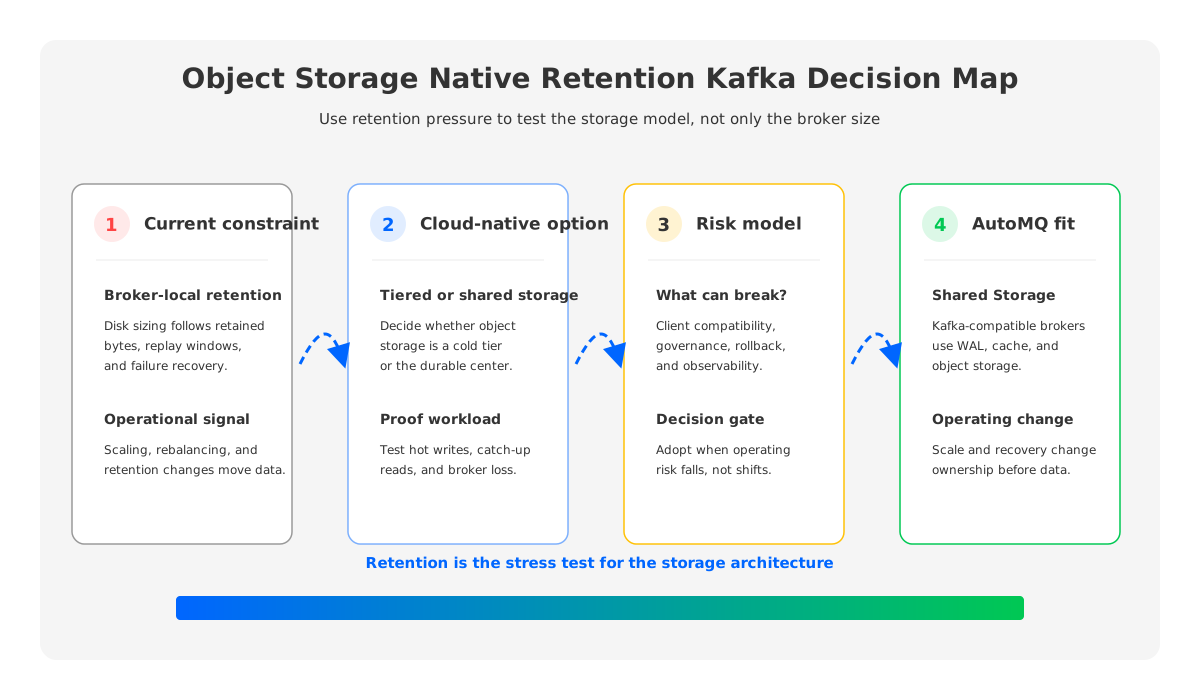
The important distinction is between "Kafka can delete data after a policy says so" and "the platform can afford to keep data until the business no longer needs it." The first is a broker configuration. The second includes disk sizing, replication, network paths, catch-up reads, object lifecycle policy, encryption keys, IAM boundaries, and migration plans. Retention exposes all of them because retained data is the part of the stream that lives long enough to meet every operational process.
2The production constraint behind the problem
Traditional Kafka follows a Shared Nothing architecture. Each broker owns local storage, partitions are assigned to brokers, and reliability comes from replicas kept across brokers. This design fits Kafka's original strengths: sequential writes, strong partition ordering, and a mature client ecosystem. It also creates a direct relationship between retained bytes and broker responsibility. When retained history grows, broker disks grow. When brokers change, partition ownership and data placement have to change with them.
Tiered Storage changes part of that equation. Apache Kafka's Tiered Storage documentation describes a local tier and a remote tier, allowing older log segments to move to remote storage while brokers continue to use local storage for the active log. For many teams, that is a useful reduction in local disk pressure. It does not automatically make the storage model object-storage-native because the broker-local tier still matters for the hot path, and teams still need to test remote reads, metadata, failure handling, and compaction behavior under their workload.
The storage assumption becomes visible during operations:
- Scale-out: Adding brokers can improve compute capacity, but the value depends on how quickly traffic and partition ownership can move without turning retained bytes into a background migration project.
- Scale-in: Removing brokers is where local ownership hurts more. The cluster has to prove that durable data can move or remain accessible without violating recovery objectives.
- Replay: Long retention is often justified by recovery and reprocessing. A design that keeps data but makes catch-up reads painful has moved the problem rather than solved it.
- Governance: Object storage brings bucket policy, encryption, lifecycle, audit, and regional controls into the streaming platform. Those controls help only when they are treated as part of the Kafka architecture.
This is why "object storage for Kafka" is too broad as an evaluation phrase. Object storage may be a remote cold tier, a backup target, a connector sink, or the primary durable center of a Kafka-compatible system. The architecture decision is not the presence of S3-compatible storage. The decision is whether durable log history remains broker-owned or becomes shared infrastructure.
3Architecture options and trade-offs
Platform teams should evaluate retention architecture through operating behavior, not labels. The following matrix keeps the conversation grounded.
| Option | Durable data model | What improves | What still needs proof |
|---|---|---|---|
| Classic Kafka with larger disks | Broker-local replicas | Familiar operations and mature ecosystem | Disk headroom, partition movement, recovery time, and cross-zone replication cost |
| Kafka Tiered Storage | Local active tier plus remote older segments | Lower pressure on local disks for older data | Remote read behavior, metadata scale, hot-tier sizing, compaction, and failure drills |
| Kafka-compatible shared storage | Object storage as durable center with WAL and cache around the write path | Retention decouples from broker-local disk ownership | WAL choice, cache behavior, object layout, client compatibility, and governance boundary |
| Managed Kafka service | Provider-operated Kafka or Kafka-compatible platform | Operational burden shifts to the provider | Data boundary, feature fit, cost model, migration path, and vendor control model |
The table is not a ranking. Classic Kafka may be the right answer when retention is short, workload shape is stable, and teams already have strong operational automation. Tiered Storage may be enough when the main pain is old data occupying expensive local disks, but broker replacement and hot-tier sizing remain acceptable. Shared storage deserves attention when every retention increase also affects scaling, recovery, and cost. Managed services deserve attention when the team wants to outsource operations, but that choice should still be tested against data ownership and exit requirements.
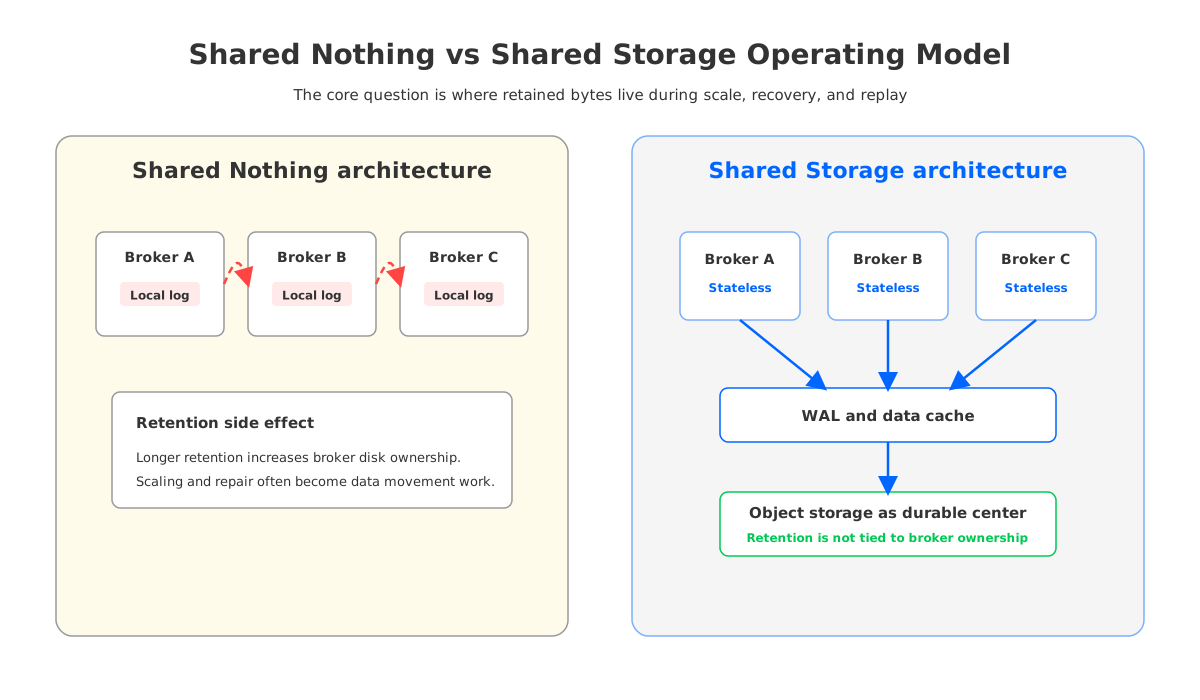
The uncomfortable part is that no option removes storage engineering. Object-storage-native systems still need a low-latency write path, cache management, metadata management, and efficient object access patterns. The trade is different: instead of asking brokers to be durable storage owners, the platform asks brokers to coordinate compute, protocol handling, caching, and ownership while shared storage carries retained history.
4Evaluation checklist for platform teams
A production evaluation should start with the existing Kafka contract. List the client versions, producer settings, transaction usage, offset management, Kafka Connect jobs, Schema Registry dependencies, consumer lag patterns, and replay objectives. Then run the retention decision through the same tests you would use for a failure drill. If the proposal works only in a clean benchmark and not during a broker replacement, consumer backlog, or rollback, it is not ready for the workload.
Use these questions as gates:
- Compatibility: Can existing producers, consumers, offset tools, transactions, and Connect workloads keep their application contract?
- Cost: Which costs scale with retained bytes: broker disks, replicated traffic, object storage capacity, object requests, network transfer, and management overhead?
- Elasticity: What happens when brokers are added or removed while retained data is large and traffic is uneven?
- Governance: Who owns the bucket, keys, endpoints, logs, audit trail, region selection, and lifecycle policy?
- Recovery: Can the platform recover a broker, availability zone, or controller event without turning retained history into a manual data operation?
- Migration: Can the team test dual-running, offset consistency, rollback, and cutover with real topics rather than synthetic streams?
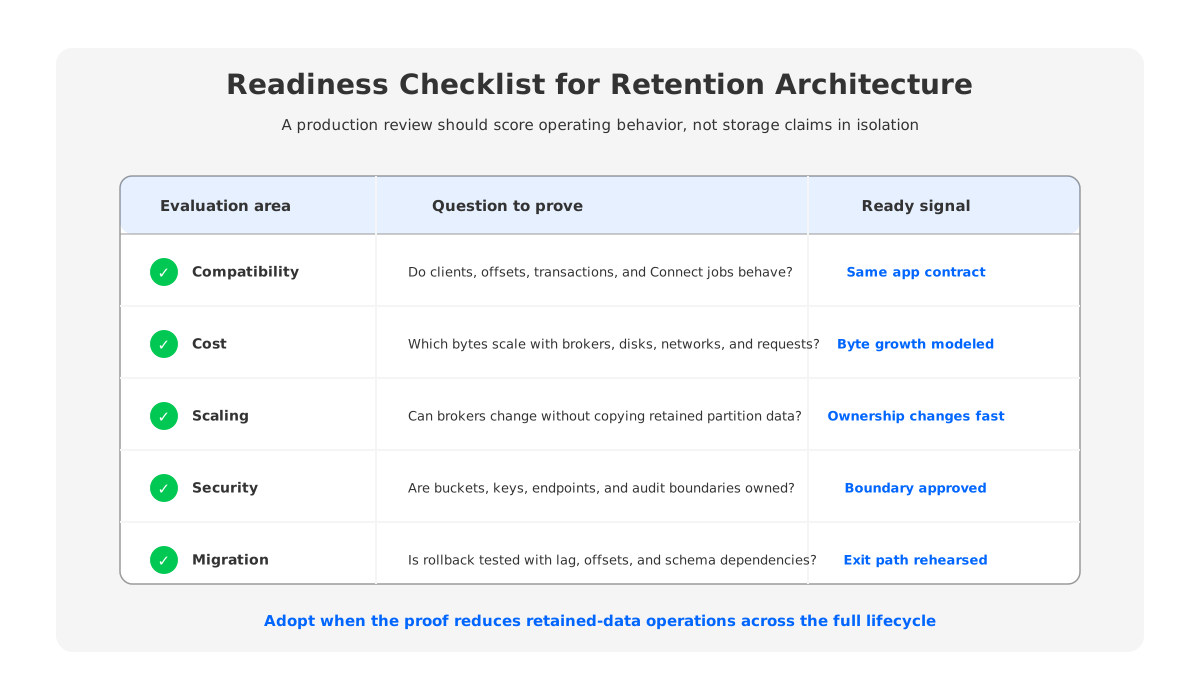
The strongest proof is boring in the right way: the test uses production-like topics, realistic consumer lag, the same security boundaries, and a rollback path that someone has rehearsed. If retained history is the reason for the architecture change, the proof must include retained-history behavior. Hot-write benchmarks alone are not enough.
5How AutoMQ changes the operating model
After the neutral evaluation, AutoMQ fits into the Kafka-compatible shared-storage category. It keeps Kafka protocol compatibility while replacing Kafka's broker-local log storage with a Shared Storage architecture built around S3Stream, WAL storage, S3 storage, and data caching. In this model, brokers are stateless for durable data ownership. They handle Kafka protocol work, leadership, caching, and scheduling, while retained data is stored in shared object storage.
That change matters most when retention growth collides with operations. If the retained log is no longer bound to a broker's local disk, scaling a broker pool is less about copying partition data and more about changing metadata, leadership, ownership, and traffic placement. AutoMQ's public architecture documents describe this as Separation of compute and storage: compute scales through brokers, while storage is carried by S3-compatible object storage with WAL storage supporting the write path.
The WAL layer is the part that keeps the design from becoming a naive "write every request directly to object storage" system. AutoMQ uses WAL storage as a durable write buffer and recovery layer, then stores long-lived stream data in object storage. Different AutoMQ deployment modes can use different WAL types, so evaluation should match the WAL choice to latency, availability, and infrastructure constraints. This is a design review item, not a footnote.
AutoMQ also changes the governance conversation. In AutoMQ BYOC, the deployment runs in the customer's cloud environment, so the data plane and supporting cloud resources can stay inside the customer's account boundary. For teams evaluating object-storage-native retention, that boundary is central: the object store is not an abstract backend. It is where durable Kafka-compatible history lives, so bucket ownership, KMS keys, network endpoints, and audit controls belong in the same architecture review as brokers and partitions.
There are still workloads where classic Kafka or Tiered Storage is enough. A small cluster with short retention and predictable traffic may not need an architectural migration. A team that mainly wants a remote cold tier should test Kafka Tiered Storage before changing the primary storage model. AutoMQ becomes more compelling when retained bytes are driving broker sizing, slow reassignment, recovery headroom, cross-AZ traffic analysis, or governance requirements that demand customer-controlled infrastructure.
6A migration scorecard you can use
Give each dimension a score from 1 to 5, where 1 means the current architecture is healthy and 5 means retention is actively limiting the platform.
| Dimension | Score 1 | Score 5 |
|---|---|---|
| Retained data growth | Retention is stable and small relative to broker capacity | Retention increases faster than broker capacity planning can absorb |
| Broker replacement | Replacement is routine and bounded | Replacement or scale-in triggers long data movement windows |
| Replay behavior | Catch-up reads meet recovery objectives | Replays disrupt brokers or miss recovery targets |
| Cost clarity | Storage, network, and request costs are understood | Retention costs are discovered after bills or incidents |
| Governance | Storage ownership and audit boundaries are approved | Retained data crosses unclear service or account boundaries |
| Migration readiness | Dual-run and rollback are tested | Cutover depends on assumptions about offsets and lag |
A high score does not mean "buy a different platform tomorrow." It means retention is no longer a storage setting. It is an architecture constraint that deserves a proof of concept with real topics, real client behavior, and failure drills.
If your retention review points toward Kafka-compatible shared storage, use the checklist above with your own topics and failure drills, then explore AutoMQ in a customer-controlled environment through the AutoMQ Cloud Console.
7FAQ
7.1Is object-storage-native retention the same as Kafka Tiered Storage?
No. Kafka Tiered Storage uses remote storage for older log segments while retaining a local tier for active data. Object-storage-native or shared-storage designs make object storage the durable center of the architecture, with WAL and cache around the hot path.
7.2Does object storage make Kafka retention unlimited?
It can make capacity planning more elastic, but "unlimited" is the wrong operating assumption. You still need object lifecycle policy, request-cost modeling, metadata scale checks, replay tests, and governance controls.
7.3What should teams test before adopting object-storage-native Kafka?
Test client compatibility, hot writes, consumer lag recovery, catch-up reads, broker replacement, scale-in, access control, encryption, observability, migration, and rollback.
7.4Where does AutoMQ fit in this evaluation?
AutoMQ fits when the target is Kafka-compatible streaming with Shared Storage architecture, stateless brokers, object-storage-backed durability, and customer-controlled deployment boundaries.
8References
- Apache Kafka Documentation: Operations and core concepts
- Apache Kafka Documentation: Tiered Storage
- AutoMQ Documentation: Architecture overview
- AutoMQ Documentation: S3Stream shared streaming storage
- AutoMQ Documentation: WAL storage


