
Table of Contents
Table of Contents
Teams usually search for read fanout architecture kafka after Kafka has already become useful. One topic has turned into a platform contract. A fraud service, a Flink job, a warehouse loader, an observability pipeline, and a replay tool all want the same stream, but they do not move at the same speed or read the same offsets. Tuning consumers, adding partitions, and separating consumer groups matter, but they do not answer the harder question: what storage model is absorbing the read pattern?
Read fanout is not a feature you switch on. In Kafka terms, it is the operational result of many independent consumers reading the same retained bytes through their own offsets and Consumer group assignments. Kafka's consumer model makes this powerful because each Consumer group can progress independently while the broker keeps the shared log. The same design makes fanout a useful stress test: when one written byte becomes many delivered bytes, broker storage, cache behavior, network placement, and recovery all become visible.
That is why fanout searches often come from platform teams rather than application developers. The application question is "Can another team read this topic?" The platform question is "What happens to broker disks, cross-zone traffic, rebalance risk, and recovery windows when five more teams do that?" A Kafka-compatible platform evaluation should start there.
1Why Teams Search for read fanout architecture kafka
Kafka makes fanout look clean at the API layer. Producers write records to a Topic, consumers read by Partition and Offset, and Consumer groups provide parallelism without forcing every downstream system to coordinate. The abstraction works because Kafka separates logical consumption progress from the physical log. A slow replay job can lag behind without blocking a low-latency serving consumer.
The trouble begins when that logical cleanliness meets production physics. A topic with one Consumer group mostly behaves like an ingest pipeline. The same topic with six independent readers behaves like a shared data product. Each reader may have different batch sizes, fetch settings, lag tolerance, security boundaries, and availability-zone placement. Some stay near the tail; others run backfills and turn retention into a read-heavy workload.
For platform teams, the first useful distinction is between steady fanout and replay fanout:
- Steady fanout is the normal number of read copies per written byte. It usually comes from production services, stream processors, search indexers, warehouse sinks, and monitoring pipelines.
- Replay fanout is the temporary reread load created by backfills, incident recovery, validation jobs, migration testing, or downstream onboarding.
- Governance fanout appears when audit, compliance, lineage, or data quality systems read the same records for reasons that are not visible to the producing team.
Those categories matter because they stress different parts of the platform. Steady fanout tests whether read throughput scales without forcing permanent over-provisioning. Replay fanout tests whether historical reads interfere with tail latency. Governance fanout tests whether access control, schema discipline, and observability can keep up as more teams treat Kafka as a shared source of truth.
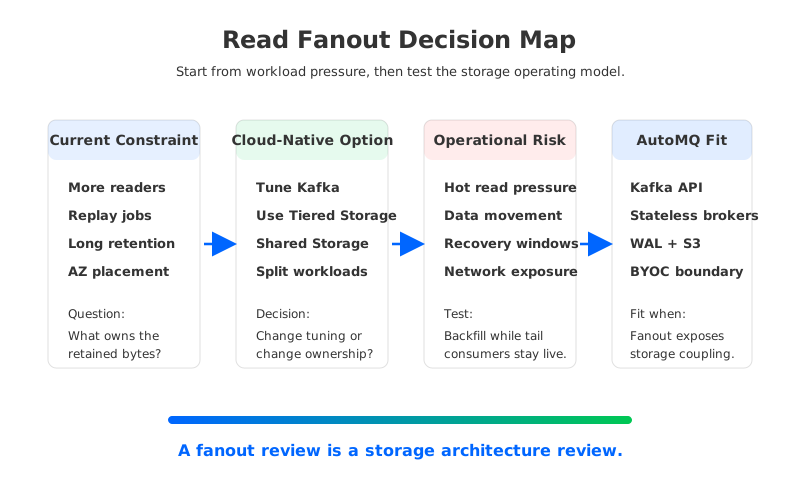
The phrase read fanout architecture kafka is a symptom of maturity. Early Kafka adoption asks whether the cluster can ingest data reliably. Mature Kafka adoption asks whether retained data can be reused safely and cost-effectively without turning every broker operation into a storage operation.
2The Production Constraint Behind the Problem
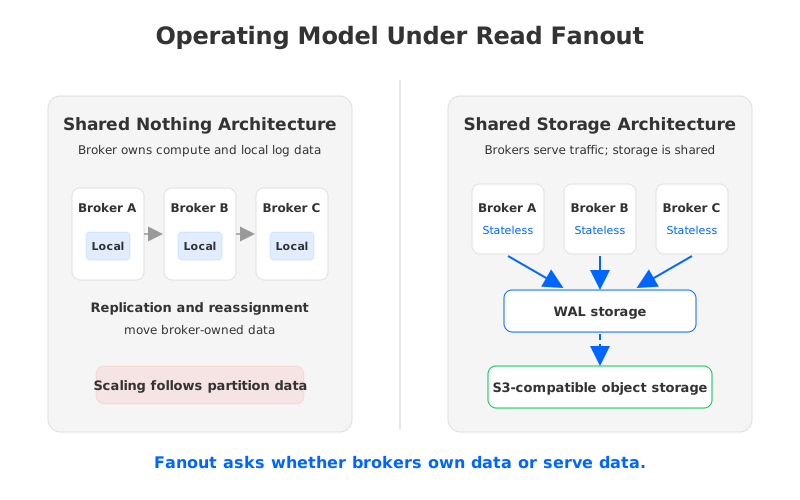
Traditional Kafka was built around a Shared Nothing architecture. Each Broker owns local log segments for the partitions it hosts, and durability comes from replication across brokers through ISR (In-Sync Replicas). The broker that serves a partition also has the local data needed to serve reads, accept writes, and recover followers.
The same design creates coupling that read fanout exposes. Broker-local storage is not only a place to keep bytes; it is part of the compute, recovery, and scaling boundary. More retained data needs more disk. More readers need more network, cache, and fetch capacity. Leadership changes and broker replacement still have to respect where data already lives.
Tiered Storage changes part of this equation, but it does not erase the operating model. Apache Kafka's Tiered Storage moves older log segments to remote storage while retaining the hot path and active log behavior on brokers. That can help long retention and disk pressure, but it does not make brokers fully stateless. The active write path, leadership, metadata, and hot reads still remain broker-centric.
This is the practical constraint behind high-fanout Kafka:
| Pressure | What teams notice | Storage assumption exposed |
|---|---|---|
| More Consumer groups | Read throughput grows faster than ingest | The broker must serve many copies from its local or cached log path |
| Backfills and replays | Historical reads compete with normal traffic | Retained data is not passive once downstream systems reread it |
| Multi-AZ placement | Reads and replication can cross failure domains | Data locality becomes a cost and latency variable |
| Scaling events | Capacity changes require careful reassignment | Partitions are tied to broker-local state |
| Broker failure | Recovery work is coupled to replica state | Replacement is not pure compute replacement |
This table is not an argument against Kafka. It is a reminder that Kafka's storage model carries assumptions from the environment it was designed for. In cloud environments, storage, compute, and cross-zone networking are billed, scaled, and failed in different ways. Fanout makes those differences harder to hide.
3Architecture Options and Trade-Offs
A platform team has several ways to respond to read fanout. The right answer depends on latency targets, retention, consumer behavior, operational ownership, and how much change the organization can absorb.
The conservative path is to keep the existing Kafka architecture and tune it hard. Teams can right-size fetch settings, isolate noisy consumers, place clients near leaders, use quotas, improve partition strategy, and separate workloads across clusters when blast radius matters. This path has low migration risk, but it keeps broker-local storage intact. If fanout is growing because Kafka is becoming a shared platform, tuning may postpone the next capacity step rather than change its shape.
Another path is to use Tiered Storage for longer retention. This can fit when historical retention is the main issue and the team wants to keep Apache Kafka's broker model. It is less satisfying when the main problem is elastic broker replacement, frequent leadership movement, or read fanout near the tail. Tiering older segments is different from redesigning where durable stream data lives.
A third path is to evaluate Kafka-compatible systems built on Shared Storage architecture. The Kafka protocol remains the application contract, but durable stream data moves away from broker-local disks into shared storage, usually object storage with a purpose-built write-ahead and cache layer. This path deserves a real benchmark because it changes the failure and scaling model while raising questions about write acknowledgment, cache behavior, object-store requests, and cold-read latency.
The architecture conversation gets healthier when teams stop asking whether one option is universally better. A low-latency trading path, a compliance replay pipeline, and an observability firehose may all use Kafka APIs, but they should not receive the same storage answer by default.
4Evaluation Checklist for Platform Teams
The most useful evaluation is not a generic feature comparison. It is a workload review that starts with the same inputs for every candidate platform. If one option is tested with real consumer lag, replay behavior, and network placement while another is judged from a diagram, the comparison will be weak.
Use this checklist before a proof of concept:
- Compatibility boundary. Confirm the required Producer, Consumer, Admin, transaction, offset, Kafka Connect, Kafka Streams, and Schema Registry behavior. Kafka-compatible should mean your real clients and tools work, not only that a sample producer can write records.
- Fanout shape. Separate steady readers from replay readers. Measure read copies per written byte, largest replay window, lag tolerance, and whether consumers read tail data, historical data, or both.
- Storage and recovery model. Identify where durable bytes live, how writes are acknowledged, what happens to data not yet uploaded to remote storage, and how a broker replacement restores service.
- Network path. Map producer, broker, consumer, object storage, and private network placement across Availability Zones, VPCs, and regions. Cloud network cost is a design variable, not an accounting afterthought.
- Governance and operations. Review access control, audit logs, encryption, observability, quota management, schema ownership, and the teams responsible for incident response.
- Migration and rollback. Test offset preservation, dual-write or replication behavior, validation reads, cutover order, and a rollback path before the target platform is treated as production-ready.
The proof of concept should include boring tests because boring tests find production risk. Restart brokers. Drain nodes. Run a backfill while normal consumers stay active. Increase fanout without increasing writes. Move one noisy consumer to another zone. Compare what breaks, what slows down, and what an SRE has to do.
5How AutoMQ Changes the Operating Model
Once the evaluation framework is clear, AutoMQ fits a specific category: a Kafka-compatible, cloud-native streaming platform that uses Shared Storage architecture instead of treating broker-local disks as the durable center. It keeps Kafka APIs while replacing local log storage with S3Stream, AutoMQ's shared streaming storage layer built around WAL (Write-Ahead Log) storage, S3 storage, and Data caching.
The architectural shift is easier to understand through failure and scaling. In a Shared Nothing architecture, a broker is both compute and the owner of local partition data. In AutoMQ's Shared Storage architecture, AutoMQ Brokers handle Kafka protocol work, leadership, caching, and request routing, while durable stream data is stored in S3-compatible object storage. The broker still has runtime responsibilities, but it is no longer the long-term home of the log.
That distinction changes how fanout is managed. Tailing Read serves recent data through cache-oriented paths, while Catch-up Read can prefetch historical data from S3 storage into cache. WAL storage absorbs the immediate durability path before data is uploaded to object storage. AutoMQ Open Source uses S3 WAL for a streamlined object-storage-only deployment, while AutoMQ commercial editions can use WAL options such as Regional EBS WAL or NFS WAL for workloads that need different latency and durability characteristics.
For high-fanout workloads, the point is not "object storage is lower cost." Storage growth, broker replacement, and read reuse no longer have to be governed by the same broker-local disk boundary. If a topic becomes a shared data product, the platform team can reason about compute, cache, WAL, object storage, network placement, and governance as separate levers.
This model also changes migration planning. AutoMQ commercial editions provide Kafka Linking for migrations that need message synchronization and offset consistency under supported conditions. That matters because fanout-heavy environments often have many downstream owners; a cutover that preserves producer writes but confuses consumer progress is not a successful migration. For teams that need customer-controlled deployment boundaries, AutoMQ BYOC runs the control plane and data plane in the customer's cloud account and VPC, while AutoMQ Software targets private data center deployments.
6A Readiness Scorecard for Fanout-Heavy Kafka
Before choosing a platform, score the workload rather than the vendor. A simple one-to-five score is enough if the conversation behind the score is honest. The point is to expose which assumptions deserve testing, not to create a false mathematical ranking.
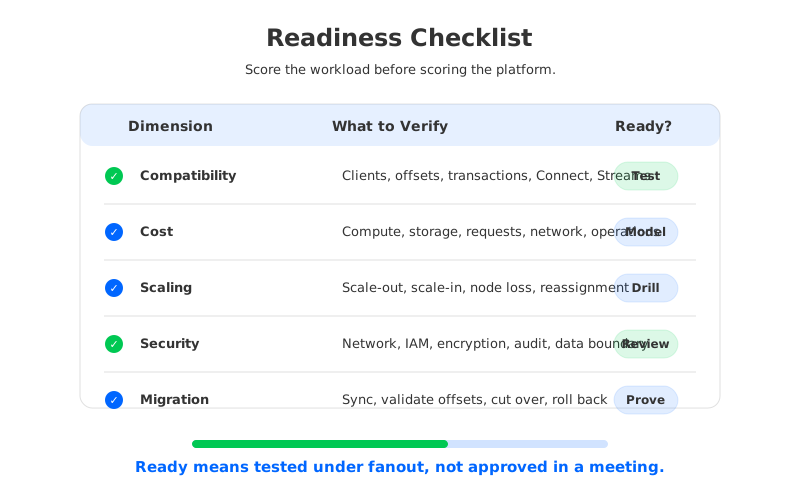
Use the scorecard this way:
| Dimension | Low-risk signal | High-risk signal |
|---|---|---|
| Kafka compatibility | Standard clients, simple offset behavior, limited transactions | Heavy transactions, custom clients, strict offset migration needs |
| Read fanout | Few steady consumers, rare replays | Many independent consumers, frequent backfills |
| Storage growth | Short retention, predictable volume | Long retention, uneven topic growth, replay-heavy use |
| Scaling | Stable cluster size | Frequent scale-out, scale-in, node replacement, or partition movement |
| Governance | Clear topic ownership and access boundaries | Many readers with weak schema, audit, or quota ownership |
| Rollback | Tested dual-run and validation plan | One-way cutover with unclear consumer recovery |
The scoring exercise usually reveals one of three outcomes. Some workloads belong on tuned Apache Kafka because fanout is modest. Some benefit from Tiered Storage because historical retention is the main pain. Others deserve Kafka-compatible Shared Storage architecture because the real problem is coupling between broker-local data, scaling, recovery, and read reuse.
7FAQ
7.1What does read fanout mean in Kafka architecture?
Read fanout is the number of independent read copies created from the same written data. In Kafka, it usually appears as multiple Consumer groups reading the same Topic at their own offsets, plus replay jobs that reread retained records.
7.2Is read fanout a Kafka problem or an application problem?
It is both. Applications create fanout by adding downstream consumers, but the Kafka platform absorbs the storage, cache, network, and recovery effects. That is why fanout belongs in architecture reviews, not only application design reviews.
7.3Does Tiered Storage solve read fanout pressure?
Tiered Storage can help when long historical retention is the main pressure. It does not make brokers fully stateless, and it does not automatically solve hot reads, active-log behavior, leader placement, or broker replacement.
7.4When should teams evaluate AutoMQ for fanout-heavy workloads?
Evaluate AutoMQ when the team wants Kafka compatibility but needs a different operating model for storage growth, broker replacement, read reuse, and cloud cost control. The strongest signal is not fanout alone; it is fanout combined with long retention, frequent scaling, replay-heavy consumers, or strict customer-controlled deployment boundaries.
7.5What should a proof of concept include?
Use real producers and consumers, not synthetic happy-path clients. Include steady fanout, replay fanout, broker restart, node replacement, consumer lag recovery, offset validation, network placement, observability, and a rollback exercise.
8Closing Thought
The next time a team asks whether another downstream service can read an existing Kafka topic, treat it as more than an application request. It is a small architecture review. If the answer depends on spare broker disk, careful partition movement, and hope that no replay job appears during an incident, the storage assumptions are already visible. To test a Kafka-compatible Shared Storage architecture in your own cloud boundary, start with AutoMQ Cloud and bring the fanout profile you actually run.


