
Table of Contents
Table of Contents
Someone searching for replication factor economics kafka is usually not asking what a replica is. They already know that a production Kafka topic often uses more than one copy, that leaders and followers matter, and that durability settings interact with acks, in-sync replicas, retention, and rack placement. The real question is sharper: when every retained byte becomes multiple broker-side copies, how much of the bill and operating model is a reliability requirement, and how much is a storage assumption inherited from the architecture?
That question matters because replication factor is one of the few Kafka settings that turns an abstract availability policy into physical infrastructure. A topic setting becomes disk footprint, broker recovery work, network movement, capacity headroom, and incident scope. If the platform team treats replication factor as a line item, they get a cost worksheet. If they treat it as an architectural signal, they get a better way to evaluate whether the storage model still matches the cloud environment around it.
1Why teams search for replication factor economics kafka
Replication factor feels like a local topic decision until it touches the rest of the platform. A team might start with a simple rule: production topics use replication factor three, test topics use fewer replicas, and critical workloads get stricter min.insync.replicas policies. That rule is defensible. Apache Kafka's design describes partitions as replicated logs, with one leader handling reads and writes while followers copy the leader and remain eligible for failover when they stay in sync.
The economic pressure appears after the cluster grows. Retention increases because more teams rely on replay. Partition count rises because application owners need parallelism. Multi-Availability-Zone placement becomes mandatory because a single zone is not an acceptable failure domain. None of those changes are waste by themselves. The problem is that traditional Kafka ties them together through broker-local storage, so the cost of reliability is paid through repeated local copies and the operational work needed to keep those copies healthy.
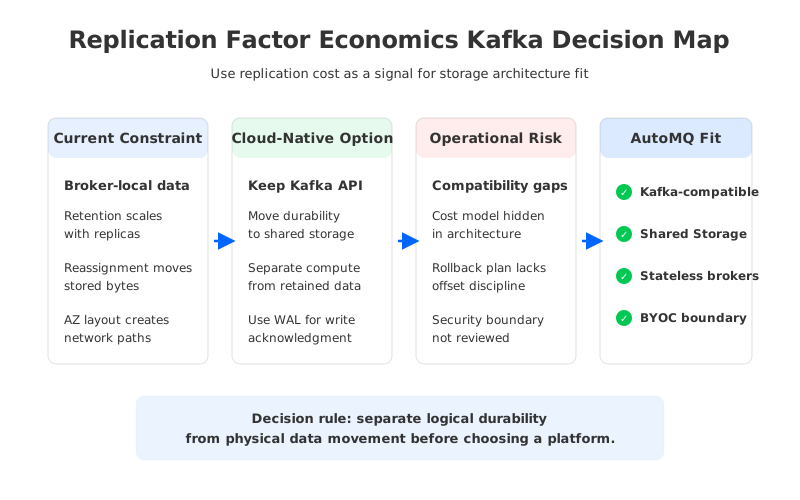
The first useful move is to separate logical durability from physical data movement. Logical durability asks how many failures the platform should tolerate before data is at risk. Physical data movement asks where bytes are copied, retained, rebalanced, and recovered. Traditional Kafka answers both questions with broker-side replicas. That answer is elegant in a Shared Nothing architecture, but it deserves a fresh review when the surrounding infrastructure already provides durable shared storage, zone isolation, identity controls, and managed networking primitives.
2The production constraint behind the problem
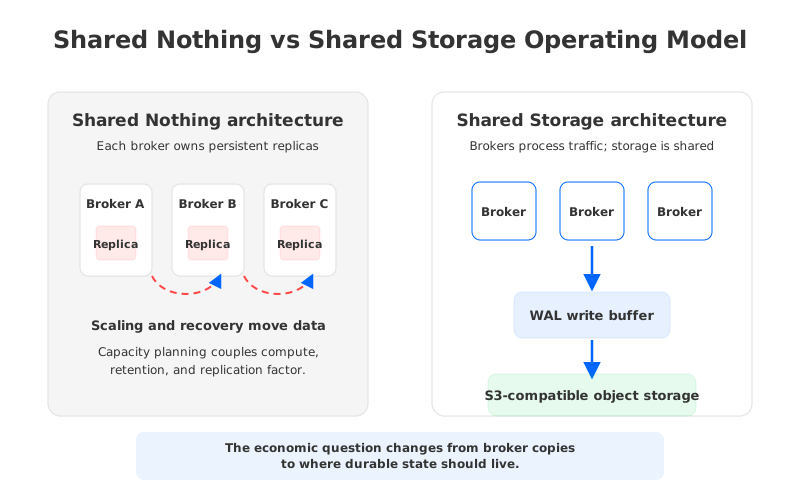
Kafka's Shared Nothing architecture was built around brokers that own their local state. A partition has a leader replica and follower replicas, and the cluster's recovery model depends on keeping those replicas placed, synchronized, and electable. This design gives Kafka direct control over ordering, acknowledgments, leader election, and catch-up behavior. It also means the broker is not disposable compute; it carries data that has to be protected before the node can be removed, replaced, or drained.
That statefulness changes capacity planning. A broker sizing review cannot consider CPU and network without also considering retained bytes, replication factor, disk utilization targets, segment behavior, compaction, and failure headroom. When a broker is added, removed, or replaced, the platform has to reason about partition placement and data movement. When a topic changes retention, the platform has to ask whether the broker fleet has enough disk and whether the recovery envelope still fits operational targets.
The practical cost model has several parts:
- Storage amplification. Retained logical data is multiplied by replication factor before disk headroom, file system overhead, compaction behavior, and snapshots enter the estimate.
- Network movement. In multi-zone layouts, follower replication and client placement can create cross-zone paths. The exact charge depends on the cloud provider, region, and routing pattern.
- Recovery headroom. A cluster needs spare disk, network, and broker capacity to survive a failure while followers catch up or partitions move.
- Change friction. Reassignment, scaling, and maintenance windows are harder when the unit of movement is retained partition data rather than ownership metadata.
Those four items explain why a replication factor discussion often becomes a platform strategy discussion. The team is not debating whether data should be durable. They are debating whether the broker-local replica model is still the right place to buy durability, elasticity, and operational safety.
3Architecture options and trade-offs
There are several legitimate ways to respond, and the wrong answer is to pretend the choice is purely about cost. Self-managed Kafka keeps the reference architecture and maximum direct control, but the platform team owns broker storage, replica placement, upgrade discipline, observability, and capacity planning. Managed Kafka services reduce some operational burden, but the buyer still needs to understand what is billed: broker capacity, storage after replication, data transfer, support tiers, and ecosystem services can each matter.
Tiered Storage changes part of the equation by moving older log segments to remote storage while keeping recent data on broker-local disks. It is valuable when long retention is the main pressure and hot data remains on the broker. It does not fully remove the stateful broker model, because leaders, followers, local hot data, and operational placement still matter. For teams whose main pain is retained history, Tiered Storage may be enough. For teams whose pain comes from scaling, recovery, and replica movement, it may leave the deeper constraint intact.
A cloud-native Kafka-compatible platform takes a different path: keep Kafka protocol behavior and ecosystem compatibility, but move durable storage away from broker-local disks. That shift is not a minor implementation detail. It changes the review question from "how many broker copies should we keep?" to "which layer should own durable state, and how does the system preserve Kafka semantics around it?"
| Architecture path | What it preserves | What it changes | Main review question |
|---|---|---|---|
| Self-managed Kafka | Direct Kafka control and familiar operations | Nothing fundamental about broker-local replicas | Can the team operate stateful brokers at the required scale? |
| Managed Kafka | Kafka semantics with reduced infrastructure ownership | Some operations move to the provider | Are billing dimensions and limits acceptable for the workload? |
| Tiered Storage | Kafka broker model with remote historical storage | Older segments can move away from hot disks | Is long retention the core problem, or is stateful scaling the core problem? |
| Shared Storage architecture | Kafka-compatible surface with shared durable storage | Brokers become less tied to retained data | Can the platform validate compatibility, durability, and migration boundaries? |
This matrix is intentionally neutral. The right option depends on workload shape, latency targets, failure domains, security requirements, team skills, and migration tolerance. A low-volume compliance log with long retention does not have the same needs as a high-throughput operational event bus with frequent scale changes and strict recovery targets.
4Evaluation checklist for platform teams
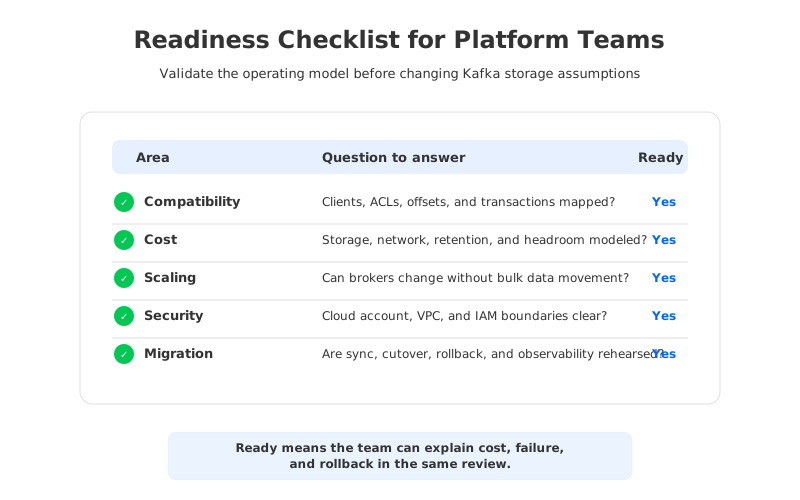
A good evaluation starts with numbers, but it should not end there. Calculate retained logical data, replication factor, compression, read fanout, peak traffic, cross-zone placement, and broker headroom. Then translate those numbers into operational questions. How long can reassignment run before it interferes with production traffic? How much spare capacity is required during a broker failure? Which teams can approve topic settings that change the shared cost envelope?
Compatibility deserves equal attention. Kafka is not a wire protocol alone; it is an ecosystem of clients, consumer groups, offsets, ACLs, transactions, Kafka Connect, Schema Registry integrations, monitoring assumptions, and operational scripts. A platform that claims Kafka compatibility should be tested against the specific client versions, authentication flows, topic configurations, offset migration requirements, and administrative workflows the organization uses.
Use this checklist before selecting or changing a platform:
- Workload shape: Measure compressed ingress, egress fanout, retention, partition count, peak factor, and replay behavior. A storage architecture that looks efficient for append-only logs may behave differently under heavy catch-up reads.
- Failure model: Define the failures the system must tolerate, including broker loss, zone outage, object storage access issues, bad deployments, and client misconfiguration.
- Cost model: Separate broker compute, broker-local storage, object storage, request costs, data transfer, observability, support, and operational labor. Do not compress all of them into a single monthly estimate.
- Governance model: Decide who can create topics, change retention, alter replication settings, and approve exceptions. Replication factor economics becomes a governance problem when many teams share one cluster.
- Migration model: Rehearse data sync, producer cutover, consumer offset handling, rollback, and post-migration validation. A platform change without a rollback path is an incident plan, not a migration plan.
The checklist forces a useful discipline: every architecture option has to explain both normal operation and failure operation. Many platforms sound similar during steady-state ingestion. They diverge when retained data has to move, when a broker disappears, when a workload doubles for a few hours, or when a team needs to replay historical data without disturbing active producers.
5How AutoMQ changes the operating model
This is where AutoMQ enters the evaluation. AutoMQ is a Kafka-compatible, cloud-native streaming platform that keeps the Kafka protocol and ecosystem surface while replacing Kafka's broker-local log storage with a Shared Storage architecture. The goal is not to make replication factor a careless setting. The goal is to move durable state into S3-compatible object storage so brokers can behave more like stateless compute.
In AutoMQ, S3Stream replaces Kafka's local log storage layer. Data is durably written through WAL (Write-Ahead Log) storage and uploaded to S3-compatible object storage, while brokers handle Kafka protocol processing, partition leadership, caching, and scheduling. WAL storage is not a second full copy of every retained log segment on every broker. It is a write buffer and recovery mechanism that helps bridge the latency gap between streaming writes and object storage.
That architectural distinction changes several operating assumptions. Scaling no longer has to mean moving large volumes of retained partition data between brokers. Recovery can focus on leadership, ownership, WAL recovery, and cache warm-up rather than rebuilding full local replicas. Retention planning can be modeled against shared object storage instead of multiplying broker disk first and then adding operational headroom. The platform still has to validate latency, read patterns, cloud storage behavior, and failure modes, but the unit of operational change is different.
For teams evaluating AutoMQ BYOC, the deployment boundary also matters. In a BYOC (Bring Your Own Cloud) model, the control plane and data plane run in the customer's cloud account and VPC, and business data remains in customer-owned storage. That boundary is important for security review because the storage architecture is not only about cost; it also determines who controls buckets, IAM policies, network paths, logs, metrics, and operational access.
The result is a different conversation with application teams. Instead of asking them to understand every broker disk side effect of retention and replication settings, the platform team can define policies around compatibility, durability, topic lifecycle, object storage, and migration readiness. That does not remove the need for engineering judgment. It moves the hard questions to a layer where cloud infrastructure is better equipped to answer them.
6Decision scorecard
The final decision should be explicit enough that an SRE, a platform architect, and a finance partner can read the same page and agree on what is being traded. If a traditional Kafka cluster is stable, cost-effective, and well understood, changing architecture may not be worth the migration risk. If replication factor is forcing recurring over-provisioning, slow reassignments, high recovery headroom, and cross-zone data movement, the storage model deserves a deeper review.
Score each candidate platform from one to five on the following dimensions:
| Dimension | What a strong answer includes |
|---|---|
| Compatibility | Verified clients, protocol behavior, ACLs, offsets, transactions, Connect, and observability workflows |
| Cost clarity | Separated compute, storage, network, request, support, and operations assumptions |
| Elasticity | Broker changes do not require bulk movement of retained data |
| Failure recovery | Clear behavior for broker, zone, storage, and deployment failures |
| Governance | Topic and retention policies map to ownership and approval paths |
| Migration safety | Tested sync, cutover, rollback, and post-cutover validation |
Return to the original search: replication factor economics kafka. The best answer is not "use fewer replicas" or "buy a larger cluster." The useful answer is to expose what replication factor is paying for in your current architecture, then decide whether broker-local copies are still the right mechanism for that job. If your review points toward a Kafka-compatible Shared Storage architecture, explore AutoMQ's architecture and deployment model through the AutoMQ documentation or start a hands-on evaluation with AutoMQ Cloud.
7FAQ
7.1Is replication factor still relevant in a Kafka-compatible shared-storage platform?
Yes, but its meaning changes by implementation. In traditional Kafka, replication factor controls broker-side partition replicas. In a Shared Storage architecture, durable state is handled through shared storage and WAL mechanisms, so platform teams should review the platform's documented durability and failure model rather than assuming the traditional broker replica model applies unchanged.
7.2Does Tiered Storage solve replication factor economics?
It can help when long retention is the main pressure because older segments can move to remote storage. It does not fully remove broker-local hot data, leader/follower replication, partition placement, or operational recovery work. Teams should treat Tiered Storage as one option, not as a complete substitute for storage architecture evaluation.
7.3What should I calculate before changing Kafka architecture?
Start with compressed ingress, retention, replication factor, disk utilization target, read fanout, cross-zone placement, peak factor, and recovery headroom. Then add migration and governance questions: client compatibility, offset handling, rollback, observability, security boundaries, and topic ownership.
7.4When should AutoMQ enter the evaluation?
After the team has a neutral evaluation framework. AutoMQ is most relevant when the platform wants Kafka-compatible APIs while reducing the operational coupling between brokers and retained data through Shared Storage architecture, stateless brokers, WAL storage, and S3-compatible object storage.


