
Table of Contents
Table of Contents
Searches for write amplification economics kafka usually start after a platform team has done the obvious work. Retention has been trimmed, oversized topics challenged, compression tuned, and producer settings reviewed. Yet the infrastructure bill still grows faster than the business signal the streaming platform carries. That is when the question changes from "How much data are we writing?" to "How many times does the architecture force us to write, copy, move, and rebalance the same data?"
Write amplification in Kafka-compatible streaming is not a single metric. It is an operating model. A record enters the system once, but the broker-centric design can turn that record into replica writes, local disk pressure, inter-zone traffic, recovery copies, partition movement, connector side effects, and governance overhead. Each copy may be necessary. The economic issue is that the cost shows up across separate budgets, hiding the full multiplier.
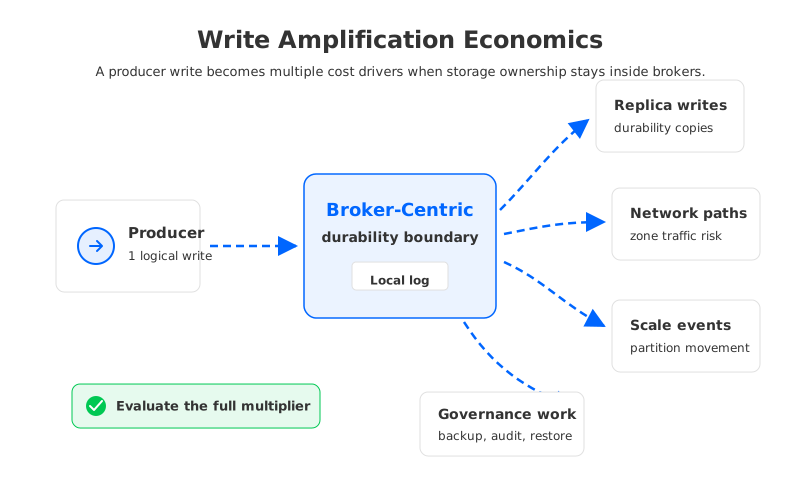
The mistake is treating write amplification as a storage tuning problem. Storage is involved, but the broader question is where durability, placement, elasticity, and recovery responsibilities live. When those responsibilities sit inside brokers with local persistent state, scaling and failure recovery become data movement scenarios. When they move into shared durable storage, the same Kafka-facing workload operates with a different cost shape.
1Why write amplification economics matters for Kafka teams
Kafka's original architecture made sense for machines with local disks, predictable capacity planning, and data center networking assumptions. A broker owned partitions, persisted local log segments, replicated data to other brokers, and served reads from the same local storage boundary. The model is direct and battle-tested. The economic pressure appears when cloud environments charge separately for compute, block storage, network movement, cross-zone placement, and operational labor.
For a technical buyer, write amplification economics asks five questions:
- How many durable writes happen for each producer write once replication and recovery are included?
- How much traffic crosses availability zones or network billing boundaries?
- How often does scaling require partition reassignment or disk-level data movement?
- How much headroom must be reserved because storage and compute scale together?
- How much human time is spent preventing, scheduling, or recovering from data movement?
These questions belong in the same evaluation because they affect one another. A team can reduce local disk pressure by adding brokers, but that may increase coordination overhead and replication paths. A team can add storage headroom, but that can leave compute underused. Aggressive rebalancing can create background I/O while production traffic is already high.
The economic unit is not the record. The economic unit is the record plus every architectural obligation attached to keeping it durable, available, movable, and governable.
This is why a narrow benchmark rarely settles the issue. A broker may show strong write throughput in a steady-state test, while the same platform becomes expensive during expansion, failover, retention growth, or multi-AZ operation. Steady-state write throughput measures the hot path; platform economics also include the cold path, the failure path, and the change path.
2Where broker-centric systems amplify writes
The first amplification point is replication. Kafka replication is a core durability mechanism: partition replicas are distributed across brokers, and the leader appends records before followers fetch and persist their own copies. This gives operators clear durability semantics, but it also means one producer write becomes multiple broker-side writes. In a multi-AZ deployment, replica placement may turn durability into network traffic across fault domains.
The second amplification point is local storage coupling. When partitions live on broker-local disks or attached block storage, the broker is not only a request processor. It is also a data placement unit. Adding capacity, replacing nodes, or rebalancing partitions means changing where data lives, and source brokers, destination brokers, network links, page cache, and consumer catch-up behavior can all feel the movement.
The third amplification point is recovery. A failed broker is not only a compute loss; it may also represent unavailable or stale local state. Kafka's replication model handles this through replica leadership, in-sync replica tracking, and recovery behavior. Those mechanisms are essential. They also mean that a resilience event can create background read and write work at the same time the cluster is trying to restore service quality.
| Amplification source | Technical reason | Economic symptom |
|---|---|---|
| Replica writes | Durability through broker-managed copies | More storage I/O and network traffic per producer write |
| Partition movement | Data ownership tied to broker-local state | Rebalance windows, throttling, and temporary overprovisioning |
| Catch-up reads | Followers and consumers need historical log data | Extra disk, cache, and object or block storage pressure |
| Retention growth | Longer log history stays attached to capacity planning | Storage headroom grows faster than compute demand |
| Governance operations | Backups, audits, isolation, and recovery drills need data access | More operational workflows around the same bytes |
The table matters because the rows are often owned by different teams. SREs see rebalance risk, FinOps sees storage and traffic, data engineers see connector lag, and security teams see governance boundaries. A platform decision that improves one row while worsening another has moved the cost to a different ledger.
3The cloud cost drivers behind the workload
Cloud infrastructure makes the multiplier visible because each resource has a separate meter. Compute hours, block volumes, object storage requests, object storage capacity, network transfer, private connectivity, observability ingestion, and managed services can all appear on different lines. This is useful for accountability, but it also hides cause and effect. A producer write may cause storage, network, compaction, and observability events that appear unrelated in the bill.
Broker-centric streaming clusters tend to reserve capacity in bundles. If brokers need more disk, the team may add instances that also bring compute and memory. If brokers need more CPU, the team may add instances that also bring disk. If the cluster needs lower risk during reassignment, the team may keep extra headroom. Bundling is operationally understandable, but it weakens the FinOps goal of scaling each resource according to demand.
The hard part is that write amplification is not evenly distributed. A stable topic with high append throughput may be predictable. A topic with bursty producers, long retention, many consumer groups, and periodic backfills can be far more expensive per useful event. The economic model should classify workloads by behavior, not only by average throughput.
Useful workload dimensions:
- Write intensity: append rate, message size distribution, compression ratio, and producer burst shape.
- Durability topology: replication factor, fault domains, acknowledgement policy, and recovery point expectations.
- Read pattern: tailing consumers, catch-up consumers, fan-out, backfills, and replay frequency.
- Retention profile: hot window, compliance window, deletion pattern, and topic growth rate.
- Change frequency: broker replacement, autoscaling, partition reassignment, tenant onboarding, and migration cycles.
Once those dimensions are explicit, cost discussions become less emotional. A team can say, "This workload is expensive because we require high write durability, long retention, multi-zone placement, and frequent tenant-driven scaling in a broker-local storage model." That sentence points toward architecture instead of blaming the application team for using the platform.
4Storage, network, and compute trade-offs
The core trade-off is where the system pays for durability. In a broker-centric shared-nothing architecture, each broker participates in durability through local persistent storage and replica coordination. This keeps the data path close to the broker, but ties compute capacity and storage ownership together. In a shared-storage architecture, brokers focus more on Kafka protocol handling, leadership, caching, and scheduling, while durable data lives outside any single broker.
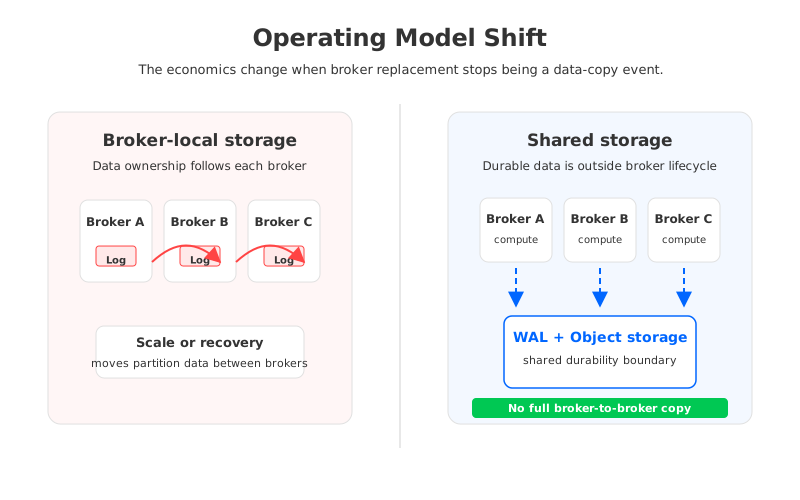
This distinction is often confused with tiered storage, but the operating model is different. Tiered storage can move older segments to object storage while brokers still own the hot log and local durability path. A diskless or shared-storage design changes the primary persistence boundary: broker replacement, scaling, and partition ownership need less broker-to-broker copying because durable data is already outside the broker's local disk lifecycle.
That shift does not remove engineering trade-offs. Object storage has different latency, request, and consistency characteristics than local disks or attached block volumes. A production design still needs a write-ahead log, caching strategy, metadata management, compaction policy, and read-path optimization. Shared storage changes which writes are mandatory and which writes are artifacts of local data ownership.
For architecture review, compare the models across operating states:
| Operating state | Broker-centric local storage | Shared-storage streaming design |
|---|---|---|
| Normal produce path | Broker writes local log and coordinates replicas | Broker persists through WAL and shared durable storage design |
| Scale-out | More brokers often means partition movement | More brokers can add compute without moving the full data set |
| Broker failure | Recovery depends on replica state and leadership changes | Replacement broker can recover ownership from shared metadata and storage |
| Long retention | Broker-attached capacity planning remains central | Object storage can carry durable history with compute scaled separately |
| FinOps review | Cost spread across broker fleet, disks, and network | Cost model can separate compute, WAL, cache, and object storage layers |
The review should be specific about workload fit. Low-latency trading pipelines, compliance archives, observability ingestion, AI feature freshness, and CDC fan-out do not stress the same part of the system. A serious evaluation maps each workload to these operating states, then checks whether the architecture reduces mandatory data movement without weakening required Kafka semantics.
5Evaluation checklist for FinOps and platform teams
A useful checklist turns write amplification from a vague complaint into a decision record. The goal is to expose hidden multipliers before a migration, renewal, or expansion locks them into the platform for another planning cycle.
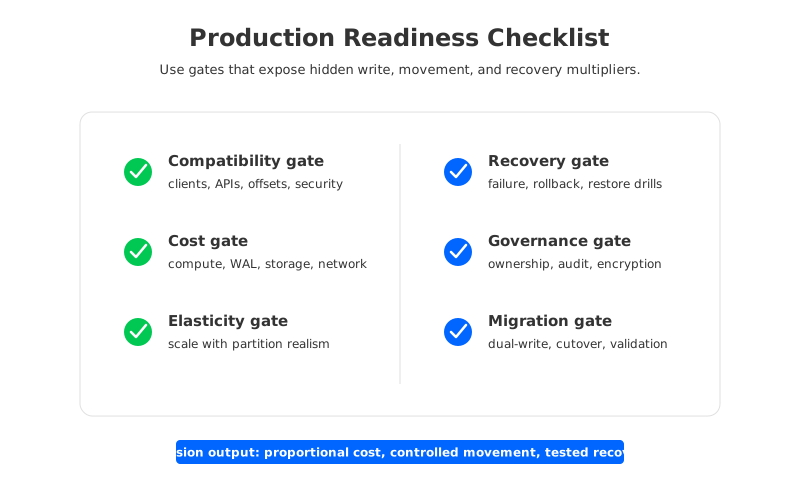
Start with compatibility. Kafka-compatible should mean more than accepting producer and consumer connections. Review client versions, consumer group behavior, offsets, transactions, idempotent producers, Kafka Connect, monitoring integrations, security configuration, and operational tooling. If an architecture reduces storage movement but breaks application semantics, the economic case collapses during migration.
Then evaluate the cost model in layers. Separate compute, WAL or hot persistence, cache, durable storage, network boundaries, observability, and control-plane operations. This prevents a common mistake: comparing broker instance cost alone while ignoring traffic, storage growth, or rebalance and recovery labor.
The checklist should include decision gates rather than vague preferences:
- Compatibility gate: required Kafka APIs, client behavior, security controls, and operational integrations are verified before cost claims are accepted.
- Cost gate: the team can explain which writes are required for durability and which are caused by broker-local placement.
- Elasticity gate: scale-out and scale-in procedures are tested with production-like partition counts and consumer behavior.
- Recovery gate: broker failure, zone impairment, and rollback scenarios have measured operational steps.
- Governance gate: data ownership, encryption, access control, audit, backup, and deletion boundaries are documented.
- Migration gate: dual-write, mirror, cutover, rollback, and validation plans are owned by named teams.
These gates change the buying conversation. Instead of asking whether a platform is "fast enough," the team asks whether the platform keeps write, movement, and recovery work proportional to the business event stream.
6How AutoMQ changes the operating model
Once the evaluation reaches architecture rather than feature checklists, AutoMQ enters the discussion naturally. AutoMQ is a Kafka-compatible cloud-native streaming platform that keeps Kafka protocol and ecosystem compatibility while moving storage to shared object storage. Brokers still handle Kafka-facing compute work, but durable data is no longer broker-local property.
In AutoMQ's design, S3Stream provides the streaming storage layer, WAL storage handles low-latency durable writes and recovery buffering, and object storage holds persistent data. Brokers can be more stateless because partition data is not bound to local disks in the same way. The cost conversation changes from "How many brokers and disks carry peak data volume?" to "How should we size compute, WAL, cache, and object storage?"
The economic impact comes from reducing avoidable data movement. If scaling adds compute without forcing large partition copies, expansion becomes a scheduling and ownership problem rather than a storage migration event. If durable history lives in object storage, retention growth does not push broker disk capacity in lockstep with compute. If the architecture avoids cross-AZ traffic in the Kafka data path, network cost becomes a design variable rather than a surprise.
This does not mean every Kafka cluster should be replaced immediately. Mature Kafka estates often encode years of operational assumptions in scripts, dashboards, client settings, quotas, and incident runbooks. AutoMQ is most compelling when the current pain is architectural: fast-growing retention, expensive multi-AZ replication, frequent scaling, tenant isolation pressure, or recovery procedures dominated by data movement.
For teams evaluating that shift, the practical next step is a workload-level model. Pick one representative topic family, document write rate, retention, fan-out, replay behavior, fault-domain requirements, and rebalance process, then compare operating states. If the largest costs come from broker-local storage coupling, shared-storage Kafka deserves a serious test.
If you are building that model for a production Kafka estate, AutoMQ's architecture docs are a useful starting point. Explore AutoMQ and use the checklist above to choose the first workload.
7References
- Apache Kafka documentation
- Apache Kafka replication design notes
- Apache Kafka KRaft documentation
- AutoMQ architecture overview
- AutoMQ S3Stream shared streaming storage overview
- AutoMQ WAL storage documentation
- AutoMQ stateless broker documentation
- Amazon S3 user guide
8FAQ
8.1What is write amplification economics in Kafka?
Write amplification economics is the total cost impact of every extra write, copy, transfer, recovery operation, and rebalance action created after a producer sends a record. In Kafka-compatible systems, the important question is not only how much data enters the cluster. It is how the architecture multiplies that data across replicas, disks, zones, storage layers, and operational workflows.
8.2Is write amplification always bad?
No. Some amplification is the price of durability, availability, and recoverability. The problem is avoidable amplification: data movement caused by tight coupling between broker compute and persistent storage, or capacity decisions that force teams to scale disk, CPU, memory, and network together when the workload only needs one of those resources.
8.3How is shared storage different from Kafka tiered storage?
Tiered storage typically moves older log segments to object storage while brokers still own the primary hot log and local persistence path. A shared-storage streaming architecture changes the persistence boundary more deeply, so durable data is not tied to a broker's local disk lifecycle in the same way. That difference matters during scaling, recovery, and long-retention planning.
8.4Where should a team start the evaluation?
Start with one workload family rather than the entire Kafka estate. Document write rate, retention, fan-out, replay behavior, fault-domain requirements, storage growth, and rebalance procedures. Then compare how the existing architecture and a shared-storage alternative behave during normal writes, scale-out, broker failure, catch-up reads, and rollback.


