
Table of Contents
Table of Contents
Teams usually search for diskless kafka write path after Kafka has already become important enough to hurt. The cluster is stable, producers are tuned, and consumer groups are familiar, but the platform team is still carrying a storage problem that does not behave like a pure Kafka problem anymore. Broker disks need headroom before the next peak. Partition reassignment moves real data through real networks. A broker failure is not only a compute replacement event; it is a storage recovery event. When the same cluster also carries audit logs, CDC streams, telemetry, and AI feature events, the write path becomes the part of the platform that decides how expensive growth will be.
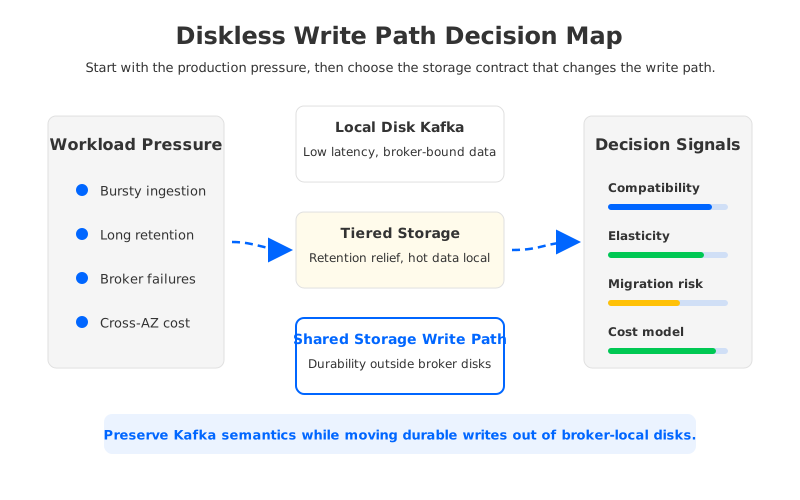
That is the useful way to think about diskless Kafka. It is not a slogan about removing every disk-shaped thing from a deployment. It is a design question: where does a successfully acknowledged write become durable, who owns that durability, and how much broker-local state must be moved when the cluster changes shape? A Kafka-compatible system can keep client APIs, producer acknowledgments, consumer groups, offsets, and operational tooling familiar while changing the storage contract underneath. The hard work is proving that the updated contract preserves the semantics your applications depend on.
1Why teams search for diskless kafka write path
The search intent is rarely academic. Platform owners are trying to answer a production question: can they keep Kafka compatibility while reducing the amount of durable data tied to broker-local disks? Traditional Kafka gives a clean programming model to application teams, but its operational model binds compute, storage, replication, and recovery tightly together. That binding is manageable when traffic is predictable and retention is short. It becomes expensive when workloads are bursty, replay-heavy, or spread across availability zones.
The write path is where this coupling shows up first. A producer sends records to the partition leader, the broker appends those records to the log, replicas fetch the data, and acknowledgments depend on the durability settings the team has chosen. Settings such as acks=all and min.insync.replicas matter because they express a business decision about loss tolerance. They also express an infrastructure decision: durable writes require data to land on enough broker-side storage before the client gets success.
Several symptoms push teams toward a diskless evaluation:
- Scaling is slowed by data movement. Adding or removing brokers is not only a compute scheduling action. Partition replicas and log segments have to move, and that movement competes with production traffic.
- Cross-zone replication becomes a material cost center. Multi-AZ Kafka improves availability, but every replicated byte can also become a network accounting event in cloud environments.
- Retention and replay pull against broker sizing. Longer retention makes analytics and recovery easier, but it also increases the storage footprint each broker must carry or coordinate.
- Failure replacement has too much storage drama. Replacing a failed broker should feel like replacing compute. In a broker-local model, the platform still has to reason about local state, replica catch-up, throttling, and hot partitions.
None of these symptoms proves that a diskless architecture is the right answer. They prove that the write path deserves architectural review. The decision should start from durability semantics and operational boundaries, not from a vendor label.
2The storage constraint behind cloud Kafka
Kafka's original storage model made sense in a world where brokers owned local disks and the cluster handled replication. A partition leader accepted writes, follower replicas copied the log, and the cluster used that replication for availability. This is a strong design. It is also why Kafka became the default backbone for event-driven systems: the log abstraction is simple, and broker storage behavior is explicit enough for operators to reason about.
Cloud infrastructure changes the economics around that design. Compute instances are easier to replace than physical servers, object storage offers durable capacity without preallocating broker disks, and managed block storage has its own replication and availability model. Meanwhile, Kafka still sees the broker as the place where active log storage lives. Cloud teams can end up paying for durability through both Kafka replica placement and the cloud provider's storage and network architecture.
The uncomfortable part is not the existence of replication. Production streaming systems need redundancy. The issue is that broker-local replication can make unrelated operations expensive. A retention change becomes a disk planning exercise. A hot partition becomes a broker placement problem. A scale-in event becomes a data relocation project.
This is why tiered storage and diskless write paths are often discussed together, but they are not the same architectural move. Tiered storage primarily changes where older log segments live. It can reduce local disk pressure and make longer retention more practical, but the active write path still typically depends on broker-local storage for hot segments. A diskless or shared-storage write path asks a sharper question: can durable writes be committed to a storage layer that is not owned by a particular broker?
3Architecture options: local disk, tiered storage, and shared storage
The easiest mistake in a diskless Kafka evaluation is comparing product names instead of write-path contracts. A better comparison starts with what happens when a producer write is acknowledged and what the platform must do after a broker disappears.
| Architecture option | Where active writes become durable | Operational strength | Hidden constraint |
|---|---|---|---|
| Local disk Kafka | Broker-local log replicas | Mature semantics, low-latency local append, familiar operations | Scaling and recovery move data between brokers |
| Tiered storage | Hot data on broker disks, older segments in remote storage | Better retention economics and replay from remote tiers | Active write path remains tied to broker storage |
| Shared storage write path | WAL and shared/object storage outside broker-local disks | Broker replacement and scaling can become compute-first operations | Requires careful latency, metadata, and compatibility validation |
Local disk Kafka is still a good fit when the cluster is predictable, retention is modest, and operators value the known failure model more than elasticity. The danger is letting familiarity hide cost. If most of the platform budget is spent preserving broker-local headroom for rare peaks, the architecture is making a business decision that nobody formally approved.
Tiered storage is a pragmatic middle ground. Apache Kafka's tiered storage work, associated with KIP-405 and remote log storage, addresses a real pain point: keeping all retained data on broker disks is wasteful when only a small fraction is actively read. For teams whose main problem is retention, tiering can be enough. It does not automatically solve scaling inertia, because leaders still append to local logs and broker replacement still has to preserve the active write path.
Shared storage is the more disruptive option. It moves durability away from the individual broker and into a storage layer designed to outlive broker instances. The broker becomes closer to a stateless compute node: it handles protocol, coordination, caching, and request processing, while the durable record of the stream lives elsewhere.
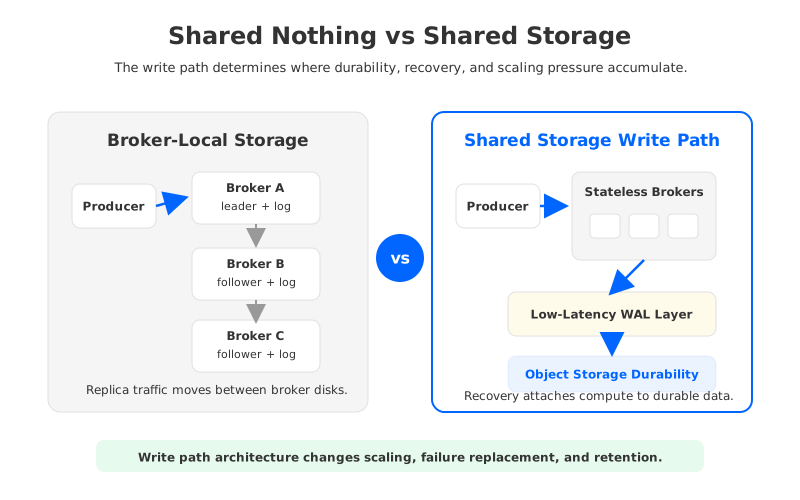
The trade is not free. Object storage is durable and elastic, but it is not a local SSD. A serious write-path design usually needs a low-latency write-ahead log layer, batching rules, metadata discipline, and clear recovery behavior. The point is not to pretend storage latency vanished. The point is to put each storage system in the role it can actually serve: fast acknowledgment path where latency matters, durable object storage where capacity and persistence matter, and brokers as replaceable compute.
4Evaluation checklist for platform teams
A useful evaluation does not start with "is it diskless?" It starts with the contract your applications already rely on. Kafka clients encode assumptions about ordering, retries, idempotence, transactions, offset commits, consumer group rebalancing, ACLs, and observability. A Kafka-compatible write path has to preserve the parts of that contract that matter to production, and it has to make any intentional limitation visible before migration.
Compatibility is the first gate because it is the easiest place to fool yourself. A benchmark that only tests simple produce and consume loops does not answer whether your actual workload is safe. Check client versions, producer idempotence, transactions, connector behavior, schema registry integration, consumer lag tooling, and administrative workflows. If the system claims Kafka compatibility, the proof should be specific enough for your application owners to sign off.
Cost is the second gate, but it should not be reduced to storage price per GB. The write path affects several cost lines at once:
- Broker compute reserved for storage headroom and catch-up work.
- Block storage or instance storage provisioned for peak retention and replica growth.
- Cross-AZ network traffic from replication, client placement, and follower reads.
- Object storage capacity, request volume, lifecycle policy, and private connectivity.
- Operational labor for reassignment, broker replacement, hot partition mitigation, and incident recovery.
The right comparison is a workload model, not a sticker price. Model the write throughput, read fan-out, retention window, replication policy, AZ topology, recovery target, and peak-to-average ratio. Then ask which architecture makes the cost curve less sensitive to traffic shape. Diskless write paths are most compelling when local storage is the main reason the cluster cannot scale with demand.
Latency is the third gate because it protects the user experience. A shared-storage design can be excellent for telemetry, CDC, audit logs, and many event-driven application streams, but the write acknowledgment path still needs measured p95 and p99 behavior under normal load, broker loss, storage throttling, and replay pressure. The useful number is what happens when the cluster is doing the kind of work that used to make Kafka operators postpone reassignments until Sunday night.
Governance is the fourth gate. Moving durable stream data into cloud storage changes who owns buckets, keys, IAM roles, network endpoints, audit logs, and backup policy. For regulated teams, this can be an advantage because data can stay inside customer-controlled cloud accounts and regions. It can also create confusion if the control plane, data plane, and operations team do not have clean boundaries.
5How AutoMQ changes the operating model
Once the evaluation is framed around the write path, AutoMQ fits into a specific architectural category: a Kafka-compatible, shared-storage streaming system that separates broker compute from durable stream storage. AutoMQ keeps the Kafka protocol surface familiar while using shared storage and object storage as the foundation for persistence. In that model, brokers no longer need to behave like the permanent home of partition data.
The practical effect is operational. If durable stream data lives in shared storage, broker replacement can be treated more like compute recovery. If storage capacity is decoupled from broker count, the team can scale compute for traffic and storage for retention independently. If cross-AZ replication no longer requires every durable byte to be copied broker-to-broker, the cloud network cost model changes.
AutoMQ's design centers on S3Stream shared streaming storage, a WAL layer, and object storage. The WAL layer absorbs the latency-sensitive part of the write path; object storage provides scalable durable capacity; stateless brokers process Kafka-compatible requests on top. That combination is the reason AutoMQ can talk about second-level scaling, faster reassignment, and reduced cross-AZ traffic without asking application teams to rewrite Kafka clients.
There are still questions a buyer should ask. Which Kafka APIs and client versions are covered for the workload? Which WAL option is used in the target cloud or private environment? How are metadata, object storage permissions, encryption keys, and operational access controlled? What does rollback look like if a migration stalls? Strong architecture makes these questions easier to answer; it does not remove the need to ask them.
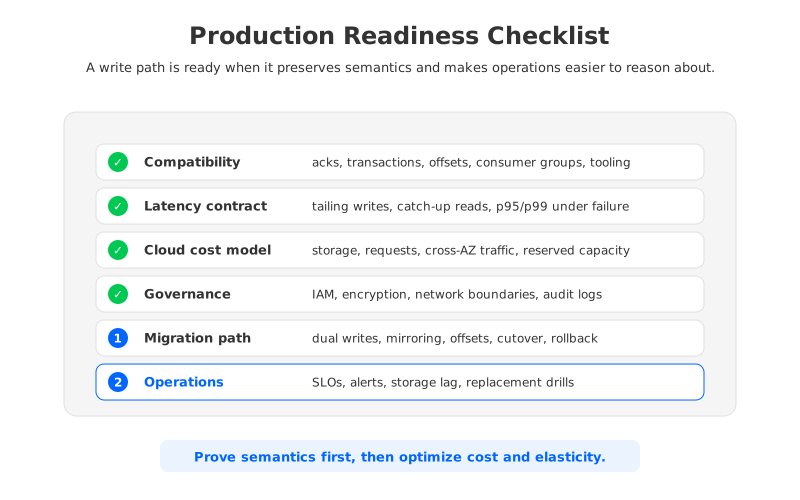
The migration pattern should be deliberately boring. Inventory client behavior, mirror or dual-write where needed, validate offsets and consumer groups, compare lag and latency under representative traffic, and rehearse rollback before declaring cutover complete. A diskless write path can make the steady-state platform simpler, but migration is still a distributed-systems change. Treat it with the same discipline you would apply to a database storage migration.
If your team is evaluating whether broker-local storage is now the limiting factor in your Kafka estate, start with the write path rather than the product category. AutoMQ's shared-storage architecture is documented in the AutoMQ Cloud overview, which is the right next step when you want to test Kafka compatibility, storage boundaries, and cloud operations against your own workload.
6References
- Apache Kafka Documentation: https://kafka.apache.org/documentation/
- Apache Kafka KIP-405: https://cwiki.apache.org/confluence/display/KAFKA/KIP-405%3A+Kafka+Tiered+Storage
- Apache Kafka KIP-1150: https://cwiki.apache.org/confluence/display/KAFKA/KIP-1150%3A+Diskless+Topics
- AutoMQ Shared Storage Architecture: https://docs.automq.com/automq/architecture/overview?utm_source=blog&utm_medium=reference&utm_campaign=aivk-0007
- AutoMQ S3Stream Shared Streaming Storage: https://docs.automq.com/automq/architecture/s3stream-shared-streaming-storage/overview?utm_source=blog&utm_medium=reference&utm_campaign=aivk-0007
- AutoMQ Kafka Compatibility: https://docs.automq.com/automq/architecture/technical-advantage/native-compatible-with-apache-kafka?utm_source=blog&utm_medium=reference&utm_campaign=aivk-0007
- AutoMQ Cross-AZ Traffic Guidance: https://docs.automq.com/automq-cloud/eliminate-inter-zone-traffics/overview?utm_source=blog&utm_medium=reference&utm_campaign=aivk-0007
7FAQ
7.1Is diskless Kafka the same as tiered storage?
No. Tiered storage usually moves older log segments to remote storage while keeping the active write path on broker-local storage. A diskless or shared-storage write path moves the durability contract for active stream data away from broker-local disks.
7.2Does a diskless write path remove all storage latency concerns?
No. It changes where latency has to be engineered. A production design still needs a low-latency acknowledgment path, clear batching behavior, metadata safety, and measured tail latency under failure and replay.
7.3What Kafka features should be checked first?
Start with the features your applications actually use: producer acknowledgments, idempotence, transactions, consumer group coordination, offset management, ACLs, Kafka Connect behavior, migration tooling, and observability integrations.
7.4When is a shared-storage Kafka-compatible architecture most useful?
It is most useful when broker-local storage is the reason the platform is hard to scale, expensive to run across AZs, slow to recover, or difficult to size for retention.
7.5How should a team pilot a diskless Kafka write path?
Pick a workload with representative producer settings, consumer fan-out, retention, and failure expectations. Run a dual-write or mirrored migration, compare offsets and lag, test broker replacement, measure p95 and p99 latency during replay, and document rollback before moving critical traffic.


