
Table of Contents
Table of Contents
Teams usually search for "traffic costs Amazon MSK" after the first bill has already made the architecture visible. The cluster looked straightforward during provisioning: three Availability Zones, managed brokers, enough storage, and a familiar Kafka API. Then the workload grows, consumers multiply, and the networking section of the AWS bill starts to look less like background infrastructure and more like a product decision. That charge is often Kafka's replication model showing through the cloud bill.
Amazon MSK is a reasonable service for many Kafka teams. It removes a large amount of broker lifecycle work, integrates with AWS networking and security controls, and keeps the Apache Kafka interface that application teams expect. The problem is narrower than "managed Kafka is expensive." The real question is whether the traffic cost comes from tunable placement choices or from the deeper mechanics of broker-local storage, multi-AZ replication, and read fanout. Those two cases lead to very different decisions.
1Why Cross-AZ Traffic Becomes an MSK Planning Issue
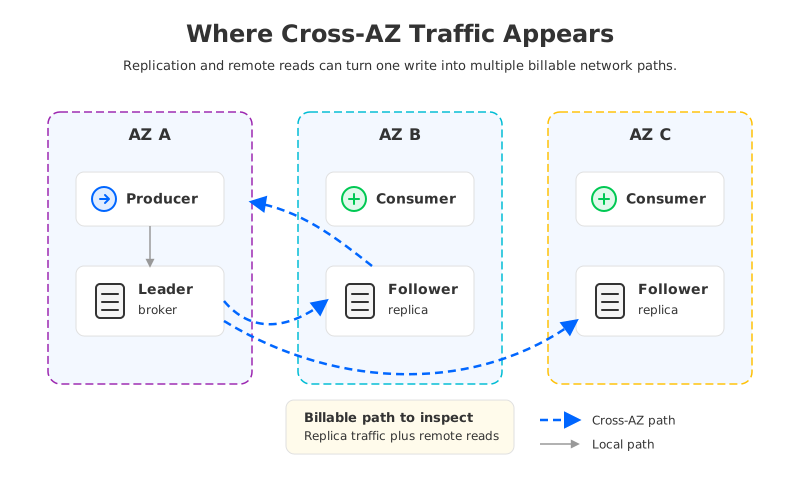
Kafka was designed around brokers that own partitions and store logs locally. For durability, a leader broker writes a record and follower brokers replicate that record. In a multi-AZ deployment, those followers often sit in different Availability Zones by design. That is good for availability, but it also means data movement crosses zonal boundaries as part of the normal write path. The same pattern can appear on reads when consumers in one zone fetch from leaders or replicas in another zone.
AWS documents data transfer pricing separately from service compute and storage pricing, and EC2 data transfer between Availability Zones in the same region is a distinct metered category. Amazon MSK pricing also reminds buyers that standard broker, storage, and data transfer charges can all apply. The exact number depends on region, workload, and topology, so a useful evaluation should avoid pretending that one universal percentage explains every bill. What matters is the formula: sustained streaming traffic multiplied by replication paths, read fanout, and hours per month.
The first useful split is between traffic you can reduce without changing platforms and traffic inherited from the architecture:
- Client placement traffic comes from producers and consumers connecting across zones. Rack-aware clients, subnet placement, and bootstrap behavior can reduce this when applications can run near the brokers they use.
- Replica traffic comes from Kafka's durability model. If a record is replicated to followers in other zones, that movement is not a mistake in the deployment; it is the deployment doing what it was asked to do.
- Fanout traffic grows with the number of independent consumers. A topic that looked affordable with one consumer group may behave very differently when analytics, monitoring, feature pipelines, and backfills all read the same stream.
- Rebalance traffic appears when partitions move between brokers. Even if it is not the dominant monthly line item, it affects maintenance windows, scaling confidence, and incident recovery.
That distinction keeps the discussion factual. MSK does not create cross-AZ traffic out of nowhere; it runs Kafka in a cloud environment where zonal data movement has an explicit price. A good MSK alternative evaluation starts by mapping avoidable and structural bytes.
2The Workload Inputs Most Cost Pages Leave Out
A traffic-cost estimate that starts with broker count is usually too late in the reasoning. Broker count is an output of throughput, retention, partition count, peak headroom, and operational policy. If those inputs are wrong, the estimate can look precise while still being useless. For planning, the better unit is the workload: how many bytes are written, how many times they are read, how long they are retained, and where each actor runs.
The following worksheet is deliberately plain. It gives platform, FinOps, and architecture teams a shared vocabulary before anyone argues about which service is lower cost.
| Input | Why it matters | Planning question |
|---|---|---|
| Sustained write throughput | Drives replication traffic and storage growth | What is the normal MiB/s, not only the peak? |
| Read fanout | Multiplies broker egress and possible cross-zone reads | How many consumer groups read the same retained data? |
| Retention window | Determines stored bytes and recovery backlog | Is Kafka used as a short buffer or a long-lived log? |
| Availability target | Sets replica placement and failure tolerance | Which AZ failures must the platform absorb? |
| Client locality | Determines whether reads and writes stay zonal | Can applications be scheduled in the same zone as their preferred brokers? |
| Change rate | Affects reassignment, scaling, and maintenance cost | How often do topics, partitions, or capacity targets change? |
The trap is to treat these inputs as finance-only data. They are architecture data. A workload with modest write throughput but high read fanout may spend more on reads than on replication. A workload with long retention may have a storage problem before it has a network problem. A workload with frequent topic churn may have an operations problem that shows up as slow rebalancing rather than as one obvious line on the bill.
3Tuning MSK Before You Replace It
An MSK alternative should not be the first answer to every bill spike. If the current deployment has poor client placement, uncompressed messages, excessive retention, or idle over-provisioned brokers, fix those issues first. They reduce waste, clarify the baseline, and make any later migration business case more credible. Tuning also prevents a common mistake: moving to a different architecture while carrying the same workload hygiene problems along with it.
Start with the controls that do not change the application contract. Compression reduces bytes before they hit the broker. Retention cleanup prevents Kafka from becoming the default archive for every downstream team. Partition reviews can reveal topics that were over-partitioned for a launch and never revisited. Client locality and rack awareness can reduce avoidable cross-zone paths, especially for consumers that can run in the same zone as the broker replicas they read from.
These levers are worth doing, but they have a ceiling. They can reduce unnecessary movement; they do not remove broker-to-broker replication when durability depends on broker-local copies. They can improve utilization; they do not make retained data independent from the broker fleet. When the largest cost and operational pain sit behind those boundaries, the evaluation has moved from tuning to architecture.
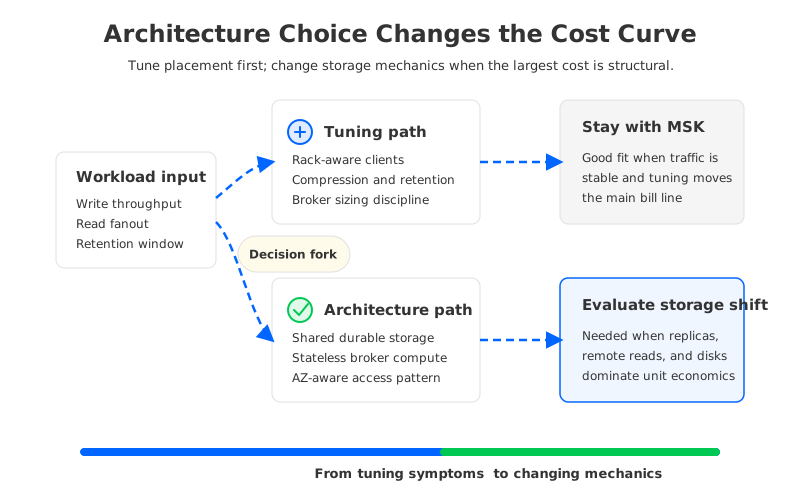
The decision point is practical: if the bill improves meaningfully after placement, compression, retention, and sizing work, MSK may still be the right answer. If network and storage remain dominant, evaluate whether the storage model is doing too much work in the broker layer.
4Architecture Choices That Change the Cost Curve
Traditional Kafka uses a shared-nothing broker model. Each broker owns local data, replication is handled by Kafka, and scaling often means moving partition data from one broker to another. That model is reliable and widely understood, which is why it remains a rational default. In the cloud, however, it can duplicate responsibilities that regional storage services already provide: durable storage, multi-zone availability, and elastic capacity behind an API.
A shared-storage Kafka-compatible architecture changes the evaluation because brokers stop being the long-term home of retained data. The durable log moves to object storage or another shared storage layer, while broker compute handles protocol, caching, coordination, and the hot write/read path. Producers still send data, consumers still read data, and storage services still have request and data-transfer characteristics. The goal is to remove the pattern where every durable write creates multiple broker-local copies across zones.
This is where the phrase "zero cross-AZ traffic" needs careful reading. In a production evaluation, it should mean zero or near-zero cross-AZ traffic for streaming data paths that previously came from broker-to-broker replication and avoidable remote reads. It is not a claim that an entire cloud account has no zonal traffic. Control-plane calls, monitoring, client placement mistakes, backups, connectors, and unrelated application flows still need to be measured. The stronger claim is architectural: the streaming platform should not require cross-AZ broker replication as the core durability mechanism.
For an MSK alternative, four technical questions matter:
- Where is the authoritative log? If it still lives primarily on broker-local disks, the cost curve may look familiar even if the implementation is faster.
- What happens when a broker disappears? Stateless or lightly stateful brokers should recover ownership without copying large retained logs back into place.
- How is write latency protected? Object storage durability is attractive, but the write path still needs a WAL, cache, or equivalent mechanism that meets the workload's latency envelope.
- How much Kafka behavior is preserved? Protocol compatibility is not enough if transactions, compaction, consumer groups, ACLs, Kafka Streams, or Connect behavior changes in ways application teams cannot absorb.
These questions keep the comparison away from simplistic "managed versus alternative" framing. The useful comparison is between failure domains, data movement, and compatibility boundaries.
5How AutoMQ Fits the Evaluation
AutoMQ becomes relevant after the workload has been measured and the architecture questions are clear. It is one example of a Kafka-compatible, shared-storage design: the Kafka protocol surface stays familiar while storage moves toward object storage and stateless broker operation. Its public documentation describes Kafka compatibility, S3Stream shared storage, WAL-based write handling, and an option to eliminate inter-zone traffic for Kafka data paths. That combination targets the broker-local replication pattern rather than only tuning around it.
The important point is not that every MSK cluster should move. Small, stable clusters with short retention and low fanout may get enough value from MSK's managed operations. AutoMQ is more interesting when the workload has high sustained throughput, long retention, frequent scaling pressure, or a bill where network and replicated storage dominate the useful application value.
The evaluation should also include deployment control. Some teams want a fully hosted service. Other teams want the data plane, metadata, network boundaries, and observability to remain inside their own cloud account. AutoMQ BYOC and AutoMQ Software can matter because traffic cost usually sits beside other concerns. Procurement, security, incident response, and exit planning all care about where the system runs and who controls the operational boundary.
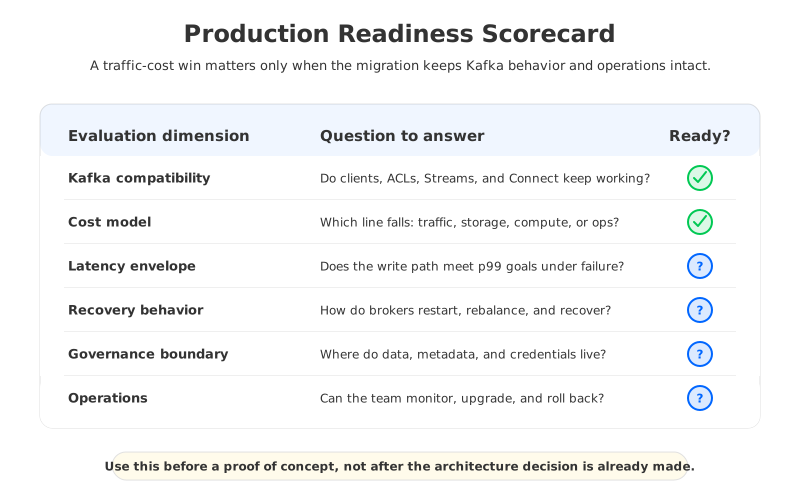
The cleanest proof of value is a workload-level test, not a generic benchmark. Pick one topic family with representative write volume, consumer fanout, retention, and failure expectations. Measure producer latency, consumer lag, recovery time, rebalance behavior, storage growth, object-storage requests, and zonal data transfer before and after. If the architecture is doing its job, the cost dashboard and operational dashboard should tell the same story: fewer structural data copies, less broker state to move, and no application-level surprise.
6Migration Planning Without Hand-Waving
Replacing MSK is an infrastructure migration, not a bootstrap-server edit. Kafka compatibility reduces application friction, but it does not remove the need for cutover design. The team still needs topic inventory, ACL parity, client configuration review, offset strategy, monitoring alignment, backfill planning, and a rollback path. A practical plan usually starts with read-only mirroring or dual pipelines for a bounded workload, then moves producers topic by topic after downstream teams validate lag and correctness.
The production checklist should include these gates:
- Compatibility gate: client libraries, serializers, security settings, ACLs, consumer groups, compaction needs, and transaction behavior are verified against real applications.
- Performance gate: p50, p95, and p99 latency are measured during normal load, peak load, broker restart, and zonal disruption tests.
- Cost gate: network, storage, compute, object-storage operations, and subscription charges are tracked as separate lines.
- Operations gate: alerts, dashboards, runbooks, upgrade steps, backup assumptions, and rollback steps are owned before cutover.
- Governance gate: data location, metadata location, access boundaries, audit paths, and support access are documented in language security teams can review.
These gates ask whether the alternative changes the expensive mechanics while keeping the Kafka contract intact. That is the standard an MSK alternative should meet.
7The Decision Framework
The strongest reason to evaluate an MSK alternative is not a vague promise of lower cost. It is a specific finding: after normal tuning, the workload still pays heavily for broker-attached storage, cross-AZ replication, remote reads, and operational data movement. When that finding is true, the architecture has become the cost center.
The strongest reason to stay on MSK is equally specific. If the workload is predictable, operational convenience matters more than storage architecture, and the bill is dominated by compute you can right-size, then a migration may create more risk than value. Good architecture decisions have a "do nothing yet" branch.
Return to the bill line that started the search: traffic costs for Amazon MSK. By the time that number is visible, the team should be able to say which bytes are avoidable, which bytes are structural, and which architecture is responsible for each. If the structural part is the problem, evaluate a Kafka-compatible shared-storage design with production-level rigor.
For teams that want to inspect a concrete implementation, start with the AutoMQ open-source project and validate the architecture against one real workload: review AutoMQ on GitHub, then build a cost and operations comparison using your own throughput, retention, fanout, and availability targets.
8References
- Amazon MSK pricing
- AWS EC2 On-Demand pricing: data transfer
- Apache Kafka documentation
- AutoMQ Kafka compatibility
- AutoMQ inter-zone traffic elimination overview
- AutoMQ GitHub repository
9FAQ
9.1Does Amazon MSK always charge high cross-AZ traffic costs?
No. The cost depends on region, throughput, topology, client placement, read fanout, and how much data crosses Availability Zone boundaries. The concern appears when cross-AZ replication, remote reads, or storage-related movement dominate the bill even after placement and retention cleanup.
9.2Can rack-aware clients remove the problem?
Rack-aware placement can reduce avoidable remote reads and improve locality, so it should be part of the tuning phase. It does not remove broker-to-broker replication when Kafka durability depends on replicas in different zones. That is why the evaluation separates client placement traffic from structural replica traffic.
9.3Is zero cross-AZ traffic the same as no network cost?
No. A careful zero cross-AZ traffic claim is about removing cross-zone streaming data paths caused by broker replication and avoidable remote reads. Producers, consumers, storage APIs, monitoring, connectors, and other cloud services still have their own traffic and request patterns. Those should stay in the cost model.
9.4When should a team evaluate AutoMQ as an MSK alternative?
Evaluate AutoMQ when the workload needs Kafka compatibility but the current MSK architecture is dominated by replicated storage, cross-AZ traffic, slow reassignment, or scaling friction. The best proof is a topic-level test that compares latency, lag, recovery, cost lines, and operational effort under your own workload rather than relying on a generic estimate.


