
Table of Contents
Table of Contents
Kafka security usually starts with a checklist: turn on TLS, choose SASL, define ACLs, isolate the brokers, rotate certificates, and collect audit logs. Those controls matter, but they do not automatically create zero-trust Kafka operations. A zero-trust operating model asks a more uncomfortable question: when a producer, broker, connector, administrator, stream processor, or support tool touches the platform, which identity is being trusted, which network path is being trusted, and which data boundary is being crossed?
Kafka is often the event backbone behind payments, customer profiles, telemetry, fraud, analytics, and AI context. A weak Kafka boundary can become a weak boundary for downstream systems. The goal is to make every access path explainable before incident review.
1Why zero trust kafka operations matters now
The search intent behind zero trust kafka operations is practical. Platform teams are running Kafka in cloud, hybrid, and regulated environments where static perimeter assumptions no longer hold. Producers may run in Kubernetes, consumers in another VPC, connector workers against SaaS APIs, and administrators through CI/CD automation. A broker security setting is only one part of that surface.
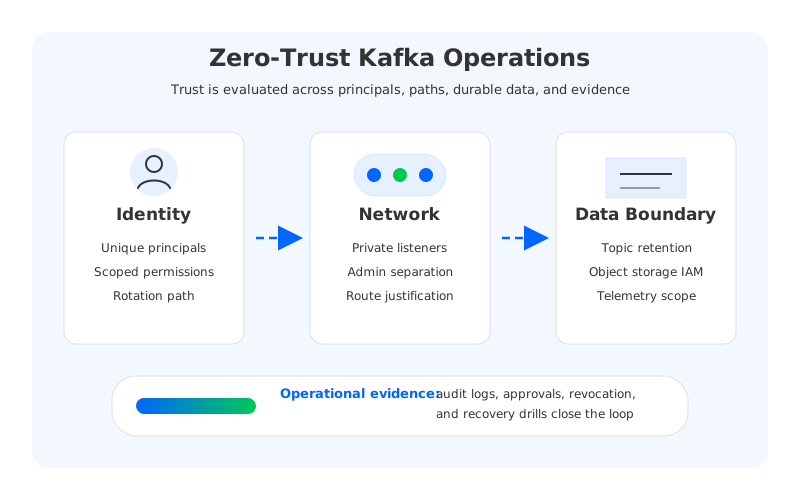
Zero trust is useful here because it treats trust as a continuously evaluated relationship, not a network location. NIST describes zero trust around resource access, identity, policy, and continuous verification rather than implicit trust in a local network. For Kafka teams, that translates into three operational boundaries:
- Identity boundary. Every client, broker, connector, operator, and automation path needs an accountable principal, scoped permissions, and a rotation story.
- Network boundary. Every listener, private endpoint, peering route, firewall rule, and service mesh policy needs an explicit reason to exist.
- Data boundary. Every topic, retained log segment, object store, backup, metric, log, and support artifact needs an ownership and access model.
The hard part is that these boundaries interact. A connector may have a strong service identity but a broad network route. A topic may have precise ACLs but long retention in storage that lives outside the expected account boundary. A managed operations workflow may reduce toil while introducing a control-plane path that security teams need to understand. Zero-trust Kafka operations is the work of making those interactions visible.
2Security controls are not the operating model
Apache Kafka gives operators important building blocks. The official Kafka documentation covers encryption, authentication, authorization, delegation tokens, quotas, and ACLs. Those features are the starting point for separating producers, consumers, administrators, and internal broker communication. They do not remove the need to design the operational model around them.
The difference shows up during change. A team can enable TLS and still share one certificate across too many services. It can use ACLs and still grant wildcard topic access because onboarding each application feels slow. It can place brokers in a private subnet and still allow broad east-west access from workloads that do not need Kafka. It can keep audit logs and still miss the storage bucket, snapshot, or observability path where sensitive event content leaks.
A better operating model starts by treating Kafka as a set of policy decisions rather than a single cluster. The broker accepts connections, but identity policy defines which principal can use which operation. The network path carries requests, but segmentation defines which workloads can reach which listener. The log stores records, but data governance defines who can see retained events, derived topics, backups, and exported telemetry.
| Boundary | Common Kafka control | Zero-trust operations question |
|---|---|---|
| Identity | TLS, SASL, ACLs, service accounts | Can every principal be tied to one workload, one owner, and one permission scope? |
| Network | Listeners, subnets, firewalls, private links | Can every route be justified without relying on a broad trusted network zone? |
| Data | Topic ACLs, retention, encryption, backups | Can every durable copy and support artifact be mapped to a data owner and access policy? |
| Operations | Admin APIs, CI/CD, observability, break-glass access | Can every privileged action be approved, logged, time-bound, and revoked? |
Zero trust cannot be delegated only to the security team. Kafka platform owners understand topic naming, consumer groups, partition counts, retention windows, replay paths, connector behavior, and recovery. Security teams understand identity providers, network controls, key management, audit requirements, and data classification. The model works when both groups draw the same map.
3Where traditional Kafka gets stressed
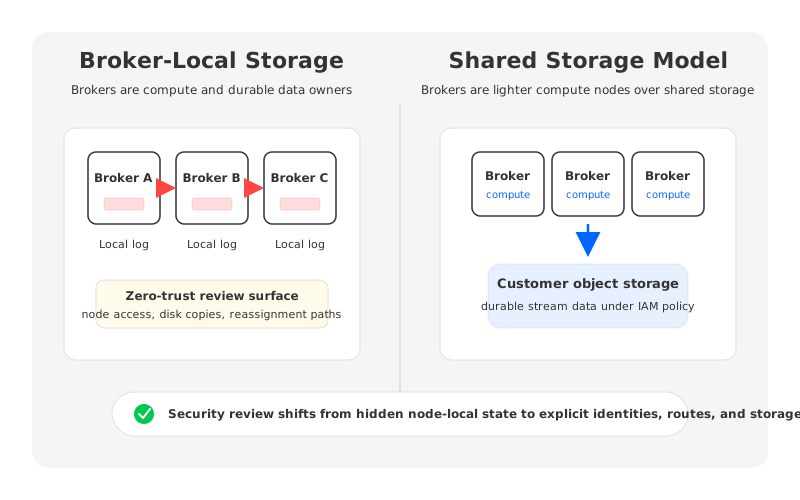
Traditional Kafka uses a shared-nothing architecture: brokers own local log storage, partitions are placed on specific brokers, and durability comes from replication across brokers. That model is proven and widely understood. It also means the broker is both a compute endpoint and a storage owner, which makes some zero-trust boundaries harder to reason about at scale.
Start with operational access. If a broker owns local durable data, repair, expansion, reassignment, and disk recovery workflows may require privileged access to long-lived nodes, volumes, or Kubernetes persistent volumes. The team can lock these paths down, but the access graph becomes larger than the client-facing Kafka API.
Storage locality adds another pressure. Replication across brokers creates multiple durable copies across failure domains. That is necessary for the shared-nothing model, but security teams still need to know where each copy resides, how it is encrypted, how retention applies, and which operational identities can inspect the underlying infrastructure. Tiered storage can move colder segments to object storage, but the primary log and broker-local operational model still remain part of the boundary.
The final stress is elasticity. When adding capacity requires partition movement, the platform team may keep extra broker and disk capacity online to avoid urgent scaling operations. Reserved capacity, long-lived identities, and broad operational access can quietly become the trusted perimeter that zero trust was supposed to retire.
4Architecture patterns teams usually compare
Kafka teams rarely choose between "secure" and "insecure." The real comparison is between operating models, each with a different trust boundary. Self-managed Kafka gives maximum control, but it also makes the platform team responsible for every patch, certificate, listener, disk, secret, and privileged runbook. A managed service can reduce infrastructure ownership, but the customer must validate where data lands and how support access is governed. A BYOC model automates operations while keeping the data plane in the customer's cloud account or private environment.
The right pattern depends on the boundary the organization needs to defend.
| Operating pattern | Strong fit | Zero-trust risk to test |
|---|---|---|
| Self-managed Kafka | Deep customization, internal platform standards, full infrastructure control | Long-lived node access, patch discipline, broad admin permissions, and inconsistent certificate rotation |
| Managed Kafka service | Teams prioritizing operational offload and standardized service controls | Data-plane location, vendor support access, network exposure, key ownership, and audit visibility |
| BYOC Kafka-compatible platform | Regulated or platform-led teams that want automation inside their cloud boundary | Control-plane metadata scope, operator permissions, telemetry path, and customer approval flow |
| Kafka-compatible shared-storage architecture | Elastic workloads, long retention, replay-heavy systems, and storage governance focus | Object storage IAM, WAL configuration, bucket policy, region choice, and storage observability |
This table is not a vendor scorecard. It forces the architecture conversation into the open. If the strongest requirement is full internal control, self-managed Kafka may be justified. If operational simplicity dominates, a managed service may fit. If the requirement is keeping the data plane and durable data in a customer-controlled account while reducing day-two operations, BYOC deserves a serious evaluation.
The same discipline applies inside the cluster. Topic-level ACLs are useful, but they are not a complete tenant model. Connector workers should not become a shortcut around data access policy. Metrics and logs should avoid exporting message payloads or secrets. A mature platform design names these risks before implementation, because retrofitting trust boundaries after hundreds of topics exist is slow.
5Evaluation checklist for platform teams
Zero-trust Kafka operations becomes real when it appears in design reviews, runbooks, and failure drills. A diagram that shows private subnets is not enough. The review needs to follow identities and data through normal operation, backfill, scaling, upgrade, incident response, and support.
- Inventory every principal. Include producers, consumers, brokers, controllers, connectors, stream processors, CI/CD jobs, observability agents, backup jobs, administrators, and break-glass accounts.
- Bind permissions to workload ownership. Avoid shared client credentials and wildcard ACLs. Each principal should map to a service owner, topic scope, operation set, and rotation policy.
- Separate client, admin, and internal paths. Listener design should make it difficult for application workloads to reach administrative endpoints or broker-internal paths by accident.
- Trace durable data copies. Topic logs, object storage, WAL storage, snapshots, backups, dead-letter topics, exported logs, and support bundles all need classification and retention rules.
- Constrain operational automation. Operators and Terraform pipelines should have enough permission to manage the platform, but not unbounded access to unrelated cloud resources or message data.
- Test incident workflows. Certificate expiry, compromised client credentials, leaked connector secrets, failed broker replacement, and emergency access should be practiced before production pressure arrives.
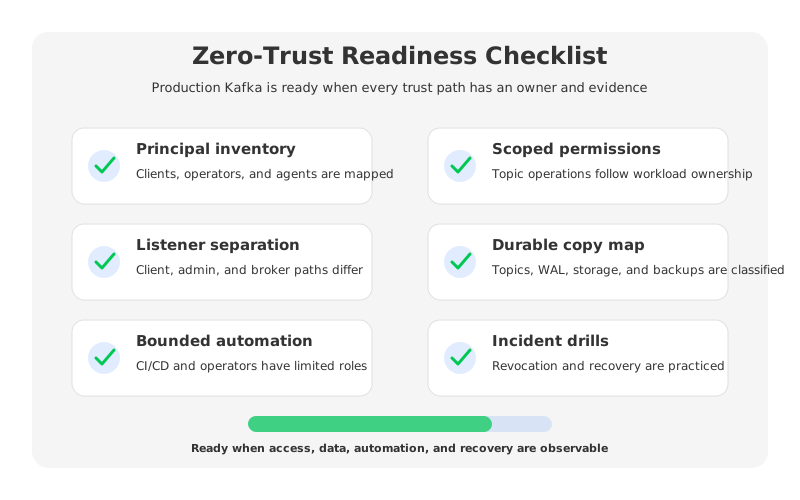
The checklist also prevents a common misunderstanding: zero trust is not the same as adding friction to every request. A well-designed Kafka platform can make secure access easier by standardizing identity creation, topic onboarding, network attachment, and audit collection. When narrow, observable access is quick, teams have less incentive to ask for broad shared credentials.
6Where AutoMQ changes the operating model
Once the evaluation reaches durable data, elasticity, and customer-controlled boundaries, AutoMQ becomes relevant as a Kafka-compatible, cloud-native streaming platform built around compute-storage separation. AutoMQ keeps the Kafka protocol and ecosystem surface familiar while moving persistent stream storage into shared object storage through its S3Stream architecture. Brokers become lighter compute nodes instead of long-term owners of broker-local log data.
That architectural shift does not replace Kafka security controls. Teams still need client authentication, authorization, encryption, key management, topic governance, and audit discipline. The value is that the durable data boundary becomes easier to reason about when stream storage is centered on customer-controlled object storage and broker compute can scale or recover with less dependence on local disk ownership. For zero-trust operations, that can simplify the question of where the durable event log lives and which cloud IAM policies govern it.
AutoMQ BYOC is also relevant to the control-plane and data-plane discussion. In a BYOC deployment model, the data plane runs in the customer's cloud environment, helping organizations align Kafka-compatible streaming with their account, VPC, object storage, key, and audit boundaries. The review is not "does BYOC sound safer?" but "which metadata leaves the environment, which operations are customer-authorized, which telemetry is exported, and which identities can touch durable data?"
There are trade-offs to test. Object storage IAM, bucket policy, endpoint routing, WAL type, region selection, and observability paths become part of the Kafka security design. A shared-storage platform changes the operating model, but it does not remove the need for disciplined policy. The evaluation should use representative topics, retention windows, connector patterns, and incident runbooks rather than a single architecture diagram.
7Decision table: what to prove before production
The practical output of a zero-trust review should be a short list of proof points. If a team cannot prove them, the architecture may still work technically, but the operating model is not ready for regulated or high-risk data.
| Proof point | Evidence to collect |
|---|---|
| Every Kafka client has a unique accountable identity | Service owner, credential type, ACL scope, rotation policy, and revocation procedure |
| Every network route has a workload reason | Listener map, subnet or VPC path, firewall rule, private endpoint, and admin-path separation |
| Every durable copy is classified | Topic retention, object storage location, backup path, dead-letter topic, telemetry export, and encryption policy |
| Every privileged operation is bounded | CI/CD role, operator role, break-glass policy, approval trail, audit log, and timeout |
| Every support workflow preserves the data boundary | Redacted logs, customer-approved access, telemetry scope, and evidence of no message-payload export |
| Every migration has rollback | Dual-write or dual-read plan, offset handling, topic compatibility, and credential cutover procedure |
The architecture answer is rarely "lock everything down and hope teams cope." Kafka succeeds because many teams can publish, consume, replay, and integrate through a common event backbone. Zero-trust operations keeps that backbone usable by making trust explicit: who is calling, over which path, against which data, and with which evidence.
If your team is reviewing Kafka security, draw the identity, network, and data boundaries before choosing the service model. Then compare your current Kafka operating model with a Kafka-compatible shared-storage design where durable stream data stays inside a customer-controlled storage boundary. To explore that option, review the AutoMQ architecture materials and test the model against your own IAM, network, retention, and audit requirements.
8References
- NIST Special Publication 800-207: Zero Trust Architecture
- CISA Zero Trust Maturity Model
- Apache Kafka documentation: security
- Apache Kafka documentation: authorization and ACLs
- AutoMQ documentation: compatibility with Apache Kafka
- AutoMQ documentation: difference with Apache Kafka
9FAQ
9.1Is zero-trust Kafka operations the same as Kafka security?
No. Kafka security provides controls such as encryption, authentication, authorization, and ACLs. Zero-trust Kafka operations uses those controls inside a broader model that covers network paths, durable data copies, privileged automation, telemetry, and support access.
9.2Which Kafka identity model should platform teams start with?
Start with one accountable principal per workload or automation path. Shared credentials make incident response and least-privilege reviews difficult. Each principal needs an owner, scope, rotation policy, and revocation path.
9.3Does BYOC automatically solve zero-trust requirements?
No. BYOC can help align the data plane with a customer's cloud account or VPC boundary, but teams still need to review operator permissions, telemetry exports, metadata scope, object storage IAM, support workflows, and customer approval paths.
9.4How does shared storage affect Kafka data boundaries?
Shared storage can make the durable log boundary more explicit because retained stream data is centered on object storage governed by cloud IAM, bucket policy, encryption, and audit controls. Teams still need to validate WAL configuration, endpoint routing, retention, and exported logs or backups.
9.5What should be tested before moving production Kafka workloads?
Test client identity onboarding, ACL enforcement, listener isolation, credential revocation, connector secret handling, object storage access, broker replacement, backfill behavior, audit completeness, and rollback. A design is production-ready when those behaviors are repeatable under incident pressure, not only during a planned demo.


